
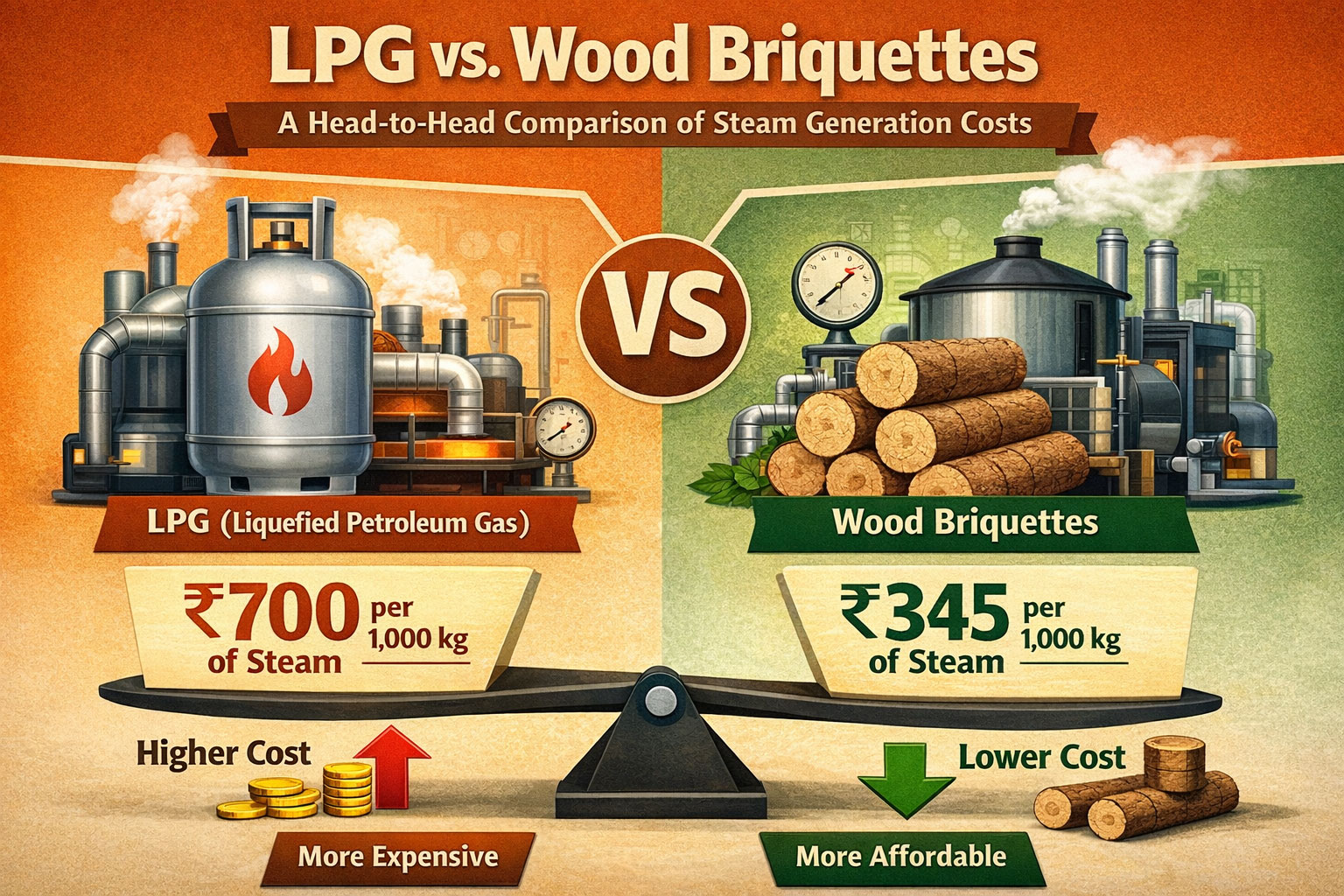
In the pursuit of operational excellence, industrial plant managers across India are increasingly forced to balance two competing priorities: cost efficiency and environmental compliance. For sectors like food processing, pharmaceuticals, and textiles, steam is the lifeblood of production. However, the choice of fuel—the primary driver of steam costs—can be the difference between a profitable year and a fiscal deficit.
At IndianBoilers.com, we frequently encounter a critical debate: Should a facility stick with the convenience and cleanliness of Liquefied Petroleum Gas (LPG), or transition to the “White Coal” of the 21st century—Wood Briquettes?
This head-to-head comparison breaks down the economics, technical performance, and long-term viability of both fuels in the 2026 industrial landscape.
1. The Energy Density Battle: Calorific Value (CV)
The first metric to consider is the amount of energy stored within the fuel.
- LPG (Liquefied Petroleum Gas): LPG is a powerhouse of energy. It typically boasts a Gross Calorific Value (GCV) of approximately 11,000 to 11,500 kcal/kg. Because it is a gas, it mixes almost perfectly with air, allowing for nearly 100% combustion.
- Wood Briquettes: These are made from compressed agricultural and forestry waste (sawdust, wood chips, coffee husk). Their GCV typically ranges from 3,800 to 4,200 kcal/kg.
The Verdict: On a weight-for-weight basis, LPG contains nearly 3 times the energy of wood briquettes. However, as we will see, energy density is only one part of the cost equation.
2. Efficiency and Equipment Performance
A fuel is only as good as the boiler’s ability to extract its heat.
| Feature | LPG-Fired Boiler | Briquette-Fired Boiler |
| Typical Efficiency | 90% – 95% (with Economizer) | 70% – 82% (with Air Pre-Heaters) |
| Combustion Control | Precision modulating burners | Automated screw feeders / Grates |
| Startup Time | Instant (3–5 minutes) | Moderate (20–40 minutes) |
| Maintenance | Low (clean burning, no ash) | Moderate (ash removal, tube cleaning) |
While LPG boilers are more efficient, modern biomass systems like the STEAMAX series from IndianBoilers.com have closed the gap. By using Air Pre-Heaters (APH) and advanced FBC (Fluidized Bed Combustion) technology, we can now push briquette boiler efficiency above 80%, making the fuel cost savings even more dramatic.
3. The Economic Reality: Cost per Ton of Steam
To understand the true impact on your bottom line, we must look at the Cost per Million kcal (Mcal) of heat delivered to the water.
Scenario: Generating 1 Million kcal of Heat
(Based on typical 2026 industrial fuel prices in India)
- LPG Pricing:
- Price: ₹75 per kg
- Effective Heat (92% Efficiency): ~10,120 kcal/kg
- Fuel Required: ~98.8 kg
- Total Cost: ₹7,410
- Wood Briquette Pricing:
- Price: ₹8.5 per kg
- Effective Heat (78% Efficiency): ~3,120 kcal/kg
- Fuel Required: ~320.5 kg
- Total Cost: ₹2,724
The “Hidden” Savings: Switching from LPG to Wood Briquettes can result in a 60% to 65% reduction in fuel costs. Even when factoring in the slightly higher electricity and labor costs for ash handling, the ROI (Return on Investment) for a new briquette-fired boiler typically ranges between 10 and 15 months.
4. Environmental Impact and Carbon Credits
In 2026, environmental compliance is no longer optional.
- LPG: While “cleaner” than coal or furnace oil, LPG is still a fossil fuel. It contributes to a company’s Scope 1 carbon footprint and is subject to global price volatility.
- Wood Briquettes: These are classified as Carbon Neutral. The CO2 released during combustion is the same amount absorbed by the plants during their growth. Many industrial hubs now offer incentives for “Green Steam,” and using biomass can help your facility qualify for MSME subsidies and renewable energy certificates.
5. Storage and Logistics: The LPG Advantage
Where LPG wins convincingly is in logistics and storage.
- LPG: Requires a high-pressure bullet tank and minimal footprint. It is piped directly into the burner.
- Briquettes: Require a large, dry, covered storage area to prevent moisture absorption. Moisture in briquettes drastically reduces efficiency and can cause smoke issues. You also need a dedicated system for ash collection and disposal (though boiler ash is often sold as a high-potash fertilizer for local farms).
Final Comparison Summary
| Criteria | LPG | Wood Briquettes |
| Fuel Cost | Very High | Low |
| Automation | Full / Precision | High (with auto-feeders) |
| Regulatory Burden | High (Safety/Pressure) | Low (Renewable/Green) |
| Capital Expense | Lower | Higher (Solid fuel handling) |
| Sustainability | Fossil Fuel | Carbon Neutral |
Conclusion: Which One Should You Choose?
If your facility is located in a high-density urban zone with zero tolerance for particulate emissions and very limited space, LPG remains a reliable, high-performance choice.
However, for the vast majority of industrial manufacturers in India’s growing hubs, Wood Briquettes are the undisputed winner for cost-competitive steam generation. The massive 60% reduction in fuel bills provides a competitive edge that fossil fuels simply cannot match.
At IndianBoilers.com, we offer a range of Multi-Fuel Boilers that allow you to switch or blend fuels, giving you the ultimate flexibility to hedge against price spikes.
