
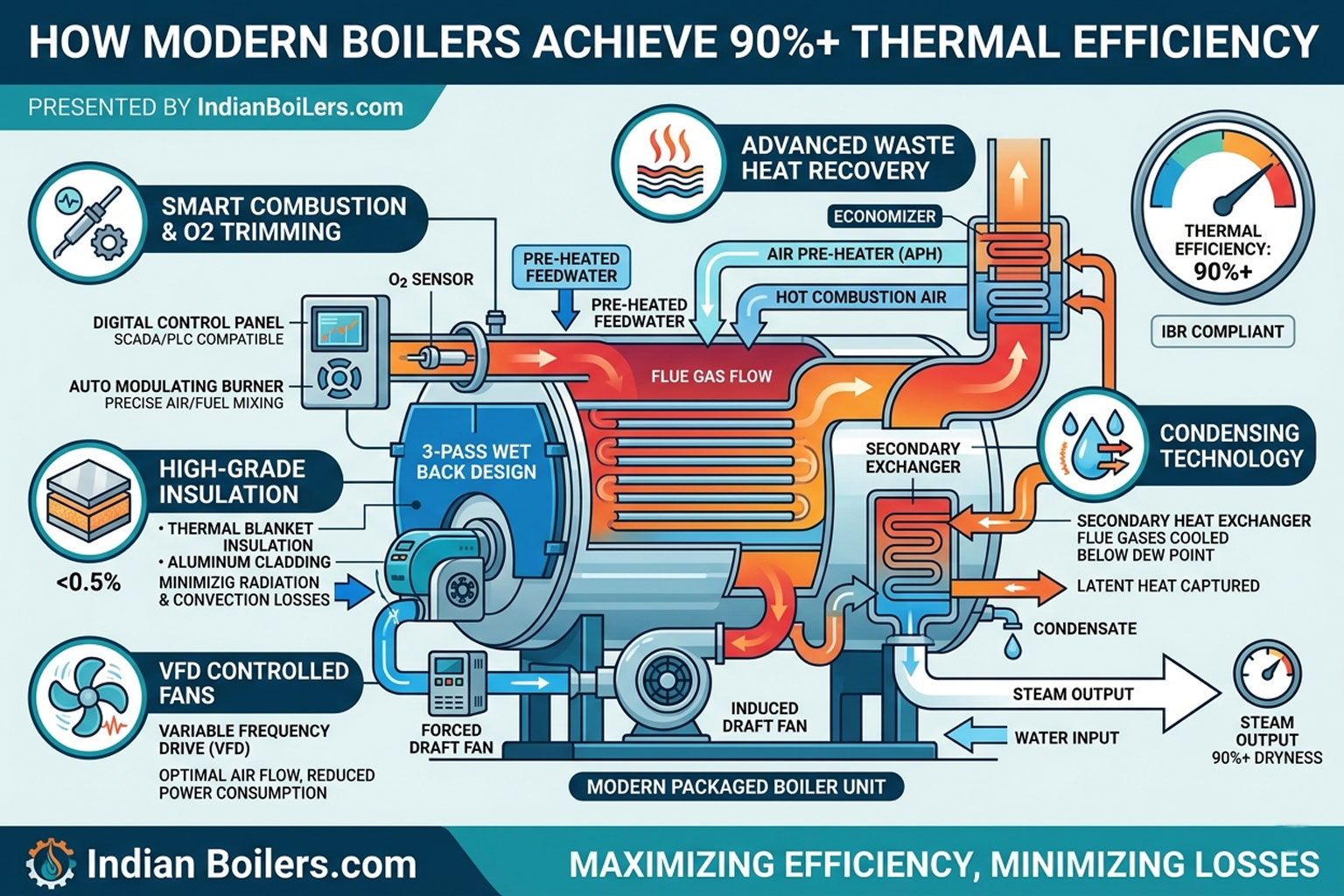
In the contemporary industrial landscape, where energy costs and ESG (Environmental, Social, and Governance) targets dominate boardroom discussions, the “efficiency gap” has become a critical metric for success. For decades, a thermal efficiency of 75% to 80% was considered acceptable for industrial boilers. However, modern engineering has shattered those limits, pushing the gold standard beyond the 90% mark.
At IndianBoilers.com, we see this shift not just as a technological upgrade, but as a financial imperative. Achieving 90%+ efficiency means that for every rupee spent on fuel, more than 90 paise is converted directly into useful steam. Here is how modern boilers—like our latest 3-pass wet-back models—bridge the gap between conventional heating and high-performance thermal engineering.
1. Advanced Waste Heat Recovery (The 5% Boost)
The single greatest thief of boiler efficiency is the chimney. In older systems, flue gases often exit at temperatures exceeding 250°C, carrying away significant energy.
- Economizers: By installing a feedwater economizer in the flue gas path, we capture heat that would otherwise be lost to the atmosphere. This pre-heats the incoming water, meaning the boiler needs less fuel to reach the boiling point.
- Air Pre-Heaters (APH): Especially in solid-fuel and biomass boilers, pre-heating the combustion air using exhaust heat ensures more vigorous, complete combustion and reduces the “thermal shock” to the furnace.
- The Rule of Thumb: In a modern setup, every 20°C reduction in flue gas temperature through recovery systems translates to roughly a 1% increase in overall thermal efficiency.
2. Smart Combustion & Oxygen Trimming (The Precision Edge)
Combustion is a delicate chemical balance. Too little air leads to incomplete combustion and dangerous carbon monoxide (CO) buildup; too much air (excess air) acts as a cooling agent, carrying heat straight out of the stack.
Modern boilers utilize Oxygen (O2) Trim Systems. These use real-time sensors in the flue to monitor oxygen levels and automatically adjust the burner’s air-to-fuel ratio. By keeping excess air at the absolute minimum required for safe combustion (typically 3–5% for gas and 5–10% for oil), we prevent the “heating the sky” phenomenon, saving up to 3% in fuel costs annually.
3. Condensing Technology: Capturing Latent Heat
Standard boilers only account for “Sensible Heat.” High-efficiency modern boilers, however, utilize Condensing Technology.
When fuel burns, it creates water vapor. In a traditional boiler, this vapor stays as a gas and escapes. A condensing boiler uses a secondary heat exchanger to cool the flue gases below the “dew point” (around 55°C). This causes the vapor to condense into liquid, releasing its Latent Heat of Vaporization back into the system. This process alone can push a boiler’s efficiency from 85% to a staggering 95% or higher.
4. 3-Pass Wet Back Design & High-Grade Insulation
The physical architecture of the boiler plays a silent but vital role.
- 3-Pass Wet Back: This design ensures that combustion gases travel through the water-filled shell three times, maximizing the surface area for heat transfer. The “Wet Back” reversal chamber is surrounded by water, ensuring no heat is lost to a rear refractory wall.
- Thermal Insulation: Modern boilers are wrapped in high-density rockwool or ceramic blankets with aluminum cladding. This minimizes “Radiation and Convection Losses.” A well-insulated boiler loses less than 0.5% of its total heat through its outer shell.
5. Automation and Variable Frequency Drives (VFDs)
Efficiency isn’t just about heat; it’s about power consumption. Modern boilers are equipped with VFDs on Forced Draft (FD) and Induced Draft (ID) fans. Instead of running at 100% power and using dampers to throttle air, the VFD adjusts the motor speed to match the exact load requirements. This reduces the “parasitic load” on the plant’s electricity bill while ensuring a stable, efficient flame at all times.
Efficiency Comparison at a Glance
| Feature | Older Boilers | Modern Boilers |
| Typical Efficiency | 70% – 78% | 90% – 95%+ |
| Flue Gas Temp | 240°C – 300°C | 110°C – 140°C |
| Combustion Control | Manual/Linkage | Auto O2 Trimming |
| Heat Recovery | Rarely Integrated | Standard (Eco + APH) |
| Fuel Monitoring | Periodic/Manual | Real-time SCADA/IoT |
Conclusion: The Bottom Line for Your Plant
Achieving 90%+ efficiency is no longer a luxury—it is a requirement for staying competitive in global markets. By integrating waste heat recovery, condensing technology, and precision automation, modern boilers provide a rapid ROI, often paying for their efficiency upgrades in fuel savings alone within 12 to 18 months.
At IndianBoilers.com, we specialize in retrofitting older units and manufacturing new, high-performance systems that meet the latest IBR standards.
