
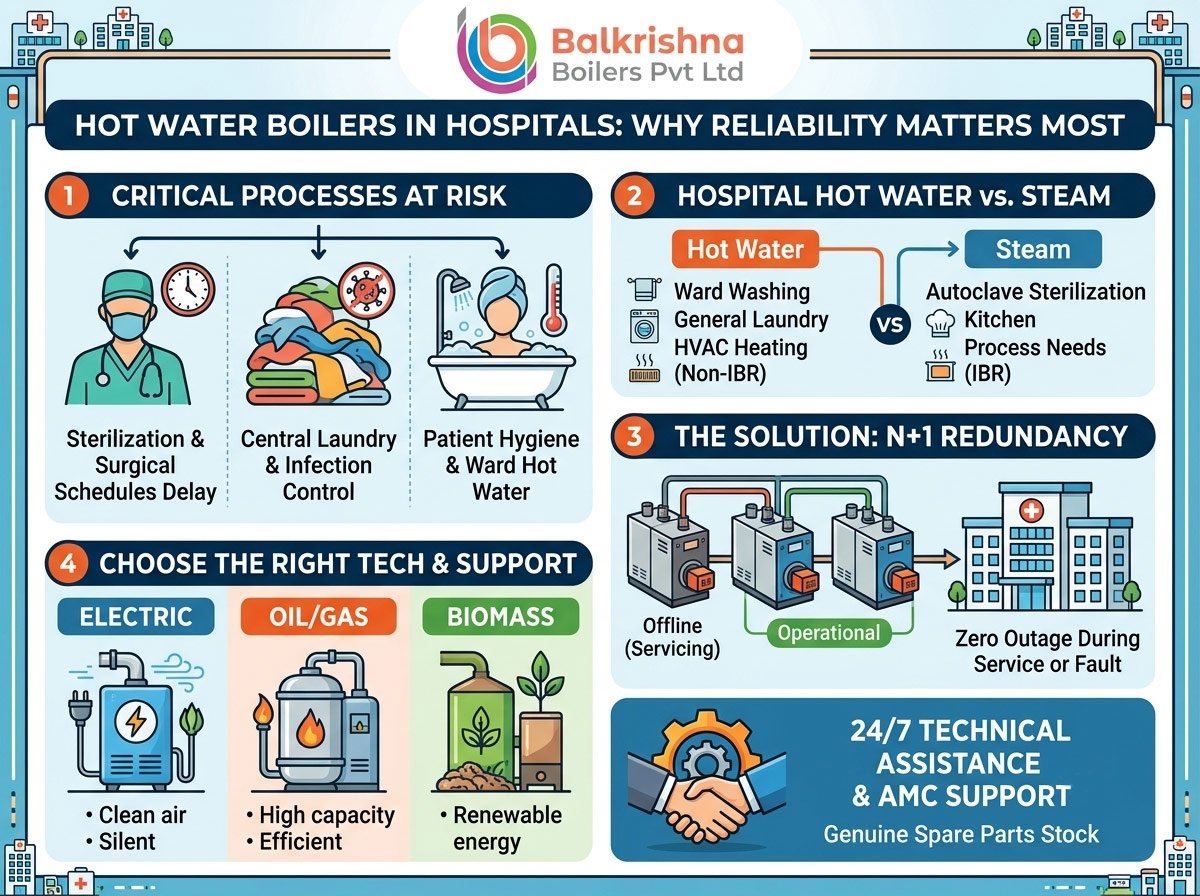
In most buildings, a boiler outage is an inconvenience. In a hospital, it can stop patient care. Sterilization schedules slip, central laundry backs up, wards lose hot water for washing and bathing, and infection control protocols that depend on hot water for cleaning and disinfection are compromised — all from a single point of equipment failure that, in almost every case, was preventable.
At Balkrishna Boilers Pvt Ltd, healthcare has been one of our core sectors for over 25 years, and it’s the one sector where we push clients hardest on redundancy and reliability over any other single specification. This guide explains why hospital hot water demands a fundamentally different approach than a factory or even a hotel, and what to actually specify when reliability isn’t negotiable.
Why Hospitals Aren’t Just “High-Demand” Facilities
It’s tempting to treat a hospital’s hot water boiler requirement as simply a larger version of a hotel’s. It isn’t. The difference is in what happens when the system fails, not just how much hot water is used.
A hotel with a boiler outage has unhappy guests for a day. A hospital with a boiler outage has:
- Delayed or cancelled sterilization cycles, directly affecting surgical schedules and instrument turnaround
- A non-functional central laundry, at exactly the facility where infection control depends most on clean linens
- Compromised patient bathing and hygiene protocols, particularly critical in wards with immunocompromised or post-surgical patients
- HVAC and space heating gaps, relevant in ICUs, neonatal units, and any ward where temperature control affects patient outcomes, not just comfort
This is why reliability, not just capacity, has to be the starting point of any hospital boiler specification — not an afterthought added once the sizing is done.
Understanding Hospital Hot Water Demand
Hospital hot water load is a genuinely different shape than most commercial buildings. It’s:
- Continuous, not peaked like a hotel. Sterilization, laundry, and ward hot water run around the clock, across shifts, with far less of a single sharp morning peak.
- Layered across critical and non-critical uses. Sterilization and lab processes typically demand the highest reliability tier; general ward and administrative hot water can tolerate marginally more flexibility, but not much.
- Regulatorily sensitive. Sterilization and infection control processes in Indian hospitals are subject to clinical protocols that assume a consistent, uninterrupted hot water and steam supply — a boiler outage isn’t just an operational problem, it can be a compliance one.
Several of our product lines list healthcare explicitly as a core use case for exactly this reason — our oil/gas fired hot water boiler page names sterilization and HVAC heating in hospitals directly, and our electric hot water boiler range lists pharmaceutical and healthcare sterilization as a primary application.
Hot Water vs Steam in a Hospital Setting
Most hospitals need both systems, running different parts of the facility. It’s worth being precise about which does what:
- Steam is typically required for autoclave sterilization, high-level disinfection, and central kitchen operations that need latent heat for rapid, high-temperature processing.
- Hot water covers ward washing and bathing, general laundry, HVAC and space heating, and lower-temperature process needs where steam would be unnecessary overkill — and where avoiding IBR registration and a certified attendant meaningfully reduces operating overhead.
If your facility is still working out which parts of its operation genuinely need steam versus hot water, our guide on Hot Water Boiler vs Steam Boiler: Which One Do You Need? walks through the distinction in detail — most hospitals end up running a dual system, with hot water covering the larger share of total demand by volume.
The Case for Redundancy: Why “N+1” Isn’t Optional in Healthcare
This is the single most important specification decision for a hospital boiler system, and it’s where under-speccing does the most damage. A single large boiler, however well-built, represents a single point of failure. If it goes down for a scheduled service, a burner fault, or a part replacement, the facility has zero hot water until it’s fixed.
The standard approach for healthcare is an N+1 configuration — for example, three mid-capacity units sized so that any two can cover full facility demand, meaning the failure or servicing of one unit never drops the hospital below operational hot water supply. This costs more upfront than a single large system, but for a hospital, it isn’t really optional — it’s the baseline standard of care for the facility’s own infrastructure.
This principle matters across every hospital size, but scales differently depending on your facility. We’ve covered a related version of this sizing and redundancy logic for hospitality properties in Hot Water Boilers for Hotels and Hospitality: A Buyer’s Guide — the same N+1 logic applies to hospitals, but with a lower tolerance for any gap at all, given the clinical consequences of an outage.
Choosing the Right Fuel and Technology for a Hospital
Electric Systems for Clean, Silent, Zero-Emission Areas
Electric hot water and steam systems are widely used in hospitals specifically because they eliminate combustion contaminants entirely — a genuine advantage in a facility where air quality and infection control are constant priorities. Our ELECTRO AQUA range, listed as electric hot water boiler on indianboilers.com, is built around exactly this kind of application, and our electrode-based steam technology is explicitly designed for hospitals and labs needing clean, quiet steam for laundry and sterilization — you can read more in our post on what applications utilize electric steam boilers besides laundries and hospitals, which covers how the same electrode technology extends into pharmaceutical and lab settings.
Oil/Gas Systems for Larger Facility Loads
For larger hospitals and hospital groups with higher continuous demand, oil/gas-fired systems like our AQUAJET series offer higher capacity per unit at a lower upfront cost than an equivalent electric setup, while still achieving 88–92% thermal efficiency. This is often the right choice for the bulk load — central laundry, general ward hot water — with electric units reserved for sterilization-adjacent or air-quality-sensitive areas.
Why Electric Steam Complements Hot Water in Sterilization-Heavy Facilities
Where autoclave sterilization is a continuous, critical-path operation, electric steam generation offers near-instant startup (full pressure in minutes from cold) and zero risk of interrupting a sterilization cycle due to burner or combustion issues. Our post on why electric boilers are the best choice for low-emission plants covers this technology in more depth, including how it pairs with hot water systems in a combined hospital installation.
IBR Considerations for Hospital Systems
Most hospital hot water applications — ward washing, laundry, HVAC — stay comfortably below 100°C and are therefore generally non-IBR, avoiding the need for annual government inspection and a certified boiler attendant on that portion of the system. Sterilization steam systems, by contrast, typically do require IBR compliance given the pressures involved. A well-planned hospital installation is usually a mix of both — non-IBR hot water covering the larger operational load, with IBR-compliant steam reserved for sterilization and critical processes that genuinely need it. Getting this split right at the design stage avoids paying for IBR certification and attendant staffing on parts of the system that never needed it.
Sizing a Hospital System Correctly
Hospital sizing follows the same underlying math as any commercial system — flow rate × temperature rise = required kcal/hr — but with peak calculated against continuous, shift-based demand rather than a single daily spike. Our detailed walkthrough in How to Size a Hot Water Boiler for Commercial Use covers the full calculation method; for a hospital specifically, the critical addition is sizing each individual unit in your N+1 configuration to independently cover a meaningful share of total demand, not just splitting total capacity evenly without checking that any single unit’s failure still leaves the facility operational.
Maintenance: Why Hospitals Can’t Run a “Reactive” Schedule
A hospital boiler system needs the same underlying maintenance discipline as any commercial installation — daily checks, monthly burner and electrical servicing, six-monthly descaling, annual inspection — but with far less tolerance for skipped intervals. Our Hot Water Boiler Maintenance Checklist for Facility Managers covers the full routine in detail; for a hospital, we’d add two hospital-specific practices on top:
- Stagger maintenance across your N+1 units so servicing one never reduces the facility below its minimum safe operating capacity, and schedule it during genuinely low-demand windows where possible.
- Log water quality and scale indicators more frequently than a standard commercial site — hospital water systems often run harder and longer than a typical commercial building, and scale-related efficiency loss compounds faster under continuous operation.
What a Hospital-Grade Installation Actually Looks Like
Pulling this together, a well-specified hospital hot water system typically includes:
- N+1 redundant configuration sized so any single unit can be serviced or fail without a facility-wide outage
- A fuel/technology split — often oil/gas or biomass for bulk hot water load, electric for sterilization-adjacent or air-quality-sensitive zones
- Correct IBR classification per subsystem, avoiding unnecessary compliance overhead on non-IBR portions while ensuring full compliance where genuinely required
- A documented, stricter-than-standard maintenance schedule, ideally under an Annual Maintenance Contract with guaranteed response times
- Water treatment sized for continuous, high-volume operation, not just standard commercial usage assumptions
Why Hospitals Choose Balkrishna Boilers
Across 5,000+ installations in India and 30+ countries, healthcare has consistently been one of the sectors where our engineering team spends the most time upfront — because the cost of getting redundancy and sizing wrong is measured in patient care disruption, not just guest complaints or a factory production delay. Our range spans the oil/gas fired AQUAJET, electric ELECTRO AQUA, and biomass-fired AQUAMAX and VTFH SERIES — the same models listed under Hot Water Boiler on indianboilers.com and Hot Water Boiler on balkrishn.com.
You can review our full product range on indianboilers.com or balkrishn.com’s Our Products page, see the broader set of sectors we serve on our Industries page, or contact our engineering team with your facility’s ward count, laundry and sterilization load, and current system details for a reliability-focused proposal.
Frequently Asked Questions
Does a hospital need both a steam boiler and a hot water boiler? Most do. Steam typically covers autoclave sterilization and central kitchen needs, while hot water covers ward washing, laundry, and HVAC — which together usually represent the larger share of total facility demand by volume.
Why is redundancy more important for hospitals than other commercial buildings? Because a hot water outage in a hospital directly affects sterilization schedules, infection control, and patient care — not just comfort or convenience. An N+1 configuration ensures the facility never loses hot water entirely, even during routine servicing or an unexpected fault.
Do hospital hot water systems require IBR certification? Generally, the hot water portion (ward washing, laundry, HVAC) stays below 100°C and remains non-IBR. Sterilization steam systems, which operate at higher pressures, typically do require IBR compliance. Most hospitals run a mix of both, sized and certified appropriately for each use.
How much more should a hospital budget for redundancy versus a single large boiler? An N+1 configuration typically costs more upfront than a single equivalent-capacity unit, but the exact premium depends on your specific load split and number of units. Our engineering team can model both configurations against your facility’s actual demand to show the tradeoff clearly.
Can electric and gas/biomass systems be combined in one hospital installation? Yes, and it’s common practice — electric units are often used for sterilization-adjacent or air-quality-sensitive zones, while gas or biomass systems cover higher-volume general hot water load at a lower per-unit cost.
Planning a new hospital installation or reviewing an existing system for reliability gaps? Contact our engineering team with your facility’s ward count, sterilization and laundry load, and current setup for a redundancy-focused recommendation.