
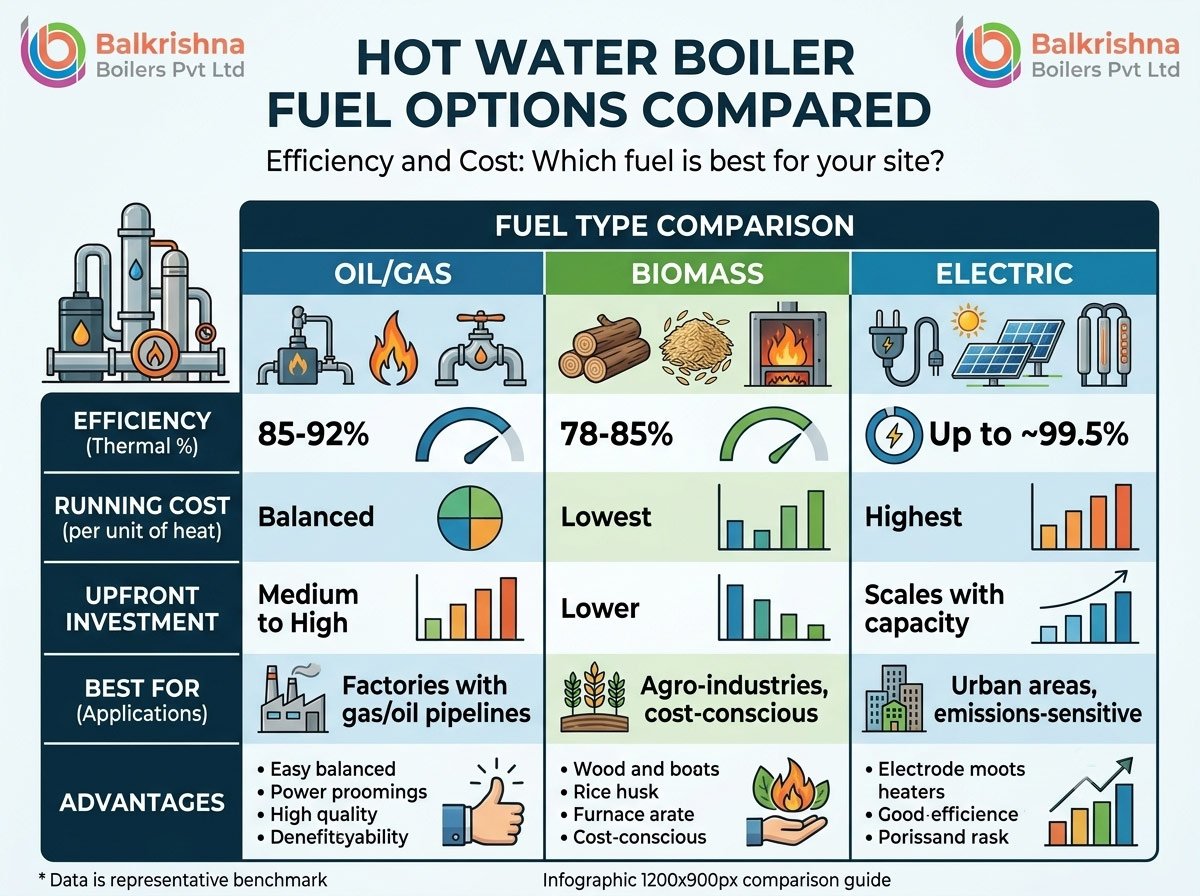
Fuel choice is where most hot water boiler buyers get stuck. The capacity math is usually settled fairly quickly — flow rate, temperature rise, and a safety margin get you to a kcal/hr figure. But then comes the harder question: oil, gas, biomass, or electric? Each has genuinely different efficiency, running cost, footprint, and maintenance implications, and the “best” answer depends entirely on your site, not on which fuel sounds most modern or most economical in general.
At Balkrishna Boilers Pvt Ltd, we manufacture across all four fuel types, which means we don’t have a fuel we’re trying to sell you toward — our job is matching the right technology to your site’s actual constraints. This guide breaks down how oil/gas, biomass, and electric hot water boilers compare on the numbers that actually matter: thermal efficiency, cost per unit of heat, upfront investment, and total cost of ownership.
The Four Fuel Categories at a Glance
Before comparing numbers, it’s worth being clear on what each category actually covers:
- Oil/Gas — diesel (HSD), LDO, furnace oil, LPG, or natural gas/PNG, burned in a combustion chamber to heat water via a heat exchanger.
- Biomass — wood logs, wood chips, briquettes, rice husk, or other agricultural residue, burned in a furnace with automatic or manual feeding.
- Electric — resistance immersion heaters or electrode technology, heating water directly with no combustion at all.
- Hybrid/multi-fuel — increasingly common systems designed to run on more than one fuel type, giving flexibility as fuel prices and availability shift.
Our product range covers all four through the oil/gas fired hot water boiler, biomass fired hot water boiler, wood/briquette fired hot water boiler, and electric hot water boiler — the same models listed as AQUAJET, AQUAMAX, and ELECTRO AQUA on balkrishn.com.
Thermal Efficiency: What the Numbers Actually Mean
Thermal efficiency measures how much of the input energy actually ends up as usable heat in your water, versus lost up a chimney, through radiation, or in standby losses. Here’s where each fuel type typically lands:
| Fuel Type | Typical Thermal Efficiency | Why |
|---|---|---|
| Oil/Gas | 85–92% | Clean combustion, three-pass wet-back designs minimize flue gas losses |
| Biomass | 78–85% | Solid fuel combustion loses more heat to flue gases and requires more careful furnace design to maximize transfer |
| Electric | Up to ~99.5% | No combustion means no flue gas losses, no radiation losses from a hot combustion chamber, and no standby losses |
Electric systems win decisively on paper efficiency — nearly all the electrical energy consumed converts directly into heat in the water, with no chimney losses at all. But efficiency alone doesn’t determine running cost, which is where the comparison gets more interesting.
Running Cost: Efficiency Isn’t the Whole Story
This is the part buyers most often get wrong — assuming the most efficient fuel is automatically the cheapest to run. It isn’t, because efficiency measures how well a fuel’s energy is used, not how expensive that energy is to begin with.
- Biomass has the lowest cost per unit of delivered heat in most of India, even with its lower thermal efficiency, because the raw fuel cost (rice husk, wood waste, briquettes) is dramatically cheaper than oil, gas, or grid electricity. Clients switching from coal to biomass briquettes commonly report fuel cost savings of 40–60%.
- Oil/Gas, particularly natural gas or PNG where a pipeline connection is available, sits in the middle — higher fuel cost than biomass, but with lower labor and handling costs and a more compact footprint.
- Electric has the highest cost per unit of electrical energy consumed, so despite near-99.5% efficiency, the running cost per kcal delivered is often the highest of the four — unless your site has access to low-cost or subsidized power, solar, or off-peak tariffs.
The practical takeaway: efficiency tells you how little energy is wasted; fuel price tells you what that energy costs in the first place. You need both numbers to compare running cost properly, not efficiency alone.
Upfront Investment: What Each System Actually Costs
As a rough 2025–2026 benchmark across our hot water range:
| Fuel Type | Small (up to ~2 Lac kcal/hr) | Medium (5–10 Lac kcal/hr) | Large (20 Lac+ kcal/hr) |
|---|---|---|---|
| Oil/Gas | ₹6 Lakh (1–3 Lac kcal/hr) | ₹7–15 Lakh | ₹25 Lakh+ |
| Biomass | ₹5 Lakh | ₹4–8.5 Lakh | ₹12 Lakh+ |
| Electric | Priced by kW (12 kW upward for commercial use) | Scales with kW to 20 Lac kcal/hr equivalent | 500 kW+ for heavy industrial demand |
Biomass systems are often the least expensive to install at a given capacity, while oil/gas systems carry a higher unit cost partly offset by lower labor requirements. Electric systems are priced differently — by electrical load (kW) rather than combustion capacity — and the total project cost depends heavily on your site’s existing electrical infrastructure and whether it needs upgrading to support the load.
Total Cost of Ownership: The Number That Actually Matters
Upfront price and running cost only tell part of the story. The real comparison is Total Cost of Ownership (TCO) — upfront investment, fuel cost over the system’s life, maintenance and labor, and the value of any efficiency-boosting accessories. A useful way to think about this: on a large steam system, a 2% efficiency gain alone can save ₹15–20 Lakhs per year in fuel cost for a 10 TPH biomass-fired unit — a number that shows how much even small efficiency differences compound over a 10–20 year equipment life, and the same logic applies proportionally to hot water systems.
Oil/Gas — Best For:
Facilities that want a compact footprint, minimal labor requirement, and fast, fully automatic operation, and that have reliable access to gas or oil supply. Maintenance is limited to monthly burner servicing and periodic electrical checks — one of the lowest labor-maintenance profiles among combustion fuels.
Biomass — Best For:
Facilities with space for fuel storage and ash handling, access to a consistent biomass supply (rice husk, wood waste, briquettes), and the labor capacity to manage feeding and ash removal. This is where the lowest long-term running cost lives, with CAPEX typically recovered within 12–24 months through fuel savings alone. Our post on Biomass Boilers vs. Coal: Which Wins for Indian Businesses goes deeper into this specific cost comparison.
Electric — Best For:
Space-constrained or emissions-sensitive sites — urban locations, facilities near residential areas, clean rooms, or hospitals and hospitality properties where no chimney and silent operation matter more than the lowest possible running cost. Maintenance is minimal: no burner, no soot, no ash, just periodic descaling and electrical terminal checks. Our detailed breakdown in Compare the Efficiency and Running Costs of Electric Steam Boilers with Gas or Oil-Fired Boilers walks through this exact tradeoff on the steam side, and the same logic carries over directly to hot water systems.
Fuel Choice Doesn’t Change Whether You Need Hot Water or Steam
It’s worth separating two decisions that often get conflated. Fuel type is independent of whether your process needs hot water or steam in the first place — that decision comes first, based on your required temperature and application, and we cover it fully in Hot Water Boiler vs Steam Boiler: Which One Do You Need?. Once you’ve settled that, fuel choice is purely about matching your site’s infrastructure, budget, and emissions goals to the options above.
Matching Fuel to Sector: Real-World Patterns
Certain sectors tend to gravitate toward specific fuel types based on their operating realities:
- Hotels and hospitality often choose oil/gas for urban properties with pipeline gas access, or electric for boutique properties where a chimney isn’t practical — covered in depth in our Hot Water Boilers for Hotels and Hospitality: A Buyer’s Guide.
- Hospitals frequently run a mix — electric for sterilization-adjacent, air-quality-sensitive zones, and oil/gas or biomass for bulk hot water load — as detailed in Hot Water Boilers in Hospitals: Why Reliability Matters Most.
- Textile and rice mill operations with on-site access to agricultural waste lean heavily toward biomass, since the fuel is often close to free relative to purchased oil or gas.
- Food processing and pharma frequently choose electric where product purity and zero combustion contamination are non-negotiable.
A Simple Decision Framework
- Do you have reliable access to biomass fuel and the labor to manage it? If yes, biomass usually wins on long-term running cost.
- Is your site space-constrained, emissions-sensitive, or near residential areas? Electric is often the right fit despite the higher per-unit running cost.
- Do you have pipeline gas access and want minimal labor with a compact footprint? Oil/gas, particularly natural gas/PNG, is typically the balanced middle choice.
- Is fuel price volatility a concern? A hybrid or multi-fuel system can hedge against price swings in any single fuel source.
None of these answers are permanent — many of our clients start with oil/gas for speed of installation and later add or transition to biomass as their fuel supply chain matures, or add electric units as backup capacity within a larger multi-fuel installation.
Getting a Fuel-Specific Recommendation
The right fuel choice depends on details specific to your site — available infrastructure, local fuel pricing, labor availability, and space — that are worth discussing directly rather than deciding from a general comparison alone. Our engineers regularly model side-by-side TCO comparisons across fuel types for a given capacity requirement, using real installation data from our 5,000+ installations across India and 30+ countries.
You can review the full hot water range on indianboilers.com or balkrishn.com’s Hot Water Boiler page, and reach our team through Contact Us with your capacity requirement and site details for a fuel-specific proposal.
Frequently Asked Questions
Which fuel is cheapest to run for a hot water boiler in India? Biomass generally has the lowest running cost per unit of delivered heat, thanks to low raw fuel prices, even though its thermal efficiency is lower than gas or electric systems. The tradeoff is the need for fuel storage space and ash handling labor.
Is electric always the most efficient option? Yes, on paper — electric systems reach close to 99.5% thermal efficiency since there’s no combustion or flue gas loss. But higher electricity costs per unit of energy mean the running cost is often higher than biomass or gas, despite the efficiency advantage.
Can a hot water boiler run on more than one fuel? Yes — multi-fuel and hybrid systems are increasingly common, giving facilities flexibility to switch fuels based on price or availability rather than being locked into a single source.
Does fuel choice affect whether I need IBR registration? No — IBR classification depends on operating temperature and pressure, not fuel type. A hot water system below 100°C is generally non-IBR regardless of whether it’s fired by oil, gas, biomass, or electricity.
How do I compare fuel options for my specific site? The cleanest way is a total cost of ownership comparison — upfront cost, running cost at your local fuel prices, and maintenance — rather than efficiency percentages alone, since the cheapest fuel to buy isn’t always the most efficient, and the most efficient isn’t always the cheapest to run.
Ready to compare fuel options for your facility? Send your capacity requirement and site details to our engineering team for a side-by-side cost and efficiency comparison.