
Guests never think about the boiler room — until the shower runs cold, the laundry backs up, or the pool loses its warmth. For hotel and resort operators, the hot water system is one of the few pieces of back-of-house equipment that has a direct, immediate effect on guest experience. And yet it’s often the last thing specified properly, bought on a rushed timeline during construction or replaced reactively after an old unit fails.
At Balkrishna Boilers Pvt Ltd, we’ve supplied hot water systems into hotels, resorts, and hospitality groups for over 25 years, and the questions buyers ask are almost always the same: how much capacity do we actually need, what fuel makes sense for our site, do we need IBR approval, and what will this cost to run every month. This guide answers all four, so you can walk into a vendor conversation — ours or anyone else’s — already knowing what to ask for.
Why Hotels Need a Different Approach Than Factories
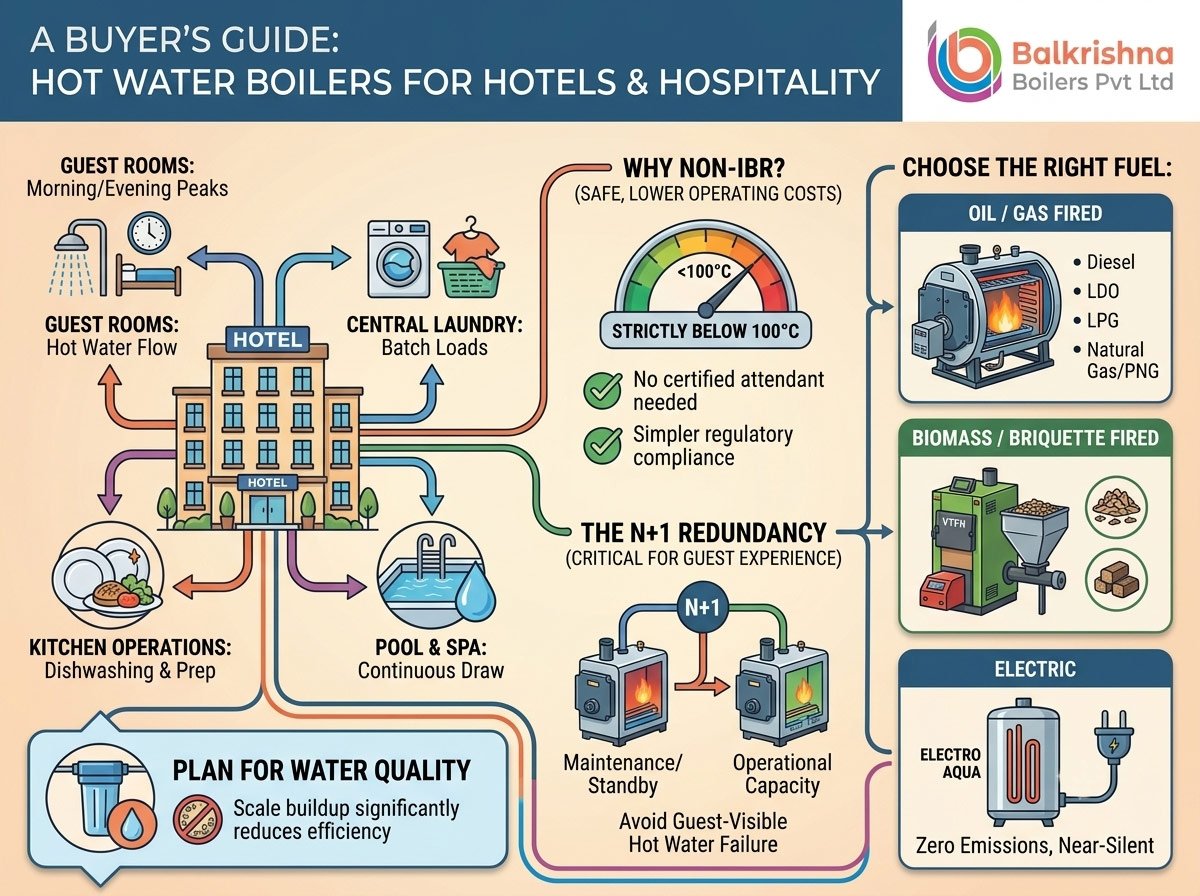
Most industrial hot water boilers are sized around a single, fairly predictable process load. Hospitality is different. A hotel’s hot water demand is a layered mix of:
- Guest room showers and taps — a sharp, simultaneous morning and evening peak
- Centralized laundry — large, steady batch loads that run through the day
- Kitchen operations — dishwashing and food prep, often with its own peak windows
- Pool and spa heating — a slower, continuous draw that still needs reliable backup
- HVAC and space heating — relevant for hill stations and cooler climates
That combination means hospitality boiler sizing has to account for peak simultaneous demand, not average daily consumption — a mistake we see often enough that it’s worth its own section below.
Why Hot Water, Not Steam, for Most Hospitality Applications
It’s worth addressing this up front: unless your property runs a large-scale central sterilization unit or an industrial-style commercial laundry with steam-pressing equipment, you almost certainly need a hot water boiler, not a steam boiler. Steam systems deliver latent heat for processes like sterilization and power generation — overkill, extra cost, and extra regulatory burden for guest hot water, kitchens, and standard laundry. We’ve laid out the full comparison in our post on Hot Water Boiler vs Steam Boiler: Which One Do You Need? — a useful read if your property also runs some steam-dependent equipment and you’re trying to decide whether you need one system or both.
Hospitality is, in fact, one of the textbook applications our own product pages list for hot water systems — our oil/gas fired hot water boiler page specifically names centralized hot water for hotels and laundries as a core use case, and our electric hot water boiler range is built around exactly this kind of guest-facing, zero-emission application.
Step 1: Calculate the Right Capacity
Hot water boiler capacity for hospitality is typically expressed in kcal/hr or LPH (liters per hour). As a starting framework:
- Boutique properties (up to ~50 rooms): Small-capacity systems in the 50,000 to 2 lakh kcal/hr range are usually enough, especially when paired with adequate storage tanks to buffer the morning peak.
- Mid-size hotels (50–150 rooms): Medium systems, typically 5 lakh to 10 lakh kcal/hr, covering rooms, a moderate laundry, and kitchen load together.
- Large resorts and hotel groups (150+ rooms, on-site laundry, pool, spa): Often need 20 lakh+ kcal/hr, frequently split across two or more units for redundancy — a critical point for hospitality, covered next.
The safest approach is never to size purely on room count. Add up your peak simultaneous draw (room showers at check-out time, laundry running its heaviest batch, kitchen at breakfast service) and build in a 15–20% margin for future expansion. Our engineering team reviews this kind of load breakdown for every hospitality inquiry — you can share your room count, laundry capacity, and pool/spa specs through our contact page for a tailored recommendation.
Step 2: Build in Redundancy — This Is Non-Negotiable for Hospitality
In a factory, a boiler going down for a day is a production problem. In a hotel, it’s a guest-facing failure that shows up in reviews within hours. This is the single biggest difference between industrial and hospitality boiler specification, and it’s where hotel buyers most often under-spec.
The standard approach is an N+1 configuration — for example, two 10 lakh kcal/hr units instead of one 20 lakh kcal/hr unit, so that if one goes down for maintenance or a fault, the property still has functioning hot water at reduced capacity rather than none at all. It costs more upfront than a single large unit, but for any property above roughly 80–100 rooms, it’s the standard our clients in this sector choose.
Step 3: Choose the Right Fuel for Your Property
Fuel choice depends less on the “hot water vs steam” decision and more on your site’s infrastructure, budget, and emissions goals.
Oil / Gas Fired
Our AQUAJET series and the equivalent oil/gas fired hot water boiler on indianboilers.com are three-pass, fully wet-back designs running on diesel (HSD), LDO, LPG, or natural gas/PNG where a pipeline is available. This is the most common choice for urban hotels — compact, fully automatic, and achieving 85–90% thermal efficiency. If your property has a PNG connection, running costs drop meaningfully compared to diesel or LPG.
Biomass / Briquette Fired
For resorts and larger properties with space for fuel storage and ash handling, biomass systems like AQUAMAX and the biomass fired hot water boiler on indianboilers.com offer the lowest running cost of any fuel option. This is a strong fit for resort properties with land, a consistent housekeeping-adjacent workforce that can manage ash handling, and a genuine sustainability story to tell guests.
Electric
The ELECTRO AQUA range, listed as electric hot water boiler on indianboilers.com, is increasingly popular for boutique hotels and heritage properties where a chimney or fuel storage yard isn’t visually or physically practical. No combustion means no soot, no flue gas emissions, and near-silent operation — genuinely useful when the boiler room sits near guest-facing areas. The tradeoff is a higher per-unit electricity cost versus gas or biomass, so it tends to make the most sense for smaller properties or as a backup unit within a larger N+1 setup. Our deeper look at the underlying technology is in Electric Boiler Technology: From Immersion Elements to Electrode Types and Why Electric Boilers Are the Best Choice for Low-Emission Plants.
Step 4: Understand the IBR Question
This is a genuine cost and operations question, not just a compliance footnote. In India, hot water systems operating below 100°C are generally classified as non-IBR, meaning they don’t require annual government inspection or a certified boiler attendant on payroll. For most hospitality applications — guest showers, laundry, kitchen hot water — you don’t need temperatures anywhere near 100°C, so a well-specified system stays comfortably in non-IBR territory.
That matters for hotel operating costs specifically, because avoiding a certified attendant requirement removes a dedicated technical headcount that many properties would otherwise need to carry. It’s one more reason hot water, not steam, is the right call for almost every hospitality application that doesn’t involve heavy sterilization or industrial-scale steam laundry equipment.
Step 5: Plan for Water Quality
Hospitality properties, especially resorts on borewell or municipal supply with variable hardness, run into scale buildup faster than they expect. Just 1mm of limescale on a heat exchanger surface can cut efficiency by around 10% and shortens equipment life. A standard water softener ahead of the boiler is a small addition to the project cost that protects the far larger investment in the boiler itself — and it’s something we recommend as standard on every hospitality installation, regardless of fuel type.
What This Actually Costs
As a rough current-market guide for the Indian hospitality segment:
- Small capacity (50,000–2 lakh kcal/hr): approximately ₹1.5 Lakh to ₹4 Lakh per unit
- Medium capacity (5–10 lakh kcal/hr): approximately ₹6 Lakh to ₹12 Lakh per unit
- Large capacity (20 lakh+ kcal/hr): ₹20 Lakh and above, often split across multiple units for redundancy as covered above
Properties switching from an old, inefficient electric geyser bank or an aging oil-fired boiler to a right-sized, high-efficiency system typically see a full return on investment within 8 to 14 months — largely driven by fuel savings and reduced maintenance callouts, which matter more in hospitality than the sticker price alone.
A Buyer’s Checklist Before You Sign a PO
- Have you calculated peak simultaneous demand, not just average daily usage, across rooms, laundry, kitchen, and pool/spa together?
- Have you specified N+1 redundancy if your property is above roughly 80–100 rooms, or has a single point of hot water failure that would be guest-visible?
- Does your fuel choice match your site — pipeline gas availability, space for biomass storage, or a preference for zero-emission electric?
- Have you confirmed the system stays non-IBR, avoiding the added cost of certified attendants and annual inspections where your temperature requirement allows it?
- Is a water softener included in the scope, not treated as an optional extra?
- What’s the after-sales support model — AMC availability, spare parts stock, and response time for a guest-facing failure?
Why Hospitality Groups Choose Balkrishna Boilers
Across 5,000+ installations in India and more than 30 countries, hospitality has been one of our most consistent sectors — precisely because hotels can’t afford the kind of downtime that a mis-specified or poorly serviced boiler creates. Our hot water range spans the oil/gas fired AQUAJET, biomass fired AQUAMAX and VTFH SERIES, and electric ELECTRO AQUA — the same models listed under Hot Water Boiler on indianboilers.com and Hot Water Boiler on balkrishn.com.
You can review our complete product range on indianboilers.com or balkrishn.com’s Our Products page, see the broader set of sectors we serve on our Industries page, or reach out through Contact Us with your room count, laundry capacity, and site details for a load-based recommendation.
Frequently Asked Questions
Do hotels need IBR-certified boilers? Not usually. As long as your outlet temperature stays below 100°C — which covers guest hot water, standard laundry, and kitchen use — the system is generally classified as non-IBR and doesn’t require annual government inspection or a certified attendant.
How many boiler units should a resort install? For any property above roughly 80–100 rooms, or anywhere hot water downtime would be guest-visible, we recommend an N+1 configuration — two or more smaller units instead of a single large one, so a fault or scheduled maintenance never means zero hot water.
Is electric or gas cheaper to run for a hotel boiler? Gas (particularly PNG where available) generally has the lowest per-unit running cost, followed by biomass for properties with space and a sustainability focus. Electric costs more per unit of heat but offers zero emissions and near-silent operation, making it a strong fit for boutique properties or as a backup unit.
Can one boiler handle rooms, laundry, and pool heating together? Yes, if sized correctly for peak simultaneous demand across all three — but most mid-to-large properties are better served by separate or redundant units so a laundry-heavy day doesn’t compromise guest room hot water.
Planning a new build or replacing an aging system? Get in touch with our engineering team with your room count, laundry and kitchen load, and site fuel availability, and we’ll recommend the right capacity, fuel, and configuration for your property.