
Every plant manager evaluating a new heating system eventually runs into the same question: do we actually need a steam boiler, or would a hot water boiler do the job for a fraction of the cost and complexity? It’s a fair question, and it’s one we get asked constantly at Balkrishna Boilers Pvt Ltd — a company that has spent over 25 years designing, manufacturing, and installing both types of systems across more than 5,000 installations in India and overseas.
The honest answer is: it depends entirely on what your process actually needs — not on which boiler sounds more “industrial.” A lot of facilities overspend on high-pressure steam systems for jobs that only ever needed hot water, and a smaller number under-spec a hot water system for a process that genuinely needed the latent heat of steam. Both mistakes are expensive. This guide breaks down exactly how these two systems differ, where each one wins, and how to make the call for your own facility.
What Is a Steam Boiler?
A steam boiler heats water inside a sealed, pressurized vessel until it changes phase from liquid to vapor. That phase change is the whole point — when water turns to steam, it expands roughly 1,600 times in volume, and that expansion is what makes steam such a powerful medium for driving turbines, running sterilizers, and supplying high-temperature process heat.
Steam boilers operate under pressure, which means they carry stored energy that hot water systems simply don’t. That’s why, in India, most steam boilers above a certain size fall under the Boilers Act, 1923, and require IBR (Indian Boiler Regulations) registration and periodic inspection. We’ve covered this in more depth in our post on what an industrial steam boiler is and how the fuel combustion and heat transfer cycle actually works inside one.
At indianboilers.com and balkrishn.com, our steam boiler range covers oil/gas-fired units like STEAMJET, biomass and agro-waste fired ranges like HUSKPOWER and COMCUBE, and fully electric options like ELECTRON — so the “steam vs hot water” decision doesn’t have to be tied to any one fuel type.
What Is a Hot Water Boiler?
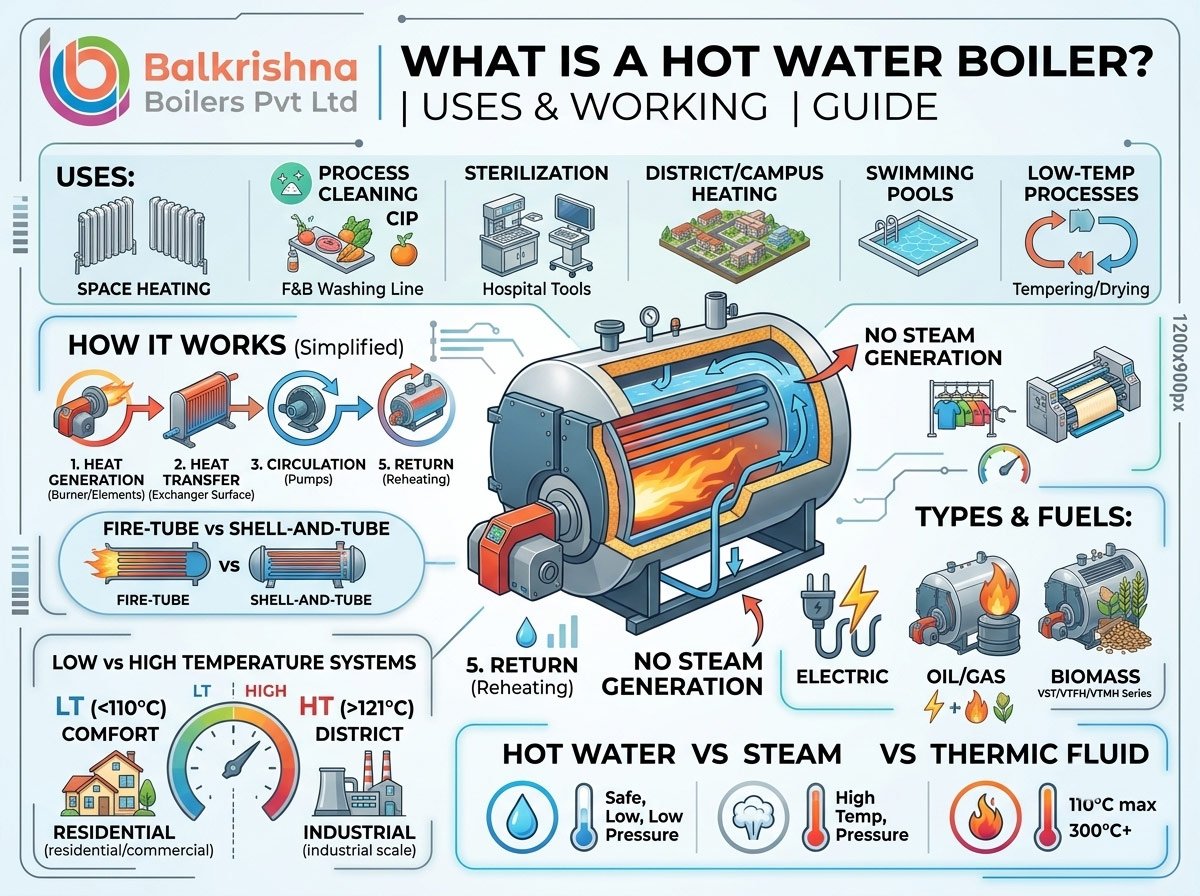
A hot water boiler does the opposite job on purpose: it heats water and keeps it in its liquid state, then circulates it through a closed loop to wherever heat is needed. There’s no phase change, no high pressure, and no steam trap or condensate return network to manage.
Hot water systems generally fall into two bands. Low-Temperature Hot Water (LTHW) tops out around 110°C and is common in building heating, process washing, and moderate industrial applications. High-Temperature Hot Water (HTHW) runs above 121°C under pressure and is used for district heating or larger industrial loops. In India, if the outlet temperature stays below 100°C, the unit is typically classified as a hot water generator and does not require IBR registration — a major operational advantage for facilities that don’t need government-certified boiler attendants or annual inspections.
Our hot water range includes oil/gas-fired units like AQUAJET, biomass and briquette-fired systems like AQUAMAX and the VTFH SERIES, and the fully electric ELECTRO AQUA — the same models listed under Hot Water Boiler on indianboilers.com, including the oil/gas fired hot water boiler and biomass fired hot water boiler.
The Core Difference: Latent Heat vs Sensible Heat
This is the one concept that resolves almost every confusion between the two systems.
- Steam boilers deliver latent heat. Steam releases a huge amount of energy when it condenses back into water, which is why it’s so effective for sterilization, power generation, and processes that need very high, very concentrated heat input.
- Hot water boilers deliver sensible heat. The water itself just gets hot and stays hot — there’s no phase-change energy involved, which makes the system gentler, more controllable, and generally more efficient for simple heating jobs.
We explored this same latent-vs-sensible comparison from the thermic fluid side in our post on Thermic Fluid Heater vs Hot Water Boiler: Key Differences — worth a read if you’re also weighing a thermic fluid system against these two.
Steam Boiler vs Hot Water Boiler: Side-by-Side Comparison
| Parameter | Steam Boiler | Hot Water Boiler |
|---|---|---|
| Medium state | Liquid converts to vapor (steam) | Stays liquid throughout |
| Typical temperature | 100°C and above, often 150–250°C+ | Usually below 100–120°C |
| Operating pressure | High pressure, measured in kg/cm² | Low to moderate pressure |
| IBR registration (India) | Mandatory above 25 liters / higher pressures | Generally not required below 100°C |
| Best suited for | Sterilization, power generation, drying, high-temp process heat | Space heating, washing, low-to-medium temp process heat |
| Energy delivered | Latent heat (very high energy density) | Sensible heat (steady, controllable) |
| System complexity | Steam traps, condensate return, blowdown routine | Simple closed-loop circulation with a pump |
| Operator requirement | Certified boiler attendant often mandatory | Not mandatory in most non-IBR cases |
| Typical efficiency | 80–88% depending on fuel and design | 88–92% for oil/gas; higher with condensing design |
| Maintenance load | Higher — scale, blowdown, safety valve checks | Lower — periodic descaling, pump seal checks |
When You Actually Need a Steam Boiler
Steam is the right call when your process needs concentrated, high-temperature energy delivered efficiently over distance, or when the process itself demands the phase change. Common cases:
- Sterilization and pasteurization — pharmaceutical and food & beverage plants rely on steam’s latent heat for reliable, repeatable sterilization cycles.
- Power generation — steam drives turbines; nothing else in this comparison does that job.
- High-temperature drying and processing — textile dyeing, finishing, and curing lines often need temperatures that hot water can’t reach without dangerously high pressure.
- Long-distance heat distribution — steam can travel through a plant and still deliver strong heat at the far end, something hot water loses more of to distance and pipe losses.
If any of this matches your process, start with our Steam Boiler range, which includes everything from the oil/gas fired steam boiler for urban, fuel-flexible installs to the biomass fired steam boiler for facilities looking to cut fuel costs with agro-waste. Our detailed breakdown on biomass boilers for steam generation is a useful next read if fuel cost is your main driver.
When You Actually Need a Hot Water Boiler
Hot water is the smarter, cheaper, lower-maintenance choice whenever your process temperature genuinely stays under 100–120°C. That covers more industrial applications than most people assume:
- Space and building heating — radiators, baseboard heaters, and hydronic radiant floor systems all run on circulated hot water, not steam.
- Process washing and rinsing — textile pre-treatment, food-grade equipment washdown, and general utility heating rarely need steam-level temperatures.
- Domestic and facility hot water — laundries, hostels, and hospitals often need consistent hot water without the regulatory overhead of a steam plant.
- Low-to-medium temperature process heat — many rice mill conditioning steps and textile utility lines run comfortably on hot water, cutting out the steam-to-water heat exchanger entirely.
If your requirement fits here, browse the Hot Water Boiler category, including the electric hot water boiler for zero-emission urban sites and the wood/briquette fired hot water boiler for facilities with access to biomass fuel. On balkrishn.com, the equivalent models are listed under Hot Water Boiler, including the VST SERIES and VTMH SERIES.
Fuel Options Are the Same for Both
One thing that surprises a lot of first-time buyers: the choice between steam and hot water is almost entirely independent of fuel choice. Both system types are available in:
- Oil/Gas — diesel (HSD), LDO, furnace oil, natural gas, PNG, or LPG, for clean, compact, fully automatic operation.
- Biomass and agro-waste — wood, briquettes, rice husk, and other agricultural residue for the lowest running cost.
- Electric — zero flue emissions, no fuel storage, and minimal footprint, ideal for space-constrained or low-emission sites. Our post on why electric boilers work for low-emission plants and electric boiler technology from immersion to induction covers this in detail.
So the real decision tree is: first decide steam vs hot water based on your process temperature and application, then decide the fuel based on your site’s cost, emissions, and infrastructure constraints.
Cost and ROI: What to Actually Expect
As a rough 2025–2026 benchmark for the Indian market:
- A 1 TPH IBR-certified steam boiler typically ranges from ₹8 Lakhs to ₹15 Lakhs depending on fuel type and automation level, with most clients seeing ROI within 12–18 months through fuel savings.
- A hot water boiler in the small-to-medium range (50,000 to 10 Lac kcal/hr) typically runs from ₹1.5 Lakhs to ₹12 Lakhs, and clients switching from inefficient electric heaters to biomass or gas hot water systems often see ROI within 8–14 months.
The gap isn’t just the equipment cost. Steam systems carry ongoing costs that hot water systems don’t: certified attendant salaries, annual IBR inspection fees, steam trap maintenance, and condensate return system upkeep. If your process doesn’t need steam’s latent heat, you’re paying for capability you’ll never use.
A Quick Decision Checklist
Ask these questions before you spec anything:
- What temperature does my process actually need? Under 100–120°C almost always points to hot water. Above that, or if you need phase-change energy, steam is likely required.
- Do I need to sterilize, power a turbine, or do rapid high-heat processing? That’s steam territory, no way around it.
- Am I trying to avoid IBR registration and a certified attendant? A hot water system below 100°C sidesteps both requirements.
- How far does the heat need to travel inside the plant? Steam holds up better over distance; hot water loses more to pipe losses on long runs.
- What’s my available fuel, and how much floor space do I have? This affects model selection within either category, not the steam-vs-hot-water decision itself.
If you’re still unsure after running through this, that’s normal — a lot of real-world processes use both systems side by side, with steam covering the high-temperature core process and hot water handling utility heating and washdown around it.
Why Facilities Choose Balkrishna Boilers for Either System
Whether the answer turns out to be steam or hot water, the manufacturing and engineering behind the boiler matters as much as the category itself. At Balkrishna Boilers Pvt Ltd, every unit — from the STEAMGEN wood/briquette fired steam boiler to the AQUAJET hot water range — is built with the same 25 years of design experience, PLC-based automation options, and pan-India service support that back our 5,000+ installations across India and 30+ countries.
You can review our complete range on indianboilers.com’s Products section or on balkrishn.com’s Our Products page, explore industries we serve, or get in touch with our engineers for a load-based recommendation specific to your facility.
Frequently Asked Questions
Can a hot water boiler be converted to a steam boiler later? No — the two are built differently for pressure handling and phase change. If there’s a chance your process will need steam in the future, it’s better to plan for a steam system, or a dual setup, from the start.
Which one is cheaper to run long-term? Hot water systems are generally cheaper to operate because they avoid steam trap losses, blowdown losses, and condensate return inefficiencies — but the comparison only makes sense if your process temperature genuinely fits within hot water’s range.
Do I need a certified boiler operator for a hot water boiler? In most cases, no — non-IBR hot water systems below 100°C don’t require a certified attendant, which is one of their biggest operational advantages over steam.
Is steam always more efficient for large industrial loads? Not necessarily. Steam is more efficient for processes that need latent heat. For large-scale space heating or washdown, a well-designed hot water system is often more efficient overall because it avoids steam-specific losses.
Still not sure which system fits your process? Contact our engineering team with your required capacity (TPH or kcal/hr) and process temperature, and we’ll recommend the right boiler — steam, hot water, or both.