
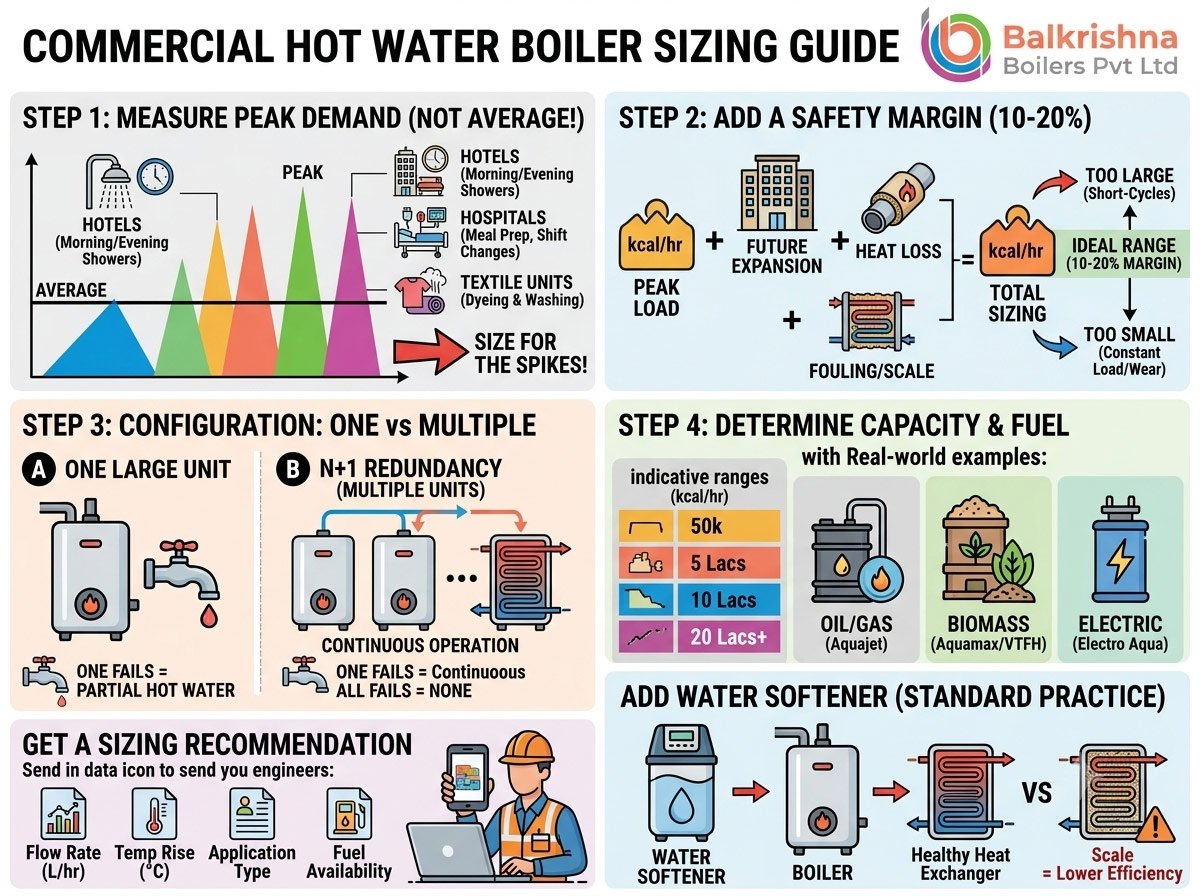
Sizing mistakes are the single most expensive error a facility manager makes when buying a hot water boiler — and they go in both directions. Undersize the system and you get inconsistent temperatures, unhappy end users, and a unit running flat-out 24/7 that wears out years early. Oversize it and you’ve paid for capacity you’ll never use, while the boiler short-cycles inefficiently because it’s too big for the actual load.
At Balkrishna Boilers Pvt Ltd, correct sizing is the first thing our engineers work through with every commercial inquiry, whether it’s for a hospital, a hotel, a textile unit, or a commercial building’s central heating system. This guide walks through exactly how we do it, so you can either size your own requirement with confidence or ask the right questions of any vendor quoting you a hot water boiler.
Step 1: Understand What You’re Actually Measuring
Commercial hot water boiler capacity in India is almost always expressed in kcal/hr (kilocalories per hour), sometimes alongside LPH (liters per hour) for flow-based systems. Before you can size anything, you need three numbers:
- Flow rate — how much water needs to be heated per hour (in liters)
- Temperature rise (ΔT) — the difference between your incoming water temperature and your required outlet temperature
- Simultaneity/peak factor — how much of your total demand actually hits at the same time
The core formula facility engineers use is:
Heat Required (kcal/hr) = Flow Rate (L/hr) × Temperature Rise (°C) × 1 (specific heat of water)
For example, heating 5,000 liters per hour from 20°C to 70°C (a 50°C rise) requires roughly 250,000 kcal/hr — before any margin is added. This single calculation is the backbone of every sizing exercise, whether you’re speccing a hotel’s central hot water system or a factory’s process washing line.
Step 2: Don’t Size on Average Demand — Size on Peak Demand
This is the mistake we see most often. A facility calculates its total daily hot water consumption, divides it across 24 hours, and specs a boiler for that average. Real demand doesn’t work that way — it arrives in spikes.
- A hotel sees a sharp peak during morning and evening shower windows, plus a separate laundry peak during the day.
- A hospital sees concentrated demand around shift changes, sterilization cycles, and meal service.
- A textile unit sees demand jump the moment a dyeing or washing line starts a new batch.
Size for your peak simultaneous load, not your daily average, and then add a safety margin on top (more on that below). We’ve written a sector-specific breakdown of this exact problem in our guide on Hot Water Boilers for Hotels and Hospitality: A Buyer’s Guide, which covers how to calculate peak demand across rooms, laundry, and kitchen loads together.
Step 3: Add a Realistic Safety Margin
Once you’ve calculated your peak load, add 10–20% margin on top. This isn’t padding for its own sake — it accounts for:
- Future expansion — new rooms, a new production line, or added capacity you’ll want in 2–3 years without replacing the whole system
- Heat loss in distribution — long pipe runs, especially uninsulated ones, lose real heat before water reaches its destination
- Fouling and scale over time — even with a water softener, heat exchanger efficiency drops gradually between service intervals, and a margin keeps output steady as it does
Going much beyond 20% margin, though, usually means you’re better off choosing a design that can be paired with a second smaller unit later, rather than buying one oversized system today. That leads into the next point.
Step 4: Decide Between One Large Unit and Multiple Smaller Units
For any facility where hot water downtime is a real operational or guest-facing problem — hotels, hospitals, large commercial buildings — sizing isn’t just about total kcal/hr. It’s about how that capacity is split.
An N+1 configuration — for example, two 5 lakh kcal/hr units instead of one 10 lakh kcal/hr unit — means that if one boiler goes down for a service or a fault, the facility still has partial hot water instead of none. This costs more upfront than a single large unit but is the standard approach for any site where a full outage is unacceptable. We cover this in more depth in our hospitality sizing guide linked above, but the same logic applies to hospitals, large commercial complexes, and multi-shift industrial facilities.
Step 5: Match Capacity to Real-World Benchmarks
Once you have your target kcal/hr figure, it helps to know where that sits against typical commercial installations, so you can sanity-check a vendor’s quote. Current indicative ranges across our Hot Water Boiler range:
| Capacity Band | Typical Use Case | Approximate 2025–26 Price (Oil/Gas) |
|---|---|---|
| 50,000 – 2 Lac kcal/hr | Small hotels, clinics, small commercial kitchens | ₹1.5 Lakh – ₹4 Lakh |
| 5 Lac – 10 Lac kcal/hr | Mid-size hotels, hospitals, commercial buildings, textile units | ₹6 Lakh – ₹15 Lakh |
| 20 Lac+ kcal/hr | Large resorts, hospital groups, industrial plants | ₹20 Lakh+ |
Biomass-fired systems in the same capacity bands, such as our biomass fired hot water boiler and wood/briquette fired hot water boiler, typically run somewhat lower on upfront cost with a higher footprint requirement, while our electric hot water boiler range spans 12 kW commercial-scale units up to 500 kW+ for heavier industrial demand, priced on electrical load rather than fuel logistics.
Step 6: Factor In Temperature Requirement, Not Just Volume
Two facilities with identical flow rates can need very different boiler sizes if their required temperature rise is different. A commercial kitchen heating incoming water from 25°C to 60°C needs meaningfully less capacity than a laundry or process line heating the same volume from 15°C to 85°C. Always confirm:
- What’s your actual incoming (cold) water temperature on site — this varies by region and season in India
- What’s your required outlet temperature for the specific application
- Whether that outlet temperature keeps you comfortably under 100°C, which affects both sizing and IBR registration requirements — most commercial hot water applications stay non-IBR, avoiding the cost of a certified attendant and annual inspection
If your requirement pushes toward or above 100°C, you’re likely looking at a different category entirely — our guide on Hot Water Boiler vs Steam Boiler: Which One Do You Need? walks through exactly where that line sits and which system fits which application.
Step 7: Choose Fuel Type Based on Site Constraints, Not Sizing
Fuel choice doesn’t change the underlying kcal/hr math, but it does affect what’s practical on your site:
- Oil/Gas — AQUAJET and the equivalent oil/gas fired hot water boiler offer compact footprints and fast response, ideal where space is tight and a gas or diesel supply is reliable.
- Biomass — AQUAMAX and the VTFH SERIES need more floor space for fuel storage and ash handling but offer the lowest running cost per kcal at scale.
- Electric — ELECTRO AQUA needs no chimney or fuel yard at all, useful where space or emissions are the binding constraint rather than running cost. Our post on Electric Boiler Technology: From Immersion Elements to Electrode Types covers how the underlying heating method affects sizing and response time for electric units specifically.
Step 8: Don’t Forget Water Quality in Your Sizing Assumptions
A correctly sized boiler will still under-deliver if scale builds up on the heat exchanger. Just 1mm of limescale can cut efficiency by around 10%, effectively shrinking your real-world capacity below what you calculated on paper. Any commercial sizing exercise should assume a water softener is part of the system from day one, not an optional extra bolted on later — this is standard practice across our installations regardless of fuel type or capacity band.
A Practical Sizing Checklist
- Calculate your peak flow rate in liters per hour, not your daily average consumption
- Confirm incoming and required outlet temperatures to get an accurate ΔT
- Run the base formula: Flow (L/hr) × ΔT (°C) = kcal/hr required
- Add 10–20% margin for future growth, distribution losses, and fouling over time
- Decide on single-unit vs N+1 configuration based on how critical uninterrupted hot water is to your operation
- Cross-check your number against real capacity bands so you can sanity-check any vendor quote
- Confirm the fuel type fits your site — space, emissions, and running-cost priorities
- Include a water softener in the scope from the start
Getting a Sizing Recommendation From Our Engineers
Rather than sizing this alone, most commercial buyers get a faster, more accurate result by sending us their flow rate, incoming and required water temperatures, application (hospitality, healthcare, textile, food processing, or general commercial), and site fuel availability. Our engineers cross-check that against real installation data from our 5,000+ installations across India and 30+ countries before recommending a specific model.
You can review the full hot water range on indianboilers.com or balkrishn.com’s Hot Water Boiler page, browse the sectors we serve on our Industries page, or contact our team directly with your load details for a proposal.
Frequently Asked Questions
What’s the simplest formula to size a hot water boiler? Heat Required (kcal/hr) = Flow Rate (L/hr) × Temperature Rise (°C). Calculate this off your peak simultaneous demand, then add a 10–20% safety margin.
Is it better to oversize slightly or undersize slightly? Neither is ideal, but a boiler that’s meaningfully oversized will short-cycle and lose efficiency, while one that’s undersized simply can’t meet peak demand. A properly calculated 10–20% margin avoids both problems — going further than that usually means you should reconsider the configuration (single unit vs. multiple units) rather than the size.
Does fuel type change how I size the boiler? No — the underlying kcal/hr requirement is the same regardless of fuel. Fuel type affects footprint, running cost, and installation requirements, not the core sizing calculation.
Do I need IBR registration for a commercial hot water boiler? Generally not, as long as your outlet temperature stays below 100°C, which covers the vast majority of commercial hot water applications — hotels, hospitals, kitchens, and general process washing.
How much floor space should I plan for? This varies significantly by fuel type — electric units need the smallest footprint since there’s no chimney or fuel storage, while biomass units need meaningfully more space for fuel storage and ash handling. Confirm this with your vendor once you’ve settled on a capacity and fuel type.
Have your flow rate and temperature numbers ready? Send them to our engineering team and we’ll confirm the right capacity, configuration, and fuel type for your facility.