
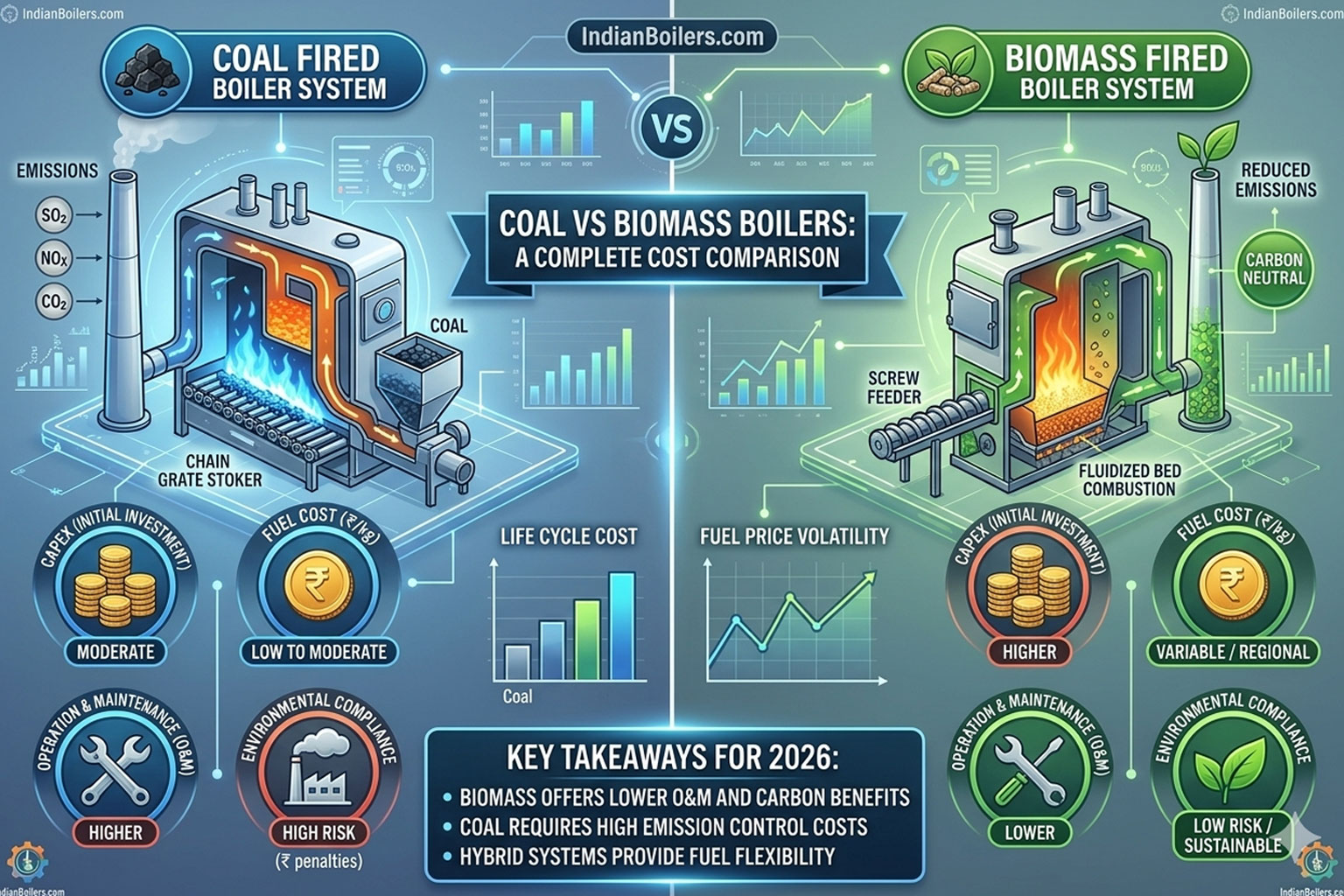
In the current industrial landscape of 2026, the choice of fuel is no longer just a matter of the lowest “price per ton.” With the implementation of the EU’s Carbon Border Adjustment Mechanism (CBAM), stricter Indian Boiler Regulations (IBR), and a nationwide mandate for 5%–7% biomass co-firing, the economics of steam generation have shifted.
At IndianBoilers.com, we help industries navigate this transition. This guide provides a granular analysis of the “Total Cost of Ownership” (TCO) for Coal vs. Biomass systems.
1. The Fuel Pricing Reality: Coal vs. Biomass
To compare these fuels accurately, we must look at the delivered prices in the Indian market as of March 2026.
| Fuel Type | Average Price (₹/kg) | Calorific Value (kcal/kg) | ₹ per 1,000,000 kcal |
| Indian Industrial Coal | ₹9.00 – ₹11.00 | 4,200 – 4,500 | ~₹2,200 |
| Imported Steam Coal | ₹12.00 – ₹14.00 | 5,500 – 6,000 | ~₹2,250 |
| Biomass Pellets (Agro) | ₹10.00 – ₹13.00 | 3,800 – 4,200 | ~₹2,800 |
| Biomass Briquettes | ₹7.00 – ₹9.00 | 3,500 – 3,800 | ~₹2,100 |
Analysis: On a pure “heat energy” basis, Biomass Briquettes have actually become more cost-effective than imported coal in many regions of Gujarat and Maharashtra due to local agricultural surpluses. However, pellets remain a premium choice due to their high density and automation compatibility.
2. Operational Efficiency: The Hidden Savings
A common mistake is assuming both boilers operate at the same efficiency. In practice, biomass systems often outperform coal-fired units in thermal transfer.
- Combustion Efficiency: Coal typically has an ash content of 25%–40%, which acts as an insulator and requires frequent “soot blowing.” Biomass (specifically wood pellets) has an ash content of only 1%–5%.
- Response Time: Biomass has higher volatile matter, allowing the boiler to respond faster to load changes. This prevents “fuel over-firing” during low-demand periods, saving roughly 2%–3% in annual fuel volume.
3. Capital Expenditure (CAPEX) Comparison
Installing a biomass-ready system requires a higher initial investment compared to a basic coal boiler.
- Fuel Handling: Biomass requires larger, covered storage to prevent moisture absorption. Automated screw feeders for pellets are more expensive than simple coal hoppers.
- Combustion Bed: Fluidized Bed Combustion (FBC) boilers—the gold standard for biomass—cost approximately 15%–20% more than standard grate-fired coal boilers.
- Emissions Tech: Coal boilers must now be equipped with expensive Flue Gas Desulfurization (FGD) and Electrostatic Precipitators (ESP) to meet 2026 environmental norms. For biomass, a simpler Cyclone Separator or Bag Filter is often sufficient, partially offsetting the higher boiler cost.
4. Regulatory Costs & “Carbon Risk”
This is where the 2026 landscape differs most from the past.
- The 5% Mandate: The Ministry of Power now mandates 5% biomass co-firing for all coal-based plants. If you run a 100% coal boiler, you may face non-compliance penalties of up to ₹0.25 per unit of shortfall.
- Ash Disposal: Disposing of coal ash is a growing cost center (approx. ₹500–₹800 per ton). Biomass ash, conversely, is rich in potash and is often sold back to farmers as fertilizer, turning a waste cost into a minor revenue stream.
- Carbon Border Tax (CBAM): If your factory exports to the EU (Steel, Aluminum, Cement), using coal increases your “embedded carbon.” Under 2026 rules, this could result in a 15%–22% price penalty on your exported goods.
5. Maintenance and Downtime (OPEX)
Coal is abrasive. It wears down internal components, grates, and fuel handling systems faster than biomass.
- Tube Fouling: Coal’s high sulfur and ash lead to “clinkering” and scale buildup. A coal boiler typically requires 2-3 more “shutdown days” per year for deep cleaning than a biomass unit.
- Manpower: Coal handling is labor-intensive and dirty. Biomass (pellets) allows for a cleaner, highly automated “Boiler House” that requires 30% less manual intervention.
Summary Table: 10-Ton Steam Boiler TCO (Estimated)
| Cost Component | Coal Fired System | Biomass (Pellet) System |
| Initial CAPEX | Medium (₹1.2 Cr) | High (₹1.5 Cr) |
| Annual Fuel Cost | Lower | Moderate |
| Ash Handling Cost | High | Net Zero / Profit |
| Maintenance Cost | ₹8-10 Lakh/Year | ₹4-5 Lakh/Year |
| Compliance Risk | High (Carbon/Pollution) | Low (Carbon Neutral) |
Conclusion: Which One Should You Choose?
- Choose Coal if: You have a long-term, low-cost supply contract for high-GCV coal and your facility is not subject to strict export carbon audits.
- Choose Biomass if: You are located near agricultural hubs (like Ahmedabad), you prioritize ESG compliance, or you want a cleaner, automated operation with lower maintenance.
At IndianBoilers.com, we recommend Hybrid Boilers for most 2026 projects. These allow you to switch between fuels based on seasonal market prices, giving you the ultimate “cost-hedge.”
