
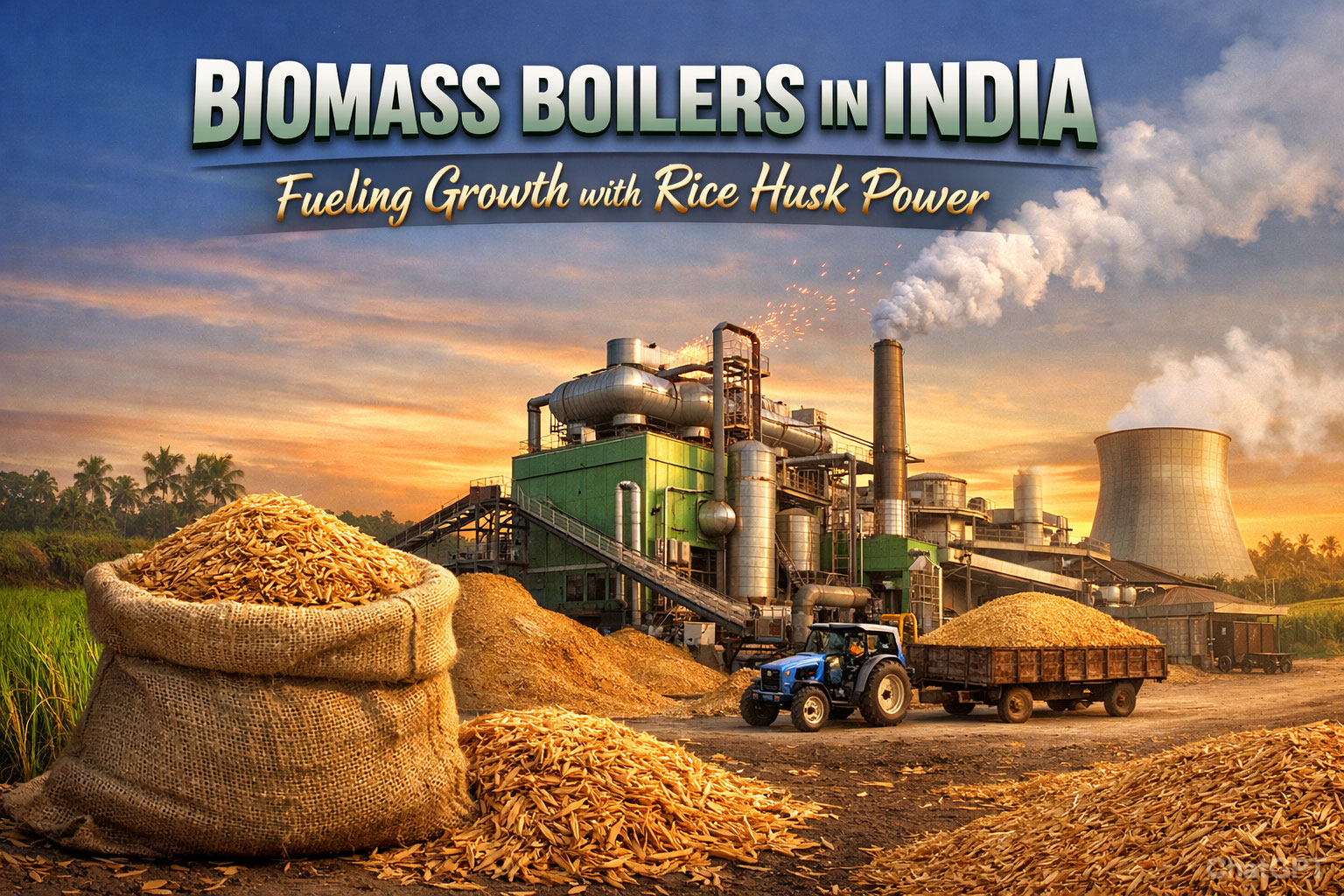
Biomass Boilers in India: Fueling Growth with Rice Husk Power
In the global race toward net-zero emissions, India stands at a unique crossroads. As one of the world’s largest producers of rice, the nation generates an incredible volume of agricultural residue—specifically rice husk. Traditionally viewed as waste, this silica-rich byproduct is now the “gold” powering a new generation of industrial energy: Biomass Boilers.
At IndianBoilers.com, we are witnessing a paradigm shift. Indian industries—from textiles and food processing to pharmaceuticals—are moving away from volatile fossil fuels toward decentralized, carbon-neutral rice husk power.
The Rice Husk Advantage: Why India?
India produces approximately 120–130 million tonnes of rice annually. For every ton of paddy milled, about 200kg of husk is produced. This translates to an annual potential of 25 million tonnes of rice husk available for energy recovery.
Why Rice Husk is the Ideal Biofuel:
- High Calorific Value: It offers a net calorific value (NCV) of roughly 3,000-3,500 kcal/kg, making it a potent energy source compared to other agro-residues.
- Uniformity: Unlike loose straw or wood chips, rice husk is granular and uniform, which allows for consistent feeding and better combustion control.
- Carbon Neutrality: The CO2 released during combustion is equal to the CO2 absorbed by the paddy crop during its growth, making it a “carbon-neutral” cycle.
Technical Architecture of Rice Husk Boilers
Designing a boiler for rice husk requires specialized engineering due to the fuel’s high silica content (nearly 20%) and low bulk density.
1. Combustion Technologies
- Fluidized Bed Combustion (FBC): This is the gold standard for rice husk. By suspending the husk in a hot bed of sand with upward-blowing air, we achieve high heat transfer rates and complete combustion.
- Reciprocating Grate: Ideal for varying moisture levels, allowing the fuel to move through different stages (drying, ignition, combustion) mechanically.
2. The Challenge of Silica
Rice husk ash is roughly 90–95% silica. If not managed correctly, this leads to clinkering (fusion of ash) and erosion of boiler tubes. Advanced Indian designs now incorporate:
- Refractory Lining: To withstand high temperatures.
- Optimized Velocity: To prevent the abrasive ash from “sandblasting” the internal components.
Economic Impacts: Fueling Industrial Growth
For an Indian SME (Small to Medium Enterprise), the switch to rice husk isn’t just about “going green”—it’s about the bottom line.
| Fuel Type | Approx. Cost (INR/kg) | Energy Value (kcal/kg) | Cost per 1,000 kcal |
| Rice Husk | ₹5.0 – ₹7.5 | 3,200 | ₹1.80 |
| Coal (Imported) | ₹12.0 – ₹15.0 | 5,500 | ₹2.40 |
| Furnace Oil | ₹50.0 – ₹60.0 | 10,000 | ₹5.50 |
The ROI Factor: While the initial CAPEX (capital expenditure) for a biomass boiler is higher than a gas/oil unit, the OPEX (operating expenditure) savings often lead to a payback period of 12 to 24 months.
The Environmental and Social Ripple Effect
1. Ending the Stubble Burning Crisis
By creating a commercial value for rice husk, we provide farmers and millers an alternative to open-field burning, which plagues North India with smog every winter.
2. Rural Empowerment
The rice husk supply chain creates a decentralized economy. Collection, bailing, and logistics provide thousands of jobs in rural heartlands, ensuring that energy spends stay within the local community.
Navigating the Challenges: The Indian Context
Despite the benefits, operating a rice husk boiler in India requires a strategic approach:
- Seasonality: Prices can fluctuate during the monsoon. Savvy plant managers at IndianBoilers.com recommend a 60-day storage buffer and multi-fuel capability.
- Ash Management: Rice Husk Ash (RHA) is a major byproduct. However, it is increasingly sold to the cement and steel industries as a reinforcing agent, turning a waste stream into a secondary revenue source.
- Emission Norms: Modern boilers must be equipped with Electrostatic Precipitators (ESP) or Cyclone Separators to meet the stringent PCB (Pollution Control Board) norms regarding particulate matter.
Government Incentives and the Path Ahead
The Indian government, through MNRE (Ministry of New and Renewable Energy), offers various subsidies and CFA (Central Financial Assistance) for biomass power projects. Furthermore, the introduction of Carbon Credits allows industries to monetize their emission reductions.
Future Trends:
- Biomass Briquetting: Converting loose husk into high-density briquettes for easier transport.
- IoT-Enabled Boilers: Using real-time sensors to monitor oxygen levels and combustion efficiency from a smartphone.
Conclusion: Powering the Future
Rice husk is no longer an agricultural headache; it is a strategic asset for India’s industrial sovereignty. By adopting advanced biomass boiler technology, Indian manufacturers can insulate themselves from global oil price shocks while contributing to a cleaner, breathable India.
At IndianBoilers.com, we don’t just sell equipment; we engineer solutions that bridge the gap between agriculture and industry.
