
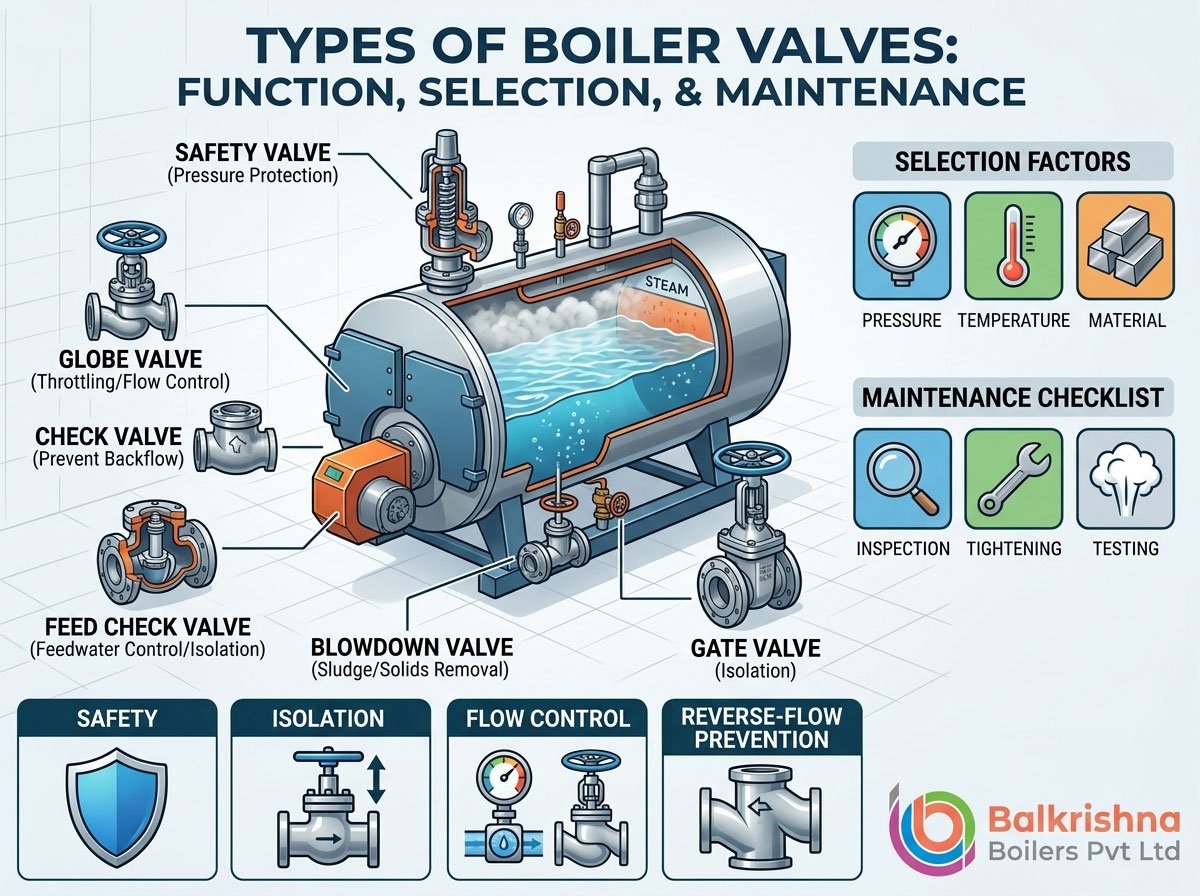
Boiler valves are among the most important components in an industrial boiler system. Although they are much smaller than the boiler itself, the correct valve arrangement controls steam flow, isolates equipment, prevents reverse flow, manages pressure, supports blowdown, and provides essential protection against unsafe operating conditions.
From a safety valve installed on the steam outlet to a feed check valve controlling boiler feedwater and a blowdown valve removing concentrated water and sludge, each valve has a specific job. Selecting the wrong valve, using an unsuitable material, or neglecting maintenance can result in leakage, poor process control, energy losses, equipment damage, or serious safety risks.
For this reason, understanding the different types of boiler valves, their functions, and their selection requirements is important for plant engineers, maintenance teams, boiler operators, and industrial facility managers.
In this guide, we explain the major boiler valves used in industrial steam systems, how they work, where they are installed, how to select them, and what should be checked during maintenance.
What Are Boiler Valves?
Boiler valves are mechanical devices installed throughout a boiler and its associated piping system to start, stop, regulate, divert, or control the movement of water, steam, fuel, and other fluids.
A typical industrial steam boiler may contain several different valve types because no single valve design is suitable for every application.
For example:
- A safety valve protects the boiler from excessive pressure.
- A gate valve is commonly used for isolation.
- A globe valve can be used where flow regulation is required.
- A check valve prevents reverse flow.
- A feed check valve controls and isolates feedwater entering the boiler.
- A blowdown valve removes concentrated boiler water and accumulated solids.
- A pressure-reducing valve reduces steam pressure for downstream equipment.
- A control valve automatically adjusts flow according to process requirements.
The valve selection therefore depends on the pressure, temperature, fluid, flow rate, piping size, operating conditions, and required control function.
Why Are Valves Important in Boiler Systems?
An industrial boiler operates with high temperatures and, in many applications, significant pressure. Steam and hot water must move through the system in a controlled manner.
Boiler valves perform four major functions:
1. Safety
Safety valves provide automatic pressure protection. If boiler pressure rises beyond the permitted setting, the safety valve opens to release pressure according to its design.
2. Isolation
Isolation valves allow operators to disconnect a boiler, section of piping, pump, instrument, or other equipment for inspection and maintenance.
3. Flow Control
Some valves regulate the amount of water or steam moving through a system. This is important for process temperature, pressure, and flow control.
4. Reverse-Flow Prevention
Check valves allow flow in one direction while preventing unwanted backflow. This is particularly important in feedwater and steam systems.
Correct valve selection therefore contributes to safe operation, stable process conditions, and easier maintenance.
Main Types of Boiler Valves
1. Safety Valve
The safety valve is one of the most critical valves installed on a steam boiler.
Its primary purpose is to protect the pressure vessel from excessive pressure. When pressure reaches the valve’s set pressure, the valve opens automatically and releases steam. Once pressure returns to an acceptable level, the valve should reseat according to its design characteristics.
Safety valves are normally installed directly on the boiler steam space or in locations specified by the applicable design and regulatory requirements.
Key functions
- Protect against excessive pressure
- Provide automatic pressure relief
- Support boiler safety
- Help prevent pressure-related equipment damage
Safety valves should never be isolated, blocked, or tampered with during operation. Their set pressure and certification must comply with the applicable boiler regulations, design requirements, and inspection procedures.
2. Gate Valve
A gate valve is primarily an isolation valve. It is designed to provide a relatively unrestricted flow path when fully open and to stop flow when fully closed.
Gate valves are commonly used on steam, water, and other compatible utility lines where the valve normally remains either fully open or fully closed.
They are generally not preferred for continuous throttling because partially opening a gate valve can cause undesirable flow conditions and accelerated wear.
Typical applications
- Steam isolation
- Feedwater isolation
- Drain and utility lines
- Equipment maintenance isolation
- Boiler auxiliary piping
A major advantage of a gate valve is its suitability for full-flow isolation applications.
3. Globe Valve
A globe valve is designed for controlling and regulating fluid flow.
Unlike a gate valve, the internal construction of a globe valve allows the flow passage to be adjusted progressively. This makes it useful when operators need more controlled flow rather than simple on/off isolation.
Common applications
- Steam flow regulation
- Feedwater control
- Auxiliary steam lines
- Heating circuits
- Process lines requiring throttling
Because globe valves can create greater pressure loss than full-bore isolation valves, the pressure-drop requirement should be considered before selection.
4. Check Valve
A check valve, also called a non-return valve, allows fluid to flow in one direction while preventing reverse flow.
This is especially important in boiler feedwater systems. If water were allowed to flow backward from the boiler toward the feed pump or feedwater line, it could damage equipment or create unsafe operating conditions.
Common applications
- Feedwater lines
- Pump discharge
- Condensate lines
- Steam distribution systems
- Auxiliary water circuits
Check valves are available in several designs, including swing, lift, and other configurations. The appropriate design depends on flow direction, velocity, pressure, installation orientation, and system requirements.
5. Feed Check Valve
The feed check valve has an important role in controlling feedwater entering the boiler.
A boiler feed system generally includes a feed pump or other feedwater arrangement. The feed check valve helps ensure that water enters the boiler while preventing unwanted reverse flow.
Depending on the boiler design, a separate stop/check arrangement may also be used.
Why it matters
A properly selected feed check valve helps:
- Prevent boiler water from flowing back into the feedwater system
- Isolate the boiler when necessary
- Maintain reliable feedwater flow
- Support safe boiler operation
Feedwater quality is equally important. Hard water can create scale on heating surfaces, while inadequate water treatment can contribute to corrosion and deposits. Therefore, valve maintenance should be considered alongside the overall boiler water-treatment program.
6. Blowdown Valve
A blowdown valve is used to discharge water from the boiler.
During boiler operation, dissolved solids and suspended matter can become concentrated in the boiler water. Blowdown removes a controlled quantity of boiler water to help maintain the required water chemistry.
There are commonly two broad blowdown functions:
Bottom Blowdown
Bottom blowdown removes sludge and settled solids from lower sections of the boiler.
Continuous Blowdown
Continuous blowdown removes a controlled quantity of concentrated boiler water to help manage dissolved solids.
The blowdown arrangement should be designed and operated according to the boiler manufacturer’s instructions and the plant’s water-treatment program.
Because blowdown involves hot, pressurized water or steam, operators should never treat the blowdown system as an ordinary drain line.
7. Pressure-Reducing Valve
Some industrial plants generate steam at a higher pressure than certain processes require.
A pressure-reducing valve (PRV) reduces upstream steam pressure to a controlled downstream pressure.
For example, a plant may operate a boiler at one pressure while a particular heating process requires lower-pressure steam.
A properly selected PRV can help provide:
- Stable downstream pressure
- Controlled process heating
- Protection for lower-pressure equipment
- Better steam distribution management
PRV selection should consider inlet pressure, required outlet pressure, steam flow rate, temperature, valve size, and allowable pressure drop.
8. Control Valve
A control valve automatically adjusts fluid flow according to a control signal.
In a modern industrial boiler system, control valves may be connected to pressure, temperature, flow, or level-control systems.
For example, a control valve may regulate feedwater flow based on boiler water level or control steam flow to a process.
The valve actuator can be pneumatic, electric, hydraulic, or another suitable type depending on the application.
When selecting a control valve, engineers normally consider parameters such as flow coefficient, pressure differential, fluid properties, temperature, actuator requirements, and the required fail position.
9. Drain Valve
Drain valves are installed at low points of piping, vessels, and equipment where water or other liquids may collect.
In boiler systems, drains can be useful during:
- Maintenance
- Equipment isolation
- System draining
- Inspection
- Startup and shutdown procedures
Drain valves must be positioned so that operators can safely discharge the fluid to an appropriate drain, blowdown tank, flash tank, or other designated system.
10. Vent Valve
Vent valves are used to release trapped air or other gases from selected portions of a system.
Air trapped in water circuits can interfere with circulation, heat transfer, and system operation. Venting arrangements are therefore important during filling, commissioning, maintenance, and certain operating conditions.
The exact venting arrangement depends on boiler design and piping configuration.
Boiler Valve Selection: What Should You Consider?
Choosing a boiler valve should never be based only on pipe diameter or purchase price.
A proper selection should consider the following factors.
1. Operating Pressure
The valve pressure rating must be suitable for the maximum pressure that it will experience.
For steam service, engineers should consider normal operating pressure as well as possible pressure fluctuations.
2. Operating Temperature
Steam and hot-water systems operate at elevated temperatures. Valve body, seat, packing, gasket, and sealing materials must therefore be compatible with the operating temperature.
3. Fluid Type
A valve used for steam may have different requirements from one used for feedwater, fuel, condensate, thermal oil, or chemical service.
4. Flow Rate
The required flow rate influences valve size and design. Oversizing a valve can make control difficult, while undersizing can create excessive pressure drop.
5. Valve Function
First identify whether the valve is required for:
- Isolation
- Throttling
- Pressure relief
- Non-return protection
- Flow control
- Blowdown
- Drainage
- Venting
The required function should determine the valve design.
6. Material Compatibility
Valve construction materials must be compatible with the fluid, pressure, temperature, and operating environment.
Common materials may include carbon steel, stainless steel, cast iron, ductile iron, and specialized alloys depending on the service.
7. End Connection
The piping system may require:
- Flanged connections
- Threaded connections
- Welded connections
- Other specialized connections
The valve connection should match the piping specification and applicable standards.
8. Automation Requirements
Manual valves may be sufficient for simple isolation. Automated systems may require pneumatic or electric actuators for frequent or remote operation.
Boiler Valve Maintenance: Practical Checklist
Valve maintenance should form part of the overall boiler maintenance program rather than being treated as a separate activity.
A practical maintenance routine includes:
Daily or Routine Inspection
Check for:
- Steam leakage
- Water leakage
- Unusual noise
- Excessive vibration
- Damaged insulation
- Corrosion
- Abnormal valve position
- Leakage around stems or packing
Weekly Checks
Where applicable, inspect valve operation and confirm that manual isolation valves can move correctly.
Do not force a seized valve. Investigate the reason for restricted movement and follow the manufacturer’s maintenance procedure.
Monthly Checks
Maintenance personnel can review:
- Packing condition
- Flange leakage
- Valve body condition
- Actuator operation
- Control response
- Instrument connections
- Blowdown valve condition
Safety-related valves should be inspected and tested only through approved procedures by qualified personnel.
Annual Inspection
A planned annual shutdown provides an opportunity to inspect valves more thoroughly.
Depending on the system, this may include:
- Internal inspection
- Seat inspection
- Packing replacement
- Actuator servicing
- Calibration
- Safety valve testing/certification
- Gasket replacement
- Corrosion assessment
The exact interval should follow the manufacturer’s recommendations, applicable regulations, plant procedures, and operating conditions.
For a broader maintenance routine, see the Steam Boiler Maintenance Checklist for Indian Factories.
Common Boiler Valve Problems
Valve Leakage
Leakage may result from damaged seats, worn packing, improper installation, corrosion, or thermal cycling.
Ignoring small leaks can increase energy losses and eventually create a larger maintenance problem.
Valve Sticking
A valve that has not been operated for a long period can become difficult to move because of corrosion, deposits, packing problems, or mechanical damage.
Incorrect Valve Selection
Using a valve that is not rated for the pressure, temperature, or fluid can result in premature failure.
Incorrect Installation
Incorrect flow direction, inadequate support, improper flange alignment, or excessive pipe stress can affect valve performance.
Poor Maintenance
Even high-quality valves require inspection. A well-designed boiler system can still experience reliability problems if valves are neglected.
Boiler Valves and Different Boiler Types
The valve arrangement can vary according to the boiler technology.
A fire-tube boiler generally has a different internal and external arrangement from a water-tube boiler, particularly as capacity and pressure increase.
Similarly, solid-fuel, oil-fired, gas-fired, electric, and biomass boilers may require different auxiliary valve arrangements.
For example, a biomass boiler may have additional considerations around ash handling, feedwater, blowdown, and combustion-related equipment, while an electric boiler does not require the same fuel shutoff arrangement as an oil- or gas-fired boiler.
Balkrishna Boilers manufactures different industrial heating systems, including steam boilers, electric boilers, hot water boilers, and thermic fluid heaters. Valve selection should therefore always be matched to the specific equipment configuration rather than copied from another boiler installation.
How Valves Affect Boiler Safety and Efficiency
Valves may not directly generate heat, but their condition can have a significant impact on boiler operation.
A leaking steam valve wastes energy. A malfunctioning feed check valve can interfere with reliable feedwater control. A faulty blowdown valve can affect boiler-water management. A poorly maintained safety valve can compromise pressure protection.
This is why valve inspection should be included in preventive maintenance programs.
The same principle applies during a new boiler installation. Valve specifications, piping arrangements, pressure ratings, instrumentation, safety devices, and commissioning checks should be reviewed before the system enters production.
A structured commissioning process helps verify that the boiler and its associated equipment are correctly installed and operating according to design requirements.
Boiler Valves for Industrial Applications
Industrial boiler systems are used in many sectors, including:
- Textile processing
- Pharmaceuticals
- Food and beverage
- Dairy processing
- Chemicals
- Paper and pulp
- Rice mills
- Sugar mills
- Packaging
- Automobile components
- Fertilizers
- Rubber and plastics
Steam requirements vary considerably between these industries. Consequently, the boiler pressure, temperature, flow rate, fuel, process requirements, and valve configuration can also vary.
For example, an industrial steam boiler used for textile processing may require reliable steam isolation and process control, while a pharmaceutical application may place additional emphasis on clean steam, precise control, documentation, and material compatibility.
Final Thoughts
Boiler valves are small components with a major responsibility. From protecting the boiler against excessive pressure to controlling steam, feedwater, and blowdown, each valve must perform its intended function reliably.
The most important points to remember are:
- Select the valve according to its actual function.
- Check pressure and temperature ratings carefully.
- Match valve materials with the service fluid.
- Consider flow rate and pressure drop.
- Use suitable isolation, check, control, and safety valves.
- Inspect valves regularly for leakage and mechanical problems.
- Test safety-related devices according to approved procedures.
- Follow the boiler manufacturer’s instructions and applicable regulations.
- Include valves in the overall boiler preventive-maintenance program.
- Use qualified engineers or technicians for critical inspection, testing, repair, and certification.
Whether the application requires a conventional industrial steam boiler, biomass-fired boiler, oil/gas-fired system, electric boiler, or another process-heating solution, the valve arrangement should be engineered around the complete system rather than selected as an afterthought.
Balkrishna Boilers Pvt. Ltd. provides industrial heating solutions through IndianBoilers.com and Balkrishn.com, covering steam boilers, electric boilers, hot water boilers, thermic fluid heaters, and other industrial heating equipment.
For a new boiler project or replacement of an existing system, discuss the required capacity, working pressure, fuel, process conditions, automation level, and applicable safety requirements with a qualified boiler engineer before finalizing the valve and piping specification.
IndianBoilers.com — existing blogs