
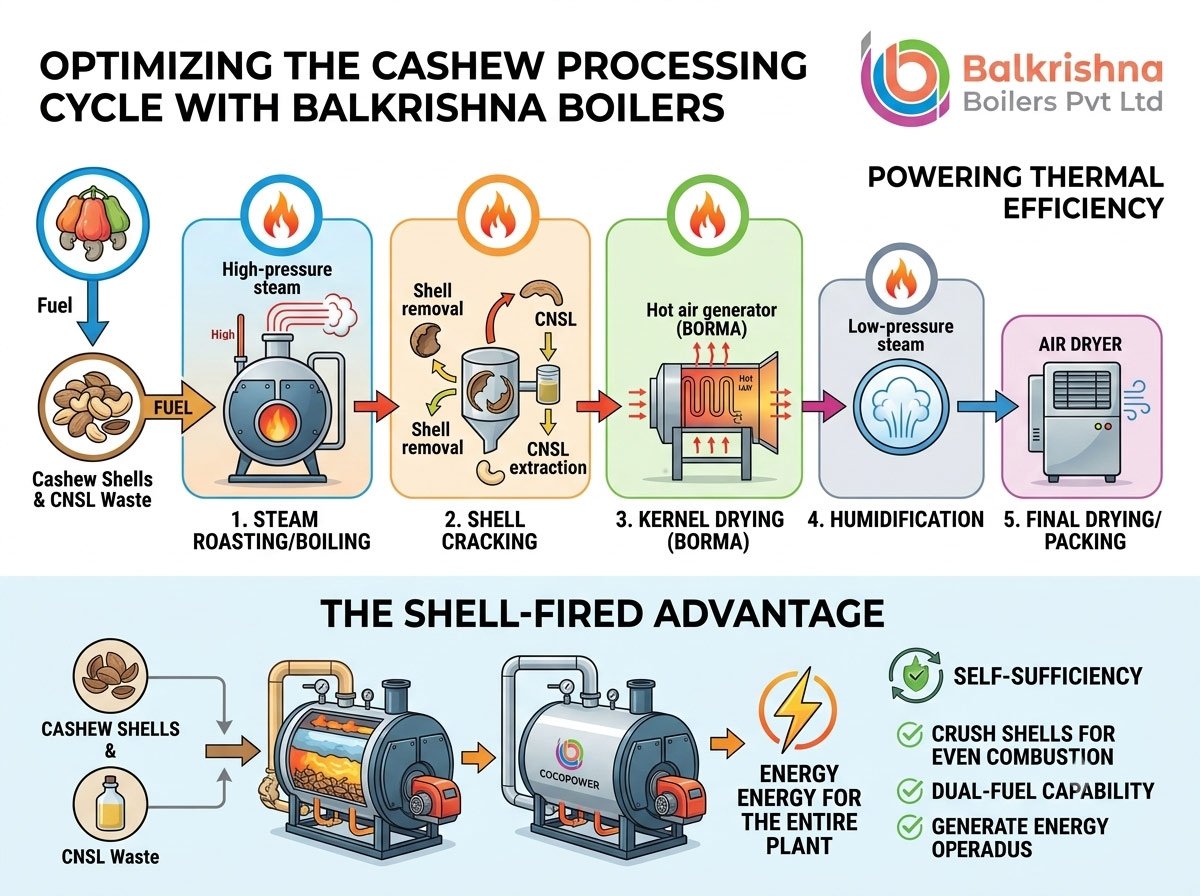
India processes a significant share of the world’s raw cashew — a large portion of it moving through processing belts in Kerala, Karnataka, Tamil Nadu, Goa, Andhra Pradesh, and Odisha, alongside imported raw nuts from West Africa. What most people outside the industry don’t realize is how heat-intensive cashew processing actually is. From the moment a raw cashew nut arrives at the factory gate to the moment a graded, polished kernel is packed for export, it passes through several distinct thermal stages — steam roasting or boiling, shell-cracking preparation, kernel drying, humidification for peeling, and final moisture-reduction before grading. Every one of these stages depends on a boiler or heater delivering the right kind of heat, at the right temperature, without fail.
Unlike many process industries, cashew processing also has an unusual advantage: it produces its own fuel. Cashew shells are a high-calorific-value biomass residue, and Cashew Nut Shell Liquid (CNSL) extracted during processing is itself combustible. A cashew unit that engineers its boiler house correctly can often meet most of its thermal energy needs from its own waste stream — turning what would otherwise be a disposal problem into a genuine cost advantage.
This guide walks through where heat is used across a cashew processing plant, which boiler and heater technologies suit each stage, and how shell-based fuel changes the economics of running one.
Why Cashew Processing Is a Distinct Thermal Challenge
Cashew processing sits somewhere between an agro-industry and a food-processing operation, and its heat requirements reflect that dual nature:
- Pre-treatment heat has to prepare the shell for cracking without damaging the kernel inside — too little heat and shells resist cracking cleanly; too much and kernel quality and yield drop.
- Drying stages are moisture-critical. Kernels have to be dried to a precise moisture band before grading and packing — under-dried kernels spoil in storage, over-dried kernels turn brittle and break during handling, directly hitting yield of whole kernels, which carry the best export price.
- Peeling relies on controlled humidification, using steam to soften the testa (skin) so it separates cleanly from the kernel without breaking it.
- Fuel is often available on-site, in the form of cashew shells and CNSL, which most other food-processing sectors don’t have as a byproduct.
- Roasting/boiling steam must be steady and repeatable across shifts, since batch-to-batch consistency in shell moisture directly affects downstream cracking efficiency.
Where Heat Is Used in a Cashew Processing Plant
1. Pre-Treatment: Steam Roasting, Boiling, or Drum Roasting
Before shelling, raw cashew nuts need their shells conditioned so the outer hard shell separates more easily from the kernel during cracking. Depending on the process route a plant follows — oil-bath roasting, steam roasting, or open-drum roasting — steam demand varies, but the requirement for stable, dry steam is constant across all of them.
Our steam boiler range is built for exactly this kind of continuous, batch-driven demand. For plants running a steady multi-shift roasting line, models like the HUSKPOWER and COMBIPOWER handle high-volume agro-residue combustion well, while smaller units can look at the compact COMCUBE design for space-constrained processing sheds. As explained in our article on how a steam boiler actually works, a stable fuel bed and consistent combustion air control are what keep steam pressure — and therefore roasting consistency — steady across a shift.
2. Shell Cracking and Kernel Extraction
This stage itself isn’t heat-intensive, but it’s where CNSL is released and collected — the oily liquid trapped in the honeycomb structure of the shell. CNSL is a valuable industrial byproduct (used in resins, brake linings, and coatings) and, relevant to a boiler house, it’s also a combustible liquid fuel in its own right. Many cashew units route recovered CNSL, along with the crushed spent shell, straight back into their boiler as fuel.
3. Kernel Drying (Borma Drying)
After shelling, kernels still hold significant moisture and need controlled drying — traditionally done in a “borma” chamber using indirect hot air, since direct flame contact with kernels would scorch them and taint flavor. This is where a dedicated hot air generator earns its place in the plant, delivering a clean, indirect hot-air stream without combustion gases ever touching the product — the same principle we detailed in our piece on thermic fluid heater applications in food processing, where indirect heat transfer protects flavor-sensitive and appearance-sensitive food products from combustion byproducts. Models such as the AIRMAX and AIRFORCE hot air generators, or a thermic fluid battery built around the VTF SERIES or VTM SERIES thermic fluid heater, are common choices for borma drying lines.
4. Peeling and Humidification
Before the kernel’s thin skin (testa) can be peeled off, it needs to be softened through controlled humidification — usually low-pressure, saturated steam introduced into a humidification chamber for a set dwell time. Too much steam and the kernel softens unevenly; too little and the skin tears rather than peels cleanly, both of which reduce the proportion of whole, unbroken kernels that fetch premium grading. A properly sized steam boiler with stable low-pressure output, rather than an oversized unit running throttled, gives more consistent humidification results.
5. Final Drying, Grading, and Packing
Once peeled, kernels go through a final drying pass to bring moisture down to the export-safe range (typically around 5%), followed by grading and vacuum or nitrogen-flush packing. This final drying stage again draws on hot air, and for plants processing for export markets with stringent aflatoxin and moisture-content requirements, a repeatable, well-controlled hot air source matters as much here as it does at the borma stage.
6. Utility Steam and Ancillary Heating
Beyond the core line, cashew units also need steam or hot water for factory sanitation, staff facilities, and — in units that also process CNSL further on-site — for CNSL distillation heating. These loads are smaller but should be factored into total boiler house capacity rather than drawn opportunistically off the main process boiler.
Cashew Shell and CNSL as Boiler Fuel
The single biggest economic lever in a cashew processing boiler house is fuel choice, and cashew shells make an unusually strong case for themselves. Shells have a high calorific value, similar in character to other hard biomass residues like coconut shells, which we’ve engineered furnaces for specifically because of their dense structure and high heat release. Balkrishna Boilers’ COCOPOWER — Nutshell and Coconut Shell Fired Fully Wetback Boiler is purpose-built to handle exactly this category of shell fuel, achieving efficiencies of up to 80% while burning crushed nut and coconut shells — the same fuel characteristics that make cashew shell a strong candidate.
A few practical points for cashew processors evaluating shell-fired boilers:
- Crushed shell feeds more evenly than whole shell, giving steadier combustion and steam pressure — most plants running a shell-fired boiler at scale invest in a simple crushing/sizing step before the fuel reaches the furnace.
- CNSL can supplement or partially replace liquid fuel in units set up for dual-fuel or CNSL-adapted burners, reducing dependence on purchased furnace oil or diesel.
- Furnace design matters. Shell fuels burn hot and release volatiles quickly, so furnace refractory and air distribution need to be engineered for that combustion profile rather than adapted from a generic wood-fired design — this is the core reason a purpose-built shell-fired boiler outperforms a generic solid-fuel unit on both efficiency and furnace longevity.
- A well-designed shell-fired boiler house can make a mid-sized cashew unit largely self-sufficient in fuel, since shell output typically tracks processing volume closely, keeping fuel supply and steam demand roughly in step.
For units that don’t generate enough shell volume to run entirely on their own residue, or that need backup capacity, our agro waste fired steam boiler and wood fired boiler ranges offer flexible multi-fuel options that can supplement shell firing with rice husk, wood, or other locally available biomass.
Choosing the Right Boiler House Configuration
There’s no one-size answer, but a practical starting checklist for a cashew processing plant looks like this:
- Separate roasting/humidification steam load from utility steam, so a peeling-line humidification cycle doesn’t starve the roasting line of pressure, or vice versa.
- Size the hot air generator or thermic fluid system for peak borma and final-drying throughput, not average daily volume — drying is usually the largest single thermal load in the plant.
- Plan fuel handling around shell and CNSL availability, including crushing, storage, and dual-fuel burner capability if CNSL will be used as supplementary fuel.
- Keep standby capacity available. Export-oriented cashew units run tight processing schedules against shipment deadlines, and unplanned boiler downtime during peak season is costly.
- Factor in future capacity. Many processors add a second or third processing line as export volumes grow, and a boiler house sized only for current throughput is commonly revisited within a few seasons.
Why Cashew Processors Choose Balkrishna Boilers
Balkrishna Boilers Pvt Ltd has over 25 years of experience engineering thermal systems for agro-processing and food processing industries that run on locally available biomass fuel — rice mills, sugar mills, and now cashew units among them. Our Steam Boiler, Thermic Fluid Heater, and Hot Air Generator ranges are engineered for multi-fuel flexibility, including shell and agro-residue firing, and every furnace design accounts for the specific combustion characteristics of the fuel it’s built to run on rather than being a generic adaptation.
If your unit is also evaluating cleaner or more automation-friendly options, our Electric Boiler and Hot Water Boiler ranges cover utility and sanitation loads without adding to your solid-fuel handling burden. You can also read more on our blog, including our detailed explainer on what an industrial steam boiler is and how its major parts work, and our guide to biomass steam boilers for rice mills and textiles, which covers many of the same agro-residue fuel-handling principles that apply to a shell-fired cashew boiler house.
Frequently Asked Questions
Can a cashew processing unit run its boiler entirely on cashew shell? Many mid-sized units can meet most or all of their steam and hot-air demand from their own shell residue, provided the boiler furnace is specifically designed for shell-type biomass and the shell is crushed for even feeding. Backup capacity on a secondary fuel is still recommended for peak season.
What boiler is best for the kernel drying (borma) stage? Indirect hot air, delivered through a dedicated hot air generator or a thermic fluid heater paired with an air-heating battery, is preferred over direct-fired drying, since it keeps combustion gases away from the kernel and protects flavor and appearance.
Is CNSL usable as a boiler fuel? Yes, recovered CNSL can be used as a supplementary liquid fuel in dual-fuel-capable burners, reducing dependence on purchased furnace oil, though this requires burner and storage systems suited to CNSL’s specific handling characteristics.
How is steam different for roasting versus peeling/humidification? Roasting typically uses higher-pressure, drier steam for consistent shell conditioning, while peeling humidification uses controlled low-pressure saturated steam for gentle skin softening — sizing and pressure regulation should account for both needs separately rather than sharing a single unregulated line.
Get the Right Boiler for Your Cashew Processing Line
Every cashew processing plant has a different mix of roasting, drying, humidification, and utility steam loads, and getting the fuel strategy and boiler sizing right from the start makes a measurable difference to both processing costs and kernel yield. Talk to Balkrishna Boilers or get in touch with our IndianBoilers.com team to plan the right steam, hot air, or thermic fluid system for your cashew processing unit.