
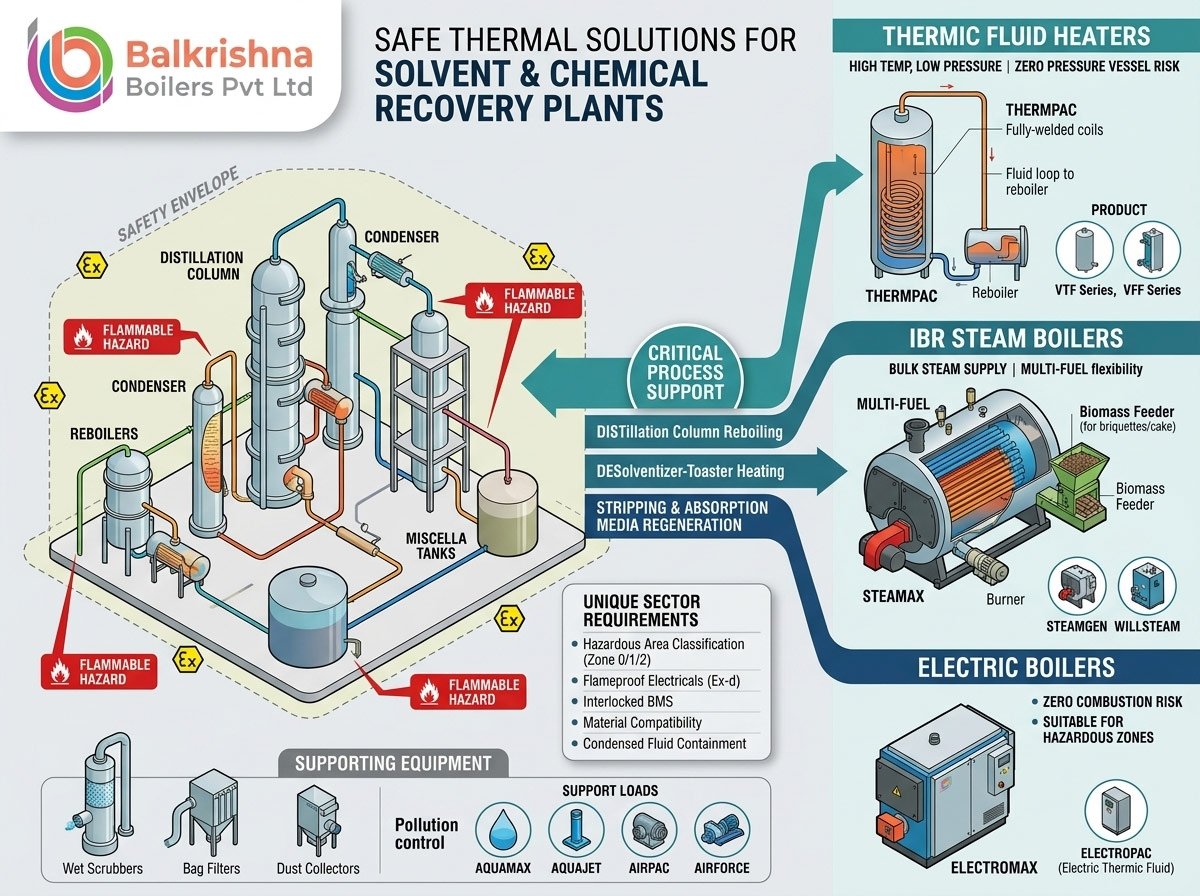
Walk into a solvent extraction plant or a chemical recovery unit and the first thing you notice isn’t the boiler — it’s the silence around it. No open flames near the desolventizer. No sparking switchgear by the miscella tanks. No stray hot surface anywhere near a hexane vapour cloud. In this industry, the boiler house isn’t just a utility room; it’s part of the plant’s safety envelope. Get the heat source wrong, and you’re not looking at a maintenance headache — you’re looking at a flash fire.
Solvent and chemical recovery plants sit in a category of their own. Oilseed solvent extraction units running hexane, pharmaceutical and API plants recovering methylene dichloride (MDC), acetone, or methanol, and specialty chemical recovery systems built around distillation and stripping columns — all of them need one thing from their heat source: absolute, unshakeable reliability, delivered without ever becoming an ignition risk. This guide looks at how these plants actually use heat, which boiler and heater technologies genuinely fit the job, and what to insist on from the manufacturer you choose.
Why Heat Demand in Solvent Recovery Plants Is Different
In a textile mill or a food plant, steam is mostly a bulk utility — you need a lot of it, fairly predictably. In a solvent or chemical recovery plant, heat is a precision tool wrapped in a safety problem.
Desolventizer-toasters (DTs) in an oilseed extraction plant need a steady, controllable heat source to strip residual hexane from de-oiled cake without scorching it. Distillation and stripping columns that separate solvent from miscella (the oil-solvent mixture) need closely held temperatures — too low and recovery efficiency drops, too high and you risk degrading the oil or over-pressuring the column. Solvent recovery systems in pharma and API plants, meanwhile, run batch by batch: a reactor is heated to reflux, the solvent is driven off and condensed for reuse, and the heat source has to ramp up and shut down cleanly, every single cycle, without lag or overshoot.
Layered on top of all this is the ever-present flammability question. Hexane, MDC, acetone, ethanol, and most process solvents form explosive vapour-air mixtures within a fairly narrow concentration band. That single fact drives almost every design decision in the boiler house: fuel selection, burner placement, electrical classification, and even how close the boiler skid can sit to the process building.
If you want the deeper context on how chemical manufacturing generally shapes boiler specification — reactor heating, batch swings, corrosive duty — our detailed guide on boilers for the chemical industry is a useful starting point before we get into solvent-specific detail here.
The Three Ways Heat Is Used in a Solvent Recovery Plant
1. Indirect steam or thermic fluid heating of process vessels. Reboilers, jacketed reactors, and distillation column reboilers are almost always heated indirectly — steam or hot thermic fluid circulates through a jacket, coil, or shell-and-tube exchanger, never in direct contact with the solvent vapour. This is the fundamental safety principle behind solvent recovery heating: the ignition source (the boiler’s combustion chamber) is physically separated from the flammable atmosphere by at least one, often two, containment barriers.
2. Desolventizing and drying. In oilseed extraction, spent cake exiting the extractor still carries 25–35% residual hexane by weight. The DT uses direct and indirect steam to flash this off cleanly, recover the solvent for reuse, and dry the meal to a stable moisture level for storage. Steam quality matters enormously here — wet, low-quality steam reduces desolventizing efficiency and increases solvent loss.
3. Solvent condensation and vapour recovery support. While condensers themselves are cooling-duty equipment, most recovery loops also need a controlled, low-pressure heat source somewhere in the circuit — for reboiling the stripping column, or for regenerating any solvent-laden absorption media — and that’s where a right-sized thermic fluid heater usually earns its place over a full steam system.
Matching Boiler and Heater Technology to Solvent Recovery Duty
Thermic Fluid Heaters: Often the Safer, More Practical Choice
For most solvent recovery and reboiler duty, a thermic fluid heater has a real edge over a conventional steam boiler. Thermic fluid systems operate at high temperatures (up to 300–350°C) but at near-atmospheric pressure, which removes the pressure-vessel risk that comes with high-pressure steam near a flammable process. There’s no steam trap network to leak, no condensate return system that can flash and lose heat, and temperature control at the reboiler is typically tighter — which matters when you’re trying to hold a distillation column at a precise separation temperature without cooking the product.
Our thermic fluid heater range and Balkrishna Boilers’ THERMPAC, VTF Series, and VFF Series thermic fluid heaters are built with the fully-welded, flameproof-rated construction that solvent-adjacent installations demand — flame failure protection, low-flow interlocks, and high-temperature cut-outs as standard, not as an add-on.
If your plant is weighing thermic fluid against steam for the first time, it’s worth reading our guide on the safety protocols specific to thermic fluid heaters in chemical manufacturing — thermal cracking, oxidation of the heat transfer fluid, and expansion tank nitrogen blanketing are all real risks that need proper engineering, not shortcuts.
Steam Boilers: Still the Right Call for Bulk Desolventizing and Stripping
Where a plant needs large, steady volumes of process steam — desolventizer-toasters, stripping columns, or plants that also run parallel utilities like drying and sterilization — a well-engineered IBR steam boiler remains the workhorse. Multi-fuel flexibility (biomass, briquettes, gas, or oil) lets solvent extraction units, many of which generate their own de-oiled cake or husk as fuel, run on low-cost, locally available fuel while still meeting steam demand.
Explore our steam boiler range, and on the Balkrishna Boilers side, models like STEAMAX, STEAMGEN, and WILLSTEAM are commonly specified for exactly this kind of continuous-process, multi-fuel duty.
Electric Boilers: Purpose-Built for Zero-Ignition-Risk Zones
Inside or immediately adjacent to a classified hazardous area — where flammable vapour concentrations can spike even under good ventilation — an electric boiler removes the combustion risk entirely. There’s no flame, no flue gas, no fuel storage tank sitting near your solvent tank farm. For smaller reboiler loads, jacket heating on pilot-scale reactors, or recovery skids inside a pharma plant’s solvent recovery room, electric heating is increasingly the specified choice.
See our electric boiler category, and Balkrishna Boilers’ ELECTROMAX electric IBR steam boiler and ELECTROPAC electric thermic fluid heater, both designed for exactly this kind of high-purity, low-risk-tolerance installation. We’ve covered the broader logic of electric heating for sensitive processing environments in our article on electric boilers for food, pharma, and dairy applications, and the same purity and zero-emission argument applies directly to solvent recovery rooms handling APIs.
Hot Water and Hot Air Systems: Supporting Roles That Still Matter
Not every heat requirement in a chemical recovery plant runs through a reboiler. Cake drying, warehouse and silo air heating, and lower-temperature process water needs are usually better served by a dedicated hot water boiler or hot air generator rather than over-specifying your main steam or thermic fluid system to cover them. Balkrishna Boilers’ AQUAJET and AQUAMAX hot water boilers, and the AIRPAC and AIRFORCE hot air generators, are sized to handle exactly these secondary loads efficiently.
Safety and Compliance Considerations Unique to This Sector
A boiler destined for a solvent extraction or chemical recovery plant has to satisfy more than the standard IBR checklist:
- Hazardous area classification. The boiler house location, burner selection, and electrical fittings must respect the plant’s Zone 0/1/2 classification under the relevant hazardous area standards, with flameproof (Ex-d) or intrinsically safe electricals wherever the boiler skid falls inside or borders a classified zone.
- Physical separation from the solvent process. Boiler rooms handling combustion are almost always sited at a defined safe distance from extractors, miscella tanks, and DTs, with fire-rated walls and dedicated, non-shared ductwork.
- Interlocked burner management systems (BMS). Flame failure detection, purge cycles, and automatic shutdown on abnormal conditions aren’t optional extras here — they’re the baseline.
- Material compatibility. Systems handling MDC, acetone, or other aggressive solvents in adjacent piping need corrosion-resistant materials specified with the same rigor as the boiler pressure parts themselves.
- Condensate and fluid containment. Any leak path between the heating medium and the solvent-side process has to be designed out, not just monitored.
Our broader look at what to check for when specifying a boiler for the chemical industry covers IBR certification, documentation, and manufacturer track record in more depth — all of it applies here, with hazardous-area compliance layered on top.
Where vapour and particulate emissions from associated drying or thermal oxidation steps need control, Balkrishna Boilers’ pollution control equipment range — including wet scrubbers, bag filters, and dust collectors — is engineered to work alongside these thermal systems rather than as an afterthought.
Learning from Adjacent Industries
Solvent extraction and chemical recovery share more with certain other sectors than you might expect. Distilleries running large stripping and rectification columns face very similar heat-transfer and vapour-handling challenges — our guide on boilers for breweries and distilleries covers column reboiling logic that translates directly to solvent stripping. Ayurvedic and herbal extraction units, which also rely on solvent and steam-based extraction from botanical material, face a comparable balance of throughput and purity — see our piece on boilers for Ayurvedic and herbal product manufacturing for that comparison. And for API and bulk drug plants where solvent recovery sits alongside sterile steam requirements, our industry-wise guide covering pharma boiler selection is worth a read.
Choosing the Right Manufacturing Partner
A solvent or chemical recovery plant cannot afford to be a proving ground for an unproven boiler design. When you’re evaluating suppliers, look for:
- Documented experience supplying oilseed solvent extraction plants, API manufacturers, or specialty chemical recovery units — not just general process industry references.
- In-house design capability across steam, thermic fluid, and electric technologies, so the recommendation you get is based on your process, not on what one product line the supplier happens to sell.
- Full IBR approval, hazardous-area documentation, and willingness to work with your process safety and EHS team from the layout stage onward.
- End-to-end support: site layout, fuel or power train design, burner or heater selection, installation, commissioning, and ongoing AMC.
Indian Boilers.com and Balkrishna Boilers Pvt Ltd design and manufacture steam boilers, thermic fluid heaters, electric boilers, and hot water and hot air systems for exactly this class of demanding, safety-critical application. With decades of combined experience across chemical, pharmaceutical, and solvent-handling installations worldwide, our engineering teams work with your process and safety requirements from the first layout drawing through commissioning and long-term AMC support.
Get Expert Help Specifying Your Solvent Recovery Heat System
Every solvent extraction or chemical recovery plant has its own vapour load, throughput, and safety zoning — there’s no off-the-shelf answer. If you’re specifying, upgrading, or replacing thermal equipment for a solvent recovery or chemical processing line, talk to our engineering team or browse our full industries page to see how we’ve solved this for plants like yours.