
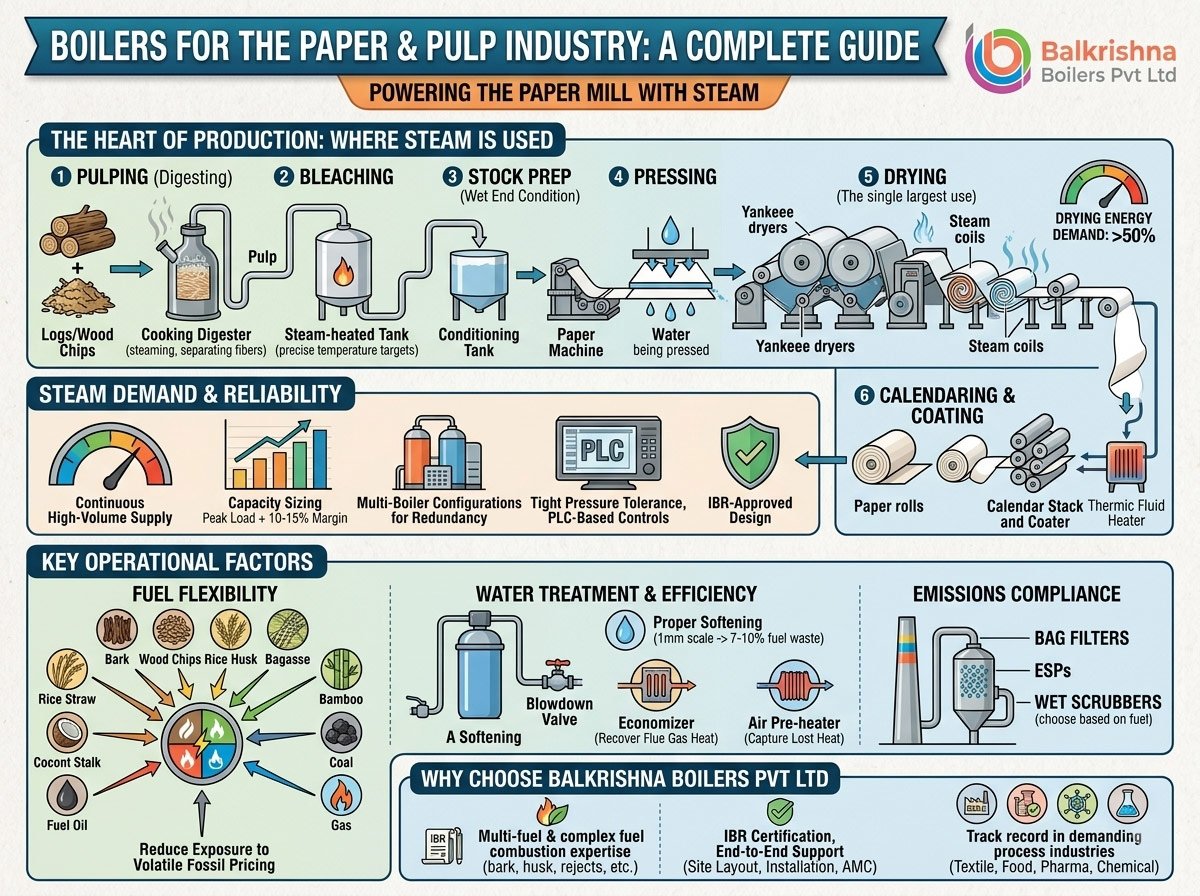
Paper doesn’t get made without steam. From the moment wood chips or waste paper enter a pulp mill to the moment a finished reel comes off the paper machine, heat is doing the heavy lifting — cooking raw fibre into pulp, driving chemical reactions in the bleach plant, pressing water out of the wet sheet, and finally drying it to a stable moisture content before it’s wound and cut. Behind all of that heat sits one machine that rarely gets the credit it deserves: the industrial boiler.
For paper and pulp manufacturers, the boiler isn’t a background utility — it’s a core production asset. A mismatched or unreliable steam system shows up immediately as poor sheet quality, unplanned downtime, and runaway fuel costs. In this guide, we’ll walk through how steam is actually used across a paper mill, which boiler types suit which stage of the process, why fuel flexibility matters so much in this industry, and what to look for when you’re specifying a new boiler for a pulp or paper operation.
Why the Paper and Pulp Industry Runs on Steam
A paper mill is really a sequence of water-removal and heat-treatment steps stacked on top of each other:
- Pulping: Wood chips, waste paper, or agricultural fibre (bagasse, straw, bamboo) are cooked or mechanically refined into pulp. Chemical pulping (Kraft or sulphite processes) needs sustained, controlled steam to break down lignin and separate fibres.
- Bleaching: Pulp destined for white paper passes through several bleaching stages, many of which require steam-heated process water to hit precise temperature and reaction-time targets.
- Stock preparation and the wet end: Steam-heated water is used to condition stock before it reaches the paper machine.
- Pressing: Mechanical presses remove as much water as possible before drying, but the sheet still carries a large amount of moisture into the next stage.
- Drying: This is the single largest steam consumer in the entire mill. The wet sheet passes over a long train of steam-heated drying cylinders (Yankee dryers or multi-cylinder dryer sections) that evaporate the remaining moisture to bring the sheet down to its final 4–8% target.
- Calendaring and coating: For coated or glossy grades, additional heat is needed to set coatings and achieve the right surface finish — an application where a thermic fluid heater is often a better fit than direct steam.
Because these stages run continuously, a paper mill’s boiler house typically needs to deliver steam almost around the clock, at a stable pressure, with minimal fluctuation — a very different duty profile from a factory that only needs steam in short bursts.
Steam Demand: Why Paper Mills Need Serious Capacity
Drying alone can account for well over half of a paper machine’s total energy use. Multi-cylinder dryer sections in particular need a continuous, high-volume supply of saturated steam at a consistent pressure — even brief pressure drops translate directly into wet spots, sheet breaks, or reduced machine speed.
This is why paper and pulp mills are rarely served by a single small boiler. Most operations run on medium-to-large capacity steam boilers, often in a multi-boiler configuration so one unit can be taken offline for maintenance without stopping the paper machine. When you’re specifying capacity, the standard approach is to add up the steam demand of pulping, bleaching, and drying at peak load, then build in a safety margin of roughly 10–15% for future expansion, line losses, and seasonal variation in raw material moisture content.
Choosing the Right Boiler Type for a Paper Mill
There’s no single “correct” boiler for paper and pulp — the right choice depends on your process, your fuel availability, and whether you’re running a large integrated pulp-and-paper unit or a smaller paper-from-waste-paper operation. Here are the boiler types most commonly specified for this industry:
Biomass and Agro-Waste Fired Boilers
Paper mills sit on top of one of the most convenient fuel sources in the industry: their own waste. Bark, wood chips, rejects from the pulping process, and rice husk or bagasse (for mills using agricultural fibre) can all be burned as boiler fuel, cutting purchased-fuel costs dramatically. A biomass fired steam boiler or an agro-waste fired steam boiler lets a mill turn what would otherwise be disposal cost into usable energy. For mills processing rice-straw or bamboo-based fibre, a rice husk fired steam boiler or a chain-grate design built for wood chip fuel is a natural fit.
Fluidized Bed Combustion (FBC) Boilers
Where fuel quality is inconsistent — a mix of bark, sludge cake, rejects, and purchased biomass — an FBC steam boiler handles the variability far better than a simple grate boiler. Fluidized bed combustion burns fuel more completely and at a lower, more uniform temperature, which also helps control emissions — an increasingly important factor as pollution norms for the pulp and paper sector tighten.
Coal, FO, and Gas Fired Options
Larger integrated mills, or mills without steady access to biomass, often still specify oil, gas, or coal-fired units for reliability and simpler fuel logistics. An oil/gas fired steam boiler offers fast response and cleaner combustion, which is useful where a mill also has strict local air-quality requirements.
Thermic Fluid Heaters for Coating and Calendaring
Not every heat requirement in a paper mill needs live steam. Coating lines, calendar stacks, and some drying-cylinder pre-heat circuits run more efficiently on hot thermic fluid, which can be circulated at high temperature without the pressure risks of steam. A thermic fluid heater is worth evaluating anywhere your process needs precise, indirect heat rather than direct steam contact.
Hot Air Generators for Auxiliary Drying
Some mills also use hot air generators for auxiliary drying duties — pre-drying reject material, drying additives, or supporting packaging lines — where direct hot air is more practical than routing steam.
Fuel Flexibility: The Paper Industry’s Biggest Advantage
Few industries are better positioned to run on waste-derived fuel than pulp and paper. Bark, chips, sludge, and rejects are generated continuously as a by-product of the core process, and a boiler designed for multi-fuel firing can absorb a changing fuel mix without a drop in output. This is exactly the same fuel-flexibility logic that shows up in other agro-processing sectors — our guide on hot air generator fuel options: biomass, coal, and gas compared breaks down the cost and handling trade-offs between these fuels in more detail, and much of that comparison applies directly to paper mill boiler houses too.
Mills that don’t generate enough of their own waste fuel often still choose a coconut shell, cotton stalk, or general agro-residue boiler to take advantage of whatever biomass is cheapest and most available in their region — a strategy that lowers landed fuel cost and reduces exposure to volatile fossil fuel pricing.
Water Treatment and Efficiency: Non-Negotiable for Paper Mills
Paper machines are unusually sensitive to steam quality. Scale build-up inside a boiler doesn’t just waste fuel — even 1mm of scale can raise fuel consumption by 7–10% — it also risks carrying impurities into the steam that reaches the dryer cans, affecting sheet quality and cylinder life. A proper water softening and treatment system, along with a disciplined blowdown routine, is one of the highest-return investments a mill can make in its boiler house.
On the efficiency side, an economizer that recovers waste heat from flue gas to pre-heat boiler feedwater is close to a standard fitment on any modern paper-mill boiler, given how much continuous fuel these systems consume. An air pre-heater delivers a similar benefit by capturing heat that would otherwise be lost up the stack.
Emissions and Compliance
Because paper mills burn large volumes of solid fuel continuously, particulate and flue-gas emissions are closely regulated. Pairing your boiler with the right pollution control equipment — bag filters, ESPs, or wet scrubbers, depending on fuel type and local norms — is now treated as part of the boiler specification, not an afterthought. This is particularly true for FBC and grate boilers running on bark, husk, or coal blends, where particulate loading is higher than with cleaner fuels like gas.
Capacity Sizing and Automation
Paper machines run continuously, so unplanned steam interruptions are expensive — a sheet break or a wet-end quality dip can cost far more than the value of the steam itself. For this reason, most paper mills specify:
- Multiple boilers rather than one large unit, so maintenance or a fuel-supply hiccup on one unit doesn’t stop the machine.
- PLC-based automation for combustion control, feedwater regulation, and safety interlocks, since manual operation struggles to hold the tight pressure tolerances a paper machine needs.
- IBR-approved design for any unit operating above the regulatory threshold, ensuring the boiler is certified for continuous industrial duty.
Why Manufacturing Matters: Choosing a Boiler Partner for Paper and Pulp
A boiler built for a textile dye house or a food plant isn’t automatically right for a paper mill’s duty cycle — continuous, high-capacity, and often running on variable-quality biomass fuel. When you’re evaluating suppliers, look for:
- Proven experience sizing boilers for continuous, high-load industrial processes, not just intermittent-demand plants.
- Multi-fuel and mixed-fuel combustion expertise, given how often paper mills fire a blend of bark, rejects, husk, and purchased biomass.
- IBR certification and end-to-end support — from site layout and chimney design through installation, commissioning, and after-sales AMC support.
- A track record across process industries with similarly demanding steam quality needs, such as textile manufacturing, food processing, and pharmaceutical manufacturing, all of which demand tight control over steam purity and pressure.
Indian Boilers.com and Balkrishna Boilers Pvt Ltd design and manufacture steam boilers, thermic fluid heaters, hot water boilers, and hot air generators engineered for continuous-duty, multi-fuel industrial processes like pulp and paper. With decades of installation experience across pulp, paper, textile, chemical, and food-processing plants, our engineering team can help you size a system around your actual fibre line, fuel availability, and steam-quality requirements — not a generic capacity chart.
Frequently Asked Questions
Which boiler type is best for a paper mill? It depends on your fuel base and load profile. Mills with steady access to bark, husk, or wood waste generally do best with a biomass or FBC boiler; mills needing tighter combustion control or running on purchased fuel often prefer oil/gas-fired units. Many larger mills run a mixed fleet to balance cost and reliability.
Why do paper mills need such large steam capacity? Drying is the single biggest steam consumer in papermaking — the multi-cylinder dryer section needs a continuous, stable supply at consistent pressure to evaporate moisture without slowing the machine or affecting sheet quality.
Can a paper mill run its boiler on its own waste? Yes. Bark, chips, sludge, and process rejects are common boiler fuels in the paper industry, and a multi-fuel biomass boiler can often absorb this waste stream directly, cutting purchased-fuel costs significantly.
How important is water treatment for a paper mill boiler? Extremely. Because paper machines are sensitive to steam purity, scale and impurities don’t just waste fuel — they can affect sheet quality and shorten dryer-cylinder life. A proper softening and blowdown routine is essential.
Do paper mills need a thermic fluid heater as well as a steam boiler? Many do. Coating, calendaring, and some auxiliary drying steps are better served by indirect thermic fluid heating than by live steam, so a combination of a steam boiler and a thermic fluid heater is common in coated-paper operations.
What emissions control equipment is typically paired with a paper mill boiler? Bag filters, electrostatic precipitators (ESPs), or wet scrubbers, chosen based on fuel type and local emission norms — particularly important for boilers running on bark, husk, or coal blends.
Looking to specify or upgrade a boiler for your paper or pulp operation? Get in touch with our engineering team for a capacity assessment and fuel-based recommendation.