
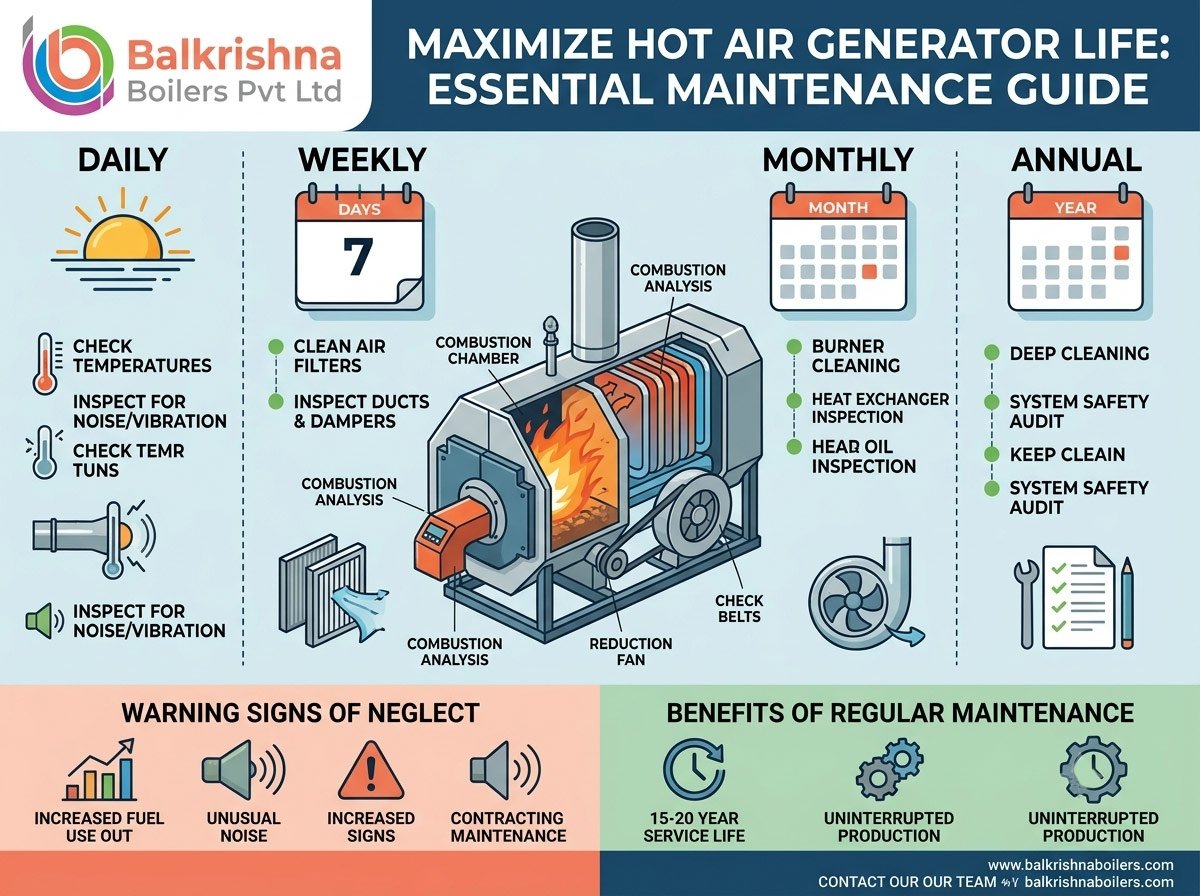
A well-engineered hot air generator, properly maintained, can reliably serve a plant for 15-20 years or more. The same unit, neglected or poorly maintained, can develop efficiency losses, unplanned downtime, and premature component failure within just a few years. The difference almost never comes down to the equipment itself — it comes down to whether a consistent maintenance routine was actually followed.
This guide lays out a complete, practical maintenance checklist for industrial hot air generators — covering daily, weekly, monthly, and annual tasks — so plant engineers and maintenance teams have a clear reference for keeping their system running efficiently for its full intended service life.
1. Why Maintenance Discipline Matters So Much for Hot Air Systems
Hot air generators combine combustion equipment, heat exchangers (for indirect-fired designs), fans and blowers, ducting, and control systems — each with its own wear patterns and maintenance needs. Neglecting any one of these doesn’t just risk that component’s failure; it often accelerates wear elsewhere in the system:
- Dirty burners cause incomplete combustion, increasing soot deposits on heat exchanger surfaces.
- Fouled heat exchangers force the burner to work harder to maintain setpoint, increasing thermal stress.
- Clogged filters restrict airflow, increasing fan load and reducing overall system efficiency.
- Worn fan bearings left unaddressed can fail catastrophically, causing unplanned downtime during peak production.
A consistent maintenance routine breaks this chain before small issues compound into major ones.
2. Daily Maintenance Checks
These quick checks take just minutes but catch developing problems early:
- Visual Inspection: Check for unusual noise, vibration, or visible smoke/soot from the flue (for combustion-fired units).
- Temperature Monitoring: Confirm outlet air temperature is within the normal operating range for current production conditions.
- Pressure Gauges: Check air pressure and, for indirect-fired systems, flue gas draft readings against normal baseline values.
- Fuel Supply Check: For solid fuel systems, confirm adequate fuel supply and proper feeding; for gas systems, check supply pressure is stable.
3. Weekly Maintenance Tasks
- Filter Inspection and Cleaning: Check intake air filters for dust and debris buildup — a restricted filter reduces airflow and forces the system to work harder to maintain target temperature.
- Duct and Damper Inspection: Visually inspect accessible ducting and dampers for leaks, damage, or blockage, particularly in high-lint or high-dust environments like textile or food processing plants.
- Ash Removal (Solid Fuel Systems): Remove accumulated ash from the combustion chamber and ash pit to maintain proper airflow and combustion efficiency.
- Belt and Coupling Checks: Inspect fan belts and couplings for wear, correct tension, and proper alignment.
4. Monthly Maintenance Tasks
A. Burner Inspection and Cleaning
For combustion-fired systems, monthly burner inspection catches nozzle wear, ignition electrode fouling, and flame pattern irregularities before they affect combustion efficiency or safety. A poorly maintained burner is one of the most common root causes of declining system efficiency over time.
B. Heat Exchanger Inspection (Indirect-Fired Systems)
Inspect the heat exchanger surface for soot buildup on the flue-gas side and scale or fouling on the air side. Fouling acts as an insulating layer, directly reducing the heat transfer efficiency explained in our guide on direct vs indirect fired hot air generators explained — a heat exchanger left uncleaned can lose a meaningful percentage of its rated efficiency within months in demanding applications.
C. Fan and Blower Servicing
Lubricate fan bearings per manufacturer specification, check for unusual vibration (often an early sign of bearing wear or fan imbalance), and confirm motor amperage draw is within normal range.
D. Control System Verification
Test temperature controllers, high-limit safety cutoffs, and any interlocked safety devices to confirm they respond correctly — don’t wait for an actual fault condition to discover a safety device has failed.
5. Quarterly Maintenance Tasks
- Combustion Analysis: For fuel-fired systems, a proper combustion analysis (checking excess air ratio, CO levels, and stack temperature) identifies drifting combustion efficiency before it becomes a significant fuel cost increase.
- Duct Leak Testing: More thorough inspection of the full ducting network for air leaks, which waste heated air and reduce delivered capacity at the point of use.
- Insulation Check: Inspect chamber and ducting insulation for damage or degradation — compromised insulation increases both energy loss and surface temperatures that could pose a safety risk.
- Electrical Connections: Check and tighten electrical connections in the control panel, as vibration over time can loosen terminals and create resistance-heating risks.
6. Annual Maintenance Tasks
A. Complete Combustion Chamber and Refractory Inspection
For solid fuel and larger combustion-fired systems, annual inspection of refractory lining catches cracking or erosion before it compromises combustion chamber integrity. With proper maintenance, quality refractory lining typically lasts 3-5 years before needing repair.
B. Full Heat Exchanger Cleaning
A thorough, deep cleaning of the heat exchanger — beyond routine monthly inspection — restores heat transfer efficiency to near-original levels, an especially valuable investment for continuous, high-utilization systems in food, textile, or tea processing applications.
C. Fan and Motor Overhaul Check
Annual bearing replacement (or inspection against manufacturer wear limits), motor insulation testing, and full alignment verification extend fan and motor life significantly beyond what reactive maintenance alone achieves.
D. Full System Safety Audit
A comprehensive test of every safety interlock, alarm, and cutoff device — flame failure detection, high-temperature limits, low-airflow interlocks — confirms the complete safety system functions correctly under simulated fault conditions, not just under normal operation.
7. Fuel-Specific Maintenance Considerations
A. Biomass and Solid Fuel Systems
- Regular ash removal and disposal planning to avoid ash buildup restricting airflow.
- Fuel quality monitoring — inconsistent moisture content in biomass fuel affects combustion stability and increases maintenance burden on the burner and combustion chamber.
- More frequent refractory and combustion chamber inspection than gas-fired systems, due to higher particulate and thermal cycling stress.
B. Gas-Fired Systems
- Regular gas train inspection, including pressure regulators, solenoid valves, and safety shut-off valves.
- Burner nozzle cleaning to maintain proper flame pattern and combustion efficiency.
- Leak detection checks at all gas connections and fittings on a routine schedule.
C. Electric Hot Air Generators
Our electric hot air generator (ELECTROAIR) range significantly simplifies maintenance compared to combustion-fired systems — no burner, no combustion chamber, no flue gas path to maintain. Maintenance instead focuses on heating element condition, electrical connection integrity, and control system calibration, generally resulting in lower overall maintenance labor and cost.
8. Application-Specific Maintenance Priorities
Different industries place different stresses on hot air generator systems, and maintenance routines should reflect this:
- Textile Applications: Lint and fiber accumulation in ducting and filters is a significant fire risk requiring more frequent cleaning than in other industries — see our guide on hot air generators for textile stenter machines for application-specific considerations.
- Food Processing Applications: Hygiene-focused cleaning schedules, in addition to standard mechanical maintenance, are essential to prevent contamination risk — covered further in how hot air generators improve drying efficiency in food plants.
- Tea and Agro-Processing Applications: Biomass fuel quality variability and higher ash volumes from agricultural waste fuel sources demand more frequent ash handling and combustion chamber attention, as discussed in hot air generators for the tea processing industry.
9. Warning Signs That Maintenance Has Been Neglected
Watch for these indicators that a system needs more attention than it’s been receiving:
- Rising fuel consumption for the same production output over time.
- Increasing temperature variation across the drying chamber or process zone.
- Longer heat-up times to reach operating temperature compared to historical performance.
- Unusual noise or vibration from fans, blowers, or the combustion chamber.
- Visible soot or smoke from combustion-fired systems during normal operation.
- Frequent nuisance trips of safety interlocks, which often indicate an underlying issue rather than a faulty sensor.
Catching any of these early and addressing the root cause — rather than resetting an alarm and moving on — is what separates a system that reaches its full 15-20 year service life from one that requires premature, costly component replacement.
10. Building a Maintenance Schedule That Actually Gets Followed
The best maintenance checklist is worthless if it isn’t consistently executed. A few practical steps help ensure maintenance discipline sticks:
- Assign Clear Ownership: Designate specific personnel responsible for each maintenance interval, rather than leaving it as a shared, easily-deprioritized responsibility.
- Maintain a Logbook: Recording readings, observations, and completed tasks over time makes it far easier to spot gradual performance drift that might otherwise go unnoticed month to month.
- Stock Critical Spares: Keep commonly needed spares (filters, burner nozzles, fan belts) on hand to avoid extended downtime waiting for parts during routine servicing.
- Schedule Around Production Downtime: Where possible, align more involved quarterly and annual maintenance with planned production shutdowns to minimize disruption.
11. Partner With Experts for Long-Term Reliability
A hot air generator is a long-term capital investment, and the maintenance discipline applied over its service life determines whether it delivers reliable performance for 15-20 years or requires costly premature replacement. At Indian Boilers.com, we support every system we supply with maintenance guidance, spare parts availability, and technical support tailored to your specific application and fuel type.
Our parent company, Balkrishna Boilers Pvt Ltd, brings over 25 years of experience and more than 5,000 installations worldwide, with maintenance and service support built around the same engineering standards that go into every unit we manufacture.
- Explore Our Hot Air Generator Range: indianboilers.com/product-category/hot-air-generator
- View the Full Balkrishna Boilers Range: balkrishn.com
- Schedule a Maintenance Consultation: Contact our technical team to set up a maintenance schedule tailored to your system and application.