
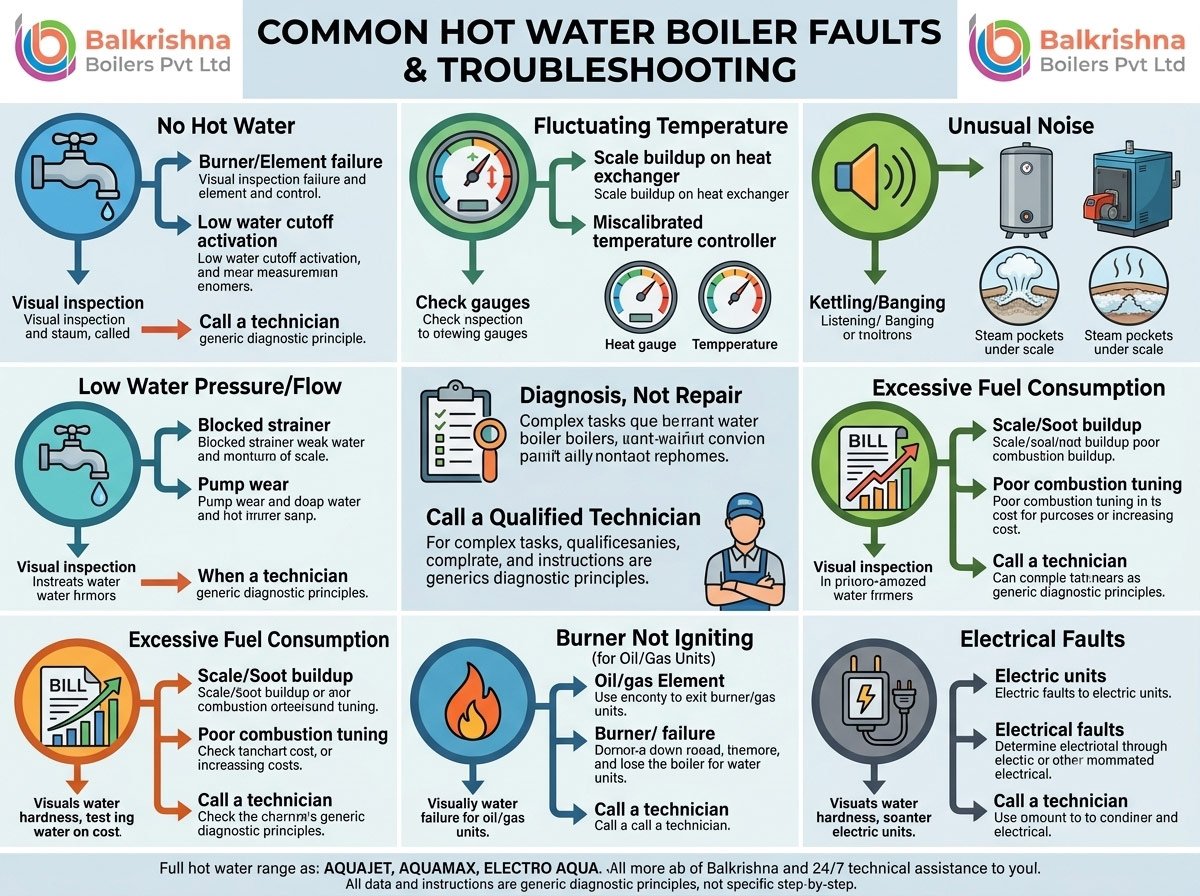
Most hot water boiler failures don’t happen without warning. They announce themselves first — a slightly lower outlet temperature than usual, a faint knocking sound from the heat exchanger, a burner that takes an extra few seconds to fire. Facility teams who know what these early signals mean can usually fix the underlying issue in an afternoon. Teams who don’t often end up with a full shutdown and an emergency service call instead.
At Balkrishna Boilers Pvt Ltd, our service team fields the same handful of fault categories across nearly every hot water boiler installation — hospitality, healthcare, textiles, and general commercial buildings alike. This guide walks through the most common faults, what typically causes each one, what a facility team can safely check themselves, and when to stop troubleshooting and call a technician.
Before You Start: What You Should Never Attempt Yourself
A few ground rules first. Hot water boilers, even non-pressurized ones, involve combustion (on fuel-fired units), electrical current (on all units), and hot water under some degree of pressure. Facility staff should feel confident checking gauges, listening for unusual sounds, and performing the basic visual inspections covered in our Hot Water Boiler Maintenance Checklist for Facility Managers — but internal component repair, burner recalibration, and any work involving the pressure vessel itself should go to a qualified technician. This guide is about diagnosis, not repair.
Fault 1: No Hot Water at All
This is the most urgent fault and usually has one of a small number of causes.
Likely causes:
- Burner or heating element failure — on oil/gas units, check whether the burner is firing at all; on electric units, a tripped over-current protection device often means an element has failed.
- Low water cut-off has activated — this is a safety device doing exactly what it’s designed to do. If water level dropped below the safe threshold, the system shuts down the burner or heating element automatically to prevent dry-firing. Don’t override this — find out why the water level dropped instead.
- Circulating pump failure — if the boiler itself is heating but no hot water is reaching the point of use, the pump that circulates water through the closed loop may have failed or lost power.
- Power or fuel supply interruption — check the obvious first: has the gas or fuel supply been interrupted, or has a breaker tripped upstream of the boiler’s own controls?
What to check yourself: Confirm power is reaching the control panel, confirm fuel supply (for combustion units) is live, and check whether any safety device has visibly tripped. If the low water cut-off has activated, don’t just top up the water and restart — investigate why the level dropped in the first place, since a leak or feed valve fault will simply repeat the shutdown.
Fault 2: Fluctuating or Inconsistent Temperature
Likely causes:
- Scale buildup on the heat exchanger — this is by far the most common cause. Scale insulates the heat transfer surface, so the boiler works harder to reach the same output temperature, and that output becomes less stable as scale accumulates unevenly.
- Failing or miscalibrated temperature controller — the digital temperature controller or PLC system that modulates the burner or heating element may need recalibration.
- Circulating pump running below capacity — a partially failing pump, or one with a clogged strainer, reduces flow and disrupts the temperature delivered at the point of use even when the boiler itself is heating correctly.
- Undersized system for current demand — if your facility’s hot water demand has grown since installation, fluctuation under peak load may simply be a sizing issue rather than a fault. Our guide on How to Size a Hot Water Boiler for Commercial Use covers how to check whether your system’s capacity still matches your actual peak demand.
What to check yourself: Test your water hardness — if it’s higher than expected, scale is the likely culprit and a descale is overdue. Check that the circulating pump sounds and runs normally. If fluctuation only happens during known peak periods (morning showers, laundry batch start), it’s more likely a sizing question than a fault.
Fault 3: Unusual Noise — Kettling, Banging, or Knocking
Likely causes:
- Scale on the heat exchanger — as scale builds unevenly, water trapped beneath it can flash to steam pockets that collapse violently, producing a knocking or “kettling” sound. This is one of the clearest early warning signs of scale before it causes a more serious failure.
- Air trapped in the system — air pockets in the closed loop can cause banging noises as water circulates around them, particularly after a fill or a service.
- Pump cavitation — if the circulating pump isn’t getting enough water flow, it can cavitate, producing a rattling or grinding noise.
What to check yourself: Kettling noise is a strong signal to schedule a descale service soon, not to ignore. If the noise started shortly after a refill or maintenance visit, trapped air is the more likely cause, and most systems have an air vent or bleed point that a facility technician can safely use.
Fault 4: Low Water Pressure or Flow at the Point of Use
Likely causes:
- Partially blocked strainer or filter on the circulation line, particularly common in areas with harder water or where a softener isn’t functioning correctly.
- Pump wear — seals and impellers degrade over time, gradually reducing flow even before a pump fails outright.
- A partially closed valve somewhere in the distribution loop, especially after any recent maintenance work elsewhere in the building.
What to check yourself: Confirm all valves in the relevant section of the loop are fully open, and check whether the reduction in flow is isolated to one area (pointing to a local blockage) or system-wide (pointing to the pump or the boiler itself).
Fault 5: Excessive Fuel Consumption for the Same Output
This one doesn’t show up as an obvious “fault” in the moment — it shows up gradually on your fuel bill, which is exactly why it’s often caught late.
Likely causes:
- Scale buildup, again — just 1mm of limescale can increase fuel consumption by 7–10%, purely from the extra energy needed to push heat through an insulated surface.
- Poor combustion tuning on oil/gas units — an incorrectly adjusted air-fuel ratio wastes fuel even when the boiler is otherwise running normally, which is why a proper burner service checks combustion efficiency, not just cleanliness.
- Soot buildup on fire-tube heat transfer surfaces, reducing heat transfer efficiency similarly to scale, but on the flue gas side rather than the water side.
- Poor pipe insulation, losing heat in distribution before it reaches the point of use, which means the boiler has to work harder to deliver the same usable temperature.
What to check yourself: Compare your current fuel consumption against historical data for a similar demand period — a steady upward trend, even a small one, is worth investigating before it becomes a large one. Our Boiler Efficiency vs. Fuel Cost: What Matters More? post breaks down how even small efficiency losses compound into significant annual cost on larger systems.
Fault 6: Burner Won’t Ignite or Keeps Cutting Out (Oil/Gas Units)
Likely causes:
- Flame safeguard system tripping — this safety device shuts off fuel if no flame is detected, preventing dangerous fuel accumulation. Repeated trips usually point to an ignition or fuel supply issue, not a fault in the safety device itself.
- Clogged nozzle or fuel filter, a routine wear item covered under standard monthly burner servicing.
- Fuel supply issues — air in the line, low tank level, or, for gas units, supply pressure problems upstream of the boiler.
What to check yourself: Confirm fuel supply and levels first — this is the most common and simplest cause. Beyond that, ignition system issues should go to a technician, since they involve components that shouldn’t be adjusted without proper training.
Fault 7: Electrical Faults (Electric Units)
Likely causes:
- Element failure from scale buildup — since electric heating elements sit in direct contact with water, scale accumulation is the leading cause of element overheating and eventual failure.
- Loose or corroded electrical terminals, which is exactly why monthly terminal checks are part of standard maintenance on our electric hot water boiler range.
- Over-current protection tripping repeatedly, usually indicating a partially failed element rather than a nuisance trip.
What to check yourself: Confirm the trip isn’t a one-off (check if it resets and holds normally) — if it trips again shortly after reset, that points to an actual element or wiring fault requiring a technician, not a transient issue.
A Quick Diagnostic Table
| Symptom | Most Likely Cause | Urgency |
|---|---|---|
| No hot water at all | Burner/element failure, low water cut-off tripped, pump failure | Immediate |
| Fluctuating temperature | Scale, controller fault, undersized system | Moderate — schedule soon |
| Kettling/knocking noise | Scale, trapped air | Moderate — schedule a descale |
| Reduced flow/pressure | Blocked strainer, pump wear, closed valve | Moderate |
| Rising fuel consumption | Scale, soot, poor combustion tuning, insulation loss | Low urgency but compounds — investigate promptly |
| Burner won’t ignite | Fuel supply, flame safeguard trip, clogged nozzle | Immediate |
| Repeated electrical trips | Element failure, scale, loose terminals | Immediate |
Prevention Beats Troubleshooting
Nearly every fault on this list traces back to one of two root causes: scale from untreated water, or skipped routine maintenance. Both are entirely preventable. A functioning water softener addresses the first; a documented daily/weekly/monthly/annual routine addresses the second — both covered in full in our Hot Water Boiler Maintenance Checklist for Facility Managers.
For facilities where an outage has real operational consequences — hotels, hospitals, continuous-process industrial sites — pairing preventive maintenance with system redundancy matters just as much as fixing faults quickly. We’ve covered this specifically for healthcare in Hot Water Boilers in Hospitals: Why Reliability Matters Most, where a single point of failure isn’t just inconvenient, it’s operationally serious.
When to Call a Technician
As a general rule, call a technician rather than continuing to troubleshoot when:
- A safety device (low water cut-off, flame safeguard, over-current protection) trips more than once
- You smell fuel, see visible flame irregularities, or notice smoke that wasn’t there before
- Any internal component — burner, element, controller — needs adjustment rather than just cleaning
- The fault involves the pressure vessel itself, welds, or the shell rather than external components
How Balkrishna Boilers Supports Facilities When Faults Happen
Across 5,000+ installations in India and 30+ countries, we back every system — the oil/gas fired AQUAJET, biomass-fired AQUAMAX and VTFH SERIES, and electric ELECTRO AQUA — with 24/7 technical assistance, Annual Maintenance Contracts, and a ready stock of genuine spare parts, so a fault doesn’t turn into extended downtime.
You can review the full hot water range on indianboilers.com or balkrishn.com’s Hot Water Boiler page, and reach our service team through Contact Us for urgent faults or to set up a preventive maintenance contract.
Frequently Asked Questions
What’s the most common cause of hot water boiler faults overall? Scale buildup from untreated or hard water, by a wide margin. It’s behind fluctuating temperature, kettling noise, rising fuel consumption, and eventual element or tube failure — nearly every fault category on this list.
Is it safe to reset a tripped low water cut-off myself? The device itself is safe to reset if water has been properly restored, but you should always investigate why the level dropped first — resetting without finding the cause usually means the same trip happens again, and repeated dry-firing risk is exactly what this safety device exists to prevent.
How do I know if a noise is serious or normal? Occasional soft sounds during startup are usually normal. A repeated knocking, banging, or kettling sound — especially one that’s gotten louder or more frequent over time — is a clear signal to schedule a descale or inspection rather than wait.
Can I troubleshoot an electric hot water boiler myself? Basic checks — confirming power, checking whether a trip resets and holds — are safe for facility staff. Anything involving the heating elements themselves or internal wiring should go to a qualified technician.
How often should faults like these actually occur if maintenance is done properly? Very rarely. Facilities following a consistent maintenance schedule and proper water treatment typically go years between anything beyond routine servicing — most of the faults covered here are the direct result of a skipped maintenance interval or a softener that stopped working correctly.
Facing a fault right now, or want to put a preventive maintenance plan in place before one happens? Contact our service team for urgent support or an Annual Maintenance Contract.