
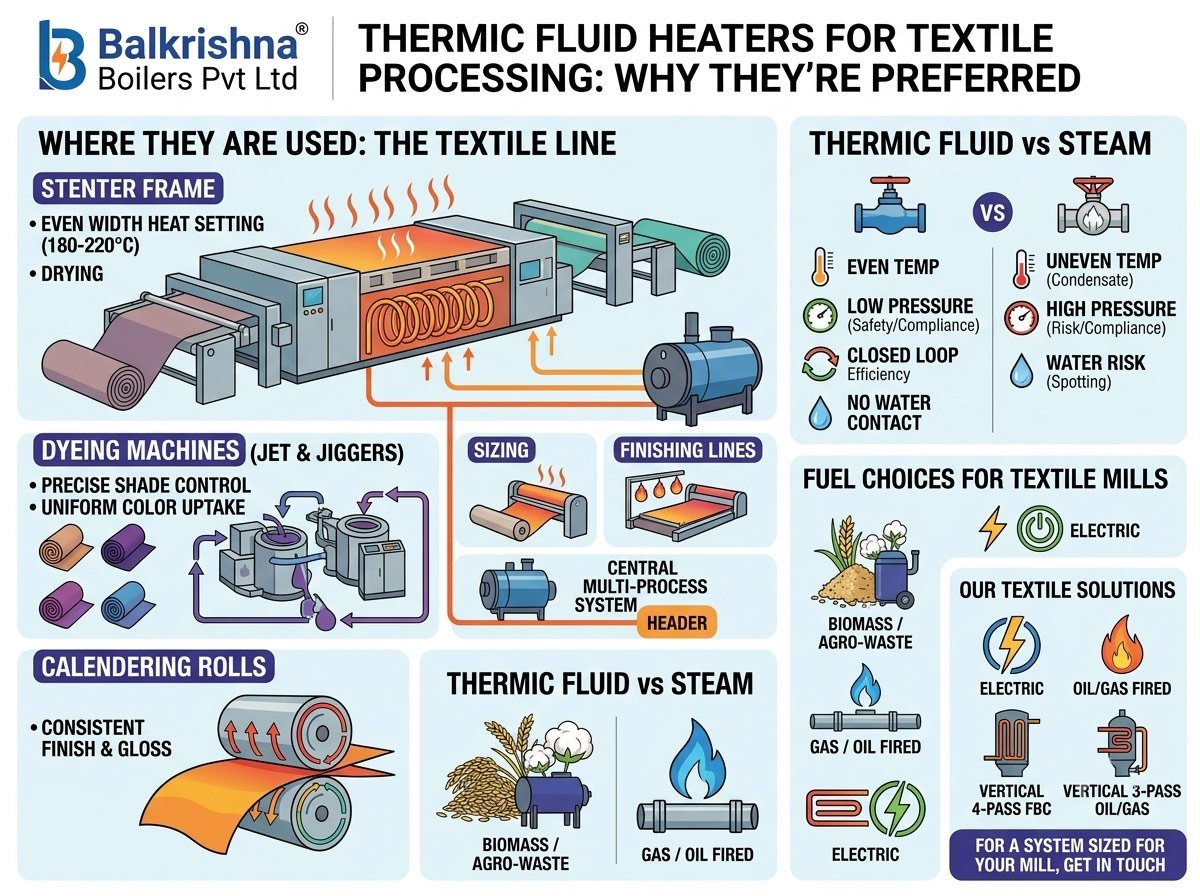
Walk through any textile processing house running stenters, dyeing ranges, or calendering lines, and you’ll find thermic fluid heaters doing the heavy lifting behind the scenes. It’s one of the industries where the technology has become close to the default choice, and not by accident — textile processing has a set of temperature and uniformity demands that map almost exactly onto what thermic fluid heating does best.
This piece covers where thermic fluid heaters fit across textile processing, why mills prefer the technology over steam or direct-fired alternatives, and what to consider when specifying a system for a textile operation.
Why Textile Processing Demands This Kind of Heat
Fabric processing is unusually sensitive to heat uniformity. A stenter frame drying and heat-setting fabric with even a small temperature variance across its width produces visible shrinkage or shade variation across the roll. A dye bath running a few degrees off target changes color uptake and consistency batch to batch. Unlike some industries where a temperature swing costs efficiency, in textiles it often costs the batch itself — reprocessing or downgrading fabric that didn’t hold specification.
Three characteristics of thermic fluid heating address this directly:
Even, stable heat delivery. Because thermal fluid stays in the liquid phase throughout the circuit, it delivers consistent heat without the temperature gradients that steam can introduce as condensate forms unevenly across a heat exchanger — a meaningful difference when you’re trying to hold a stenter chamber at a uniform temperature across its full width and length.
High temperature at low pressure. Stenter frames and several finishing processes need sustained temperatures in the 180°C to 220°C range. Reaching that with steam requires high pressure, with the compliance and safety overhead that comes with it. Thermic fluid delivers the same temperature range at near-atmospheric pressure — the core advantage covered in our guide on what a thermic fluid heater is and how it’s used.
No water contact with the process. Because the fluid never directly touches the fabric — it heats air or a jacket that then contacts the process — there’s no risk of water spotting, mineral deposits, or condensate drips landing on fabric mid-process, a real quality risk with some steam-heated finishing equipment.
Stenter Frames: The Primary Application
Stenter frames — used for drying, heat-setting, and finishing woven and knitted fabric — are the single largest thermic fluid application in textile processing. The stenter pulls fabric through a series of heated chambers, typically using thermal fluid-heated finned tube heat exchangers to warm the circulating air that dries and sets the fabric.
Getting this right depends on holding a tight, even temperature across every chamber and across the full width of the machine — a wide stenter can be several meters across, and any hot or cold zone across that width shows up directly as inconsistent shrinkage or finish quality across the fabric roll. Thermic fluid’s stable, non-fluctuating heat delivery is what makes maintaining that uniformity practical at production speed.
Dyeing: Jet Dyeing Machines and Jiggers
Dye bath temperature control directly affects dye uptake, levelness, and reproducibility batch to batch — a critical concern for mills that need to match shade consistently across production runs for the same customer order. Thermic fluid-heated jacketed dyeing machines — jet dyeing machines, jiggers, and similar equipment — use an indirect heat exchanger to bring the dye liquor to temperature and hold it there through the dyeing cycle.
The precision matters in both directions: underheating slows dye uptake and can produce pale or uneven shade, while overheating risks damaging certain fiber types or accelerating dye migration in ways that compromise levelness. A well-controlled thermic fluid circuit holds the dye bath within a tight band through the full cycle, supporting the batch-to-batch shade consistency mills are judged on.
Calendering and Finishing
Calendering — passing fabric between heated rollers to achieve a particular surface finish, gloss, or texture — needs the roller surface held at a precise, stable temperature, since roller temperature directly determines the finish quality achieved. Thermic fluid-heated calender rolls are widely used for exactly this reason: internal fluid circulation through the roll body delivers even surface temperature that’s difficult to match with electric heating elements embedded in a large roller.
Similar thermal fluid-heated roller systems are used across other finishing processes — sanforizing, coating, and lamination lines — where consistent roller or platen temperature is the determining factor in finish quality.
Sizing and Desizing
Sizing (applying a protective coating to yarn before weaving) and desizing (removing that coating after weaving) both involve heated processes where consistent temperature affects how evenly the size is applied or removed. Thermic fluid-heated size boxes and washing ranges support the same uniform, stable heating that benefits the later stenter and dyeing stages — quality issues introduced at the sizing stage tend to compound through the rest of the process.
Why Mills Prefer Thermic Fluid Over Steam for These Applications
For textile processors weighing thermic fluid against steam, the decision usually comes down to a few concrete factors specific to fabric processing:
Temperature uniformity across wide equipment. Stenter frames and wide calender rolls are exactly the kind of large, wide equipment where steam’s tendency toward uneven condensate distribution can create real hot-and-cold-zone problems. Thermal fluid’s stable liquid-phase heat transfer handles this more predictably.
No risk of water/condensate contact with fabric. Any steam system carries some risk of condensate reaching the fabric path if a heat exchanger or trap isn’t performing correctly — a real quality concern for fabric that needs to stay dry through certain process stages. A properly designed thermic fluid system eliminates this risk entirely, since the fluid stays in its own sealed loop.
Lower compliance overhead. Thermic fluid’s low-pressure operation generally sits outside IBR requirements, reducing the certified-attendant and inspection burden that a high-pressure steam system serving stenter or calendering temperatures would carry.
Efficiency for continuous operation. Textile processing houses typically run continuous multi-shift operation, and thermic fluid’s closed-loop design avoids the blowdown and condensate losses that accumulate meaningfully over that kind of running schedule. Our piece on how thermic fluid heaters improve energy efficiency covers exactly where those savings come from.
For a broader comparison beyond textile-specific considerations, see Thermic Fluid Heater vs Steam Boiler: Which Suits Your Process?
Central Systems for Multi-Process Mills
Most textile processing houses run several thermally demanding processes — stenters, dyeing machines, calenders — often simultaneously across different production lines. A central thermic fluid system, sized correctly and distributed through a well-balanced header, can serve all of these from one efficient heat source rather than running separate heating systems for each process area.
Getting this right depends on accurate peak-demand analysis across every connected process, since stenters, dye baths, and calenders don’t all draw heat continuously or simultaneously in most production schedules. Our guide on thermic fluid heater capacity: how to choose the right size covers how to approach sizing for exactly this kind of multi-process demand.
Fuel Choice for Textile Mills
Textile processing houses in India commonly choose between a few fuel options for their thermic fluid heaters, and the right choice depends heavily on local availability and cost:
- Biomass and agro-waste fired systems (rice husk, cotton stalk, and similar locally available fuels) are popular in textile clusters where these fuels are cost-effective and reliably available, supporting significant running cost savings at scale.
- Gas-fired systems offer clean, stable combustion with lower maintenance overhead where natural gas or LPG supply is reliable.
- Electric systems are increasingly considered for smaller processing units or where combustion infrastructure isn’t practical, though running cost depends on local electricity tariffs relative to fuel alternatives.
Keeping a Textile-Line Thermic Fluid System Reliable
Textile processing runs continuous multi-shift schedules more often than not, which puts a premium on disciplined maintenance since there’s rarely a natural pause for inspection. Coil fouling, fluid degradation, and flow imbalance across a header serving multiple stenter chambers or dye machines are the issues we see most often on textile-line systems — all covered in detail, with the full maintenance schedule, in how to maintain a thermic fluid heater for long service life. If a stenter or dye bath is already showing inconsistent temperature on a running line, our guide to common thermic fluid heater problems and their solutions is a useful first stop for narrowing down the cause.
Our Thermic Fluid Heater Range for Textile Processing
At Balkrishna Boilers Pvt Ltd, we’ve supplied thermic fluid heating systems to textile processing houses running stenters, dyeing, and calendering lines across major textile clusters in India. Depending on fuel preference and capacity requirement, our range includes:
- Electric Thermic Fluid Heater
- Oil / Gas Fired Thermic Fluid Heater
- Vertical Four Pass FBC Thermic Fluid Heater — a common choice for mills running biomass or agro-waste fuel.
- Vertical Three Pass Oil / Gas Fired Thermic Fluid Heater
Get a System Sized for Your Textile Processing Line
Whether you’re setting up a new stenter or dyeing line, or centralizing multiple processes onto one thermal fluid header, our technical team can size a system around your actual process temperature and simultaneous demand. Get in touch with your machine count, process type, and target temperature, and we’ll put together a proposal.