
Rising fuel costs, tightening pollution norms, and pressure to hit sustainability targets have pushed Indian manufacturers to rethink how they generate steam and hot water. For decades, coal, biomass, and oil-fired systems were the default choice. Today, more plant heads in pharma, food processing, textiles, and chemicals are asking a different question: does it still make sense to run a combustion boiler at all?
For a growing number of facilities, the answer is no. Electric boilers have moved from a niche, small-capacity option to a serious industrial heating solution — and the shift is driven by hard numbers, not just environmental optics. At Indian Boilers.com and its parent company Balkrishna Boilers Pvt Ltd, we’ve spent over two decades designing thermal systems for exactly these industries, and our Electric Boiler range has become one of the fastest-growing categories in our portfolio.
This guide breaks down the real, measurable benefits of switching to an electric boiler, who should consider it, and how to evaluate whether it fits your process.
What Is an Industrial Electric Boiler?
An industrial electric boiler generates steam or hot water using high-quality resistance heating elements that are directly immersed in water, instead of burning coal, biomass, oil, or gas. There is no combustion chamber, no chimney, and no flue gas path — electrical energy converts almost directly into thermal energy.
Depending on the process requirement, this can take the form of a resistance-element steam boiler, an electric induction boiler, an electric hot water boiler, or an electric thermic fluid heater. Balkrishna Boilers manufactures this range under several product lines, including the ELECTROMAX, ELECTROAQUA, ELECTROAIR, and INDUCTRON series — each engineered for a different combination of capacity, pressure, and fluid.
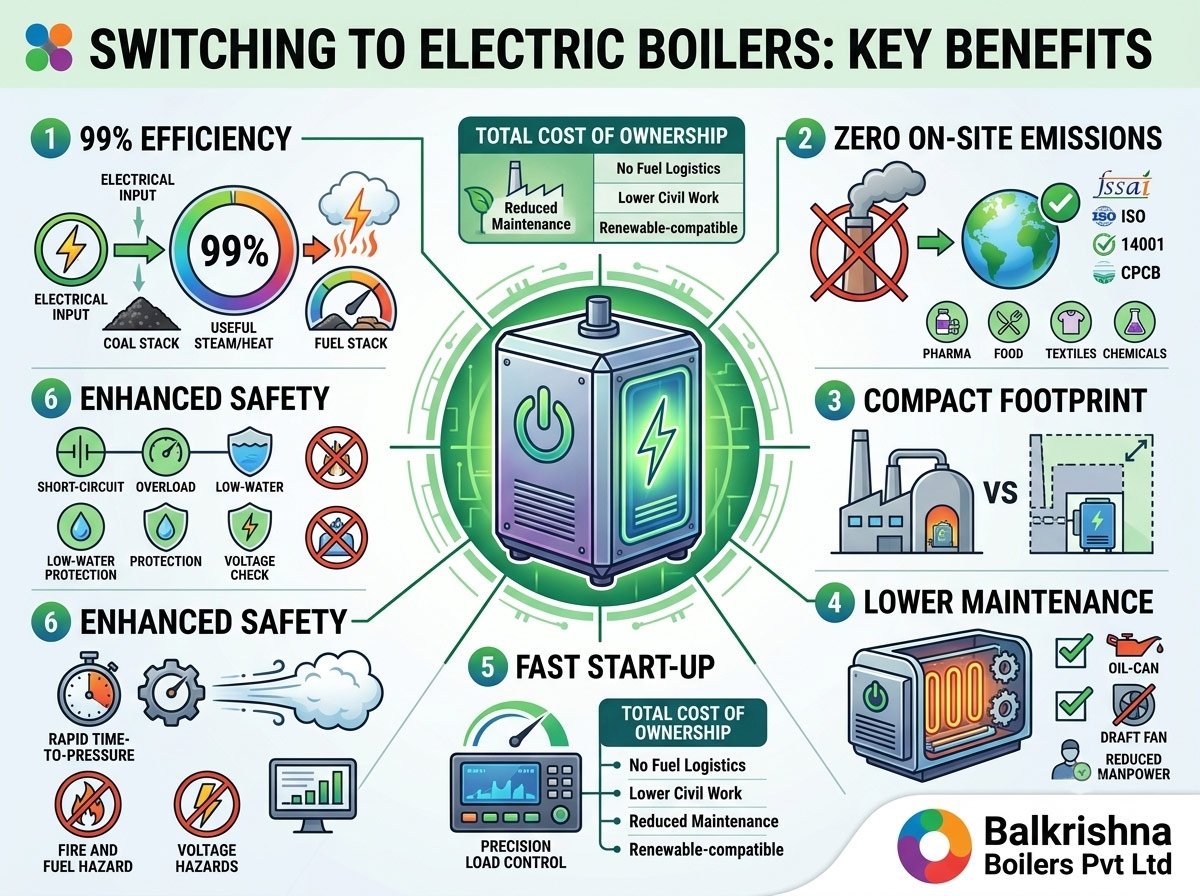
1. Unmatched Thermal Efficiency — Up to 99%
This is the single biggest reason plants switch. A conventional fuel-fired boiler loses a meaningful share of its input energy through flue gases, chimney stack losses, incomplete combustion, and radiation. Even a well-maintained coal or biomass boiler typically operates in the 75–85% efficiency band.
An electric boiler has no combustion process, so there is nowhere for that energy to escape. Electrical input converts almost directly into heat inside the water, pushing thermal efficiency close to 99%. Over a year of continuous operation, that efficiency gap compounds into a significant difference in usable energy per rupee spent — which is why efficiency-sensitive industries increasingly shortlist our Electric Steam Boiler range alongside their existing fuel-fired assets.
2. Zero On-Site Emissions and Easier Compliance
Pollution Control Board approvals, emission monitoring, and CSR-linked sustainability targets have become a genuine operational burden for boiler owners. An electric boiler removes that burden almost entirely because there is no combustion at the point of use — no NOx, no SOx, no particulate matter, no CO2 released on-site.
This matters most for:
- Pharmaceutical and API manufacturing units, where clean-room adjacency and contamination control are non-negotiable.
- Food and beverage plants pursuing FSSAI and ISO 14001 compliance.
- Facilities inside urban or CPCB-restricted industrial zones, where fresh consent-to-operate for a new combustion boiler is difficult to secure.
If your unit is being pulled toward biomass as a “greener” alternative to coal, it’s worth comparing both paths side by side — our post on what a biomass boiler actually offers covers where biomass still wins on running cost, and where an all-electric system wins on emissions and simplicity.
3. Compact Footprint and Faster Installation
Fuel-fired systems need fuel yards, ash handling, a chimney, and often a dedicated, structurally reinforced boiler house. An electric boiler needs none of this. The tank-style, skid-mounted design means the unit can frequently be installed close to the point of use — right next to a dryer, autoclave, or process vessel — cutting down on steam distribution length and the heat loss that comes with it.
This is a major advantage for:
- Plants retrofitting heating capacity into an already-built facility with no room for a new boiler house.
- Companies expanding a process line where floor space is at a premium.
- R&D labs and pilot plants that need heating capacity without the civil work a combustion system demands.
Because there’s no open flame or flue gas involved, statutory clearances and site approvals also move faster — commissioning timelines are typically much shorter than for a comparable fuel-fired installation.
4. Lower Maintenance and Fewer Points of Failure
Every burner, fuel line, ash-handling system, and exhaust fan on a combustion boiler is a component that can fail, need cleaning, or require a spare part. Electric boilers strip that complexity out. There’s no soot to remove, no burner nozzle to service, no draft fan to balance.
Routine maintenance on an electric unit is largely limited to:
- Checking and tightening electrical terminals
- Periodic descaling of heating elements
- Verifying safety interlocks (pressure switches, low-water cut-off, over-current protection)
Fewer moving parts also means fewer unplanned shutdowns — a real consideration for plants running continuous processes where an unscheduled stoppage is costly. Because heating elements sit in direct contact with water, feedwater treatment becomes the one area you cannot skip: using properly softened water is what protects element life and keeps maintenance costs low over the years.
5. Instant Start-Up and Precise Load Control
A coal or biomass boiler needs time to build a fire bed and reach operating pressure. An electric boiler doesn’t — because the heating elements are immersed directly in water, heat transfer is near-instantaneous. Full steam pressure is reached far faster than with a traditional fuel-fired unit.
This responsiveness carries into day-to-day operation too. Many electric boilers, including our thyristor-controlled models, offer highly precise modulation of output — useful for:
- Batch processes with intermittent steam demand
- Applications where overshoot or pressure fluctuation would affect product quality
- Facilities that need to bring heating online and offline quickly around shift patterns
For processes that swing between idle and full load frequently, this kind of control is difficult to replicate with a large combustion boiler designed to run steadily.
6. Enhanced Safety by Design
Combustion boilers inherently carry fire, fuel-handling, and flue-gas risks. Electric boilers remove the open-flame and fuel-storage hazard from the equation entirely. Multiple layers of electronic protection — high/low water level sensors, short-circuit and overload protection, voltage abnormality detection, and mechanical safety valves — are standard on a properly engineered industrial unit.
For plants operating under strict EHS audits, or those in sectors like pharmaceuticals and electronics where an on-site combustion source is a liability in itself, this is often as important a driver as the efficiency numbers.
7. Strong Total Cost of Ownership, Not Just Efficiency
Electricity tariffs are usually higher per unit of energy than coal or biomass, which leads some buyers to assume electric boilers cost more to run. In practice, total cost of ownership tells a more complete story:
- No fuel storage or handling infrastructure — no coal yard, no ash disposal contracts, no biomass procurement logistics.
- Lower installation cost — no chimney, no boiler house civil work, no fuel piping.
- Minimal maintenance labour — fewer components, less skilled manpower required for upkeep.
- No certified boiler operator requirement for smaller units, depending on capacity and state regulations.
- 99% conversion efficiency, so a larger share of every unit of electricity purchased actually becomes usable heat.
For facilities with access to captive solar or renewable power, or favourable industrial electricity tariffs, the running-cost gap narrows further — and in some cases disappears entirely once fuel logistics and manpower are factored in. Our team walks through this comparison regularly with clients evaluating our ELECTROPAC and ELECTRON series against their existing fuel-fired assets.
8. Ideal for Clean, Sensitive, and Space-Constrained Industries
While electric boilers suit almost any low-to-mid capacity heating requirement, they are the preferred choice in industries where cleanliness, precision, or space is critical:
- Pharmaceuticals and laboratories — for sterilization and process heating where product contamination risk from combustion by-products is unacceptable.
- Food and beverage processing — for cooking, pasteurization, and CIP systems requiring clean, dry, high-quality steam.
- Textiles — for ironing, curing, and finishing lines needing consistent, responsive heat.
- Hospitality — for laundry and kitchen operations in hotels where noise, space, and emissions all matter.
- R&D and pilot plants — where compact footprint and fast start-up outweigh raw capacity.
Electric vs. Steam and Biomass Boilers: Which Should You Choose?
Switching to electric isn’t an all-or-nothing decision for every plant. Many of our clients run a hybrid setup — a steam boiler or biomass system for base-load, high-capacity steam demand, with an electric unit handling smaller, intermittent, or quality-critical loads.
As a rough guide:
- Choose electric when emissions compliance, footprint, hygiene, or start-up speed matter more than raw fuel cost.
- Choose biomass or coal-fired steam boilers when you need very high, continuous capacity and have reliable access to low-cost fuel — our industrial boiler blog archive covers grate types, fuel selection, and efficiency tuning for these systems in detail.
- Consider a thermic fluid heater instead of a steam system if your process needs high-temperature heat transfer without high pressure — both electric and fuel-fired thermic fluid heater options are available depending on capacity.
How to Choose the Right Electric Boiler Capacity
Capacity selection comes down to three inputs: required steam or hot water output (kg/hr or kW), operating pressure, and available electrical supply (industrial units typically run on 3-phase, 415V, 50Hz). Balkrishna Boilers manufactures electric boilers from roughly 12 kW up to 600 kW and beyond, across IBR and Non-IBR configurations, so capacity is rarely the limiting factor — matching the right series to your process is.
For steam applications, models in our Electric Boiler category — including the 0.5 Ton and 1 Ton electric steam boilers — cover smaller, precision-driven loads, while higher-capacity units like the 3 Ton and 5 Ton electric boilers serve larger continuous processes. On the Balkrishna Boilers side, the ELECTROMAX and ELECTROAQUA series are engineered specifically around this capacity spread.
Final Thoughts
Switching to an electric boiler isn’t just an environmental upgrade — it’s a genuine operational and financial decision backed by measurable gains in efficiency, uptime, safety, and installation simplicity. For plants facing tighter emission norms, space constraints, or rising maintenance overhead on ageing fuel-fired systems, an electric boiler is often the fastest, cleanest path to reliable process heat.
If you’re evaluating whether an electric boiler fits your process, our engineers can size the right capacity and configuration for your plant. Explore the full Electric Boiler range on Indian Boilers.com, browse the complete lineup on Balkrishna Boilers, or get in touch with our team for a detailed commercial proposal.