
For a large industrial plant running steam round the clock, choosing a boiler is a capacity and fuel-logistics decision. For a small or medium enterprise, it’s a different problem altogether. Capital is tighter, floor space is limited, there’s usually no dedicated boiler operator on the payroll, and every rupee spent on infrastructure has to justify itself quickly. This is exactly the environment where an electric boiler tends to outperform a traditional fuel-fired system — and it’s why we get more SME enquiries for electric boilers every year at Indian Boilers.com, part of Balkrishna Boilers Pvt Ltd.
This guide is written specifically for SME buyers — job workers, small food processors, textile units, pharma ancillary units, and workshops — who are evaluating an electric boiler for the first time and want a clear, practical way to decide what to buy.
Why SMEs Are Moving Toward Electric Boilers
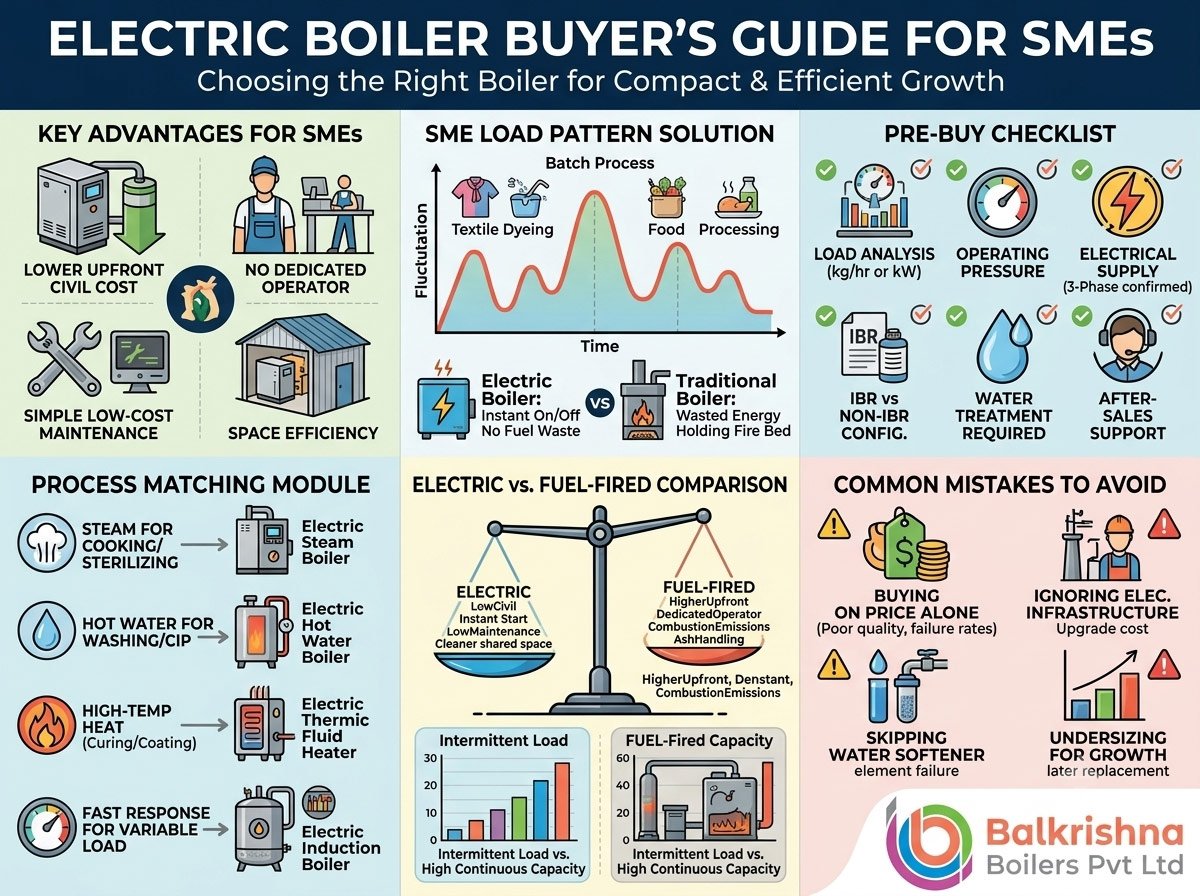
Most small and medium units don’t run a boiler at full load all day. Demand is often intermittent — a dyeing unit that needs steam for a few hours per batch, a small dairy that heats and cools on a fixed cycle, or a job-work unit that only fires up equipment when an order comes in. Fuel-fired boilers are inefficient in this kind of stop-start pattern; they lose a lot of energy just getting up to temperature and holding a fire bed for low, irregular demand.
An electric boiler doesn’t have that problem. Because there’s no combustion process to sustain, it starts instantly, delivers steam or hot water on demand, and shuts down just as quickly with no fuel wasted while idle. For an SME watching every cost line closely, that operating pattern alone can be the deciding factor.
Key Advantages That Matter Most to Smaller Units
1. Lower Upfront Infrastructure Cost
A coal or biomass boiler needs a dedicated boiler house, a chimney, fuel storage, and ash handling — all civil work that adds significantly to project cost before the boiler itself is even switched on. An electric boiler is compact and skid-mounted, so it can often be installed directly on the shop floor near the point of use, with no chimney and no fuel yard. For an SME working with limited capital and limited space, this alone can bring total project cost down considerably.
2. No Dedicated Boiler Operator Required (for Smaller Capacities)
Many fuel-fired boilers above a certain capacity legally require a certified boiler operator on-site — an ongoing manpower cost most SMEs would rather avoid. Smaller electric boiler installations typically don’t carry this requirement, which simplifies staffing and compliance considerably. Always confirm the exact threshold with your local boiler inspectorate, but this is one of the most common reasons SME buyers choose electric.
3. Simple, Low-Cost Maintenance
There are no burners to clean, no soot to remove, and no fuel-handling equipment to service. Maintenance on an electric unit is largely limited to checking electrical terminals and periodic descaling of the heating elements — work that doesn’t need specialized combustion-engineering skills. For a unit without an in-house maintenance team, this is a meaningful, ongoing saving.
4. Fast Payback Through Efficiency
Electric boilers convert close to 99% of input electrical energy into usable heat, since there’s no flue-gas or chimney loss. Combined with the lower installation and maintenance costs above, many SMEs find the total cost of ownership comparable to — or better than — a fuel-fired system, even with a higher per-unit electricity tariff. Our Electric Boiler product line is engineered around exactly this efficiency profile.
5. Space Efficiency
Floor space is often the tightest constraint for an SME operating out of a rented shed or a compact industrial unit. Electric boilers have a small footprint compared to an equivalent-capacity fuel-fired system with its chimney and fuel storage, freeing up space for production equipment instead.
6. Safer for Compact, Shared Facilities
Many SME units operate in shared industrial sheds or GIDC estates where fire risk and emissions are closely regulated. Removing the combustion process removes the associated fire and flue-gas risk, which matters both for insurance and for staying within estate safety norms.
What to Check Before You Buy: A Practical Checklist
Choosing the right electric boiler isn’t just about picking the cheapest unit. Here’s what an SME buyer should verify before placing an order.
Steam or hot water output required (kg/hr or kW). Under-sizing leads to production bottlenecks; over-sizing wastes capital. Base this on your actual peak demand, not a rough guess — our team can help calculate this from your process details.
Operating pressure. Confirm the pressure your process genuinely needs. Many SME processes (laundry, small dyeing units, packaged food heating) don’t need high-pressure IBR-certified units, which keeps both capital cost and compliance simpler.
Available electrical supply. Industrial electric boilers typically require a 3-phase, 415V, 50Hz supply. Confirm your sanctioned load and transformer capacity can support the boiler before finalising a model — this is the single most common sizing mistake SME buyers make.
IBR vs. Non-IBR requirement. If your steam pressure and capacity fall under Indian Boiler Regulations, you’ll need an IBR-certified unit. Many small SME applications qualify for Non-IBR units, which are simpler to commission. We manufacture both — see our IBR Electric Steam Boiler and Non-IBR Electric Steam Boiler ranges.
Water treatment setup. Since heating elements sit directly in water, scale buildup from untreated water is the most common cause of premature element failure. Budget for a basic softener alongside the boiler — it’s a small cost that protects a much larger investment.
After-sales support and spares availability. For an SME without in-house engineering staff, a manufacturer that can service the unit quickly and supply spares without long lead times matters as much as the machine itself.
Matching the Right Electric Boiler to Your Process
Not every SME needs the same type of unit. Here’s a quick way to map your process to the right product category.
- Need steam for cooking, sterilizing, or small process heating? Look at our Electric Steam Boiler range, starting from the 0.5 Ton Electric Steam Boiler — a common entry point for small food processing and job-work units.
- Need hot water for washing, laundry, or CIP cleaning? The Electric Hot Water Boiler is built specifically for this load profile.
- Need high-temperature heat transfer without high pressure? An Electric Thermic Fluid Heater is often a better fit than a steam system for processes like curing or coating.
- Need a compact, fast-response unit for a small or variable load? The Electric Induction Boiler — 100 to 1000 kg/hr — is designed for exactly this kind of intermittent SME demand.
- Need hot air for drying or curing rather than steam? Our Electric Hot Air Generator is a purpose-built alternative worth comparing against a steam-based drying setup.
On the Balkrishna Boilers side, the same requirement maps to our Electric Boiler series, including ELECTROMAX for general steam applications, ELECTROAQUA for hot water, ELECTROAIR for hot air generation, and INDUCTRON for induction-based steam generation.
Electric vs. Fuel-Fired: A Quick Comparison for SME Buyers
If you’re still weighing electric against a small coal or biomass unit, the decision usually comes down to your fuel access and load pattern:
- If your unit runs intermittently and you don’t have in-house fuel logistics or a boiler operator, electric is almost always the simpler, lower-hassle choice.
- If you run continuous, high-volume steam demand and have reliable, low-cost access to biomass or coal, a fuel-fired steam boiler may still offer a lower running cost at scale — our industrial boiler blog section covers fuel selection and efficiency for these systems if you want to compare further.
- If emissions compliance, hygiene, or shared-facility safety norms are a concern, electric boilers remove most of that risk outright — a factor worth reading about in our broader piece on the benefits of switching to an electric boiler.
Common Mistakes SME Buyers Make
Buying on price alone. The cheapest unit on paper often skips features like proper low-water cut-off protection or quality heating elements, leading to higher failure rates and shorter element life.
Ignoring electrical infrastructure costs. If your existing transformer or sanctioned load can’t support the boiler, you’ll need to budget for an upgrade — factor this in before comparing quotes.
Skipping water treatment. This is the single most common cause of early heating-element failure, and it’s almost always avoidable with a basic softener.
Undersizing for future growth. If you expect production to scale in the next two to three years, it’s often more economical to size slightly ahead of current demand than to replace the unit later.
How Balkrishna Boilers Supports SME Buyers
We manufacture electric boilers across a wide capacity range — from small 12 kW units suitable for a single process line, up to 600 kW and beyond — so SME buyers aren’t forced into an oversized, over-engineered system designed for large plants. Our engineers work directly with first-time buyers to calculate the right capacity from your actual steam or hot water requirement, confirm IBR applicability, and recommend the right series for your budget and process.
Final Thoughts
For an SME, the right boiler isn’t necessarily the biggest or the cheapest — it’s the one that matches your actual load pattern, fits your available space and power supply, and doesn’t add operational overhead you don’t have the manpower to manage. For most small and medium units with intermittent or moderate steam and hot water demand, an electric boiler checks all three boxes: lower installation cost, minimal maintenance, and efficient use of every unit of electricity you pay for.
If you’re evaluating your first boiler purchase, our team can help you size the right unit for your process. Browse the full Electric Boiler range on Indian Boilers.com, explore the complete lineup on Balkrishna Boilers, or get in touch with our team for a free capacity assessment and quote.