
Zero-emission manufacturing has moved from a sustainability slogan to a genuine procurement requirement. Global buyers are asking Indian suppliers for carbon disclosures before signing contracts. Pollution Control Boards are tightening consent-to-operate conditions for combustion equipment. And corporate ESG targets, once a marketing line, are now tied to board-level reporting. For any plant that generates process heat, the boiler room is usually the single largest point-source of emissions on-site — which makes it the obvious place to start when a facility commits to going low- or zero-emission.
At Indian Boilers.com, part of Balkrishna Boilers Pvt Ltd, we’ve watched this shift play out directly in our order book. A growing share of enquiries now come from plants that aren’t just comparing efficiency and cost — they’re comparing emissions data, because a customer, auditor, or export market is asking for it. This piece looks at exactly how an electric boiler fits into a genuine zero-emission manufacturing strategy, and where it fits alongside other options.
What “Zero-Emission” Actually Means for a Boiler Room
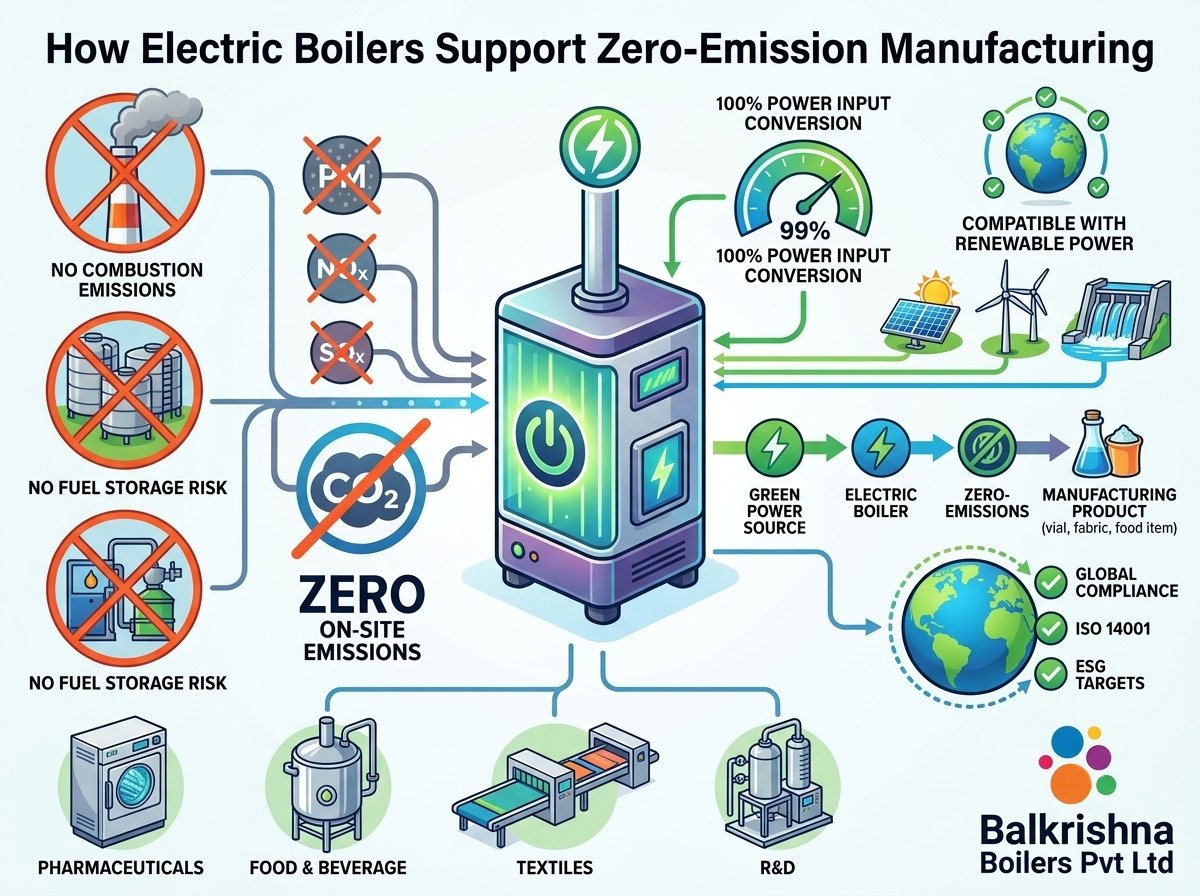
It’s worth being precise here, because the term gets used loosely. A boiler is “zero-emission at the point of use” when it produces no combustion by-products on-site — no CO2, NOx, SOx, or particulate matter released from a chimney or stack. An electric boiler meets this definition because there’s no combustion process at all: electrical energy converts directly into heat inside the water.
Whether the electricity itself is zero-carbon depends on your power source. Grid electricity in India still carries a carbon footprint tied to the generation mix. But an electric boiler powered by captive solar, wind, or renewable-backed grid supply comes genuinely close to true zero-emission process heating — combustion emissions and stack emissions are eliminated entirely at the plant, and the remaining footprint is only as large as your electricity source’s.
This is a materially different starting point than a combustion boiler, where even the cleanest fuel and best-tuned combustion still produces flue gas that has to be treated, monitored, and reported.
Why the Boiler Room Is the First Place to Target
For most process industries — textiles, food and beverage, pharmaceuticals, chemicals — the boiler is responsible for a large share of total site emissions, often more than compressors, HVAC, or material handling combined. It’s also usually the single largest, most concentrated combustion source on the premises, which means it’s the easiest piece of equipment to isolate, measure, and replace as a discrete project.
That combination — high emissions contribution, single point of intervention — is exactly why sustainability consultants and plant engineers usually start an emissions-reduction roadmap in the boiler room rather than spreading effort thinly across dozens of smaller equipment items.
How Electric Boilers Deliver Zero On-Site Emissions
No Combustion, No Flue Gas
Because heat is generated by resistance elements immersed directly in water, there’s no fuel burned, no chimney, and no flue gas stream to treat or monitor. Compliance reporting simplifies considerably — there’s no stack emission testing required because there’s no stack.
No Fuel Storage or Handling Risk
Coal yards, biomass storage, and oil tanks all carry secondary environmental risk — dust, runoff, spillage, and fire hazard. Removing fuel storage from the site removes these secondary risks along with the primary combustion emissions, which matters for facilities pursuing broader environmental certifications, not just air-emission targets.
Near-Total Energy Conversion
Because there’s no flue-gas heat loss, close to 99% of the electrical energy input converts into usable heat. This matters for a genuine sustainability case: a boiler that wastes less energy per unit of steam produced needs less total energy input to run your process, which lowers your overall footprint even before accounting for the source of that electricity.
Compatible with Renewable Power
Unlike a combustion boiler, which is fundamentally tied to whatever fuel it’s built to burn, an electric boiler runs on whatever electricity reaches it — grid, captive solar, wind, or a hybrid supply. As more Indian manufacturers install rooftop or open-access solar capacity, pairing that generation with an electric boiler is one of the most direct ways to convert renewable electricity into usable process heat, rather than only using it for lighting and machinery loads.
Where This Matters Most: Industry Applications
Pharmaceuticals and API manufacturing. Sterilization and process heating in pharma facilities often sit inside or adjacent to clean-room environments, where combustion by-products are a contamination risk as much as an emissions one. Electric steam generation, such as our Electric Steam Boiler range, removes that risk entirely while supporting ISO 14001 and GMP-aligned sustainability commitments.
Food and beverage processing. Export-oriented food manufacturers increasingly face carbon-reporting requirements from international buyers. Switching cooking, pasteurization, and CIP heating to an Electric Hot Water Boiler is one of the more straightforward ways to show a measurable reduction in Scope 1 emissions on a facility audit.
Textile processing. Ironing, curing, and finishing lines traditionally run on coal or biomass-fired thermic fluid heaters. An Electric Thermic Fluid Heater delivers the same high-temperature heat transfer without a combustion source, which matters increasingly to global apparel brands auditing their supply chain’s carbon footprint.
Hospitality. Hotel laundry and kitchen operations generate meaningful steam demand in a relatively small footprint. Electric boilers fit this profile well — compact, quiet, and free of the flue and fuel-storage requirements that are difficult to accommodate in a hospitality building.
R&D, laboratories, and pilot plants. Facilities piloting new processes or product lines increasingly specify zero-emission utilities from the outset, since retrofitting emissions controls later is far more expensive than designing them in from day one.
Electric Boilers and Emissions Certifications
Facilities pursuing ISO 14001 (Environmental Management Systems), CSR-linked sustainability reporting, or customer-mandated carbon audits generally find that combustion equipment is where the most detailed reporting burden sits — fuel consumption records, emission testing, stack monitoring, and consent renewals all apply specifically to fired equipment. Removing a fired boiler from the site, or adding electric capacity alongside it to reduce combustion hours, directly reduces this reporting burden while producing a defensible, auditable emissions reduction.
For plants targeting a formal net-zero or carbon-neutral roadmap, an electric boiler running on renewable-backed power is one of the few process-heating options that gets a facility close to true zero Scope 1 emissions from thermal energy generation — a claim that’s very difficult to make with any fuel-fired system, however efficient.
Electric vs. Biomass: Two Different Sustainability Paths
Biomass is often positioned as the “green” alternative to coal, and it does offer a lower net-carbon profile than fossil fuel combustion because the CO2 released is largely offset by the CO2 absorbed during biomass growth. But biomass combustion still produces on-site particulate matter and flue gas that requires monitoring and consent — it reduces net carbon impact without eliminating on-site emissions.
If your priority is genuinely zero on-site emissions — for a clean-room-adjacent process, a contamination-sensitive product, or a strict urban PCB consent — electric is the more direct route. If your priority is lower net carbon at high continuous capacity and you have reliable, low-cost biomass access, it remains a strong option worth evaluating; our post on what a biomass boiler actually offers covers that trade-off in detail, and our broader industrial boiler blog section covers fuel and grate selection for biomass systems more generally.
Many facilities pursuing an ambitious sustainability roadmap end up running both — a biomass or steam boiler for high, continuous base-load demand, and an electric unit for quality-critical or emissions-sensitive process steps.
Practical Steps to Move Toward Zero-Emission Process Heating
1. Audit current boiler-room emissions and energy use. Understand what share of total site emissions your existing combustion boiler actually represents before committing to a replacement plan.
2. Identify process steps that are contamination- or emissions-sensitive. These are usually the highest-value places to switch first, since the benefit extends beyond emissions reporting into product quality and compliance.
3. Size an electric boiler to your genuine load, not your combustion boiler’s rated capacity. Fuel-fired systems are often oversized for actual demand; an electric replacement sized correctly can be smaller and more efficient than a like-for-like swap.
4. Evaluate your electricity source. If captive solar or renewable-backed power is available or planned, pairing it with electric process heating maximizes the genuine carbon benefit, not just the on-site emissions benefit.
5. Plan water treatment from day one. Since electric heating elements sit in direct contact with water, a basic softening system protects element life and keeps the unit running at its rated efficiency for years.
How Balkrishna Boilers Supports Zero-Emission Projects
We manufacture a full range of electric boilers — steam, hot water, and thermic fluid — engineered specifically for industries where emissions, contamination control, and compliance reporting matter as much as raw capacity. On the Balkrishna Boilers side, our Electric Boiler series includes ELECTROMAX for steam applications, ELECTROAQUA for hot water, ELECTROAIR for hot air generation, and INDUCTRON for induction-based steam generation — each sized from small SME loads up to large continuous-process capacity.
If you’re building a sustainability roadmap and need to understand where an electric boiler fits, our engineers can walk through your current emissions profile, process requirements, and available power infrastructure to recommend the right configuration.
Final Thoughts
Zero-emission manufacturing isn’t achieved through a single equipment change, but the boiler room is consistently the highest-impact place to start, because it’s usually the largest single combustion source on-site and the easiest to isolate and measure. Electric boilers offer a direct, auditable way to eliminate on-site combustion emissions entirely — and when paired with renewable electricity, they come as close as any current process-heating technology to genuine zero-emission steam and hot water generation.
Explore the full Electric Boiler range on Indian Boilers.com, browse the complete lineup on Balkrishna Boilers, or get in touch with our team to discuss how electric process heating fits your sustainability roadmap.