
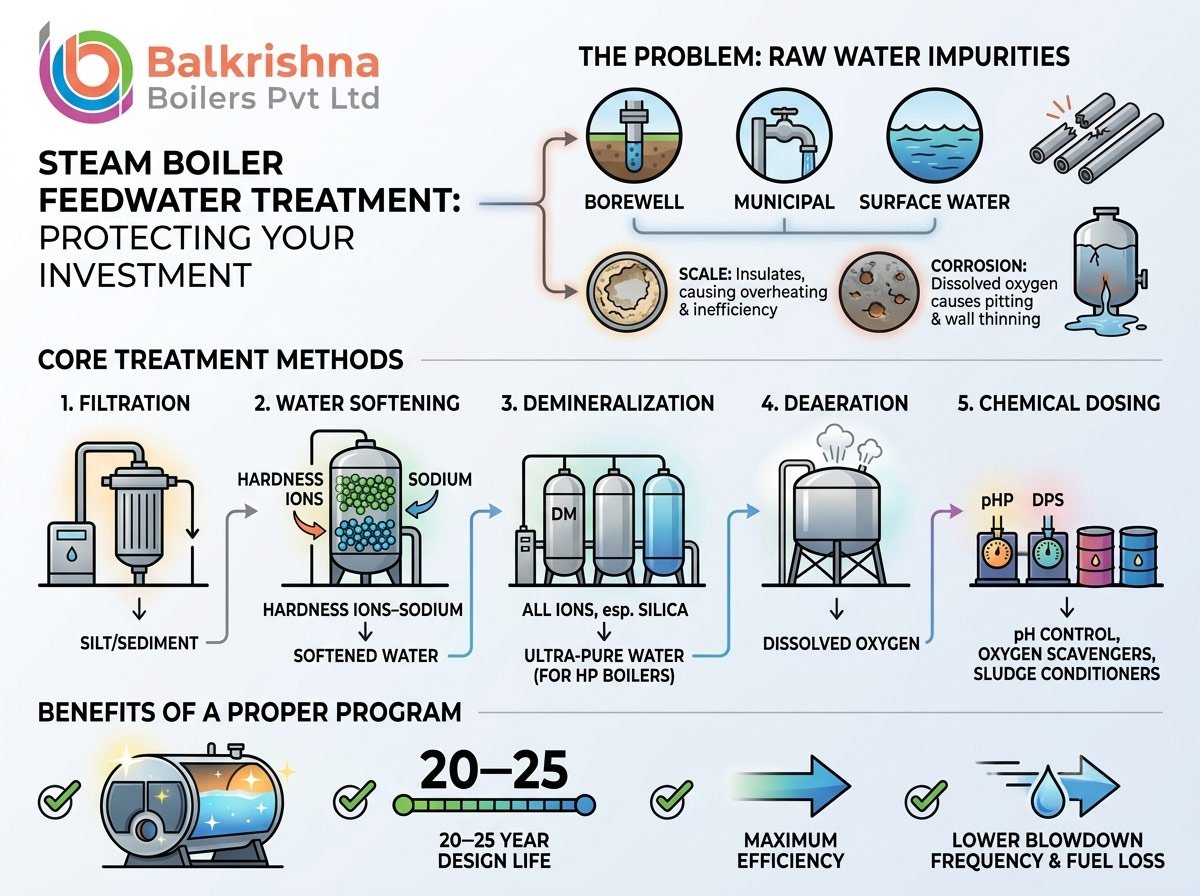
If there’s one factor that determines whether your boiler reaches its full 20–25 year design life or fails a decade early, it’s water quality. More boiler tubes fail from poor feedwater treatment than from any other single cause — and unlike many mechanical failures, most water-related damage happens silently, inside the vessel, long before any visible symptom appears.
This guide explains what feedwater treatment actually involves, why raw water is dangerous for boilers, the main treatment methods used in Indian industrial plants, and how to build a treatment program that protects your investment for the long term.
Why Raw Water Can’t Go Directly Into a Boiler
Water straight from a borewell, municipal supply, or surface source carries a range of dissolved and suspended impurities that are perfectly harmless to drink but genuinely damaging inside a pressurized, high-temperature boiler:
- Dissolved hardness minerals (calcium and magnesium) that precipitate out as scale when heated
- Dissolved oxygen and carbon dioxide, both highly corrosive at boiler operating temperatures
- Suspended solids and silt, which settle as sludge inside the vessel
- Dissolved silica, which can form extremely hard, difficult-to-remove deposits
- Total Dissolved Solids (TDS), which concentrate over time as pure water evaporates into steam, leaving impurities behind
Left untreated, these impurities don’t just reduce efficiency — they actively shorten the structural life of the boiler through scale-driven overheating and corrosion. Our guide on the top 10 causes of steam boiler breakdown covers this in more depth, but water quality alone is worth its own dedicated look given how central it is to boiler longevity.
The Two Damage Mechanisms: Scale and Corrosion
Scale Formation
When hard water is heated, calcium and magnesium salts lose solubility and precipitate onto the boiler’s internal surfaces as scale. Scale is a poor conductor of heat compared to metal, so it acts as an insulating barrier between the flame/flue gas and the water. This forces the metal beneath the scale to run hotter than designed to transfer the same amount of heat, weakening it over time and increasing the risk of tube rupture. Just 1 mm of scale buildup can increase fuel consumption by 7–10% — a cost that compounds daily for as long as the scale remains.
Corrosion
Dissolved oxygen and carbon dioxide react with boiler metal at elevated temperatures, causing pitting and general wall thinning. Unlike scale, which is often visible during inspection, corrosion can progress internally for years before a leak or failure makes it apparent. Corrosion is particularly aggressive in the presence of oxygen that hasn’t been properly removed from feedwater before it enters the boiler.
Core Feedwater Treatment Methods
1. Water Softening (Ion Exchange)
Softening is the most common first line of defense against scale. It works by passing raw water through a resin bed that exchanges calcium and magnesium ions for sodium ions, which don’t form scale under boiler conditions. Softeners are periodically regenerated using a brine (salt) solution to restore the resin’s exchange capacity.
Best for: Reducing hardness-driven scale formation in most standard industrial boiler applications.
2. Demineralization (DM Plant)
For higher-pressure boilers or applications requiring very high purity feedwater, demineralization removes not just hardness minerals but virtually all dissolved ionic impurities, including silica, using a combination of cation and anion exchange resins. DM water is significantly purer than softened water and is typically required for high-pressure IBR-classified boilers and clean-steam applications like pharmaceutical sterilization.
Best for: High-pressure boilers, pharmaceutical and food-grade steam applications, and plants aiming to minimize blowdown frequency through superior feedwater purity.
3. Deaeration
A deaerator mechanically and thermally removes dissolved oxygen and carbon dioxide from feedwater before it enters the boiler, dramatically reducing the corrosion risk that these gases pose at operating temperature. Deaeration is typically combined with chemical oxygen scavengers for complete protection.
Best for: Any boiler operation aiming to minimize internal corrosion, particularly larger or higher-pressure systems where corrosion-related failures are costlier to repair.
4. Chemical Dosing
Even with softening, demineralization, and deaeration in place, chemical treatment plays an ongoing role in maintaining water chemistry:
- Oxygen scavengers neutralize any residual dissolved oxygen that mechanical deaeration doesn’t fully remove.
- pH control chemicals keep boiler water within the optimal alkaline range to minimize corrosion risk.
- Sludge conditioners help keep any residual suspended solids in a free-flowing form that’s easier to remove through blowdown, rather than allowing them to bake onto heat-transfer surfaces.
- Scale inhibitors provide an additional layer of protection against precipitation, particularly useful where softening alone isn’t sufficient.
5. Filtration
Mechanical filtration removes suspended solids and silt before water reaches the softening or demineralization stage, protecting downstream treatment equipment and reducing the sludge load the boiler itself has to handle through blowdown.
Matching Treatment Level to Boiler Type and Pressure
Not every plant needs the same level of feedwater treatment — the right approach depends on your boiler’s pressure rating, capacity, and application:
| Boiler Type | Typical Minimum Treatment | Recommended Additional Treatment |
|---|---|---|
| Small/low-pressure boilers (up to ~10.5 kg/cm²) | Softening | Chemical dosing, basic filtration |
| Mid-pressure industrial boilers | Softening + Deaeration | Chemical dosing, blowdown optimization |
| High-pressure boilers (17.5+ kg/cm²) | Demineralization + Deaeration | Full chemical program, continuous TDS monitoring |
| Pharma / food-grade clean steam | Demineralization + Deaeration | Stainless steel construction, strict water testing protocol |
If you’re unsure which pressure class applies to your operation, our guide on steam boiler pressure settings for operators explains how working pressure is determined based on your connected process equipment.
How Feedwater Quality Connects to Blowdown
Feedwater treatment and blowdown work as a single system, not two separate concerns. Better feedwater quality directly reduces the blowdown percentage required to keep boiler water TDS within safe limits — meaning less water wasted, less fuel lost as heat in blown-down water, and a more stable, easier-to-manage boiler overall.
Blowdown % = Feedwater TDS ÷ (Maximum Permissible Boiler Water TDS − Feedwater TDS) × 100A boiler running on poorly treated, high-TDS feedwater will require significantly more frequent blowdown than one running on demineralized water — often enough that upgrading water treatment pays for itself through reduced blowdown-related fuel and water loss alone. Our dedicated guide on steam boiler blowdown: why it matters and how often to do it covers this relationship and the calculation in full detail.
Signs Your Feedwater Treatment Needs Attention
- Visible scale deposits during internal boiler inspection
- Rising fuel consumption without a corresponding increase in steam demand
- Increasing blowdown frequency required to maintain safe TDS levels
- Discolored or turbid boiler water samples
- Foaming or unstable water level readings, indicating possible carryover
- Frequent unplanned tube or fitting leaks
Any of these signs warrant an immediate water quality test and a review of your current treatment program, rather than waiting for the next scheduled inspection.
Building a Feedwater Treatment Program
A properly structured program typically includes:
- Raw water analysis at the outset to determine hardness, TDS, silica, and other relevant parameters specific to your water source.
- Appropriately sized softening or demineralization equipment matched to your boiler’s pressure class and daily makeup water volume.
- Deaeration for boilers where corrosion risk is a meaningful concern, particularly mid-to-high pressure systems.
- A documented chemical dosing schedule, adjusted based on regular water testing rather than a fixed, unchanging routine.
- Regular water testing — daily or per-shift for critical parameters like TDS and pH, with more detailed lab analysis on a periodic basis.
- Calibrated, TDS-informed blowdown, rather than a purely time-based schedule disconnected from actual water chemistry.
Treating feedwater quality as an ongoing program rather than a one-time installation is what separates plants that get 20+ years from their boiler from those facing premature tube failure well before that point.
Feedwater Treatment Considerations by Fuel and Boiler Type
Water treatment requirements apply across every boiler fuel type, though a few nuances are worth noting:
- Oil / Gas Fired Steam Boilers benefit from consistent water treatment since stable combustion performance depends on maintaining clean, efficient heat-transfer surfaces.
- Biomass-fired boilers, such as those using rice husk or agro waste, face the same water treatment requirements as any other fuel type — water quality issues are independent of what fuel is burning.
- Electric Steam Boilers still require proper feedwater treatment, since scale and corrosion risks exist regardless of whether heat comes from combustion or electrical elements — in fact, scale on electric heating elements can cause particularly rapid localized overheating.
- High-pressure and clean-steam applications, such as our IBR Electric Steam Boiler range used in pharma and food-grade contexts, typically demand the highest level of feedwater purity given both equipment protection and steam quality requirements.
You can review our full boiler range on the Steam Boiler category page and Electric Boiler category page.
Balkrishna Boilers’ engineered lineup — including COMBIPOWER, STEAMGEN, STEAMJET, STEAMPOWER, HUSKPOWER, and ENERPOWER — can be specified with softening, demineralization, and deaeration systems tailored to your plant’s water source and pressure requirements. The complete range is available on the Steam Boiler page at balkrishn.com.
The Cost of Getting Feedwater Treatment Wrong
Poor feedwater treatment doesn’t just risk a dramatic failure — it quietly erodes fuel efficiency and boiler lifespan every single day it goes uncorrected. A boiler running with scaled heat-transfer surfaces due to inadequate softening can lose a meaningful percentage of its rated efficiency well before any visible symptom prompts an inspection. Over years of operation, that gap in fuel efficiency, combined with the eventual cost of tube replacement or premature boiler replacement, dwarfs the cost of a properly sized water treatment system from the outset.
Final Thoughts
Feedwater treatment is one of those investments that’s easy to underspend on at the time of purchase, since its value only becomes fully apparent years later — either through a boiler that reaches its full design life efficiently, or one that requires costly repairs well ahead of schedule. Getting the treatment level matched correctly to your boiler’s pressure class, combined with consistent monitoring and a calibrated blowdown routine, is one of the highest-leverage decisions you’ll make for your plant’s long-term operating cost.
Explore our full steam boiler range:
- Steam Boiler Product Range – indianboilers.com
- Steam Boiler Product Range – balkrishn.com
- Electric Boiler Range – indianboilers.com
Related reading:
- Steam Boiler Blowdown: Why It Matters and How Often to Do It
- Top 10 Causes of Steam Boiler Breakdown and How to Prevent Them
- Steam Boiler Pressure Settings: A Practical Guide for Operators
- How to Calculate Steam Boiler Capacity for Your Plant
For help selecting the right water treatment system for your boiler and water source, get in touch with our engineering team for a free technical consultation.
Frequently Asked Questions
Why can’t I just use raw or municipal water directly in my boiler? Raw water contains dissolved hardness minerals, oxygen, silica, and suspended solids that cause scale formation and corrosion inside a boiler, even though the same water is perfectly safe to drink.
What is the difference between softening and demineralization? Softening removes hardness minerals (calcium and magnesium) using ion exchange, while demineralization removes virtually all dissolved ionic impurities, including silica, producing much higher purity water required for high-pressure or clean-steam applications.
Do I need a deaerator for my boiler? Deaeration is strongly recommended for mid-to-high pressure boilers where corrosion from dissolved oxygen and carbon dioxide poses a meaningful risk. Smaller, low-pressure systems may rely more on chemical oxygen scavengers alone.
How does feedwater quality affect blowdown frequency? Better feedwater quality reduces the TDS entering the boiler, which directly lowers the blowdown percentage required to maintain safe boiler water TDS levels — saving both water and the fuel energy carried away in blown-down water.
What are the signs of inadequate feedwater treatment? Visible scale during inspection, rising fuel consumption without increased demand, more frequent blowdown requirements, foaming, and unexplained tube or fitting leaks are all warning signs worth investigating immediately.
Does an electric steam boiler still need feedwater treatment? Yes. Scale and corrosion risks exist regardless of the heat source, and scale buildup on electric heating elements can actually cause particularly rapid localized overheating if left untreated.