
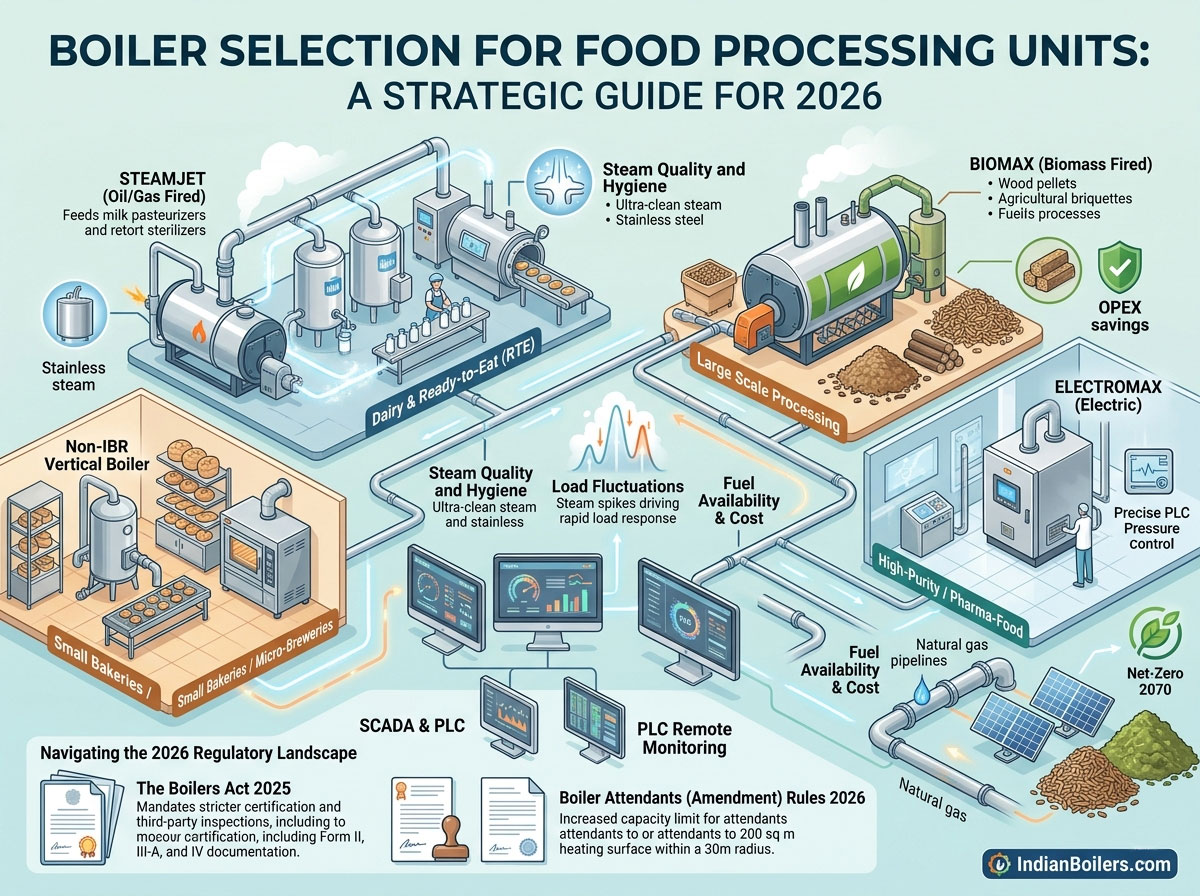
Boiler Selection for Food Processing: The Strategic Factors That Actually Decide It
In food processing, steam is genuinely the lifeblood of production — pasteurizing dairy, sterilizing cans, powering industrial ovens, driving CIP cleaning cycles. Your boiler choice directly touches product safety, operating cost, and regulatory compliance simultaneously, which makes this a genuinely higher-stakes decision than boiler selection in many other sectors. With the current Boilers Act, 2025 and its associated attendant certification rules now in effect, Indian food processors are operating under a framework worth understanding properly before making a purchasing decision.
This piece focuses on the strategic selection factors — steam quality, load pattern, fuel economics, and current compliance requirements — rather than repeating the detailed sector-specific application guidance already covered in our electric boilers for food, pharma & dairy and biomass heat for food processing posts, both worth reading alongside this one for the deeper application detail.
1. Steam Quality and Hygiene: The Non-Negotiable Starting Point
In food processing, steam frequently comes into direct contact with the product itself — steam injection into a process, direct culinary steam applications — which makes steam purity a genuinely different category of requirement than in general industrial heating.
Zero carryover matters concretely — liquid water droplets carried along with steam can transport dissolved boiler-water chemicals directly into food, a genuine food safety concern rather than a theoretical one. For applications requiring the highest purity assurance, stainless steel construction or dedicated clean-steam generation should be evaluated specifically, rather than assuming general industrial steam quality is automatically adequate for direct food contact.
2. Load Fluctuation: Why “Spiky” Demand Changes the Equation
Food processing frequently runs in batches — retort sterilization cycles, large kettle boils, CIP cleaning cycles between production runs — creating genuinely spiky steam demand rather than the steady load pattern some other industries experience.
A boiler with slow load response risks a pressure drop precisely when a batch process most needs stability — and in food processing specifically, an inconsistent sterilization or pasteurization cycle isn’t just an efficiency problem, it’s a food safety compliance risk. This is why rapid load response deserves real weight in your selection criteria, not just raw capacity.
3. Fuel Availability and Cost: A Regional, Not Universal, Decision
Fuel choice in food processing genuinely varies by what makes sense locally, and India’s continued push toward its Net-Zero 2070 commitment adds a sustainability dimension on top of the pure cost calculation.
Biomass and agro-waste — genuinely well-suited to facilities located in strong agricultural regions like Punjab, Maharashtra, and Gujarat, where local fuel access can meaningfully reduce operating costs. Our COMCUBE Series is engineered specifically for this application.
Electricity — best suited to urban, clean-room-adjacent environments where flue gas emissions are genuinely restricted or undesirable near sensitive processing areas.
Natural gas — remains a strong choice for clean combustion and high efficiency where reliable gas supply exists, particularly for facilities not located near strong biomass supply.
Rather than defaulting to whichever fuel a previous generation of equipment used, map your actual local fuel access and current pricing before committing — this genuinely differs by region in ways a generic recommendation can’t account for.
4. A Quick Orientation by Process Type
| Process Type | Starting Point | Key Consideration |
|---|---|---|
| Small bakeries / micro-breweries | Compact non-IBR vertical boiler | Space-saving, no dedicated boiler house required |
| Dairy and ready-to-eat processing | Oil/gas-fired system (e.g., STEAMJET) | High efficiency with clean, consistent combustion |
| Large-scale processing | Biomass-fired system (e.g., COMCUBE) | Meaningfully lower fuel cost where local biomass access is strong |
| High-purity or pharma-adjacent food processing | Electric system (e.g., ELECTROMAX) | Zero on-site emissions, precise PLC-based pressure control |
This is a starting orientation, not a final specification — actual capacity and technology choice should be confirmed against your specific load profile and local fuel access. Our electric boilers for food, pharma & dairy guide goes much deeper into the electric-versus-fuel-fired decision specifically for this sector.
5. Navigating the Current Regulatory Landscape
This is worth getting precisely right, since compliance errors carry real operational risk.
The Boilers Act, 2025 governs boiler registration, design certification, and third-party inspection requirements nationally, replacing the earlier 1923-era framework. Our dedicated guide to the Boilers Act, 2025 covers exactly what this involves for registration and inspection timelines.
Boiler attendant certification is governed by the current Boiler Attendants’ Rules, 2025, issued alongside the main Act. It’s worth being precise here rather than treating this as a brand-new relaxation: a second-class attendant certificate has, for some years now, permitted supervision of a single boiler — or a battery of up to three connected boilers — up to 200 square meters of aggregate heating surface, provided all boilers sit within a 30-meter radius on the same premises under the same owner. A first-class certificate extends this to boilers exceeding 1,000 square meters of heating surface. This is the current, established standard under the 2025 Rules — a useful planning figure for growing plants considering how many attendants their expansion will require, rather than a recent regulatory change specifically.
Documentation requirements for IBR-certified equipment include design approval, material certification, and inspection documentation as specified under the current Act — confirm the exact current form references and documentation package directly with your supplier or the relevant State Boiler Inspectorate, since specific form numbering is worth verifying against the latest official notification rather than assuming it matches older 1923-era terminology.
Safety infrastructure — modern installations should include SCADA/PLC integration for remote monitoring, supporting proactive incident prevention rather than purely reactive response.
6. What Genuinely Well-Engineered Equipment Should Include
Regardless of fuel choice, a properly specified boiler for food processing should include:
- IBR compliance verification through the current design, material, and hydrostatic testing process required under the Boilers Act, 2025.
- Quality pressure-vessel-grade steel construction, using recognized boiler plate material grades appropriate to your pressure and capacity requirement — confirm exact material specification with your supplier for your specific unit.
- Integrated efficiency equipment — economizers and air preheaters where appropriate to your fuel type, which measurably improve fuel economy over the equipment’s operating life.
- Automated water treatment and blowdown control, particularly important in food processing where water quality directly affects steam purity for any direct-contact application.
7. A Practical Selection Checklist
- Confirm whether steam will contact food directly — this single factor determines whether clean-steam-grade construction is a genuine requirement or a nice-to-have.
- Map your actual load pattern — steady versus batch-cyclical demand changes which load-response characteristics matter most.
- Confirm local fuel access and current pricing before committing to a fuel type, rather than defaulting to precedent.
- Verify current Boilers Act, 2025 compliance documentation directly with your supplier, and confirm attendant staffing requirements against your planned installation’s total heating surface.
- Build your actual cost comparison using current local fuel pricing — our biomass ROI framework covers the calculation methodology in detail.
Conclusion: Steam Quality and Compliance Both Deserve Real Weight
Boiler selection for food processing genuinely differs from general industrial selection in two specific ways: steam that may contact food directly demands a different purity standard, and the regulatory framework — now the Boilers Act, 2025 and its associated attendant rules — carries real operational consequences if misunderstood. Getting both of these right, alongside a properly matched fuel and load-response decision, is what separates a boiler that quietly supports your production from one that becomes a recurring operational risk.
Balkrishna Boilers Pvt Ltd engineers equipment across fuel-fired, biomass, and electric technology specifically for food processing applications. Explore the full range on IndianBoilers.com or Balkrishn.com.
Specifying a boiler for a food processing application? Contact our engineering team for a consultation covering your specific process, hygiene requirement, and current compliance obligations.
Related Reading
- Electric Boilers for Food, Pharma & Dairy: Safe, Clean Steam Solutions
- Biomass Heat for Food Processing: Matching the Right System to Steam, Water, and Air Needs
- The Boilers Act, 2025 – Download PDF
- Textile, Pharma, or Food: A Quick-Reference Guide to Matching Your Boiler
- The Biomass Boiler ROI Calculation: A Framework, Not Just a Percentage