
How Your Boiler Determines Your Plant’s Carbon Footprint — And How to Actually Reduce It
Of everything inside a typical industrial plant, few single pieces of equipment influence a company’s overall carbon footprint as directly as its boiler house. As India works toward its Net-Zero 2070 commitment, and as regulatory and buyer scrutiny on industrial emissions continues tightening, understanding exactly how your boiler contributes to your carbon number — and which levers actually move it — has become a genuine operational priority, not just an environmental one.
This guide breaks down the real mechanics of boiler-related carbon emissions and the specific, verifiable strategies available to reduce them. If you’re specifically weighing a biomass transition, our biomass vs. coal comparison and biomass ROI framework cover that specific decision in more depth than this piece needs to repeat.
1. The Basic Chemistry Behind Every Boiler’s Carbon Output
At the most fundamental level, boiler carbon emissions come from a straightforward chemical reaction: burning a fossil fuel combines the carbon within that fuel with atmospheric oxygen to form CO2, released through the stack.
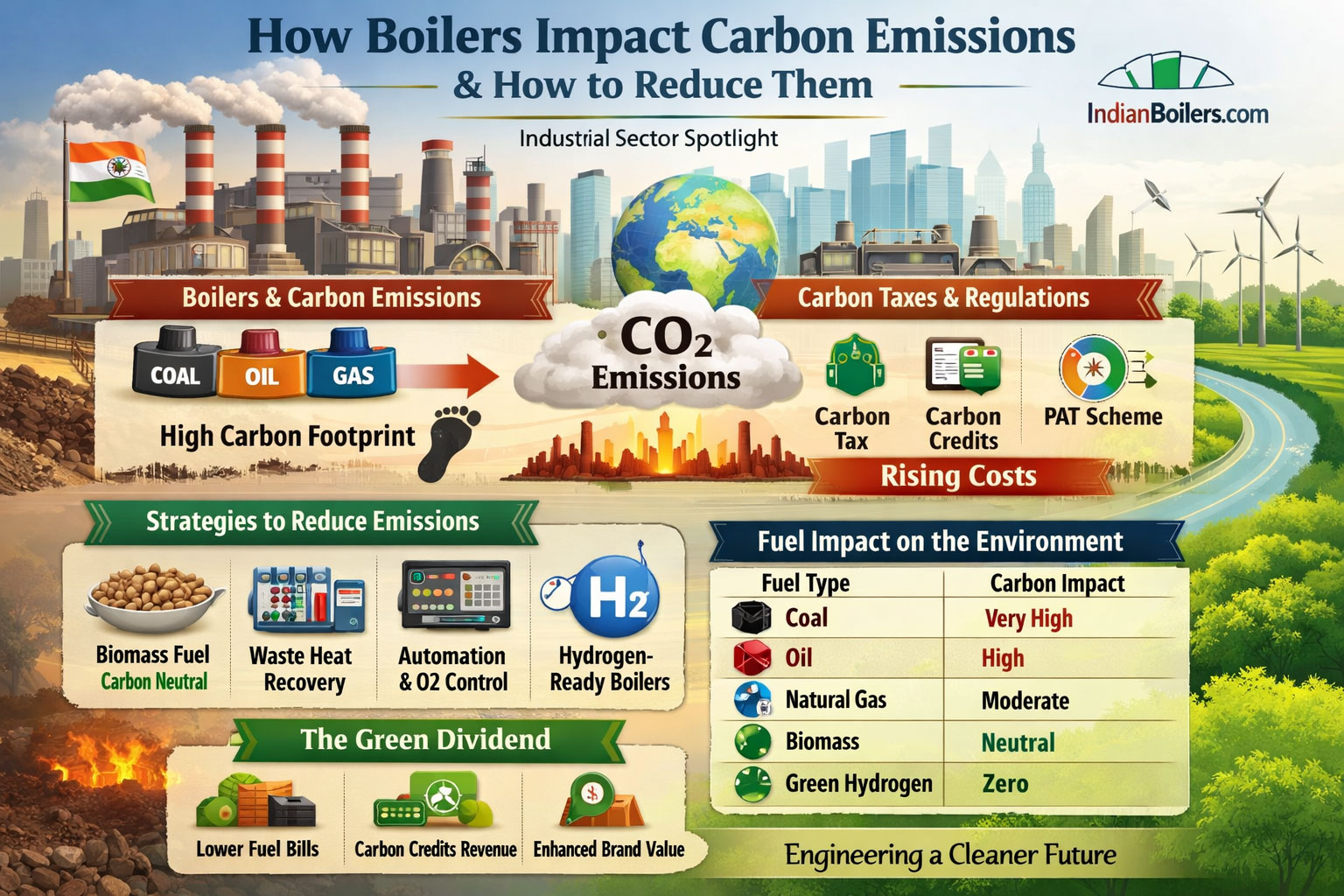
Fuel type determines carbon intensity directly:
- Coal carries the highest carbon intensity among common industrial fuels, alongside significant SOx and NOx emissions and ash by-product.
- Furnace oil and LDO remain highly polluting, with meaningful sulfur emissions alongside their CO2 output.
- Natural gas burns considerably cleaner than coal or oil on a per-unit-of-heat basis, but remains a fossil fuel — combustion still adds “new,” long-sequestered carbon to the atmosphere with no natural offsetting mechanism.
- Biomass is generally treated as carbon-neutral in sustainability accounting, since the CO2 released during combustion roughly matches what the source plant material absorbed from the atmosphere during its own growth cycle — a closed carbon loop, structurally distinct from fossil fuel combustion.
Incomplete combustion compounds the problem beyond CO2 alone — when fuel isn’t burned completely, it releases carbon monoxide and black carbon (soot), both of which carry meaningfully higher near-term warming impact than CO2 itself. This is a genuinely important point: a poorly-tuned boiler doesn’t just waste fuel, it actively worsens its emissions profile beyond what its fuel choice alone would suggest.
2. The Regulatory and Financial Picture, Stated Accurately
The cost of carbon is increasingly moving from an external environmental concern onto an actual balance sheet — but it’s worth being precise about which mechanisms genuinely apply to your specific business rather than assuming broad applicability.
The PAT (Perform, Achieve, Trade) scheme, administered by India’s Bureau of Energy Efficiency, sets specific energy consumption reduction targets for designated large energy-intensive industries and enables Energy Saving Certificate trading for those who exceed their targets. This applies to formally designated consumers in specific sectors — not automatically to every industrial facility — so confirm your plant’s designation status directly with the Bureau of Energy Efficiency rather than assuming eligibility.
Carbon credit and offset markets do allow verified emission reductions to generate tradeable value in various voluntary and compliance markets, but eligibility, verification requirements, and actual market value vary considerably by scheme and current market conditions — this is worth exploring with a qualified carbon markets consultant for your specific situation rather than treating it as a guaranteed, automatic revenue stream.
The EU’s Carbon Border Adjustment Mechanism (CBAM), in full operational phase as of January 2026, currently applies specifically to iron and steel, aluminium, cement, fertilizers, electricity, and hydrogen imports into the EU. If your exports fall within one of these six categories, the carbon intensity of your production process genuinely affects your cost competitiveness there. If your business operates outside these specific sectors, CBAM itself doesn’t directly apply to your exports — though broader buyer sustainability scrutiny in international B2B procurement remains a real, if less formally quantified, consideration regardless of CBAM’s specific scope.
3. Five Genuinely Effective Strategies to Reduce Boiler Emissions
A. Shifting to Carbon-Neutral Biomass Fuel
This remains the single most impactful lever available for most facilities. Transitioning from coal, furnace oil, or LDO to biomass briquettes, pellets, or rice husk meaningfully reduces net carbon emissions — the exact reduction depends on your baseline fuel and combustion efficiency, so treat any specific percentage figure as illustrative rather than a guaranteed outcome for your facility. Modern, purpose-engineered biomass systems, like our COMCUBE and STEAMAX ranges, are designed with combustion technology specifically suited to clean, complete biomass combustion rather than adapted from a fossil-fuel design.
B. Recovering Waste Heat
Every percentage point of thermal efficiency gained is directly a percentage point of avoided emissions. Installing economizers and air preheaters to capture flue gas heat that would otherwise escape unused typically delivers a genuine, measurable reduction in fuel consumption and corresponding emissions — our guide to modern boiler efficiency techniques covers exactly how these components work and what they realistically deliver.
C. Precision Combustion Control
Excess combustion air carries heat straight out the stack unused; insufficient air causes incomplete combustion and the black carbon problem covered above. Automated oxygen trim systems hold the air-fuel ratio precisely at the minimum level needed for safe, complete combustion, ensuring fuel converts to usable heat rather than smoke and wasted excess air — a genuine emissions and efficiency improvement that compounds over the equipment’s operating life.
D. Improving Steam Distribution
Emissions reduction doesn’t stop at the boiler shell — it extends through your entire steam distribution network. Poorly insulated steam lines lose substantial energy along their length. Faulty steam traps leak live steam continuously, forcing the boiler to work harder to compensate. Condensate recovery — returning hot condensate to the boiler rather than discharging it and using fresh cold feedwater — meaningfully reduces the energy needed to reheat incoming water. All three are genuine, often underexploited opportunities that don’t require any equipment replacement, just proper maintenance discipline.
E. Evaluating Hydrogen-Ready Design for the Future
As India’s National Green Hydrogen Mission scales over the coming years, blending hydrogen with natural gas combustion is emerging as a longer-term pathway toward substantially lower combustion emissions. Investing in equipment designed to be retrofittable for future hydrogen blending is a genuine forward-looking consideration for facilities planning equipment with a multi-decade service life — our hydrogen-ready boilers guide covers where this technology currently stands and its practical readiness for Indian industry today.
4. Fuel Comparison at a Glance
| Fuel Type | Carbon Impact | Primary Pollutants | General Sustainability Position |
|---|---|---|---|
| Coal | Very high | CO2, SO2, ash, NOx | Weakest |
| Furnace oil | High | CO2, sulfur, particulates | Weak |
| Natural gas | Moderate | CO2, NOx | Moderate |
| Biomass pellets/briquettes | Generally carbon-neutral | Minimal, closed-loop | Strong |
| Electric (grid-dependent) | Varies with grid mix, zero on-site | None on-site | Strong and improving as grid decarbonizes |
Electric boiler technology is worth including in this comparison specifically because its emissions profile improves automatically as India’s electricity grid continues shifting toward renewables — a genuine structural advantage over any combustion-based fuel choice, where the emissions profile is fixed by the fuel itself rather than improving over time. Our complete guide to industrial electric steam boilers covers this technology in full.
5. The Economic Case Alongside the Environmental One
Lower emissions and lower operating cost frequently point the same direction, for a straightforward reason: most emissions-reduction strategies covered above — better combustion control, waste heat recovery, reduced steam losses — are simultaneously fuel-efficiency improvements. A well-run, low-emission boiler house typically sees reduced fuel bills (because less fuel is being burned for the same output), reduced compliance risk and cost (fewer issues with pollution control board consent renewals), and improved standing with environmentally conscious B2B customers and investors increasingly scrutinizing supply chain emissions as part of procurement decisions.
6. Building Your Own Emissions Reduction Roadmap
Rather than a fixed case study result that won’t reflect your specific plant, here’s the actual framework worth applying:
- Establish your current baseline — your current fuel type, consumption, and, if available, actual stack emissions data from your most recent compliance audit.
- Identify your highest-leverage opportunity — for most coal or furnace-oil facilities, fuel switching to biomass typically offers the single largest reduction; for facilities already on cleaner fuel, waste heat recovery and combustion tuning often deliver more of the remaining opportunity.
- Calculate the combined cost and emissions case — using your actual fuel costs and consumption, not an industry average, following the same methodology as our ROI calculation framework.
- Confirm any applicable incentive or compliance program eligibility directly with the relevant authority — PAT designation, carbon credit market access, or export-market carbon requirements — rather than assuming applicability.
Conclusion: The Boiler House Is Where Your Carbon Number Actually Gets Decided
Reducing industrial carbon emissions is a genuinely multi-front effort — fuel choice, combustion precision, distribution efficiency, and forward planning for emerging technology all play a role. But the boiler house sits at the center of nearly all of it, which makes it the highest-leverage place to start for most Indian manufacturers working toward genuine emissions reduction rather than just a stated commitment.
Balkrishna Boilers Pvt Ltd designs equipment across fuel-fired, biomass, and electric technology, all engineered with efficiency and emissions performance as core design priorities. Explore our full range on IndianBoilers.com or Balkrishn.com.
Want a genuine carbon and cost audit of your current boiler house? Contact our engineering team for an assessment built around your actual fuel data and emissions profile.