
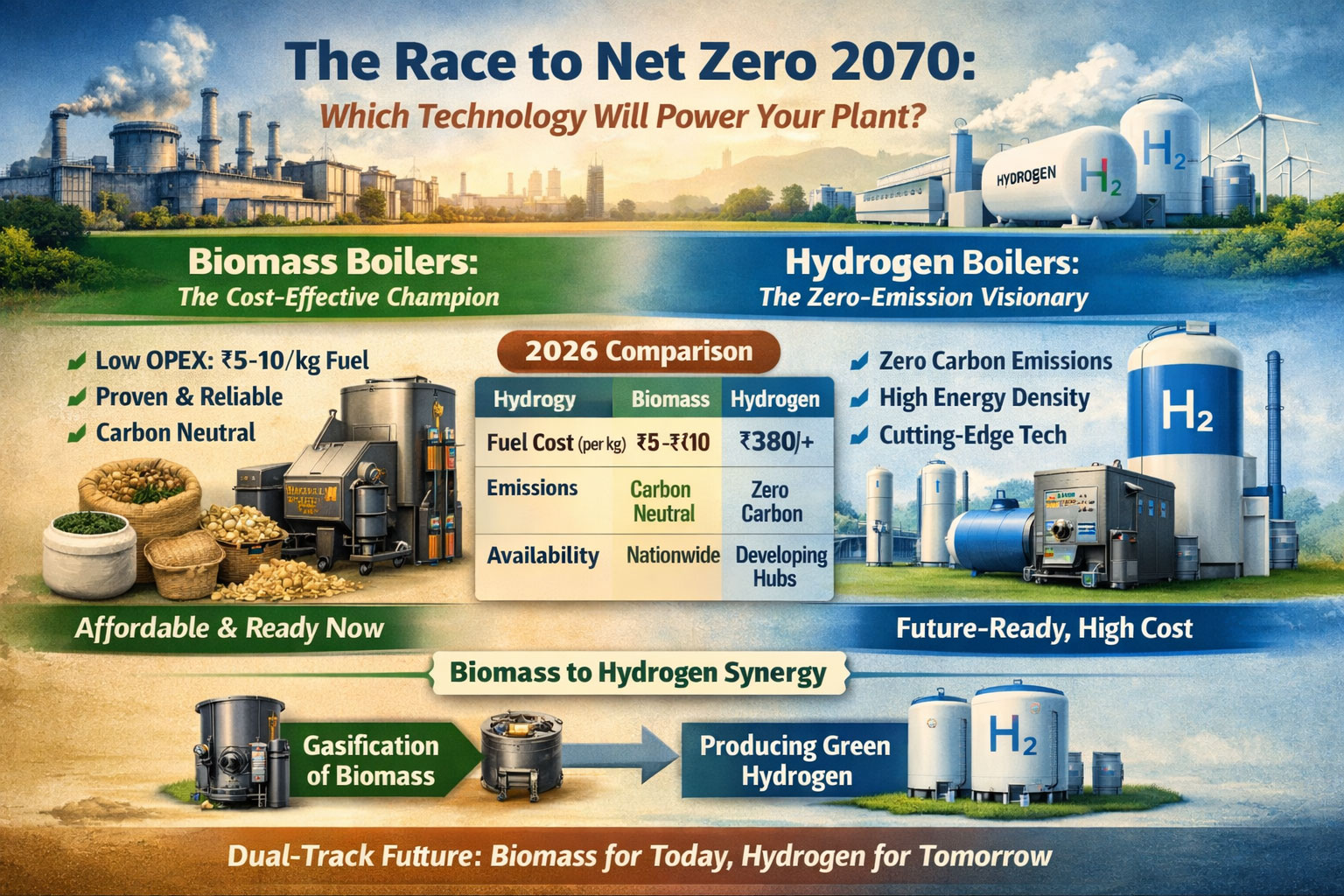
Hydrogen vs. Biomass: Two Different Timelines for Industrial Decarbonization
Every conversation about India’s industrial heating future eventually runs into this question: is hydrogen the real endgame, and is biomass just a stopgap until it arrives? The honest answer, grounded in where each technology actually stands in 2026 rather than where the press releases suggest they’ll be, is that these aren’t competing on the same timeline at all. Biomass is a mature, deployable, cost-effective solution available today. Hydrogen is a genuinely promising long-term technology still in early, subsidised, refinery-and-fertiliser-scale deployment — not yet a realistic option for most industrial plants. This piece lays out where each actually stands, verified against current data, so you can plan around reality rather than a narrative.
Biomass: The Deployable Option Today
Biomass boilers represent mature, refined combustion engineering — reciprocating grate and fluidized bed combustion (FBC) systems are well-understood, IBR-approved, and installed across thousands of Indian facilities in textiles, food processing, and pharmaceuticals. This maturity is exactly why biomass remains the practical default for most industrial decarbonization decisions being made right now.
The genuine advantages:
- Cost-effectiveness. With agricultural residues like rice husk, sawdust, and mustard stalk widely available through established regional supply chains, operating cost is commonly 20–50% lower than furnace oil or LDO on a per-unit-heat basis — the exact figure depends on your current fuel and local biomass pricing, so always confirm against your own invoice.
- Technology maturity. Decades of refinement mean biomass combustion systems are reliable, serviceable by a well-established technician base, and IBR-approved for immediate industrial deployment.
- Carbon-neutral combustion cycle. The CO₂ released during biomass combustion is part of the same short-term carbon cycle the crop absorbed during growth, a genuinely different accounting basis than fossil fuel combustion.
The genuine challenges:
- Logistics. Collecting and transporting low-density agricultural residue remains more complex than sourcing a centralized fossil fuel.
- Storage. Large-scale biomass storage needs real yard space and moisture protection to prevent fuel degradation.
Our Complete Guide to Biomass Boilers for Steam Generation and The Future of Biomass Boilers in India cover both sides of this in more depth.
Hydrogen: Genuinely Promising, Genuinely Early
Hydrogen’s appeal is straightforward on paper — combustion produces only water vapor at the point of use, with no carbon released at all. India’s National Green Hydrogen Mission, launched in 2023, targets 5 million tonnes per year of production capacity by 2030. As of February 2026, however, the country has commissioned only around 8,000 tonnes per annum of green hydrogen capacity — a genuinely early, small fraction of that target, and worth being precise about rather than rounding up to “hydrogen has arrived.”
Current pricing, verified against recent government data: competitive bidding under the mission has discovered green hydrogen supply prices in the range of ₹387–397 per kg (including GST) for supply to major refineries, with one recent tender for a large-scale project reaching as low as roughly ₹279 per kg. These figures come from large, subsidised, refinery-and-fertiliser-scale procurement — not pricing available to a typical mid-sized industrial boiler buyer today. India’s stated target is bringing costs down toward roughly $2 per kg by 2030, and independent analysts broadly agree that genuine cost competitiveness without subsidy is unlikely before 2030, and possibly not until 2032–2035 for many project configurations.
What this means practically: at current pricing, green hydrogen remains several times more expensive than biomass per unit of delivered energy, and — critically — is currently being deployed almost exclusively at large industrial scale (refineries, fertiliser plants) rather than through infrastructure a typical SME or mid-sized manufacturer could access directly today.
The genuine advantages, where hydrogen does apply:
- Zero point-of-combustion carbon. Unlike biomass’s lifecycle-neutral accounting, hydrogen combustion itself releases no carbon at all.
- High energy density, suited to very high-temperature processes that push beyond what other fuels handle comfortably.
- Hydrogen-ready boiler designs are entering the market — systems built to burn a blend of natural gas and hydrogen, allowing a gradual transition as hydrogen supply and pricing improve over the coming decade.
The genuine challenges:
- Cost, as detailed above, remains the primary barrier to adoption outside subsidised, large-scale procurement.
- Storage and handling safety. Hydrogen is a very small molecule prone to leakage and capable of embrittling certain metals over time, requiring specialised high-pressure storage and dedicated leak-detection systems.
- Production efficiency losses. Producing hydrogen via electrolysis and then combusting it involves meaningful energy conversion losses compared to burning biomass directly for the same heat output.
A More Honest Head-to-Head Comparison
| Feature | Biomass Boilers | Hydrogen Boilers |
|---|---|---|
| Fuel source | Agricultural residue, pellets, briquettes | Green hydrogen via electrolysis |
| Current availability for industrial buyers | High, established supply chains across most of India | Very limited — largely committed to refinery/fertiliser-scale procurement |
| Installation cost | Moderate | Very high, and infrastructure-dependent |
| Fuel cost (per kg, energy-equivalent) | Roughly ₹5–10/kg for common biomass fuels | Roughly ₹380–400/kg at current large-scale discovered pricing |
| Emissions | Carbon-neutral combustion cycle | Zero carbon at point of combustion |
| Maintenance focus | Ash management, grate wear | Leak detection, embrittlement monitoring |
| Realistic timeline for most industrial buyers | Available now | Likely 2030s for broad industrial accessibility |
The Genuine Bridge: Biomass Gasification to Hydrogen
It’s worth noting these two technologies aren’t purely competitors — there’s a genuine emerging pathway that combines them. Biomass gasification converts agricultural residue into a hydrogen-rich syngas under controlled conditions, offering a route to “bio-hydrogen” that leverages India’s existing biomass supply chains rather than depending entirely on electrolysis infrastructure that’s still being built out. This is a genuinely interesting area of ongoing development, though it’s worth noting it remains at a comparatively early stage of commercial deployment itself, similar to electrolysis-based green hydrogen — not yet a mainstream option for most industrial buyers today, but worth watching as the technology matures over the next several years.
A Practical Decision Framework
Biomass is the realistic choice today if:
- Your priority is immediate, achievable cost reduction against current fossil fuel spend
- You’re located in a state with strong agricultural residue availability — much of Punjab, Haryana, Gujarat, Maharashtra, and Uttar Pradesh qualify
- You need a reliable, high-uptime steam solution with a well-established service and technician base
- You want a genuine, achievable payback within 12–24 months rather than a multi-decade infrastructure bet
Hydrogen-ready design is worth considering, cautiously, if:
- You’re in a hard-to-abate sector (steel, heavy chemicals, fertiliser) where hydrogen is being actively piloted at scale, and your facility might realistically access dedicated hydrogen supply infrastructure as it develops
- You’re planning capital investment on a genuine 10–15 year horizon and want the option to blend hydrogen into your fuel mix as pricing and infrastructure improve, without committing to a hydrogen-exclusive system today
- You have direct access to committed, subsidised green hydrogen supply through a specific industrial cluster or offtake agreement — not a general assumption that supply will simply become available
For the overwhelming majority of Indian SMEs and mid-sized manufacturers, hydrogen isn’t a realistic near-term purchasing decision in 2026 — it’s a genuine long-term technology worth monitoring, not yet a competing option to biomass for most facilities. Our detailed piece on hydrogen-ready boilers: are they practical for Indian industries? goes deeper into this specific readiness question.
Why “Future-Proofing Against Carbon Taxes” Needs a More Precise Framing
It’s worth flagging directly: some comparisons of this kind frame hydrogen adoption as a way to “future-proof against carbon taxes” — implying a broad, imminent domestic carbon tax regime that every Indian manufacturer should hedge against today. That overstates where Indian carbon policy currently stands. India’s compliance carbon market (the Indian Carbon Market) applies to obligated entities in a defined set of energy-intensive sectors — aluminium, cement, chlor-alkali, pulp and paper, petroleum refining, petrochemicals, and textiles — above specific size thresholds, not a general carbon tax across all industry. If your business falls within one of those sectors, that’s a genuine, specific consideration worth planning around with a compliance consultant; if it doesn’t, “future-proofing against carbon taxes” isn’t an accurate description of your current regulatory exposure and shouldn’t be the primary justification for a hydrogen-readiness investment.
Where This Leaves Most Plant Managers
The honest 2026 conclusion is a dual-track reality rather than a single winner: biomass is the deployable, cost-effective solution available now for the vast majority of industrial heating needs, while hydrogen remains a genuinely important but still-maturing technology, currently accessible mainly to large-scale, subsidised industrial procurement rather than typical SME buyers. Choosing a “hydrogen-ready” biomass or gas system today — one engineered to accommodate a future fuel blend without requiring a wholesale replacement — is a reasonable way to keep future options open without betting your current operations on infrastructure that isn’t yet broadly available.
Our Approach
Balkrishna Boilers Pvt Ltd — IndianBoilers.com and Balkrishn.com — specialises in efficient, IBR-approved biomass systems that meet today’s practical decarbonization and cost-reduction needs, while staying informed on hydrogen-readiness developments as the technology matures. Our Steam Boiler range includes husk-specific HUSKPOWER and the compact COMCUBE system, alongside waste-heat-focused ENERPOWER.
Frequently Asked Questions
Can I buy a hydrogen-fired boiler for my plant today? Not practically, for most industrial buyers — green hydrogen supply is currently committed almost entirely to large-scale refinery and fertiliser procurement at subsidised pricing, not generally available to a typical mid-sized manufacturer. “Hydrogen-ready” designs exist, meaning a system built to accommodate a future hydrogen blend, but genuine standalone hydrogen combustion isn’t a realistic near-term option for most plants.
Is green hydrogen really that much more expensive than biomass? Yes, currently — verified 2026 discovered pricing for large-scale green hydrogen procurement runs roughly ₹380–400 per kg, compared to roughly ₹5–10 per kg for common biomass fuels. This gap is expected to narrow over the coming decade as production scales, but it remains substantial today.
Should I wait for hydrogen instead of switching to biomass now? For the overwhelming majority of industrial applications, no — biomass offers achievable, immediate cost savings and reliable technology today, while hydrogen’s broad industrial accessibility remains likely years away. Waiting means continuing to pay current fossil fuel costs in the meantime, with no guarantee of when hydrogen becomes practically available to your specific facility.
What does “hydrogen-ready” actually mean for a boiler I buy today? It typically means the combustion system is designed to accommodate a blend of natural gas and hydrogen as hydrogen supply develops, without requiring full replacement — a reasonable way to keep future options open, though it doesn’t mean hydrogen fuel is available to you now.
Does biomass gasification to hydrogen let me use hydrogen without waiting for national infrastructure? It’s a genuinely promising pathway that leverages existing biomass supply chains rather than depending entirely on electrolysis infrastructure, but it remains at a relatively early commercial stage itself — worth monitoring as it matures rather than treating as a currently accessible standard option.
Talk to Our Engineering Team
If you’d like a practical decarbonization strategy for your plant — grounded in what’s actually deployable today rather than a future timeline — get in touch with our engineering team or browse our complete product range.
Further reading: Hydrogen-Ready Boilers: Are They Practical for Indian Industries? · The Future of Biomass Boilers in India: Opportunities & Challenges · The Complete Guide to Biomass Boilers for Steam Generation · Multi-Fuel Boilers: The Future of Industrial Heating in India