
For decades, coal was the default fuel choice across Indian industrial boiler rooms — abundant, familiar, and backed by established supply chains. That default is under real pressure now. Rising compliance costs under India’s tightening air quality regulations, a significant 2025 GST restructuring that changed coal’s tax treatment, and mounting sustainability expectations from customers and regulators alike are all pushing plant owners to genuinely re-examine whether coal still makes sense — or whether biomass has closed the gap enough to switch.
This guide breaks down that comparison honestly — economics, compliance, equipment, and maintenance — rather than presenting biomass as an unconditional win. If you’re specifically weighing biomass fuel types against each other rather than against coal, our posts on biomass pellet vs. briquette performance and rice husk vs. mustard straw go deeper into fuel-specific decisions.
1. The Economics: What Actually Changed
Fuel Cost and Sourcing
Coal pricing is tied to national and international supply chains, mining logistics, and long-distance rail transport — costs that fluctuate with factors well outside any individual plant’s control. Biomass fuel — rice husk, wood waste, agro-residue briquettes, and pellets — is, by contrast, a genuinely hyper-local resource in many parts of India. In states with strong agricultural output like Punjab, Haryana, Gujarat, and Maharashtra, agro-waste feedstock is often available at meaningfully lower delivered cost than coal once transport logistics are factored in, though the exact savings vary significantly by region and season.
The GST Picture (Corrected for Current Rates)
This is worth getting right, since it materially affects the cost comparison: under a September 2025 GST Council reform, the tax rate on coal was raised from 5% to 18%, replacing the earlier flat compensation cess structure. Biomass briquettes and pellets, by contrast, continue to attract a comparatively low 5% GST rate under their applicable HSN classification. That’s a meaningful and currently accurate tax differential in biomass’s favor — worth confirming with your tax advisor at the time of purchase, since GST rates are periodically revised.
Payback Period
Because biomass fuel savings can be substantial relative to coal in regions with strong local feedstock supply, the additional capital cost of a well-specified biomass system is often recovered within a reasonably short period through operational savings — though the exact payback timeline depends heavily on your specific fuel cost differential, plant utilization, and boiler capacity, so it’s worth requesting a tailored calculation for your situation rather than relying on a generic industry figure.
2. Regulatory Pressure: Where Coal Is Genuinely Losing Ground
India’s air quality regulations have tightened meaningfully in recent years, particularly around particulate matter emissions from industrial combustion. The Commission for Air Quality Management (CAQM) has taken an increasingly active regulatory stance in the National Capital Region specifically, and industrial zones nationally face progressively stricter emission monitoring.
Coal-fired systems increasingly require investment in emission control equipment — electrostatic precipitators or flue gas treatment — to remain compliant, and non-compliance carries real operational risk, including potential closure notices in regulated zones.
Biomass combustion is generally treated as carbon-neutral in regulatory and sustainability accounting, since the CO2 released during combustion is broadly offset by the CO2 the source plant material absorbed during growth — a genuine environmental accounting advantage that increasingly translates into easier compliance pathways and stronger ESG positioning for businesses reporting to customers or investors on sustainability metrics.
3. Equipment: What’s Actually Available
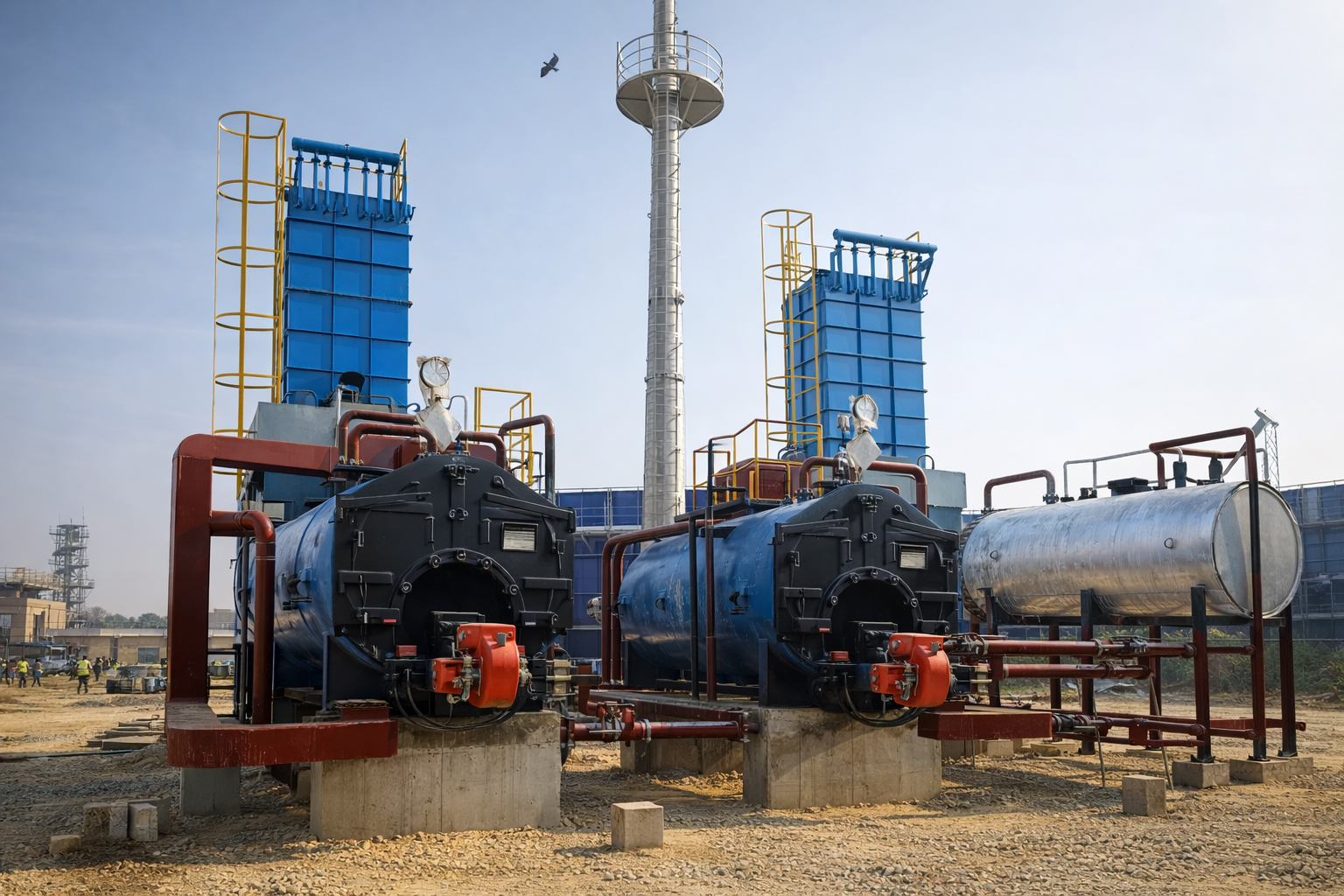
COMCUBE Series — Our modular, skid-mounted biomass steam boiler line, built for capacities suited to larger operations, with pre-insulated construction designed to reduce on-site installation time significantly compared to field-erected alternatives. The design supports Fluidized Bed Combustion configuration for handling lower-grade biomass or rice husk efficiently, and includes monitoring capability for tracking fuel consumption and steam output remotely.
For plants weighing biomass against oil or gas rather than coal specifically, our STEAMJET – Oil/Gas Fired Steam Boiler and our dedicated Biomass Boiler and Rice Husk Fired Steam Boiler lines cover the broader fuel-type comparison. And where fuel flexibility itself is the priority — hedging against seasonal biomass supply variability by retaining coal or wood capability — our post on multi-fuel boilers and the future of industrial heating in India covers that hybrid approach directly.
4. Maintenance: Addressing a Common Misconception
A persistent myth holds that biomass boilers are inherently less reliable or more maintenance-intensive than coal systems. In practice, the comparison depends heavily on fuel quality and combustion design, not on biomass as a category.
Ash content is one genuine, structural difference — coal typically leaves behind meaningfully more ash residue than good-quality biomass fuel, and coal ash has a greater tendency to clinker and damage grates over time, which is a real maintenance consideration worth weighing.
Corrosion tends to be less of a concern with biomass specifically because it generally contains negligible sulfur compared to many coal grades, which reduces the acidic corrosion that shortens the service life of chimneys and heat exchangers in coal-fired systems over time.
That said, biomass combustion quality varies significantly by fuel source and moisture content — inconsistent or poorly-sourced biomass fuel can introduce its own soot and efficiency issues, which is why fuel sourcing discipline matters as much as equipment choice. Our fuel moisture vs. boiler efficiency guide covers this in more technical detail.
5. Side-by-Side Comparison
| Factor | Coal | Biomass (COMCUBE and similar) |
|---|---|---|
| Fuel source | Mined, finite resource | Renewable, agro-waste derived |
| Carbon accounting | High carbon footprint | Broadly carbon-neutral |
| Current GST rate | 18% (as of the 2025 reform) | 5% on briquettes/pellets |
| Regulatory exposure | Increasing compliance burden in emission-controlled zones | Generally favorable regulatory treatment |
| Typical thermal efficiency | Roughly 70–75% in conventional designs | Roughly 82–88% in well-engineered modern systems |
| Ash and grate maintenance | Higher ash content, more clinkering risk | Generally lower ash content with good-quality fuel |
6. Where Coal Still Makes Sense
It’s worth being honest that biomass isn’t universally the better choice. Heavy metallurgical industries with process requirements specifically suited to coal’s combustion characteristics, and remote operations with captive coal mining access and limited biomass logistics, may still find coal the more practical option in the near term. The right call depends on your specific location’s fuel logistics, your regulatory exposure, and your process requirements — not a blanket industry recommendation either way.
7. Making the Switch, If You Decide To
- Confirm local biomass supply reliability before committing — seasonal availability varies by region and fuel type, and a boiler is only as good as its fuel supply chain.
- Size the system to your actual steam demand, not your current coal-fired capacity — biomass combustion characteristics differ enough that a direct one-to-one swap isn’t always the right engineering approach.
- Factor in current GST treatment when running your cost comparison, since the 2025 reform meaningfully shifted the math in biomass’s favor.
- Evaluate multi-fuel capability if biomass supply reliability in your region is uncertain, giving you a hedge against seasonal shortages.
- Confirm current pricing and specific ROI with our engineering team directly — fuel costs and equipment pricing both shift, so a tailored quote will always be more accurate than a general industry estimate.
Conclusion: The Case for Biomass Has Genuinely Strengthened, But It’s Not Universal
The economics have shifted meaningfully in biomass’s favor over the past year — particularly with the 2025 GST reform widening the tax differential between coal and biomass fuel — and the regulatory environment continues to make coal a progressively harder position to defend in emission-controlled zones. For the majority of Indian businesses without a specific process requirement or logistics constraint tying them to coal, biomass now represents a genuinely stronger long-term position on cost, compliance, and sustainability.
Balkrishna Boilers Pvt Ltd manufactures both technologies and can help you run the actual numbers for your specific location and fuel access. Explore the full range on IndianBoilers.com or Balkrishn.com.
Ready to see what a biomass transition would actually cost and save at your plant? Contact our engineering team for a tailored fuel and cost comparison.
Related Reading
- What is a Biomass Boiler?
- Biomass Pellet vs. Biomass Briquette: Which Fuel Gives Better Boiler Performance?
- Rice Husk vs. Mustard Straw: Which Biomass Fuel Offers Better ROI for Indian Factories?
- Multi-Fuel Boilers: The Future of Industrial Heating in India
- Biomass Boiler Emission Control Systems: A Complete Guide