
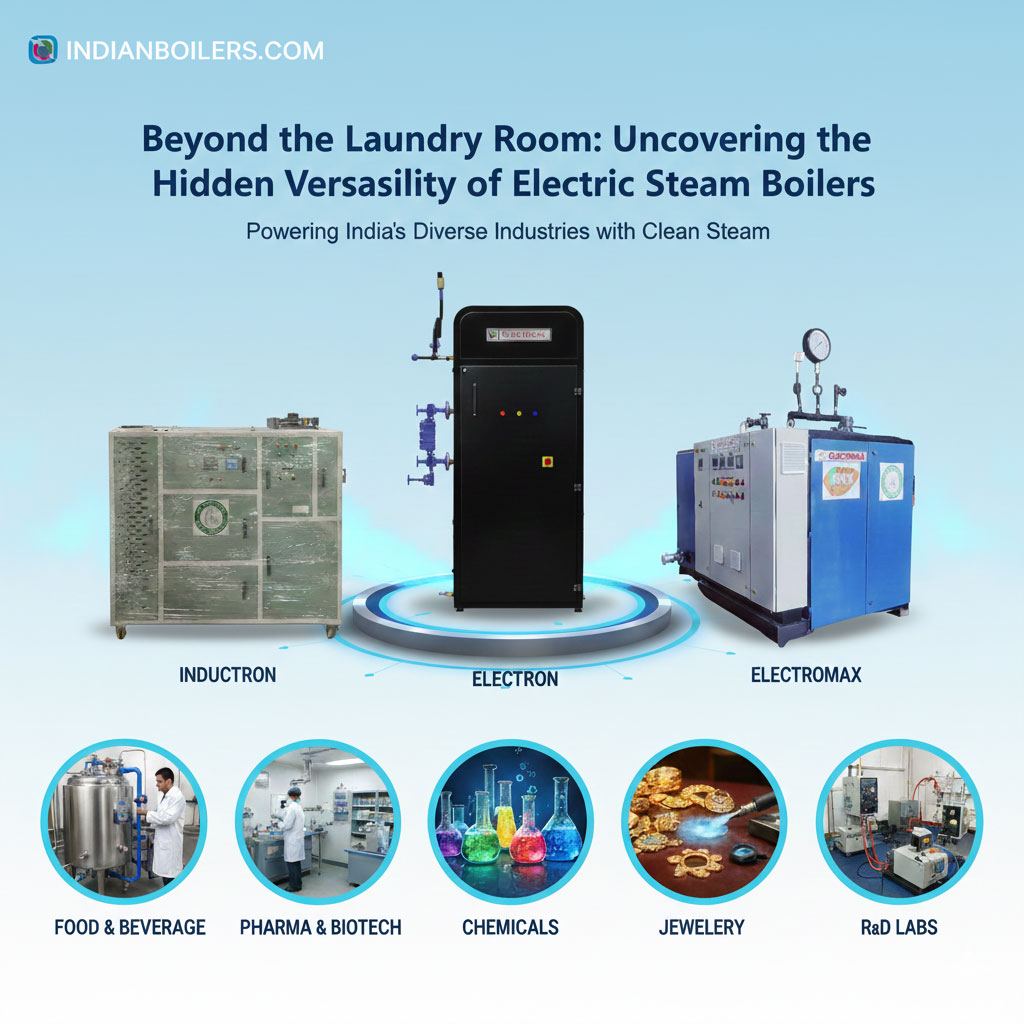
Mention “electric steam boiler” and most people picture a laundry press or a hospital autoclave — and fairly so, since those are genuinely common applications. But the same properties that make electric boilers work well there — zero on-site emissions, near-instant steam availability, and a compact footprint — turn out to matter just as much in a handful of niche industries that rarely come up in a typical product conversation.
This piece covers the applications that don’t usually make the list. We’ll touch briefly on food, pharma, and chemical processing since those are covered in depth elsewhere on this site — see our posts on electric boilers for food, pharma & dairy and thermic fluid heaters in the chemical industry for the full detail — and spend most of this post on the genuinely under-covered ground: research labs, precious metal refining, leather processing, and electronics manufacturing.
1. Food, Pharma, and Chemical: The Quick Version
These three sectors share one underlying reason electric steam fits well: any risk of combustion byproducts reaching a sensitive product is a risk these industries can’t accept, whether that’s food contamination, a failed sterility validation, or an unwanted reaction in a chemical process. ELECTRON and ELECTROMAX handle general process and sterilization steam across food and pharma applications, while the absence of an open flame in chemical processing environments — particularly around flammable solvents — is a genuine safety advantage independent of any efficiency argument. If these sectors are your primary interest, the linked posts above go far deeper than this section can.
2. Research and Development Labs: Where “Small But Precise” Matters More Than Volume
University research departments, corporate R&D centers, and scientific institutions rarely need large volumes of steam — but what they do need is precise, on-demand, intermittent steam that doesn’t require hours of lead time or dedicated fuel infrastructure crammed into a lab building.
Pilot plants testing a new industrial process at small scale before committing to full plant rollout need steam behavior that genuinely represents what the process will see at production scale — inconsistent or “dirty” steam from an improvised source can skew pilot results in ways that only show up once the process is scaled up and behaves differently than expected.
Material science applications — curing composite materials, testing steam resistance and thermal cycling on new material formulations — need tightly controlled, repeatable steam conditions across many test cycles, where run-to-run consistency matters more than raw output.
Environmental chambers simulating specific humidity and temperature conditions for product testing need steam generation that can start, stop, and modulate on a schedule dictated by the test protocol, not by a boiler’s own warm-up requirements.
Why electric fits so naturally here: A compact ELECTRON unit installs into lab spaces that were never designed around fuel storage, ducting, or flue venting — a genuine practical constraint in most existing lab buildings. Its rapid startup and shutdown mean it draws power only when a test actually requires steam, rather than idling on standby the way a combustion system effectively has to. For labs running intermittent, unpredictable testing schedules, that on-demand behavior alone often justifies the choice over a fuel-fired alternative sized for continuous operation it will rarely see.
3. Precious Metal Refining and Jewellery Manufacturing: Where Contamination Has a Price Tag
This is possibly the least obvious application on this list, and one of the most compelling once you understand why it matters. In precious metal work, contamination isn’t just a quality issue — it’s a direct financial loss, since even trace impurities introduced during processing can measurably affect the purity, and therefore the value, of gold, silver, or platinum output.
Degreasing and cleaning steps remove oils, polishing compound residue, and other impurities from metal components before further processing — and any contamination introduced by the cleaning steam itself defeats the entire purpose of the step.
Lost-wax casting, a foundational technique in jewellery and precious-metal component manufacturing, uses steam to melt wax out of investment molds before the metal pour — a process that depends on clean, consistent steam to produce a mold cavity free of residue that could affect the final casting’s surface finish.
Why electric fits so naturally here: The absolute cleanliness of electric-generated steam — no combustion particulate risk whatsoever — directly protects the purity of a material where purity is the entire basis of its value. Consistent, predictable pressure and temperature also mean more repeatable results across production runs, which matters in an industry where even subtle process variation shows up in the finished piece.
4. Leather Processing and Tanneries: An Underappreciated Fit
Leather tanning and finishing use steam at several stages — softening hides before processing, controlling humidity during finishing, and setting dyes and treatments into the leather surface. Tannery environments are often humid, chemically active spaces where combustion equipment adds both a fire-risk and an air-quality complication that most tannery operators would rather avoid entirely.
Electric steam generation removes the combustion risk from an already chemically sensitive environment, and the more precise temperature control available from staged electric heating helps avoid the surface damage that inconsistent steam temperature can cause during finishing — a real quality concern in an industry where visible surface defects directly affect the value of the finished leather.
5. Electronics and Semiconductor Manufacturing: Precision Above Almost Everything Else
Electronics and semiconductor cleanroom environments operate under some of the strictest contamination controls of any manufacturing sector, and humidity control within cleanrooms is a genuine process requirement, not just a comfort consideration — static discharge risk and certain fabrication steps are both humidity-sensitive.
Electric steam generation for cleanroom humidification avoids introducing any combustion particulate into an environment that’s otherwise filtered to an extraordinary degree — defeating a cleanroom’s filtration system with boiler-generated particulate would be a genuinely costly mistake. The precise, staged control available from electric heating also matches the tight humidity tolerances these environments require far better than a combustion system cycling on and off.
6. What All Five Applications Actually Have in Common
Step back from the specific industries, and a clear pattern emerges: every one of these applications values something other than raw steam volume. R&D labs value flexibility and on-demand response. Precious metal refining and electronics manufacturing value absolute purity. Leather processing values reduced fire risk in an already hazardous chemical environment. None of them are choosing electric because it’s cheaper on a per-tonne-of-steam basis — they’re choosing it because the alternative genuinely can’t meet a non-negotiable requirement specific to their process.
This is worth internalizing as a broader principle: the “best” boiler technology was never a universal ranking. It’s always a function of what your specific process actually can’t tolerate — and for a growing list of niche Indian industries, what they can’t tolerate is any risk of combustion contamination at all.
7. Matching Technology to These Niche Applications
| Application | Best-Fit Product | Why |
|---|---|---|
| R&D pilot plants, material testing | ELECTRON | Compact, rapid startup for intermittent use |
| Precious metal cleaning, lost-wax casting | ELECTRON / INDUCTRON | Absolute steam purity, no particulate risk |
| Leather tanning and finishing | ELECTRON / ELECTROMAX | Removes combustion risk from a chemically active environment |
| Cleanroom humidification (electronics) | ELECTRON with precise staged control | Avoids contaminating filtered cleanroom air |
| High-volume validated processes across all of the above | ELECTROMAX | IBR-rated capacity where scale is genuinely needed |
All of these are available on both IndianBoilers.com and the full Balkrishn.com catalogue.
Conclusion: The Common Denominator Is Purity, Not Volume
The applications covered here rarely show up in a typical electric boiler sales conversation, but they represent a genuine and growing share of where this technology earns its place — not because of efficiency percentages, but because combustion-based steam simply carries a contamination or safety risk these industries can’t accept. As Indian manufacturing continues to diversify into higher-precision, higher-value niches, this list is likely to keep growing rather than staying fixed at laundries and hospitals.
Balkrishna Boilers Pvt Ltd designs electric steam systems for exactly this kind of specialized, purity-critical application, alongside the higher-volume industrial and pharma work our other posts cover in depth. Explore the full range on IndianBoilers.com or Balkrishn.com.
Working in an application that doesn’t fit a standard category? Talk to our engineering team — we’ve likely encountered something similar before.
Related Reading
- The Complete Guide to Industrial Electric Steam Boilers
- Electric Boilers for Food, Pharma & Dairy: Safe, Clean Steam Solutions
- Where Electric Boilers Are Actually Being Installed Right Now
- Electric Boiler Technology: From Immersion Elements to Electrode Types
- Thermic Fluid Heaters in the Chemical Industry: The Ultimate Safety Guide