
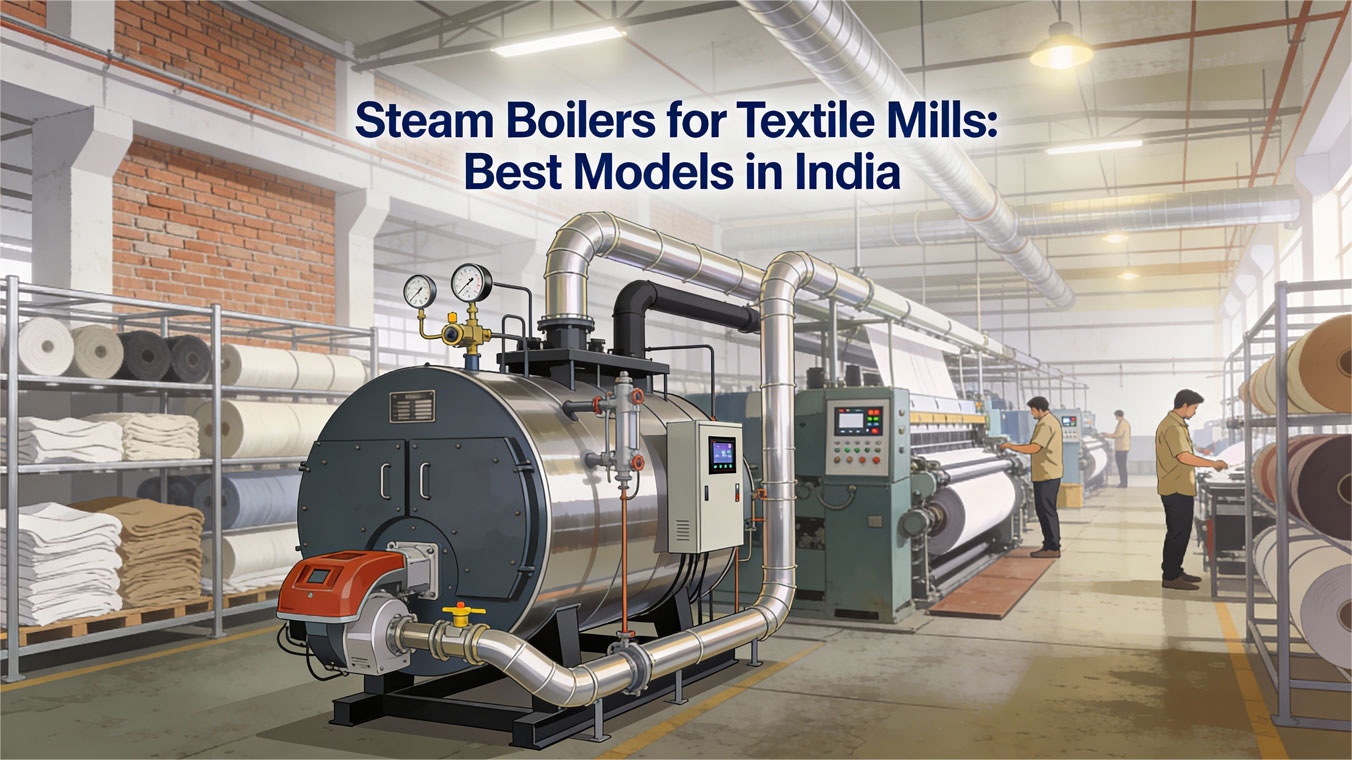
Textiles remain one of India’s largest employers, providing work to more than 45 million people and contributing roughly 2–2.3% to national GDP — and steam sits at the center of almost every stage that fabric passes through, from yarn conditioning to dyeing, sizing, and finishing. One figure puts the scale of this in perspective: dyeing alone accounts for something close to 43% of the entire textile industry’s total energy consumption. Get the boiler behind that process wrong, and it doesn’t just cost you fuel — it shows up directly in fabric quality and production uptime.
This guide walks through what actually differentiates a well-matched steam boiler from a poorly-fitted one for textile applications specifically — the load pattern, the fuel logic, the pressure requirements by process stage — rather than presenting a generic model comparison. If you’re weighing electric technology against traditional fuel-fired systems for your mill, our complete guide to industrial electric steam boilers covers that decision in depth.
1. Why Textile Steam Demand Is Its Own Engineering Problem
Textile processing isn’t a single, steady steam load — it’s several distinct processes stacked together, often running simultaneously on staggered schedules, each with a different pressure, temperature, and consistency requirement.
Yarn conditioning and humidification in spinning needs low-pressure, continuous steam to maintain fiber moisture content within a narrow band — too dry and yarn breaks during processing, too humid and it clumps.
Dyeing is where the sharpest load swings happen: heating a dye bath to temperature draws a significant demand spike, then the bath holds while the batch soaks, then the next batch spikes again. Multiplied across dozens of dye machines on staggered cycles, this creates a genuinely pulsating overall plant load that a boiler has to absorb without pressure instability — because pressure instability during dyeing directly risks uneven color uptake and batch-to-batch inconsistency.
Sizing and finishing need stable, moderate-pressure steam for extended periods, closer to a continuous process load than dyeing’s spiky pattern.
Heat setting and stentering (for synthetic and blended fabrics) push toward the higher end of temperature requirements, sometimes better served by high-temperature thermal fluid heating than steam at all.
Recognizing which of these four patterns dominates your specific mill’s operation is the actual starting point for boiler selection — not capacity alone.
2. Matching Boiler Technology to the Load Pattern
High-Volume, Cyclical Steam: The Dyeing Problem
The sharp spike-and-soak pattern in dye houses needs a boiler that can absorb rapid demand changes without pressure sag. Our STEAMJET – Oil/Gas Fired Steam Boiler delivers the fast combustion response and precise control that gas and oil firing allow, well suited to mills where fuel supply is reliable and dye-quality consistency is the top priority.
For mills with access to biomass fuel, STEAMGEN – Wood/Briquette Fired Steam Boiler handles the same cyclical demand at scale using rice husk, wood, or briquette fuel — a genuinely cost-effective option in regions with strong local biomass availability.
ELECTROMAX – Electric IBR Steam Boiler is worth serious consideration here too — its staged electric elements respond to demand spikes essentially instantly, arguably even more precisely than combustion systems recovering from a load jump, and it removes fuel storage and combustion emissions from a process area entirely. Our post on 7 key benefits of switching to an electric boiler system covers this trade-off further.
High-Temperature, Low-Pressure: Heat Setting and Stentering
Where the requirement is very high temperature without the complexity of high-pressure steam, ELECTROPAC – Electric Thermic Fluid Heater delivers precise, flameless heat via thermal fluid rather than steam — a genuinely better fit for stentering and heat-setting lines than trying to push a steam system to temperatures it wasn’t optimized for.
Continuous, Stable Demand: Sizing and General Utility
Steady, moderate-pressure loads suit either STEAMJET or a compact ELECTRON – Electric Steam Boiler, depending on whether fuel logistics or zero-emission operation is the higher priority for that part of the mill.
Hard-Water Regions
Many textile clusters sit in areas where water hardness accelerates scale formation in any resistance-based system. Where that’s a known issue, INDUCTRON – Induction Boiler‘s non-contact induction heating avoids the direct water-contact scaling that shortens element life in resistance systems — a meaningful long-term maintenance advantage in the right water conditions.
3. Fuel Choice: A Genuinely Regional Decision
Fuel logistics matter more in textiles than almost any other sector, because mill locations cluster heavily around specific regional fuel availability.
Biomass-rich regions — where rice husk, cotton stalk, or wood waste is abundant and cheap — favor STEAMGEN-class solid fuel systems, and Fluidized Bed Combustion designs specifically handle the variable moisture content common in agricultural residue fuels efficiently.
Gas-connected urban and industrial clusters favor STEAMJET, trading a typically higher per-unit fuel cost for faster startup (minutes rather than hours for solid fuel) and more precise combustion control — a real advantage for time-sensitive dyeing schedules.
Electric power availability and tariff structure increasingly make ELECTROMAX and ELECTRON viable even where they weren’t a decade ago, particularly for mills that can shift a meaningful share of steam-intensive processing into off-peak tariff windows. Our electric steam boiler sizing guide covers how that kind of tariff-driven strategy factors into a capacity decision.
Rather than defaulting to whatever fuel type a previous generation of equipment used, it’s worth actively reassessing local fuel and tariff economics against current prices — that calculation shifts meaningfully over a boiler’s 15–20 year service life.
4. Design Features That Actually Matter for Textile Applications
Automatic blowdown and low-water cutoff systems aren’t optional extras in continuous mill operation — they’re the baseline safety features that prevent the majority of preventable boiler incidents, and they matter more in 24/7 dyeing and processing environments than in intermittent-use applications.
Modulating combustion or staged electric elements prevent the wet steam that damages fabric quality — steam carrying entrained water droplets, often caused by a burner or element bank cycling hard between on and off rather than modulating smoothly, can leave visible marking or uneven dye uptake on finished fabric.
Corrosion-resistant construction matters specifically because mill environments run humid — steam processing itself adds ambient moisture to the plant floor, and equipment not built for that environment ages faster than the same design would in a dry industrial setting.
PLC-based monitoring with remote alerting for scale buildup, pressure anomalies, or maintenance needs increasingly separates well-run mills from ones firefighting unplanned downtime — our post on how AI and IoT are transforming boiler operations covers how this technology is changing predictive maintenance across the sector.
5. Installation and Water Treatment Specifics for Mill Environments
Textile mill boiler installations need careful site assessment — adequate foundation stability, appropriate distance from processing areas for safety and heat management, and correct venting for exhaust temperatures in fuel-fired systems.
Water treatment discipline deserves particular emphasis in textile applications specifically, because dyeing chemistry is sensitive to water quality in a way general industrial processes aren’t — foaming or contamination in a dye bath from poorly treated feedwater or blowdown water doesn’t just hurt boiler efficiency, it can compromise the batch itself. Regular blowdown to control total dissolved solids, disciplined softening for hard borewell water common across many textile clusters, and consistent monitoring are worth treating as production-quality controls, not just boiler maintenance line items.
6. Regulatory Compliance for Textile Boiler Installations
Any boiler operating above the relevant pressure and capacity thresholds must be registered and inspected under The Boilers Act, 2025, which replaced the earlier 1923-era regulatory framework. Required safety fittings — safety valves, water level gauges, and appropriate pressure-relief mechanisms — apply identically across textile applications and any other industrial use; there’s no sector-specific exemption for mills. Given the flammability of certain textile processing environments, particularly where oil-based dyes or finishing agents are present, flameproof electrical fittings around the boiler installation are a genuine safety requirement worth confirming with your installer, not an optional upgrade.
7. A Practical Selection Process
- Calculate actual steam demand by process stage, not just an overall plant estimate — dyeing, sizing, and finishing have different profiles and may be better served by different equipment rather than one oversized central system.
- Confirm local fuel or electrical tariff economics rather than defaulting to whatever your mill has always used.
- Match pressure requirement to process — most general textile processing sits in a moderate pressure range, with higher-temperature stentering applications sometimes better served by thermal fluid than steam pressure at all.
- Prioritize load responsiveness for dye-heavy operations specifically, since pressure instability here has a direct fabric-quality consequence that other applications don’t carry.
- Factor water quality into the resistance-versus-induction decision if electric technology is on the table, given how common hard water is across Indian textile clusters.
Conclusion: The Right Boiler Follows the Process, Not the Mill Type
“Steam boiler for textile mills” isn’t really one specification — it’s several, depending on whether your mill’s dominant load is dyeing’s sharp cycles, sizing’s steady demand, or stentering’s high-temperature requirement. Getting that match right protects both fuel efficiency and, just as importantly, the fabric quality that depends on stable, consistent steam delivery.
Balkrishna Boilers Pvt Ltd manufactures across the full range relevant to textile applications — fuel-fired systems like STEAMJET and STEAMGEN, and electric systems like ELECTROMAX, ELECTRON, INDUCTRON, and ELECTROPAC. Explore the complete range on IndianBoilers.com or the full catalogue on Balkrishn.com.
Ready to match the right boiler to your mill’s actual process mix? Contact our engineering team for a site audit covering your specific dyeing, sizing, and finishing steam demand.