
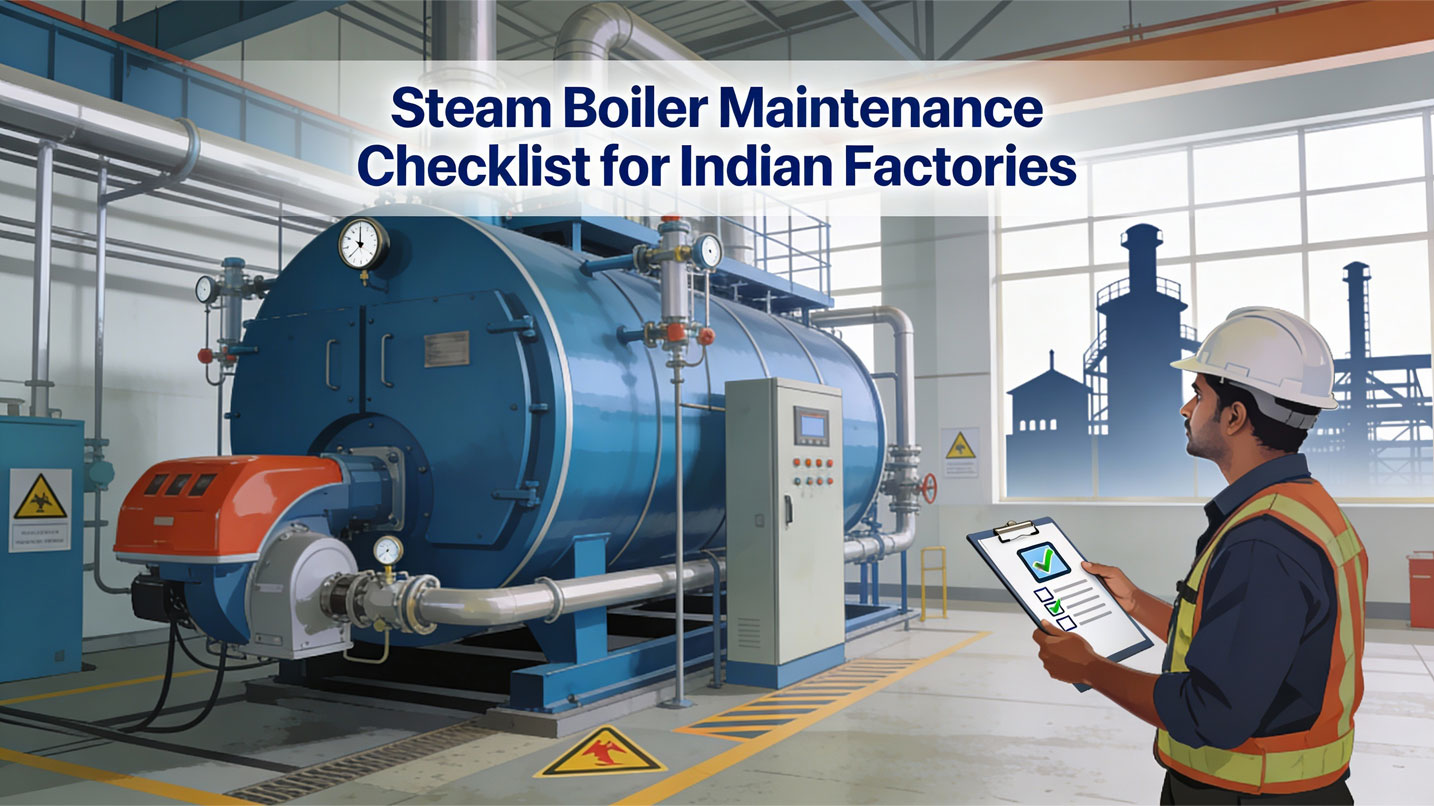
Most boiler failures don’t happen because of a single dramatic malfunction — they happen because a small, easily catchable issue got missed for weeks or months until it became an expensive one. A slightly sticky low-water cutoff valve, a burner running a fraction rich on fuel, a gasket that’s just starting to harden — none of these stop production the day they appear. All of them will, eventually, if nobody’s checking.
This is a practical, structured maintenance checklist for steam boilers operating under Indian industrial conditions — hard water in many regions, dusty environments, variable fuel quality, and monsoon humidity that all add wear a temperate-climate maintenance schedule wouldn’t anticipate. If your plant is weighing whether some of this maintenance burden is worth escaping entirely, our 7 key benefits of switching to an electric boiler system post covers how much of this checklist simply disappears with electric technology — more on that toward the end.
1. Why This Matters More in Indian Operating Conditions
Boilers running in India face a specific combination of stresses that a generic maintenance schedule doesn’t account for. Hard water in many regions accelerates scale formation on heating surfaces far faster than in areas with naturally soft water supply. Dusty industrial environments clog burner ports and air intakes more aggressively. Variable fuel quality — particularly with biomass and agro-waste fuels — means combustion tuning needs more frequent attention than a single calibration would provide. And humid monsoon conditions add corrosion risk to electrical control panels and exposed metal components that dry-climate maintenance guides simply don’t emphasize.
A disciplined maintenance schedule addresses all of this directly — not by adding unnecessary work, but by catching the specific failure modes these conditions actually produce, before they become downtime.
2. Daily Checks: 15–30 Minutes That Prevent Most Major Breakdowns
Daily checks are the foundation of boiler reliability — quick, visual, and catch the majority of developing issues before they escalate.
| Task | What You’re Checking | When |
|---|---|---|
| Water level | Sight glass shows proper level; top up with treated feedwater if low | Start of shift |
| Pressure gauge | Steam pressure within normal operating range; note any anomaly | Log at least twice daily |
| Burner flame | Stable flame with no soot or flickering — a sign of poor air-fuel mix | During operation |
| Leak inspection | Visual scan of pipes, valves, and boiler body for water, steam, or fuel leaks | Full walkaround |
| Low-water cutoff test | Blow down the LWCO valve; confirm the burner shuts off before water drops out of sight-glass view | End of shift |
| Bottom blowdown | Open the mud drum valve briefly to remove settled sludge | Once daily, while hot |
| Venting check | Confirm chimney and vents are clear of debris or blockage | Quick external check |
In dusty environments especially, cleaning burner ports as part of the daily routine — rather than waiting for a scheduled deeper clean — prevents the incomplete combustion that quietly drives up fuel consumption without an obvious symptom.
3. Weekly Tasks: The Mechanical Layer
Weekly maintenance addresses the mechanical components under continuous wear from round-the-clock operation, common across Indian MSME facilities running multiple shifts.
- Linkage and damper inspection — tighten burner linkages, test air dampers for smooth movement, lubricate anything sticking
- Valve functionality — manually operate fuel shutoff valves, confirming free movement with no leakage
- Pilot and igniter check — clean the pilot assembly, inspect electrodes for cracking, verify stable ignition
- Control circuit test — cycle the operating controls, high-limit switch, and flame safeguard system, noting response time
- Gasket examination — check front and rear door gaskets for hardening or wear, replacing before they fail rather than after
- Pump alignment — check feedwater pump alignment and vibration, lubricate bearings as needed
- Wiring condition — scan the control panel for frayed wiring or loosened connections, especially relevant given monsoon humidity’s effect on electrical components over time
For coal or biomass-fired systems, add a weekly firebox ash sweep to this list.
4. Monthly Procedures: Where Precision Tools Come In
Monthly maintenance typically requires a brief partial shutdown and instruments like a combustion analyzer or multimeter for accurate readings rather than visual inspection alone.
- Combustion tuning — adjust air-fuel ratio using a combustion analyzer for optimal oxygen and low CO readings; clean the burner diffuser
- Safety valve testing — lift-test relief valves to confirm they pop at the correct set pressure; this is the single most safety-critical item on the entire checklist
- Flue gas piping inspection — check for corrosion, blockage, or leaks; clean soot accumulation from tubes
- Water chemistry analysis — test pH, total dissolved solids, and hardness, dosing softeners or corrosion inhibitors as needed
- Refractory check — inspect furnace lining for cracking, patching promptly with refractory cement before a small crack becomes a structural issue
- Electrical safety check — test ground continuity and overload relays; clean accumulated dust from the control panel
- Blowdown separator check — verify the cooler and drain are functioning correctly
In hard-water regions especially, monthly TDS-driven blowdown discipline is one of the highest-leverage items on this entire list — scale buildup measurably reduces heat transfer efficiency, and catching it monthly rather than quarterly prevents compounding loss.
5. Quarterly Deep Dives
Every three months, maintenance moves from routine checks into genuine inspection work, ideally carried out by a qualified technician rather than general plant staff.
- Tube cleaning — brush fireside soot and waterside scale from tube surfaces
- Gas train leak testing — verify shutoff valve seat tightness with proper leak-detection methods
- Control calibration — verify modulating controls and setpoints against manufacturer specification
- Condensate system flush — check return lines for corrosion, test steam traps for correct operation
- Insulation audit — repair any damaged lagging, since heat loss through degraded insulation compounds quietly over months if left unaddressed
6. Annual Overhaul: The Non-Negotiable Deep Service
Annual maintenance involves a full shutdown of several days and should be carried out by properly qualified, certified technicians — this is also the point at which registration renewal requirements under The Boilers Act, 2025 typically come into play, so it’s worth coordinating your overhaul schedule with your renewal timeline rather than treating them as separate calendar events.
- Full disassembly — drain, open manholes, flush internal scale and sediment
- Burner overhaul — disassemble, clean nozzles and electrodes, recalibrate scanners
- Tube integrity testing — ultrasonic thickness gauging to identify tubes needing replacement before they thin further
- Safety valve certification — bench-test and reseal per current regulatory requirements
- Refractory rebuild — replace damaged brick, reapply wash coat
- Hydrostatic testing — pressurize above normal operating pressure to verify joint and structural integrity
- Full internal and external survey — inspect for cracking, erosion, or any structural concern
Keep detailed records of every stage — under current regulation, maintaining documented maintenance and inspection history isn’t just good practice, it’s expected as part of your compliance record, and it materially affects resale value if the equipment is ever sold or transferred.
7. Common Failure Patterns Worth Recognizing Early
Scale buildup shows up first as gradually rising fuel consumption and, eventually, wet steam quality — the fix is disciplined water treatment and blowdown, not a bigger burner.
Soot accumulation from lower-grade fuel creates hot spots on tube surfaces — weekly cleaning and, where feasible, a shift toward cleaner-burning fuel sources both help.
Repeated low-water trips usually point to an auto-feed valve issue rather than a sensor fault — check the valve before assuming the safety system itself is malfunctioning.
Unusual vibration almost always signals pump or component misalignment — catching this at the quarterly realignment check prevents it from becoming a bearing failure.
8. Tracking the Metrics That Actually Tell You Something
Rather than just completing checklist items, track a small number of KPIs that reveal whether your maintenance program is actually working:
- Fuel-to-steam ratio — a rising trend over time is often the earliest sign of scale or combustion inefficiency, well before it shows up as a visible symptom
- Blowdown rate — should stay within an efficient range; excessive blowdown wastes both water and the heat already invested in it
- Unplanned downtime frequency — the ultimate measure of whether your preventive schedule is actually preventing anything
Digital monitoring is increasingly making this kind of tracking automatic rather than manual — our post on how AI and IoT are transforming boiler operations covers how predictive sensors are catching developing issues before they’d show up on a manual weekly check at all.
9. What Changes If You’re Running Electric
It’s worth being direct about this: a meaningful portion of the checklist above exists specifically because of combustion — burner tuning, flame safeguard testing, flue gas inspection, soot cleaning, refractory maintenance. None of that applies to an electric system like ELECTROMAX or INDUCTRON, because there’s no combustion process generating those failure modes in the first place.
What remains for electric systems is largely the water-side items — water chemistry, blowdown, scale monitoring — plus periodic inspection of heating elements or, in INDUCTRON’s case, the induction core, which is inherently more scale-resistant than a submerged resistance element. For plants weighing the ongoing maintenance burden as part of an equipment decision, that reduction in checklist scope is a genuine, measurable operational benefit, not just a marketing claim — our complete guide to industrial electric steam boilers covers this comparison in more depth.
10. Training and Documentation
Proper operator training matters as much as the checklist itself — an untrained operator following a checklist mechanically will still miss the judgment calls that experience teaches, like recognizing an abnormal flame color or an unusual vibration before it’s flagged by an instrument. Maintain digital logs where possible; trend data over months reveals gradual efficiency drift that a single day’s readings never will, and current regulation expects maintained inspection and maintenance records as part of your ongoing compliance position.
Conclusion: Consistency Beats Intensity
The plants that get the most out of a maintenance program aren’t the ones doing the most intensive annual overhaul — they’re the ones that never skip the boring daily and weekly items, because that’s where developing problems actually get caught while they’re still cheap to fix. A structured, consistently followed checklist, tailored to Indian operating conditions, does more for uptime and safety than any single deep-service event.
Balkrishna Boilers Pvt Ltd supports maintenance and compliance audits across the equipment we install — fuel-fired and electric alike. Explore the full range on IndianBoilers.com or Balkrishn.com.
Want a maintenance schedule tailored to your specific boiler and operating conditions? Contact our engineering team for a site audit and customized checklist.