
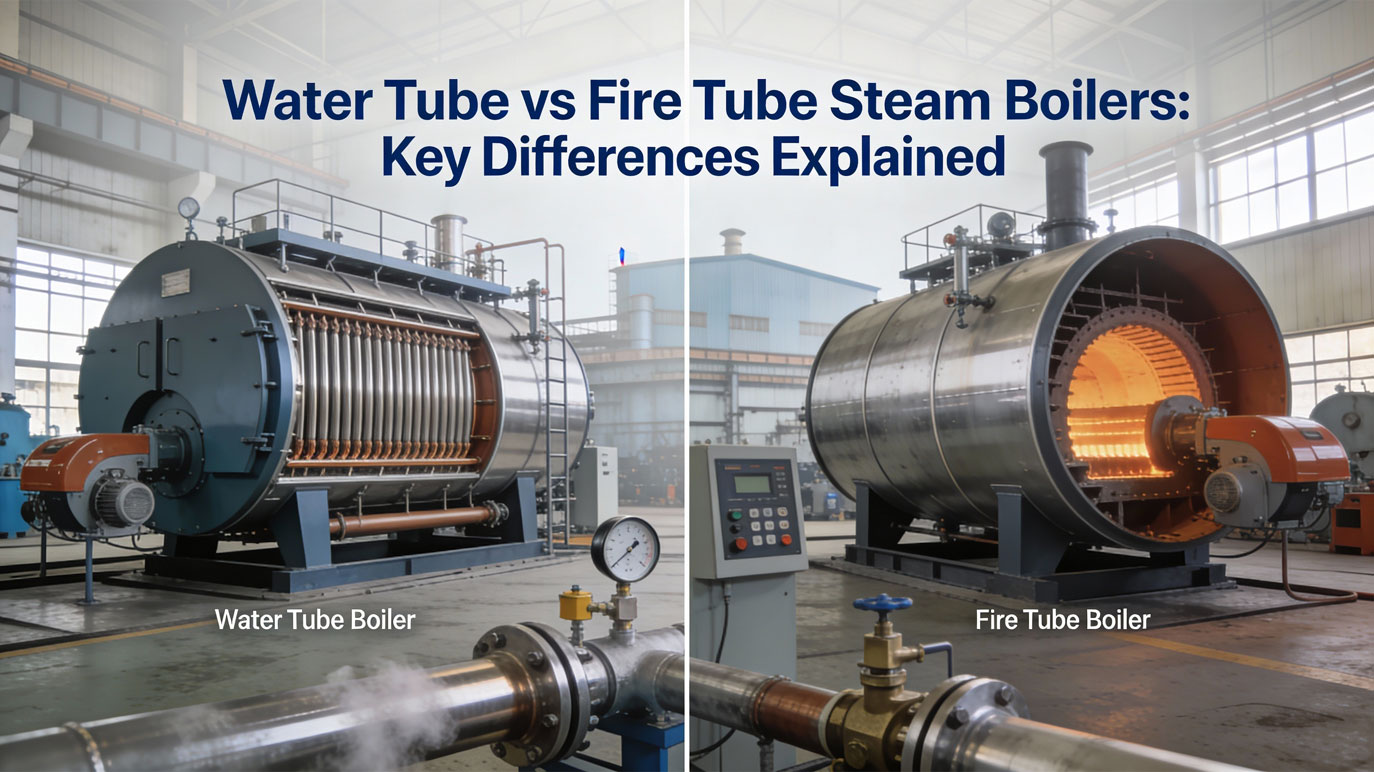
Every steam boiler sold in India falls into one of two fundamental design families, and the difference between them isn’t a minor engineering footnote — it determines your maximum achievable pressure, how fast you can respond to demand swings, your footprint, and ultimately whether the boiler will actually keep up with your process or become the bottleneck in your plant.
The two families are fire-tube and water-tube, and the distinction comes down to one simple question: does the hot gas travel through the tubes, or does the water? That single design choice cascades into nearly every other performance difference between them. This guide breaks down exactly how, and where each one genuinely belongs. For the full foundational picture of how steam boilers work, our post on what a steam boiler is is a useful companion read.
1. The Core Design Difference
Fire-tube boilers route hot combustion gases through tubes that sit submerged in a surrounding shell full of water. The gas heats the tube walls from inside, and that heat transfers outward into the water bath, generating steam that collects in the upper section of the shell. It’s a design that’s been refined for well over a century — simple, mechanically robust, and forgiving of variable loads because of the large water volume acting as thermal ballast.
Water-tube boilers reverse the arrangement entirely: water flows inside the tubes, while hot combustion gas surrounds them from outside. Because the water sits in a much smaller volume per tube, it heats and turns to steam far faster, and the design tolerates dramatically higher pressures without the structural challenges a large fire-tube shell would face at the same pressure rating.
That water-volume difference is the single fact that explains almost every other row in the comparison below.
2. Side-by-Side: Where Each Design Actually Wins
| Aspect | Fire-Tube | Water-Tube |
|---|---|---|
| Heat flow | Gas inside tubes, water outside | Water inside tubes, gas outside |
| Typical pressure ceiling | Moderate — well suited to general industrial process pressure | High — built for demanding, high-pressure applications |
| Steam generation rate | Lower, suited to small-to-mid capacity | Higher, scales to large industrial and power-generation output |
| Startup time | Slower — large water volume takes longer to bring to temperature | Faster — lower water volume responds to heat quickly |
| Footprint per tonne/hour | Larger | More compact |
| Load fluctuation handling | Good for stable, steady loads | Excellent — responds quickly to demand swings |
| Mechanical complexity | Lower | Higher |
| Water treatment sensitivity | Moderate | Higher — precise feedwater chemistry matters more |
None of these differences make one design objectively “better” — they make each one objectively better suited to a specific kind of load.
3. Why the Water Volume Difference Cascades Into Everything Else
It’s worth spending a moment on the mechanism, because understanding why these differences exist makes the selection decision far more intuitive than memorizing a comparison table.
A fire-tube boiler’s large water reservoir acts as thermal ballast — it absorbs and stores heat, which means the system tolerates brief fuel interruptions or load spikes gracefully, holding pressure steady while it draws down stored thermal energy. That same large water mass, though, is what makes it slower to heat from cold start, and it’s also what limits how far pressure can safely scale — a bigger volume of pressurized water at higher pressure is a bigger structural and safety engineering problem.
A water-tube boiler’s small per-tube water volume flips both of those trade-offs. Because there’s comparatively little water to heat, the system responds to demand changes almost immediately — which is exactly why it handles the sharp, cyclical load swings common in high-demand processing far better than a fire-tube design can. And because that small volume is distributed across many individual tubes rather than one large shell, engineering a much higher pressure rating becomes structurally practical in a way it isn’t for a large fire-tube vessel.
This is also why water-tube systems demand tighter water chemistry discipline: with less water volume providing dilution, and higher pressure amplifying the consequences of scale formation on heat-transfer surfaces, feedwater treatment quality matters more here than it does in a forgiving, high-volume fire-tube system.
4. Where Each Design Actually Gets Deployed
Fire-Tube: Simplicity for Stable, Moderate-Pressure Loads
Fire-tube boilers remain the practical, cost-effective choice for a wide range of Indian industrial applications — textile dyeing and drying in compact MSME setups, batch cooking in smaller food processing units, and general process steam where the load stays relatively steady and pressure requirements don’t push toward the extreme end. The design’s mechanical simplicity also means a smaller technical team can operate and maintain it competently, which matters in facilities without a large dedicated engineering staff. Our STEAMJET – Oil/Gas Fired Steam Boiler is built on this proven, dependable design principle.
Water-Tube: Where High Pressure and Fast Response Are Non-Negotiable
Water-tube design dominates power generation, large chemical processing, and any application where superheated, high-pressure steam is a genuine operational requirement rather than a nice-to-have. Refineries, large-scale food and beverage retort operations, and cogeneration setups in process-heavy industries all lean on this design specifically because the rapid response to load swings prevents the pressure instability that would otherwise disrupt production during peak demand periods. Our STEAMGEN – Wood/Briquette Fired Steam Boiler applies this design logic to larger biomass-fired installations needing that same high-output scalability.
5. The Third Option Neither Design Family Accounts For
Here’s a genuinely important point this comparison usually misses entirely: both fire-tube and water-tube are fundamentally combustion-based designs, built around burning fuel and managing the resulting flue gas heat transfer. Electric boiler technology sidesteps the entire fire-tube-versus-water-tube question, because there’s no combustion gas path to design tubes around in the first place.
ELECTROMAX – Electric IBR Steam Boiler, built on submerged resistance elements, achieves the pressure stability and rapid load response that would normally require a water-tube design — but without any combustion, flue gas, or emissions to manage. INDUCTRON – Induction Boiler goes further still, using a non-contact induction core that avoids the scale-sensitivity concerns that affect resistance elements in water-tube-equivalent hard-water conditions.
For plants evaluating fire-tube versus water-tube purely because of a high-pressure or fast-response requirement, it’s worth pausing to ask whether the actual underlying need — precise, rapid, stable steam delivery — might be better solved by electric technology entirely, sidestepping the combustion trade-off altogether. Our complete guide to industrial electric steam boilers covers this comparison in full.
6. Compliance Applies to Both Designs Equally
Neither fire-tube nor water-tube boilers are exempt from regulatory oversight once they cross the relevant pressure and capacity thresholds. As of 2025, that framework is The Boilers Act, 2025, which replaced the previous 1923-era law and governs registration, certified welding, and inspection requirements for both design families identically — the compliance burden doesn’t shift based on which tube arrangement you choose, only the engineering does.
7. Installation and Maintenance: Different Priorities, Not Different Difficulty
Fire-tube installation needs a solid foundation sized for the unit’s weight, with clear access maintained for periodic tube-end cleaning — soot and scale buildup at the tube ends is the most common efficiency drain in these systems if inspection schedules slip.
Water-tube installation requires more precise tube alignment and properly engineered expansion joints to accommodate thermal cycling, given the tighter tolerances the design operates within. Water chemistry management is the ongoing priority here — feedwater pH and hardness need active, disciplined control, since the smaller water volume and higher pressure both amplify the consequences of scale formation faster than a fire-tube system would show the same issue.
Both design families benefit meaningfully from automated controls — PLC-based blowdown, feedwater management, and flame or element monitoring reduce both the labor burden and the incident risk that comes with manual operation, regardless of which tube arrangement is underneath.
8. How to Actually Decide
Rather than starting from “which design is better,” start from your actual operating requirement:
- Is your required pressure comfortably within moderate industrial range, and does your load stay relatively stable? Fire-tube is very likely the more cost-effective, appropriately-scaled choice.
- Do you need high pressure, rapid response to load swings, or large-scale continuous output? Water-tube is built specifically for this.
- Is your priority actually purity, precision, or zero emissions rather than raw pressure or scale? It’s worth evaluating electric technology directly rather than defaulting into a combustion-based comparison at all.
Our electric steam boiler sizing guide and general steam boiler buyer’s guide both walk through the fuller decision process, including capacity calculation and vendor evaluation, once you’ve narrowed down the underlying design question.
Conclusion: The Right Design Follows the Load, Not a Ranking
Fire-tube and water-tube boilers aren’t competing for the same job — one prioritizes simplicity and thermal stability for steady, moderate-pressure loads, and the other prioritizes speed and scale for demanding, high-pressure applications. Understanding why that trade-off exists — the water volume difference and everything it cascades into — is what turns this from a spec-sheet comparison into an actual engineering decision matched to your process.
Balkrishna Boilers Pvt Ltd manufactures across both design families, alongside the full electric range that sidesteps the trade-off entirely where that’s the better fit. Explore the complete steam boiler range on IndianBoilers.com or the full catalogue on Balkrishn.com.
Not sure which design your process actually needs? Talk to our engineering team for a load and pressure assessment before you commit to a spec.