
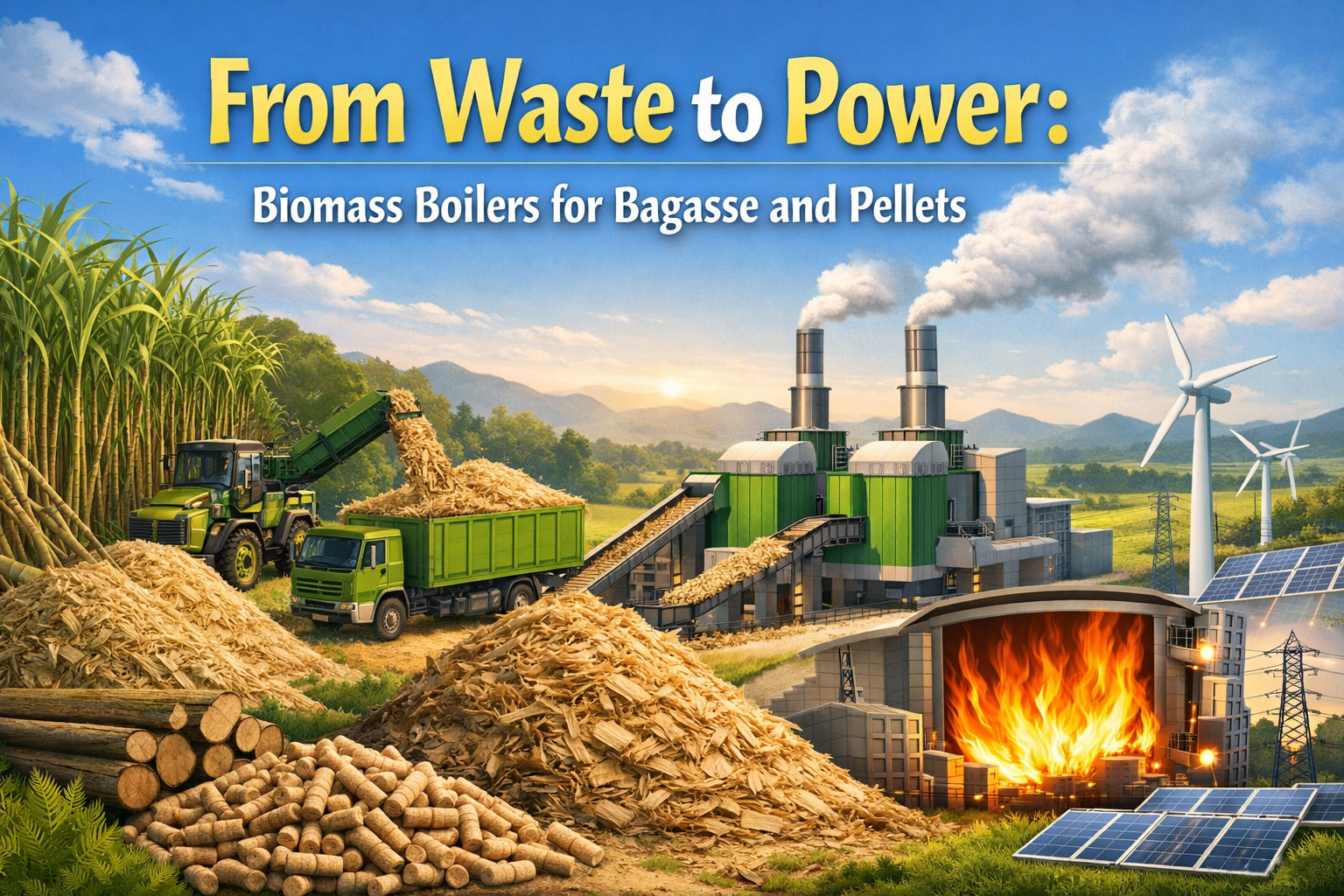
From Waste to Power: Biomass Boilers for Bagasse and Pellets
In the heart of India’s industrial belt, a silent revolution is taking place. What was once discarded as agricultural “trash”—the fibrous residue of crushed sugarcane and the compressed dust of timber mills—is now the primary engine of industrial growth.
At IndianBoilers.com, we are helping factories transition from the “Linear Economy” (Take-Make-Waste) to a Circular Energy Economy. This guide explores the two titans of the biomass waste world: Bagasse and Biomass Pellets, and how modern boiler technology is turning this waste into high-pressure power.
1. The Power of Bagasse: The Sugar Industry’s Secret Weapon
India is the world’s second-largest producer of sugar. For every ton of sugarcane crushed, approximately 300kg of wet bagasse is produced. Historically, this was a disposal headache. Today, it is the cornerstone of “Co-generation.”
The Chemistry of Bagasse
Bagasse is essentially cellulose, hemicellulose, and lignin. Its heating value is heavily dependent on its moisture content.
- Fresh Bagasse: ~50% moisture, Gross Calorific Value (GCV) of 2,200 kcal/kg.
- Dried Bagasse: ~10-15% moisture, GCV can jump to 4,000 kcal/kg.
Why Bagasse Boilers are Unique
Bagasse is “bulky” and “stringy.” Standard coal feeders will clog instantly. Modern bagasse boilers utilize:
- Spreader Stokers: These “throw” the bagasse into the furnace, allowing smaller particles to burn in suspension while larger fibers burn on the grate.
- Pulsating Grates: These vibrate or move to ensure the “mat” of bagasse doesn’t clink together, allowing air to penetrate for complete combustion.
2. Biomass Pellets: The “Liquid Gold” of Solid Fuels
While bagasse is specific to the sugar belt (Uttar Pradesh, Maharashtra, Karnataka), Biomass Pellets are the universal solution for urban and decentralized factories.
What are Biomass Pellets?
Pelleting is the process of compressing agricultural residue (sawdust, groundnut shells, cotton stalks) under high pressure. This increases the bulk density from 100 kg/m3 to over 600 kg/m3.
The Technical Advantages of Pellets:
- High Energy Density: Pellets offer a consistent GCV of 3,800-4,200 kcal/kg.
- Low Moisture: Usually below 10%, meaning you aren’t wasting energy “boiling off” the fuel’s own water.
- Flowability: Pellets behave like a fluid. They can be stored in silos and moved through narrow screw conveyors, allowing for precise, automated “Micro-Feeding.”
3. Comparing the Two: Which One Suits Your Factory?
| Feature | Bagasse Boilers | Pellet Boilers |
| Best For | Sugar Mills & Large Co-gen Plants | Textiles, Pharma, & Food Processing |
| Storage Requirement | Large open yards (Fire risk) | Compact silos (Weatherproof) |
| Combustion Type | Spreader Stoker / Fluidized Bed | Small-step Grate / Automated Burners |
| Ash Content | 1-2% (Very Low) | 3-8% (Depends on source material) |
| Operational Cost | Lowest (If self-generated) | Moderate (Higher than husk, lower than Oil) |
4. Engineering the Combustion: Turning Waste into Steam
Converting waste into power isn’t just about burning; it’s about thermal efficiency. At IndianBoilers.com, we focus on three engineering milestones:
A. The “3-T” Rule of Combustion
To get energy out of waste without smoke, you need:
- Temperature: Maintaining the furnace at 850°C to 1,000°C.
- Turbulence: High-velocity secondary air to “mix” the gases.
- Time: Ensuring the gases stay in the hot zone long enough to oxidize fully.
B. Managing Alkali Metals
Agro-waste like bagasse contains potassium and sodium. At high temperatures, these can form “sticky” deposits on boiler tubes (fouling). Modern designs include:
- Soot Blowers: High-pressure steam jets that clean the tubes during operation.
- Wider Tube Pitch: Increasing the gap between tubes to prevent ash bridging.
5. The Economic Impact: A Case for ROI
Let’s look at a 4 TPH (Tons Per Hour) boiler operating in a textile unit in Tirupur.
- Previous Fuel (LDO/Diesel): Annual cost of approx. ₹4.2 Crores.
- New Fuel (Biomass Pellets): Annual cost of approx. ₹2.1 Crores.
- Capital Cost of Boiler: ~₹80 Lakhs.
- Payback Period: Under 6 Months.
In the Indian context, where interest rates for industrial loans can be 9-11%, a 6-month payback makes biomass boilers the single most profitable asset on the balance sheet.
6. Environmental Compliance & Social Responsibility
By using bagasse and pellets, Indian factories solve two major environmental crises simultaneously:
- Stubble Burning: Pelleting plants buy crop residue from farmers, providing them with an income of ₹2,000–₹3,000 per acre, which prevents them from burning the fields and choking North India in winter.
- Fossil Fuel Depletion: Every ton of bagasse burned replaces approximately 0.5 tons of imported coal.
Did You Know? Under the PAT (Perform, Achieve, Trade) scheme by the Bureau of Energy Efficiency (BEE), Indian industries can earn Energy Saving Certificates (EScerts) by switching to biomass, which can be sold for additional profit.
7. Storage and Handling: The Practical Side
Modern “Waste-to-Power” plants require smart logistics:
- Moisture Control: For bagasse, we recommend “Pre-drying” using the boiler’s own exhaust gases. This can increase boiler efficiency by 5-7%.
- Fire Suppression: Biomass dust is combustible. Modern installations at IndianBoilers.com include spark arrestors and integrated sprinkler systems in the fuel feed galleries.
8. Why Choose IndianBoilers.com for Your Waste-to-Power Project?
We don’t believe in “One-Size-Fits-All.” Our process involves:
- Fuel Testing: We analyze your specific bagasse or pellet samples in our lab for GCV and Ash Fusion Temperature.
- Custom Grate Design: Whether it’s a Dumping Grate for high-ash waste or a Fluidized Bed for high-moisture bagasse.
- Turnkey Execution: From civil foundations to the final chimney emission test.
Conclusion: The Future of Indian Industry
The transition from “Waste” to “Power” is no longer a futuristic dream—it is a current industrial mandate. Whether you are a sugar mill looking to export power to the grid or a pharmaceutical plant looking to slash steam costs with pellets, the technology is ready.
Bagasse and pellets are the fuels of the “Atmanirbhar” (Self-Reliant) India. They are grown on our soil, processed by our workers, and burned in our boilers to power our growth.
