
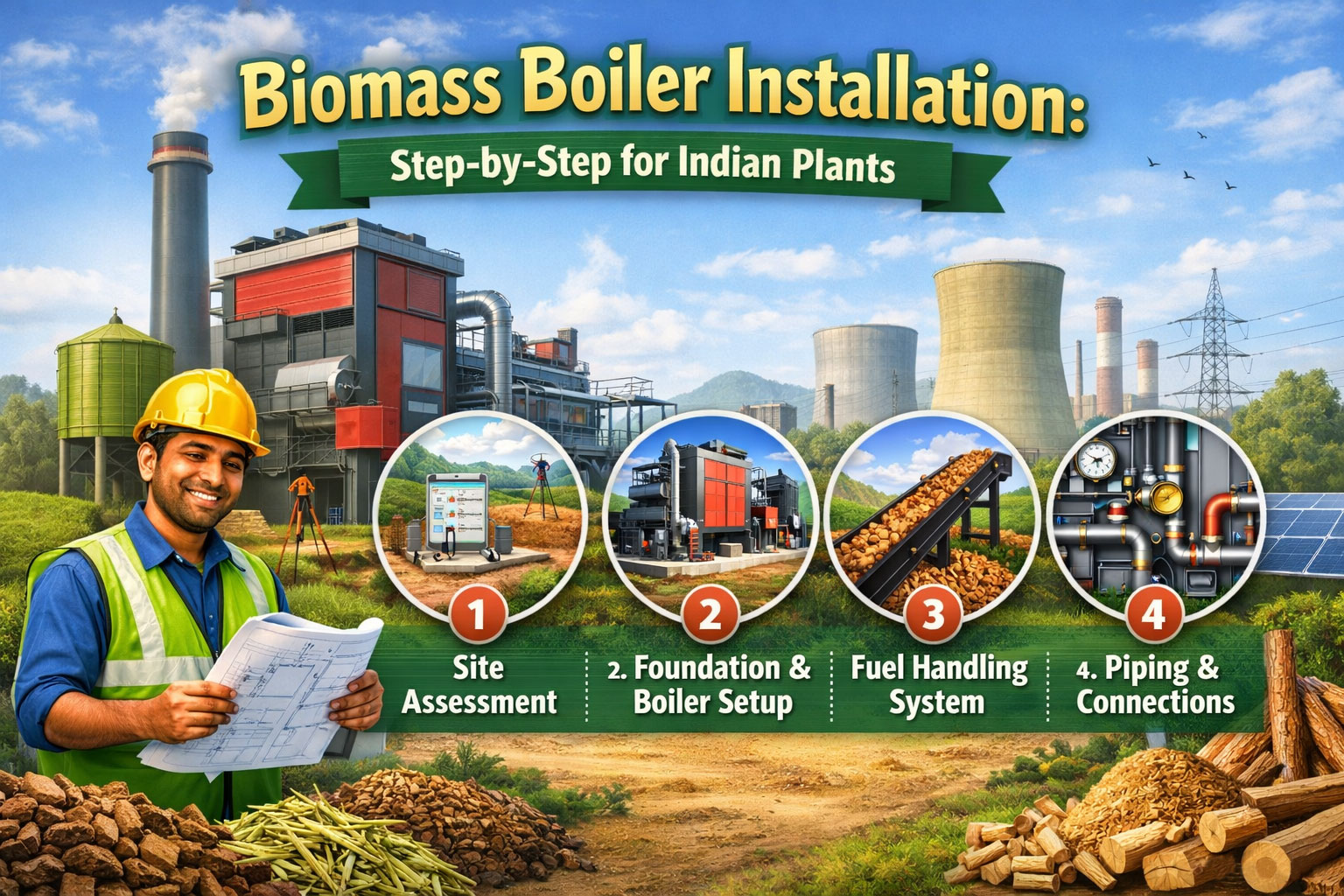
Biomass Boiler Installation: A Step-by-Step Guide for Indian Plants
Deciding to switch to a biomass boiler is a strategic financial move, but the success of that investment depends entirely on the quality of installation. Unlike oil or gas boilers, which are relatively “compact,” a biomass installation is a heavy-duty engineering project involving fuel logistics, ash management, and complex emission controls.
At IndianBoilers.com, we have overseen hundreds of installations across India. This guide outlines the rigorous, step-by-step process required to commission a world-class biomass steam plant.
Phase 1: Pre-Installation & Site Readiness
Before a single bolt is tightened, the site must be prepared to handle the unique footprints of biomass energy.
1. Civil Foundation & Structural Audit
Biomass boilers are significantly heavier than their oil-fired counterparts due to the refractory-lined furnace and fuel-feeding systems.
- Soil Testing: Ensure the soil bearing capacity can handle the localized load of the boiler shell and the chimney.
- Foundation Curing: Concrete foundations must be cured for at least 21–28 days before the boiler is mounted to prevent structural cracking due to vibration.
2. Fuel Storage Planning (The 30-Day Rule)
Biomass is bulky. A 5 TPH boiler burning rice husk requires a massive storage area compared to a small LDO tank.
- Moisture Protection: The storage yard must be covered to prevent rain from soaking the fuel, which can drop efficiency by 20%.
- Fire Safety: Installations must include fire hydrants near the storage yard and spark arrestors in the fuel conveyors.
Phase 2: Mechanical Installation
Once the site is ready, the “Heavy Lift” begins. This phase requires precision alignment and certified welding.
3. Positioning the Boiler Shell and Furnace
Most industrial biomass boilers come in two main components: the furnace (combustion chamber) and the pressure part (shell/tubes).
- Alignment: The furnace must be perfectly leveled with the shell to ensure seamless heat transfer and to prevent “gas bypassing,” where hot gases escape through gaps in the refractory.
4. Integration of Combustion Systems
Whether you are installing a Fluidized Bed (FBC) or a Reciprocating Grate, the feeding mechanism is critical.
- Fuel Feeders: Screw conveyors or rotary feeders must be aligned to prevent “back-firing” (where fire travels back into the fuel hopper).
- Refractory Lining: High-alumina bricks or castables are installed inside the furnace. This must be done by specialists to ensure the “expansion joints” are placed correctly; otherwise, the lining will crack during the first heat-up.
Phase 3: Auxiliary Equipment & Piping
A boiler is only as good as its “Lungs” (Fans) and its “Heart” (Pumps).
5. Fans and Ducting (Draft System)
Biomass requires high air-to-fuel ratios.
- Forced Draft (FD) Fan: Pushes air into the furnace.
- Induced Draft (ID) Fan: Pulls flue gases out.
- Crucial Step: The ducting must be insulated to prevent heat loss and to protect workers from burns.
6. Feed Water System
Indian groundwater is often hard, leading to scaling.
- Water Treatment Plant (WTP): An RO or Softener plant must be installed and commissioned before the boiler is filled.
- Deaerator: In large plants, a deaerator is installed to remove dissolved oxygen from the water, preventing internal tube corrosion.
Phase 4: Compliance and Safety (The “IBR” Factor)
In India, the Indian Boiler Regulations (IBR) are the law. Failure to comply can lead to heavy fines or plant shutdowns.
7. The IBR Inspection
- Registration: The boiler must be registered with the State Boiler Inspectorate.
- Hydraulic Test: Before commissioning, the inspector will conduct a “Hydro Test” where the boiler is pressurized to 1.5 times its working pressure to check for leaks.
- Pipeline Inspection: All high-pressure steam piping must be welded by IBR-certified welders and radiographed (X-rayed) for integrity.
8. Pollution Control Board (PCB) Clearances
Modern Indian plants must meet stringent SPM (Suspended Particulate Matter) norms.
- Installation of APCD: Air Pollution Control Devices like Cyclones, Multi-cyclones, or Bag Filters must be integrated into the flue gas path.
- Stack Height: The chimney height must comply with CPCB norms (usually a minimum of 30 meters or based on the factory building height).
Phase 5: Commissioning & Optimization
The final phase turns the “Machine” into a “Solution.”
9. Refractory Dry-out (The Slow Burn)
You cannot start a biomass boiler at full capacity. The new refractory contains moisture.
- The Process: A small wood fire is lit, and the temperature is raised by only 10°C-20°C per hour over several days. This “bakes” the bricks, ensuring they don’t explode from trapped steam.
10. Performance Trial & Training
Once at full pressure, the IndianBoilers.com team conducts a performance trial.
- Efficiency Mapping: We calculate the “Evaporation Ratio” (How many kg of steam are produced per kg of fuel?).
- Operator Training: Modern boilers are automated. We train your staff on PLC handling, emergency shutdown procedures, and “blowdown” schedules to remove sludge.
Summary Checklist for Plant Managers
| Step | Focus Area | Common Pitfall to Avoid |
| Foundation | Structural Integrity | Not allowing enough curing time. |
| Refractory | Heat Retention | Using low-quality bricks that crumble. |
| Piping | Pressure Safety | Using non-IBR pipes for high-pressure lines. |
| Pollution | Compliance | Undersizing the Bag Filter for the fuel type. |
| Storage | Logistics | Placing the fuel yard too far from the boiler. |
Conclusion: Partnering for Success
Installing a biomass boiler is a complex puzzle, but when the pieces fit—the ROI is unparalleled. A professional installation ensures that your plant isn’t just “Green” on paper, but efficient, safe, and profitable for decades to come.
At IndianBoilers.com, we don’t just deliver a boiler; we manage the entire lifecycle of the installation. From the first civil drawing to the final IBR certificate, we ensure your transition to biomass is seamless.
