
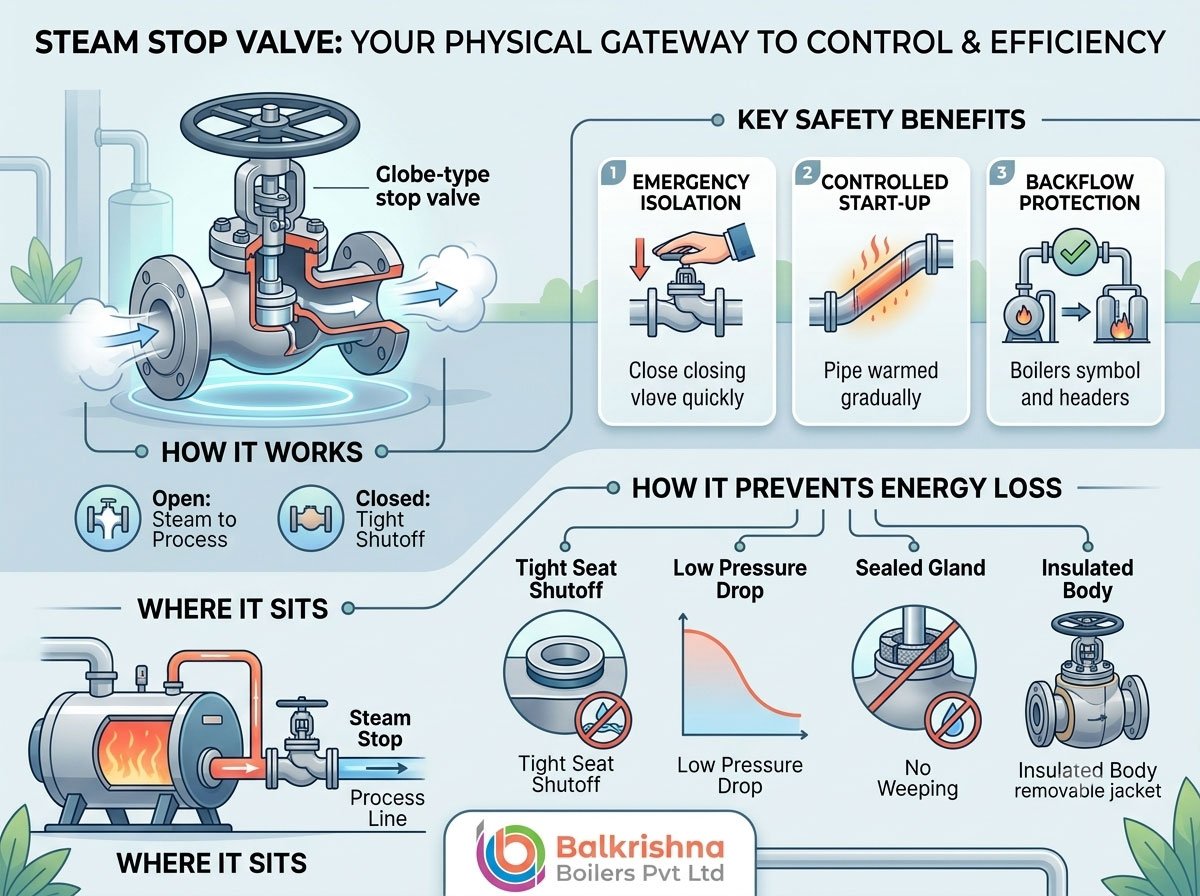
Every steam plant has one component that decides when steam leaves the boiler and when it does not: the steam stop valve. It rarely gets the attention that burners, economizers or automation panels get, yet it is the physical gate between a pressurised vessel and your entire process line. A poorly chosen or badly maintained stop valve can leak steam for years, waste fuel every shift, and, at worst, leave operators unable to isolate the boiler in an emergency.
This guide explains what a steam stop valve does, how it is built, how to choose one, and how to keep it tight so that steam goes only where you want it, with no energy lost on the way.
What Is a Steam Stop Valve?
A steam stop valve is an isolation valve fitted in a steam line to start, stop, or throttle the flow of steam. When it is open, steam moves to your process equipment. When it is closed, it must seal completely, even at full operating pressure and temperature.
That last requirement is what separates it from ordinary plumbing valves. Steam is hot, expansive and unforgiving. A valve that “mostly” closes will pass wet, high-energy steam across its seat and wear itself out through wire-drawing (erosion of the seat by high-velocity steam). A proper stop valve is built to hold a tight shutoff cycle after cycle.
Stop valves are also central to regulatory compliance. Under the Indian Boiler Regulations (IBR), a boiler must be able to be positively isolated from the steam header, and the stop valve is the device that makes this possible. Our guide on core boiler components from fuel system to safety valves shows where it sits among the other mountings.
Where the Steam Stop Valve Sits in Your Steam System
The most important one is the main steam stop valve, mounted on the boiler’s steam outlet. Everything the boiler produces passes through it on the way to the plant. Further downstream you will find additional stop valves that isolate branches, individual machines, or sections of pipework for maintenance.
If you want to see the full journey from fuel to process, read our explainer on the steam boiler working principle. In short: water is heated, steam collects in the drum or steam space, and the stop valve then releases that steam to the header. The same logic applies whether you run a shell-type unit or a water-tube boiler.
How a Steam Stop Valve Works
Most industrial stop valves use a simple, robust mechanical principle:
- The operator turns a handwheel, which rotates a spindle (stem).
- The spindle lifts or lowers a disc (valve head) relative to a seat.
- When the disc is pressed onto the seat, steam is blocked completely.
- When the disc is raised, steam flows through the gap between disc and seat. The wider the gap, the more steam passes.
Because the disc moves straight up and down against the seat, the valve gives a reliable seal and some ability to throttle flow. That is why it is different from a control valve: a control valve modulates flow continuously through an actuator, while a stop valve is mainly for on/off duty.
Main Parts of a Steam Stop Valve
- Body: the pressure-containing casting or forging, with flanged ends for bolting into the line.
- Seat: the ring the disc closes onto. Seats are commonly made of a harder material than the body to resist erosion.
- Disc: the moving element that opens and closes the passage.
- Spindle: transfers handwheel motion to the disc.
- Bonnet: the cover that closes the body and houses the spindle.
- Gland and packing: seal the spindle where it leaves the pressure boundary. This is the most common leak point on an ageing valve.
- Yoke and handwheel: support the spindle and let the operator work the valve.
Types of Steam Stop Valves Used in Boilers
Globe stop valve. The workhorse of boiler houses. Its shape gives tight shutoff and reasonable control, at the cost of more pressure drop than a straight-through valve.
Angle stop valve. Works like a globe valve but turns the flow through 90 degrees, useful where the pipe changes direction anyway.
Stop-and-check (non-return) valve. Combines isolation with automatic protection against backflow. When several boilers feed one common header, this prevents steam from a live boiler flowing back into an idle one.
Gate valve. Uses a sliding wedge. Once fully open it offers very little resistance to flow, so it suits large lines that are mostly kept open, but it is a poor choice for frequent operation or throttling.
Choosing among these depends on line size, pressure, duty cycle and whether more than one boiler shares a header.
How a Steam Stop Valve Keeps Your Plant Safe
It provides positive isolation. During maintenance, an isolated boiler must stay isolated. A reliable stop valve, closed and locked, protects people working on equipment downstream.
It allows controlled start-up and shutdown. Opening the valve slowly lets pipework warm through gradually. Rushing this step pushes condensate through the line at high speed and causes water hammer, a leading cause of damaged pipes and fittings.
It supports emergency response. In a leak, rupture or process upset, closing the stop valve cuts the supply at the source. This only works if the valve is free to move, so valves that are never exercised can seize.
It prevents backflow in multi-boiler plants when a stop-and-check design is used.
Safety mountings work as a team. The stop valve isolates, the safety valve relieves overpressure, the gauge and level controls tell you what is going on. For a wider look at plant safety, see our steam boiler maintenance checklist for Indian factories.
How a Steam Stop Valve Prevents Energy Loss
Steam has already cost you fuel to make. Every leak turns that fuel into waste. A well-specified stop valve protects your energy in several ways.
1. Tight seat shutoff. A worn or scored seat lets steam bleed into idle lines. That steam either condenses somewhere useless or escapes through drains and vents, and you pay for it every hour.
2. Sealed gland. A weeping gland loses steam continuously and also drops pressure at the point of use. Repacking or replacing packing at the right time is cheap compared with the steam lost.
3. Low pressure drop when open. A correctly sized valve passes the required flow without choking it. An undersized valve throttles steam, which forces the boiler to run at higher pressure than the process actually needs.
4. Insulation on the valve body. Valves and flanges are often left bare while the pipe around them is insulated. A bare body radiates heat constantly. Removable insulation jackets are a simple fix and let you still service the valve.
5. Correct drain and trap arrangement. Condensate collects ahead of a closed valve. Fitting drain points and steam traps there keeps the line dry, protects the valve seat from wet steam erosion, and stops water hammer.
6. Less wet steam. Dry steam carries more usable heat per kilogram. A stop valve alone does not dry steam, but a boiler designed for dry steam paired with a properly drained line keeps your quality high all the way to the process.
How to Select the Right Steam Stop Valve
Ask these questions before ordering:
- Working pressure and temperature: the valve rating must exceed your boiler’s design pressure with margin.
- Line size: match the connection to the outlet and the flow you actually need.
- Duty: frequent operation favours a globe design; rarely operated isolation lines may suit a gate valve.
- Single or common header: if you have more than one boiler, choose a stop-and-check valve.
- Material: cast iron, cast steel or forged steel, depending on pressure class and whether the steam is saturated or superheated.
- IBR compliance: for regulated boilers, valves must meet IBR requirements and carry the correct documentation.
- Fuel and boiler type: a fast-cycling instant steam unit and a large solid-fuel unit place very different demands on their valves.
Matching the valve to the boiler matters. For example, our gas fired steam boiler starts and stops quickly, while a horizontal boiler or coal fired boiler tends to run long, steady loads with heavy steam volumes.
Installation Best Practices
- Install in the direction marked on the body. Globe valves are directional; fitting them backwards shortens seat life.
- Support the pipework. Valves should not carry the weight of the line.
- Provide a drain point upstream of the valve, with a trap.
- Fit a warm-up bypass on larger valves so pressure can equalise before the main valve is opened.
- Leave access room for handwheel operation and future gland repacking.
- Insulate the body and flanges once commissioning is complete.
Operating Tips Every Operator Should Follow
- Open the valve slowly, and never crack it open suddenly against a cold, wet line.
- Open fully, then turn back a fraction so the spindle is not jammed hard against its stop.
- Close by hand only. Using a wrench or cheater bar damages the seat and spindle.
- Exercise rarely used valves periodically so they do not seize.
- Record any leak, however small, and fix it at the next opportunity.
Maintenance: Keeping the Valve Tight
A schedule beats emergency repairs. Build these into your planned shutdowns:
- Check the gland for weeping; tighten evenly or repack.
- Inspect seat and disc for scoring, erosion or wire-drawing; lap or replace as needed.
- Lubricate the spindle threads with a suitable high-temperature lubricant.
- Verify the handwheel turns smoothly through its full travel.
- Test for seat leakage with the downstream line drained.
- Check insulation is intact and dry.
Where a valve cannot be restored, replace it. A new valve costs far less than the fuel wasted by a leaking one over a year.
Common Problems and Their Causes
| Problem | Likely cause | Fix |
|---|---|---|
| Steam leaking from the spindle | Worn or dry gland packing | Repack or tighten gland evenly |
| Valve will not close fully | Scored seat or debris on the seat | Lap seat or replace disc and seat |
| Handwheel stiff or seized | No lubrication, long idle period | Lubricate, exercise regularly |
| Hammering in the line | Condensate carried through on opening | Open slowly, fit drains and traps |
| Steam passing when closed | Seat erosion | Replace or recondition internals |
Steam Stop Valves Across Different Boiler Systems
The valve is only as useful as the system around it. If you are planning a new installation or an upgrade, consider the whole package rather than the valve on its own:
- Solid-fuel plants: a biomass boiler delivers steady, large-volume steam and demands a robust, correctly rated stop valve.
- Compact, quick-start needs: a coil type boiler reaches working pressure in minutes, so valves are cycled often.
- Clean-steam processes: electric boilers for food, pharma and dairy rely on tight shutoff to keep steam quality high.
- Small industries: our low-cost industrial boiler range suits MSMEs that need dependable steam on a controlled budget.
You can browse the full industrial boiler range and electric boiler range on Indian Boilers, or explore the wider Balkrishna Boilers product line, including electric boilers and hot water boilers.
If you also use thermal oil systems, our thermic fluid heater safety guide covers the isolation and safety practices that apply there.
Frequently Asked Questions
What is the difference between a steam stop valve and a safety valve?
A stop valve isolates or controls steam flow and is operated by a person. A safety valve opens automatically to release excess pressure. They protect the plant in different ways and one never replaces the other.
Can a steam stop valve be used to regulate flow?
A globe-type stop valve can throttle to a limited extent, but continuous regulation is the job of a control valve. Running a stop valve partly open all the time accelerates seat erosion.
Why is my steam stop valve leaking after closing?
The usual causes are a damaged seat, debris trapped on the seat, or a worn disc. Bring the valve in for reconditioning rather than tightening it harder.
How often should a steam stop valve be inspected?
Check the gland and operation during routine rounds, and inspect internals during planned shutdowns and annual boiler inspection.
Is a stop-and-check valve better than a plain stop valve?
For a boiler feeding a common header with other boilers, yes. It adds automatic backflow protection to the isolation function.
Conclusion
The steam stop valve is small compared with the boiler it serves, but it controls the point where fuel energy becomes useful work. Choose it for the right pressure, duty and boiler type, install it with proper drains and insulation, operate it gently, and maintain it on a schedule. Do that, and it will isolate safely when needed and deliver steam without wasting a kilogram of fuel.
Need help specifying a boiler and mountings for your plant? Talk to the engineering team at Balkrishna Boilers. Contact us for a recommendation matched to your steam load, fuel and industry.