
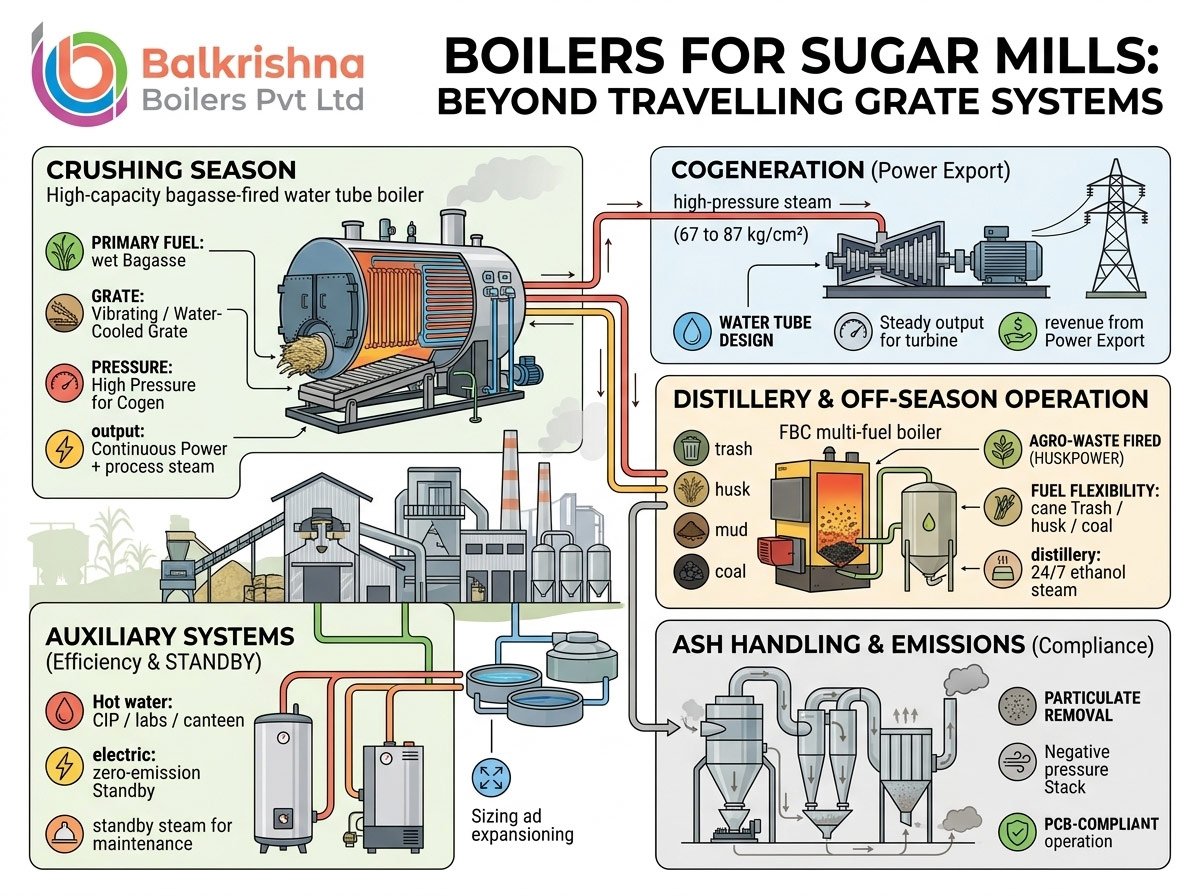
Ask most people in the sugar industry what a sugar mill boiler looks like, and they’ll describe a travelling grate bagasse boiler — and for good reason. It’s been the sector’s workhorse for decades, and it’s genuinely well matched to bagasse’s fibrous, high-moisture, high-ash characteristics. But a modern sugar mill’s thermal requirement has grown well past what a single travelling grate unit was ever designed to cover. Cogeneration for grid power export, four-to-six months of off-season operation on alternate fuels, integrated distilleries running on molasses, and increasingly strict emissions norms have all pushed sugar mills toward a more layered thermal strategy — one where the travelling grate boiler is a critical piece, but no longer the whole picture.
At Balkrishna Boilers Pvt Ltd, we manufacture bagasse-fired boilers, high-pressure water tube boilers, agro-waste fired steam boilers, and hot water and electric boiler systems that support sugar mills across every stage of their annual cycle — not just the crushing season. This guide looks at what “beyond travelling grate” actually means in practice.
Travelling Grate: Still the Right Baseline for Bagasse
There’s no getting around it — for burning fresh, mill-wet bagasse during the crushing season, a travelling or vibrating grate remains the right technology, and it’s what we build as the core of our bagasse-fired boiler range. As we explain in our guide on biomass boilers for bagasse and pellets, <cite index=”48-1″>traveling or vibrating grate designs keep the fuel bed moving to prevent bagasse from matting together into a dense layer that blocks air penetration</cite>, which is precisely the failure mode that causes incomplete combustion in fibrous, high-moisture fuels like bagasse.
Our own comparison guide, Vibrating Grate Boiler vs Reciprocating Grate Boiler, breaks this decision down further — vibrating, water-cooled grates handle high-volatility, high-moisture fuel like bagasse particularly well and reduce internal mechanical wear, while reciprocating designs can offer a lower upfront cost. Either way, the grate you choose is a genuine engineering decision, not a commodity spec, and it’s the correct starting point for any sugar mill’s boiler house.
Where “beyond travelling grate” becomes relevant is everything else the plant needs across a full year and a full production chain — cogeneration pressure requirements, off-season fuel flexibility, distillery steam, and the precision or emissions-sensitive circuits a grate-fired unit isn’t built to serve.
Cogeneration: Why Sugar Mills Need High-Pressure Water Tube Boilers
Most large and mid-sized Indian sugar mills today aren’t just generating steam for the crushing process — they’re running bagasse-based cogeneration plants to export surplus power to the grid, turning a former disposal problem into a revenue stream. That shift changes the boiler specification considerably. Cogeneration turbines typically need steam at 67 to 87 kg/cm² and higher, pressures well beyond what a standard fire-tube travelling grate boiler is designed to deliver efficiently.
This is where a water tube boiler becomes essential. Because water tube designs circulate water inside the tubes while combustion gases flow around them, they’re built for exactly this kind of high-pressure, high-capacity duty — reaching full working pressure within minutes and sustaining the steady, high-pressure output a turbine-driven cogeneration set requires. A sugar mill planning a new or expanded cogeneration facility needs to specify its boiler around the turbine’s steam conditions from day one, not retrofit a crushing-season-only boiler to a job it was never designed for.
Off-Season Fuel Flexibility: Beyond Bagasse Alone
Sugarcane crushing typically runs 150 to 180 days a year, but most sugar mills need steam and power capability well beyond that window — for continuous processes like the distillery, for maintenance-period utilities, and increasingly for cogeneration contracts that commit to year-round grid supply. That means the boiler house has to run on something other than bagasse for a large part of the year.
As we cover in our guide on understanding the working principle of biomass steam boilers, Fluidized Bed Combustion (FBC) technology handles this kind of fuel variability particularly well, since <cite index=”53-1″>fuel is suspended in a boiling bed of hot sand and air</cite>, achieving high combustion efficiency even with lower-grade or mixed fuels — a genuine advantage for a sugar mill switching between bagasse, cane trash, press mud, coal, or purchased biomass depending on the season and market pricing. Our Agro-Waste Fired Steam Boiler, built on FBC and specialized grate technology under the HUSKPOWER series, is engineered for exactly this kind of multi-fuel flexibility, handling everything from bagasse and cane trash to rice husk and other locally available agro-residue. Our broader Complete Guide to Biomass Boilers for Steam Generation covers how different grate and combustion technologies match different fuel profiles in more depth, which is worth reviewing before finalizing an off-season fuel strategy.
Distillery Integration: Steam Demand Beyond the Crushing Floor
A growing number of Indian sugar mills now run an integrated distillery alongside the crushing plant, converting molasses (and increasingly B-heavy or sugarcane juice) into ethanol under India’s ethanol blending programme. As noted in our bagasse-fired boiler guide, <cite index=”47-1″>distilleries need reliable steam for fermentation and distillation processes</cite>, and this steam demand runs on a very different schedule than the crushing season — fermentation and distillation columns need continuous, stable steam whether or not cane is currently being crushed. This is one of the strongest arguments for a layered boiler strategy: the main travelling grate bagasse boiler can carry the load during crushing season, while a secondary agro-waste or gas fired steam boiler sustains distillery operations through the off-season without idling the entire main boiler house for a fraction of its rated capacity.
Hot Water and Electric Boilers: The Auxiliary Systems Most Mills Overlook
Not every thermal requirement in a sugar mill complex needs high-pressure steam. General utility hot water — for CIP (clean-in-place) systems, effluent treatment heating, laboratory and quality-control use, and administrative needs — is usually better and more economically served by a dedicated hot water boiler rather than tapping high-pressure steam and letting it down through a reducing station. Our Electric Hot Water Boiler (ELECTROAQUA series) is a strong fit here, particularly for effluent treatment plant heating, where zero-emission, precisely controlled output supports environmental compliance without adding to the main boiler house’s fuel load.
Electric boilers more broadly are increasingly relevant for sugar mills too — as standby capacity during main boiler maintenance windows, for smaller precision circuits in the laboratory or quality lab, and for mills looking to reduce their carbon footprint on auxiliary loads even while the core crushing-season steam remains bagasse-fired. This same layered approach — a primary combustion-based system supported by electric or hot water units for specific, quality-sensitive, or standby circuits — is one we cover in more depth across other process industries in our Steam Boiler and Electric Boiler category pages. The equivalent range on Balkrishn.com is available under Steam Boiler, Hot Water Boiler, and Electric Boiler.
Ash Handling and Emissions: Non-Negotiable at Sugar Mill Scale
Bagasse and alternate biomass fuels carry meaningfully higher ash and particulate loads than gas or oil, and at sugar mill scale — often running boilers continuously through a multi-month crushing season — emissions control isn’t optional. As detailed in our guide on biomass steam boiler working principles, a properly engineered biomass boiler house includes multi-cyclone separators to capture heavier ash particles, bag filters for fine particulate, and an induced draft fan system to maintain safe negative pressure through the stack — not as add-ons, but as core parts of the combustion and emissions design from day one. Any sugar mill boiler proposal should include this equipment as standard, not as an optional extra bolted on to satisfy a pollution control board inspection.
Sizing Your Sugar Mill’s Full Thermal System
A few questions our engineering team works through with sugar mill clients:
- What’s your crushing capacity (TCD)? This determines your primary bagasse boiler’s rated steam capacity during the crushing season.
- Do you run cogeneration, and at what export target? This dictates whether you need water tube, high-pressure steam capability beyond a standard fire-tube design.
- What’s your off-season operating requirement? Distillery, maintenance, or standby power needs determine whether a secondary agro-waste or gas-fired boiler is justified.
- What alternate fuels are realistically available locally? Cane trash, press mud, purchased biomass, or coal all factor into whether FBC or a specialized grate design makes more sense.
- What’s your expansion or cogeneration upgrade timeline? Many mills add or expand cogeneration in phases; sizing the boiler house with future turbine steam conditions in mind avoids a costly retrofit later.
Why Sugar Mills Choose Balkrishna Boilers
With over 25 years of experience and more than 5,000 installations across sugar, distillery, and biomass-fuelled process industries, Balkrishna Boilers Pvt Ltd brings a full-system view to sugar mill boiler houses rather than a single-product approach:
- Purpose-built bagasse boilers with vibrating or reciprocating grate options matched to your specific fuel and operational profile.
- High-pressure water tube systems engineered around your cogeneration turbine’s exact steam conditions.
- Multi-fuel FBC and agro-waste boilers for reliable off-season and distillery-integrated operation.
- Auxiliary hot water and electric systems for effluent treatment, quality labs, and standby capacity.
- Full emissions and ash handling integration, from multi-cyclone separators to bag filters, engineered into the proposal from the start.
Whether you’re commissioning a new crushing-season bagasse boiler, adding cogeneration capacity, or building out off-season and distillery steam supply, our team can engineer a complete thermal system around your mill’s full annual cycle — not just the crushing months.
Frequently Asked Questions
Is a travelling grate boiler still the right choice for bagasse? Yes, for the crushing season specifically. Travelling and vibrating grates handle bagasse’s high moisture and fibrous texture better than most alternatives, keeping the fuel bed moving to prevent matting and ensure complete combustion.
Why do sugar mills need water tube boilers if they already have a bagasse boiler? Cogeneration turbines typically require steam pressures well beyond what a standard fire-tube travelling grate boiler is designed for. A water tube boiler is built specifically for the high-pressure, high-capacity steam a cogeneration set demands.
What fuel do sugar mills use when bagasse isn’t available? Common alternatives include cane trash, press mud, purchased biomass, husk, and coal, often burned in an FBC or specialized-grate boiler engineered for multi-fuel flexibility, such as our Agro-Waste Fired Steam Boiler.
Does an integrated distillery need its own boiler? Many sugar mills with integrated distilleries run a secondary boiler dedicated to distillery steam, since fermentation and distillation need continuous, stable steam on a schedule independent of the crushing season.
What emissions control equipment is standard on a modern bagasse boiler? Multi-cyclone separators, bag filters, and an induced draft fan system are standard components of a properly engineered biomass boiler house, ensuring particulate emissions stay within pollution control board limits.
Ready to design a complete thermal system for your sugar mill — from crushing season bagasse boilers to cogeneration, distillery, and off-season capacity? Get in touch with our engineering team or request a quote from Balkrishna Boilers with your crushing capacity, cogeneration plans, and fuel availability, and we’ll propose a solution built for your mill’s full annual cycle.