
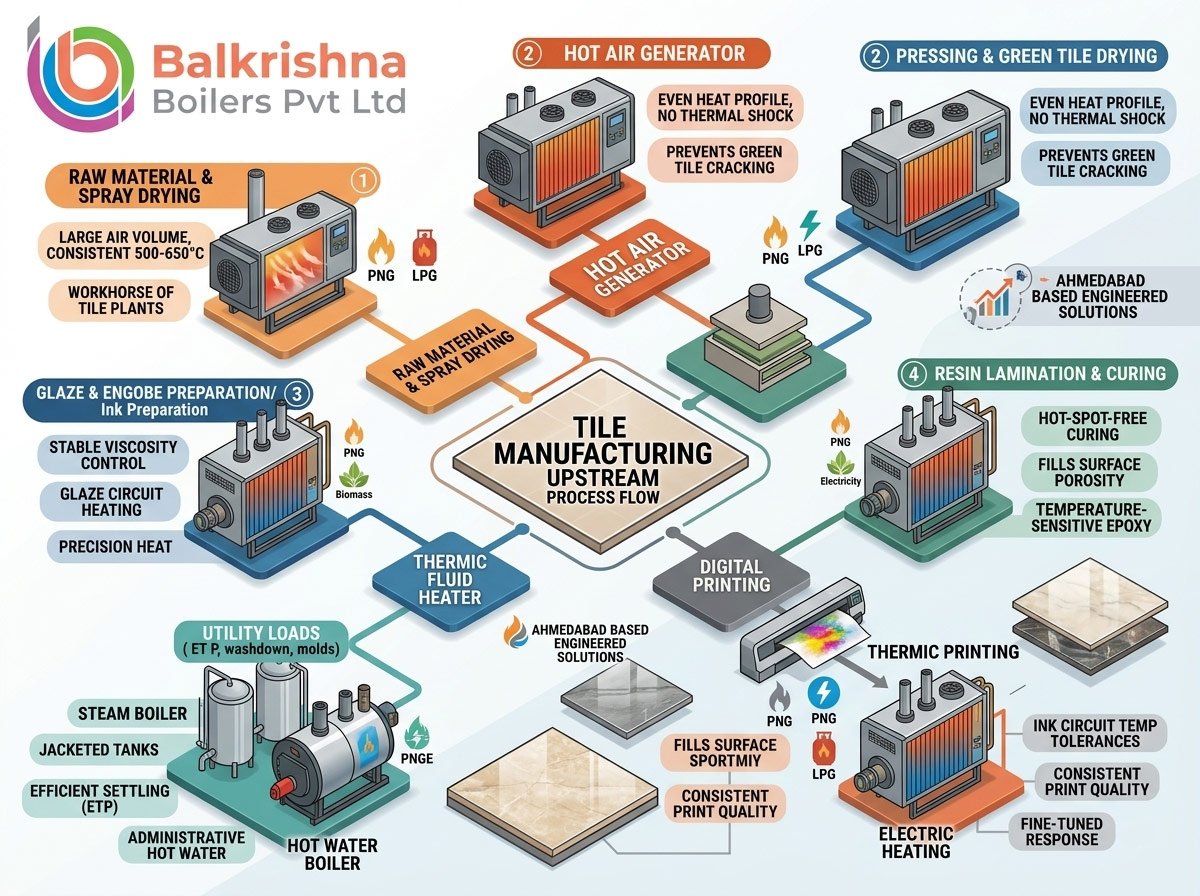
Gujarat’s Morbi belt alone produces the majority of India’s ceramic and vitrified tiles, and every single tile that leaves those plants has passed through several thermal processing stages before it ever reaches a kiln. Spray-dried body powder, pressed and dried “green” tiles, prepared glaze slip, and — for polished vitrified tiles — resin-filled and cured surfaces all depend on precisely controlled heat well before firing even begins. Get that upstream thermal chain wrong, and you’re looking at inconsistent powder moisture, cracked green tiles, uneven glaze application, or resin defects that show up only after polishing, when the cost of rework is highest.
At Balkrishna Boilers Pvt Ltd, based in Ahmedabad, we’ve engineered hot air generators, thermic fluid heaters, steam boilers, and hot water boilers for ceramic and tile manufacturers across Gujarat and beyond. This guide breaks down where each type of equipment fits into a tile plant’s process flow, and how to choose the right one for your line.
Where Thermal Energy Is Used in Ceramic Tile Manufacturing
A modern ceramic or vitrified tile plant is really a sequence of heat-dependent stages stitched around the kiln:
- Raw material preparation and spray drying — ball-milled clay/feldspar slurry is atomized and dried into a free-flowing body powder, the single largest thermal energy consumer in most tile plants.
- Pressing and green tile drying — pressed tiles pass through vertical or horizontal dryers to remove residual moisture before glazing, since any trapped moisture causes cracking or explosion in the kiln.
- Glaze and engobe preparation — glaze slip is mixed, milled, and often heated for viscosity control and consistent application.
- Digital printing and ink preparation — modern digital glazing lines require temperature-stable ink circuits for consistent print quality.
- Resin lamination and curing (for polished vitrified tiles) — epoxy resin filling of surface pores needs controlled curing temperature to bond properly without discoloring the tile.
- Firing — handled by gas-fired tunnel or roller kilns, which sit outside the boiler/thermal fluid equipment category but depend on the same plant utility and fuel infrastructure.
- General utility needs — hot water for slip/glaze washdown, effluent treatment heating, and administrative or canteen hot water.
Firing itself is a kiln, not a boiler application — but every stage before it is where a well-matched boiler, thermic fluid heater, or hot air generator directly affects tile quality, throughput, and fuel cost.
Hot Air Generators: The Workhorse of Tile Manufacturing
For most ceramic and tile plants, hot air generators are the single most important piece of thermal equipment on the floor, simply because spray drying and green tile drying consume more thermal energy than any other stage in the process.
Spray drying requires large, consistent volumes of hot air (typically 500–650°C at the atomizer inlet) to flash-dry slurry droplets into body powder with a tight, repeatable moisture specification. Green tile drying, by contrast, needs a gentler, evenly distributed heat profile across the dryer chamber to remove moisture without inducing thermal shock or warping in the pressed tile. Both applications demand indirect-fired systems that keep combustion by-products away from the product wherever the powder or tile surface is exposed to the airstream, and consistent, load-following output that doesn’t drift as ambient conditions or fuel pressure change through a shift.
Our Oil/Gas Fired Hot Air Generator (AIRJET series) is a strong fit for continuous, high-volume tile lines running on natural gas or LPG — the fuel of choice across most of Gujarat’s tile clusters thanks to the region’s gas grid access. For plants seeking a lower-cost supplementary drying source, the Wood/Briquette Fired Hot Air Generator offers an alternative where biomass fuel is locally available, and the Electric Hot Air Generator (ELECTROAIR series) is worth evaluating for smaller drying zones or R&D lines where precise, flame-free temperature control matters more than raw throughput. The complete range, including the AIRJET, AIRPAC, and AIRTHERM models, is available on the Hot Air Generator category page at Balkrishn.com.
Thermic Fluid Heaters: Precision Heat for Resin Lamination and Glaze Lines
Not every ceramic process needs raw combustion heat blasted through a chamber — several stages need closely controlled, uniform temperature delivered indirectly, and that’s exactly what a thermic fluid heater is built for.
Resin lamination and curing, used on polished vitrified and full-body tiles to fill surface porosity with epoxy resin before polishing, is highly temperature-sensitive: too little heat and the resin doesn’t cure properly, too much (or uneven) heat and it discolors or degrades the bond. A closed-loop thermal fluid system delivers the steady, hot-spot-free heat this process needs, in the same way it protects heat-sensitive product in other industries — as we cover in our guide on what a thermic fluid heater is and how it’s used. Thermic fluid systems are equally useful for glaze and engobe circuit heating, where maintaining a stable viscosity directly affects the consistency of glaze application across every tile on the line, and for digital ink circuit temperature control, where print head performance depends on tight thermal tolerances.
Our Vertical Three Pass Oil/Gas Fired Thermic Fluid Heater suits plants running dedicated resin or glaze-heating circuits with moderate floor space, while the Electric Thermic Fluid Heater is a good fit for smaller lamination lines where combustion equipment near a resin-handling area isn’t ideal. If you’re deciding between a thermic fluid system and steam for a particular circuit, our comparison article on Thermic Fluid Heater vs Steam Boiler: Which Suits Your Process walks through the trade-offs, and our guide to thermic fluid oil selection is worth reading before finalizing the heat transfer fluid for a resin-curing application specifically. The equivalent Balkrishn.com lineup — DELTAPAC, THERMPAC, and the VTF/VTM Series — is listed on the Thermic Fluid Heater category page.
Steam and Hot Water Boilers: Utility Heat Across the Plant
While hot air and thermal fluid dominate the product-facing processes, most tile plants still need a dedicated steam boiler or hot water boiler for utility functions:
- Glaze and slip preparation vessels, where jacketed mixing tanks are heated to keep glaze slurry at a stable, workable viscosity before it reaches the application line.
- Effluent treatment plant (ETP) heating, since many tile manufacturing effluent streams benefit from controlled-temperature treatment for better settling and processing efficiency.
- General plant hot water, covering washdown, mold cleaning, and administrative needs.
For plants that need moderate steam capacity for glaze preparation and general utility, our Gas Fired Steam Boiler (200 KG to 850 KG/hr) is a compact, quick-to-commission option well suited to the natural gas infrastructure common across Gujarat’s ceramic clusters. Where the requirement is purely hot water rather than steam, the Oil/Gas Fired Hot Water Boiler (AQUAJET series) avoids the added cost and complexity of generating full steam pressure for a task that only needs 60–95°C water, and the Electric Hot Water Boiler (ELECTROAQUA series) is a strong fit for plants prioritizing a zero-emission, low-maintenance utility source. The Steam Boiler and Hot Water Boiler category pages on Balkrishn.com cover the equivalent STEAMJET, AQUAJET, and AQUAMAX ranges.
Electric Heating: Where Precision and Emissions Control Matter Most
A growing number of tile manufacturers, particularly those exporting to markets with stricter environmental compliance requirements, are evaluating electric boilers and electric thermal fluid systems for select parts of their utility block. As we explain in Why Electric Boilers Are the Best Choice for Low-Emission Plants, electric heating eliminates fuel storage, combustion by-products, and chimney requirements entirely — a genuine advantage for plants located in densely packed industrial clusters like Morbi, where space and local emissions norms are both under increasing scrutiny. Precision temperature control is another reason electric heating fits naturally into resin curing and digital ink circuits, where the fine-tuned, rapid response of electric elements outperforms combustion-based systems, as detailed in our broader piece on applications for electric steam boilers beyond laundries and hospitals. The Electric Boiler category on Balkrishn.com, featuring the ELECTRON, ELECTROMAX, and INDUCTRON series, covers this equivalent range.
Fuel Selection for Tile Plants
Fuel choice in this industry is shaped heavily by location and scale:
- Natural gas (PNG) is the dominant fuel across Gujarat’s major tile clusters thanks to established gas grid infrastructure, offering clean combustion and consistent quality — a strong fit for both hot air generators and steam/hot water boilers.
- LPG remains common where PNG connectivity is limited, particularly for smaller or newer units.
- Biomass and briquettes offer a lower-cost alternative for supplementary drying or utility loads where a plant has access to consistent agro-waste or wood-processing residue nearby.
- Electricity is increasingly used for precision, low-emission circuits — resin curing, digital ink heating, and smaller utility loads — even where the bulk of plant heating remains gas-fired.
Most large tile plants end up running a mixed fuel strategy rather than a single source, matching fuel type to the precision, emissions, and cost requirements of each individual thermal circuit.
Sizing Your Thermal System for a Tile Plant
A few questions our engineering team typically works through with ceramic and tile manufacturers:
- What’s your daily tile production volume? Spray dryer and green tile dryer capacity scale directly with output, and this is usually the largest single thermal load in the plant.
- Do you produce polished vitrified tiles? If resin lamination is part of your process, a dedicated thermic fluid circuit sized for that specific curing profile is essential.
- What’s your local fuel infrastructure? Gas grid access, biomass availability, and electricity tariffs all shape which combination of equipment makes economic sense.
- How many separate thermal circuits do you need? Spray drying, tile drying, glaze heating, and resin curing rarely share the same equipment efficiently — most plants run several dedicated units rather than one oversized system.
- What’s your expansion plan? Tile demand and capacity additions move quickly in this industry; sizing utilities with headroom avoids a disruptive mid-expansion retrofit.
Why Ceramic and Tile Manufacturers Choose Balkrishna Boilers
With over 25 years of experience and more than 5,000 installations across chemical, textile, food, and process industries, Balkrishna Boilers Pvt Ltd brings the same rigorous engineering approach to ceramic and tile manufacturing:
- High-capacity, load-following hot air generators engineered for continuous spray drying and green tile drying duty.
- Indirect-fired and electric thermal fluid systems for resin lamination, glaze, and digital ink circuits that demand precision.
- Compact, gas-optimized steam and hot water boilers matched to Gujarat’s established gas grid infrastructure.
- End-to-end project engineering, from capacity calculation through piping, insulation, and commissioning across multi-circuit plants.
Whether you need a single high-capacity hot air generator for a new spray drying line or a fully integrated utility block covering drying, resin curing, glaze preparation, and general plant steam, our team can engineer a solution around your throughput and fuel infrastructure.
Frequently Asked Questions
What consumes the most thermal energy in a ceramic tile plant? Spray drying is typically the single largest thermal energy consumer in a ceramic tile plant, since converting slurry into body powder at scale requires large, continuous volumes of high-temperature hot air.
Why use a thermic fluid heater instead of steam for resin lamination? Resin curing needs steady, hot-spot-free heat to bond properly without discoloring the tile surface. A thermic fluid heater delivers this uniform indirect heat at near-atmospheric pressure, avoiding the localized temperature spikes that direct steam coils can sometimes create.
Can biomass fuel a tile plant’s hot air generators? Yes, for supplementary or utility drying loads, though most large-scale spray drying and green tile drying in Gujarat’s tile clusters runs on natural gas or LPG due to the region’s gas grid access and the need for tightly consistent output.
Do ceramic tile plants need IBR-approved boilers? Any pressure vessel above the regulatory capacity threshold requires IBR certification regardless of industry. Hot air generators and hot water boilers used for drying and utility circuits typically fall outside IBR scope, but any steam boiler above threshold capacity does not.
Is electric heating practical for a large tile manufacturing plant? It’s most practical for specific precision circuits — resin curing, digital ink heating, and smaller utility loads — rather than replacing the entire plant’s thermal system, since the scale of spray drying in most tile plants still favors gas-fired hot air generators on a cost basis.
Ready to design the right thermal system for your ceramic or tile manufacturing plant? Get in touch with our engineering team or request a quote from Balkrishna Boilers with your production volume, process details, and fuel infrastructure, and we’ll propose a solution built for your line.