
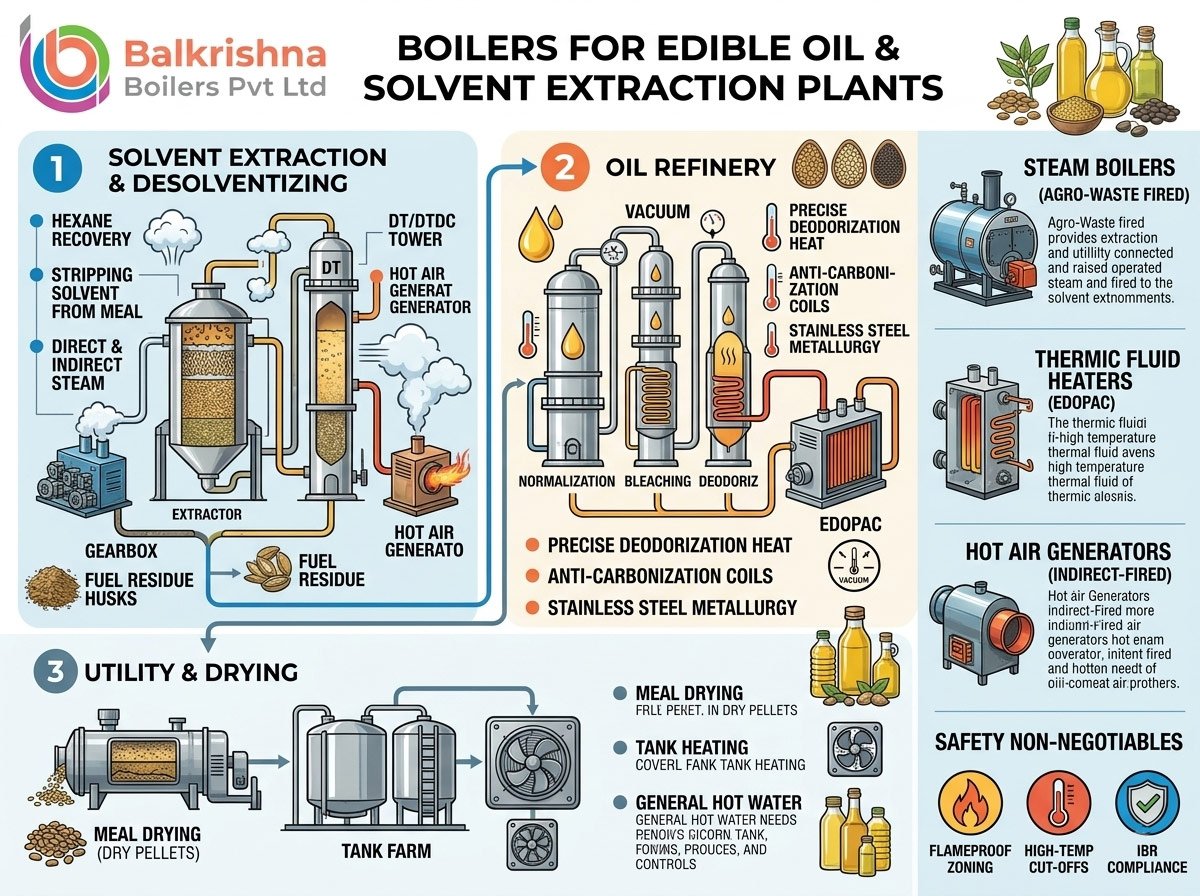
India’s edible oil and solvent extraction industry runs on heat. From the moment oilseed enters a plant to the moment refined, deodorized oil leaves it in a tanker or a tin, almost every step — conditioning, extraction, desolventizing, neutralization, bleaching, and deodorization — depends on a reliable, precisely controlled source of thermal energy. Get the heating system wrong, and you’re looking at scorched meal, off-flavour oil, high solvent losses, or a plant that simply can’t run at rated capacity. Get it right, and thermal energy quietly becomes one of your biggest levers for yield, quality, and fuel cost control.
At Balkrishna Boilers Pvt Ltd, we’ve spent over two decades engineering steam boilers, thermic fluid heaters, and hot air generators for oil mills, solvent extraction plants, and refineries across India and overseas. This guide walks through where each type of equipment fits into the process, how to size it, and what safety and hygiene factors matter most when the process fluid you’re heating is edible oil or hexane vapour.
Why Heat Management Is So Critical in This Industry
A solvent extraction plant is really three thermal systems stitched together:
- The extraction and desolventizing section, where hexane (or another food-grade solvent) is used to pull oil out of seed meal, then driven off using steam and hot air.
- The oil refinery, where crude oil is neutralized, bleached, and deodorized — the deodorization step alone typically needs high-temperature steam or thermal fluid under vacuum.
- Utility and drying operations, including meal drying, tank heating, and general process hot water.
Each of these zones has different pressure, temperature, and hygiene requirements, which is exactly why plants rarely run on a single heating source. Understanding which equipment belongs where is the first step to designing an efficient utility block.
Steam Boilers: The Backbone of Desolventizing and Refining
For most solvent extraction plants, a well-sized steam boiler is still the primary utility. Steam is used to:
- Strip solvent from de-oiled meal in the Desolventizer-Toaster (DT/DTDC), where direct and indirect steam simultaneously evaporate residual hexane and toast the meal for animal feed use.
- Heat the extractor and miscella distillation system, driving off solvent from the oil-solvent mixture (miscella) before final oil recovery.
- Provide process steam for the refinery — neutralization (degumming and caustic treatment), bleaching, and, indirectly, deodorization via steam ejector vacuum systems.
Because most oilseed plants — soybean, groundnut, mustard, cottonseed, rice bran, sunflower — generate their own biomass residue (husk, shells, de-oiled cake), a biomass or agro-waste fired steam boiler is often the most economical choice, letting the plant use its own by-product as fuel instead of paying for coal, oil, or gas. Where a plant needs faster load response or runs on natural gas or LDO, an oil/gas fired steam boiler or a compact rice husk fired steam boiler is a common fit, particularly for rice bran extraction units. As we’ve covered in our detailed guide on rice husk steam boilers, solvent extraction is one of the standard applications this fuel type serves well, thanks to consistent local availability near rice milling clusters.
Larger, integrated crushing-cum-extraction plants that also run continuous jacketed reactors or presses sometimes prefer a FBC (Fluidized Bed Combustion) steam boiler, which burns a wider range of biomass fuels cleanly and at higher efficiency. All our steam boilers are manufactured under Indian Boiler Regulations (IBR), which matters here because DT units and refinery vessels are typically fed with IBR-rated pressure steam.
Thermic Fluid Heaters: Precision Heat for Refining and Frying-Grade Oil
While steam is the workhorse for bulk process heat, several stages in an oil refinery need higher, more precisely controlled temperatures without the pressure penalty of high-pressure steam. This is where a thermic fluid heater becomes essential. As we explain in our guide on how a thermic fluid heater works, these systems circulate a closed-loop thermal fluid instead of generating steam, which means a plant can reach 250–350°C at near-atmospheric pressure — ideal for:
- Deodorization and bleaching, where consistent, non-fluctuating heat is essential to strip off-flavours without degrading the oil.
- Refinery reboilers and heat exchangers, indirectly heating process streams without direct contact between the fuel-side combustion and the oil.
- Edible oil and frying oil heating, where oil quality, clarity, and food safety cannot tolerate hot spots or carbonization.
For this last application specifically, our EDOPAC series is a purpose-built solution. Unlike a standard thermic fluid heater, EDOPAC is engineered around the viscosity and thermal sensitivity of edible oil itself, using a low heat-flux, anti-carbonization coil design to prevent hot spots that would otherwise darken or degrade the oil. It’s built in high-grade stainless steel for zero contamination, achieves up to 96% thermal efficiency, and is fully drainable for quick cleaning when switching between oil types — a common requirement in edible oil refineries and frying-oil applications. You can review the complete specification sheet on the EDOPAC product page.
For refineries and solvent extraction units that need a broader thermal fluid range beyond edible-oil-specific duty, our standard lineup includes the Vertical Three Pass Oil/Gas Fired Thermic Fluid Heater for plants with limited floor space, and the Vertical Four Pass FBC Thermic Fluid Heater for units running on biomass. On the Balkrishn.com product range, this same category is represented by the DELTAPAC, THERMPAC, and VTF/VTM Series, which you can browse on the Thermic Fluid Heater category page. If you’re unsure whether steam or thermal fluid is the better fit for your refinery’s temperature profile, our comparison article on Thermic Fluid Heater vs Steam Boiler: Which Suits Your Process breaks down the decision in detail, and our piece on thermic fluid oil selection is worth reading before you finalize the heat transfer fluid itself.
Hot Air Generators: Drying Meal and Managing Residual Solvent
The third piece of the thermal puzzle is hot air. In a solvent extraction plant, hot air generators support:
- Final drying and cooling of de-oiled meal after the desolventizer-toaster, bringing moisture down to storage-safe levels.
- Drying of oilseed before it enters the extractor, improving extraction efficiency and reducing wear on preparation equipment.
- Supplementary indirect heating for ancillary dryers used for spices, husk, or by-products processed alongside the main extraction line.
Because these plants handle a solvent-laden atmosphere, indirect-fired hot air generators are strongly preferred over direct-fired units — the process air must never mix with combustion gases in an environment where flammable solvent vapour may be present. Our Oil/Gas Fired Hot Air Generator (AIRJET series) is built on exactly this principle, using a heat exchanger to keep the discharged air 100% clean and isolated from the combustion chamber. For plants prioritizing zero-emission, food-grade air quality, the Electric Hot Air Generator (ELECTROAIR series) is worth evaluating, since it eliminates any flame or flue path near the process area entirely. Where biomass is abundant on site, the Wood/Briquette Fired Hot Air Generator offers a lower-cost alternative for non-critical drying duty. The full technical range, including the AIRFORCE, AIRPOWER, and AIRTHERM models, is available on the Hot Air Generator category page at Balkrishn.com.
Safety: The Non-Negotiable in Solvent Extraction Applications
Hexane and other extraction solvents are highly flammable, and this single fact shapes almost every equipment decision in the plant’s utility block:
- Flameproof and spark-free zoning near solvent-handling areas is mandatory, which is why indirect heating (steam coils, thermal fluid coils, or heat-exchanger-based hot air) is preferred over direct-fired equipment inside the extraction and DT house.
- Low Flow Switches and High-Temperature Cut-offs are standard on our thermic fluid heaters to prevent the fluid film from exceeding safe temperatures, which could otherwise generate hot surfaces near solvent vapour.
- IBR compliance for any steam-generating equipment ensures the pressure vessel meets certified design, material, and inspection standards — critical in a plant where a pressure failure near a solvent atmosphere would be catastrophic.
- Stainless steel and food-grade metallurgy on units like EDOPAC ensure the equipment doesn’t introduce contamination risk into oil destined for human consumption.
Any reputable industrial boiler manufacturer serving this sector should be able to walk you through hazardous-area classification, burner interlocking, and vent/flame arrestor requirements as part of the proposal — not as an afterthought.
How to Size Your Boiler or Heater for an Edible Oil / Solvent Extraction Plant
A few practical sizing questions we ask every client:
- What is your seed/meal throughput (TPD)? This drives the steam or thermal fluid load for the DT unit and refinery.
- What refinery processes are on-site? A plant with in-house deodorization needs meaningfully more high-temperature capacity than one that only does degumming and bleaching.
- What fuel is realistically available at your location? Husk, de-oiled cake, and shells are often free or low-cost by-products; if you’re near a rice mill cluster, rice husk is usually the most economical fuel; if you’re in a groundnut belt, groundnut husk is a natural fit.
- How much automation do you need? A continuous, multi-shift plant benefits from PLC-based load-following controls that most manual or semi-automatic systems can’t match.
- What’s your future expansion plan? It’s almost always cheaper to size the utility block 15–20% above current peak demand than to retrofit a second boiler two years later.
Our engineering team can walk through these questions during a technical consultation and propose the right combination of steam, thermal fluid, and hot air capacity — rather than selling a single “one size fits all” unit.
Why Plants Choose Balkrishna Boilers for This Application
Balkrishna Boilers Pvt Ltd has supplied heating systems into the oil exploration, solvent extraction, foods and beverages, and dairy and food processing sectors for over 25 years, with more than 5,000 installations across India and 30+ countries. Every system we design for this industry benefits from:
- In-house EDOPAC engineering, purpose-built for edible oil and frying-grade heating rather than adapted from a generic thermal fluid heater.
- IBR-approved steam boiler manufacturing, tested and certified to the standards required for pressure equipment near solvent-handling zones.
- Indirect-fired hot air systems, designed with hazardous-area safety as a starting principle, not an add-on.
- End-to-end project support, from capacity calculation and fuel selection through piping, chimney design, and commissioning.
Whether you need a single EDOPAC unit for your refinery’s frying or deodorizing line, a complete agro-waste fired steam boiler for your DT house, or a fully integrated utility block covering steam, thermal fluid, and hot air, our team can engineer it around your specific throughput and solvent-safety requirements.
Frequently Asked Questions
Which is better for edible oil refining — a steam boiler or a thermic fluid heater? Most refineries use both. Steam handles bulk heating loads like degumming and bleaching, while a thermic fluid heater (or a dedicated unit like EDOPAC) provides the higher, more precisely controlled temperatures needed for deodorization and frying-grade oil heating without the pressure risk of high-temperature steam. Our article on Thermic Fluid Heater vs Steam Boiler covers this trade-off in more depth.
Can a solvent extraction plant use a biomass boiler safely? Yes, and it’s often the most economical option, since husk and de-oiled cake are usually generated on-site. The key is ensuring all heating is delivered indirectly (through steam or air-heat-exchanger coils) rather than direct-fired equipment operating near solvent vapour zones.
Why is stainless steel construction important for edible oil heaters? Mild steel can react with free fatty acids in oil or corrode during cleaning cycles. Stainless steel, as used in our EDOPAC series, stays hygienic, rust-free, and chemically inert against food-grade oil, which is essential for both product quality and food safety compliance.
What capacity range do EDOPAC units cover? The EDOPAC series covers 0.2 to 1.0 million Kcal/hr (models EDP-20 through EDP-100), running on natural gas, LPG, diesel, or heavy oil, with thermal efficiency up to 96%. Full specifications are available on the EDOPAC product page.
Do hot air generators used in solvent extraction plants need to be indirect-fired? Yes, in almost all cases. Indirect-fired designs, like our AIRJET series, keep combustion gases fully separated from the process air stream — a critical safety requirement anywhere solvent vapour may be present.
Ready to design the right heating system for your edible oil or solvent extraction plant? Get in touch with our engineering team or request a quote from Balkrishna Boilers with your throughput, fuel availability, and process details, and we’ll propose a solution built for your plant.