
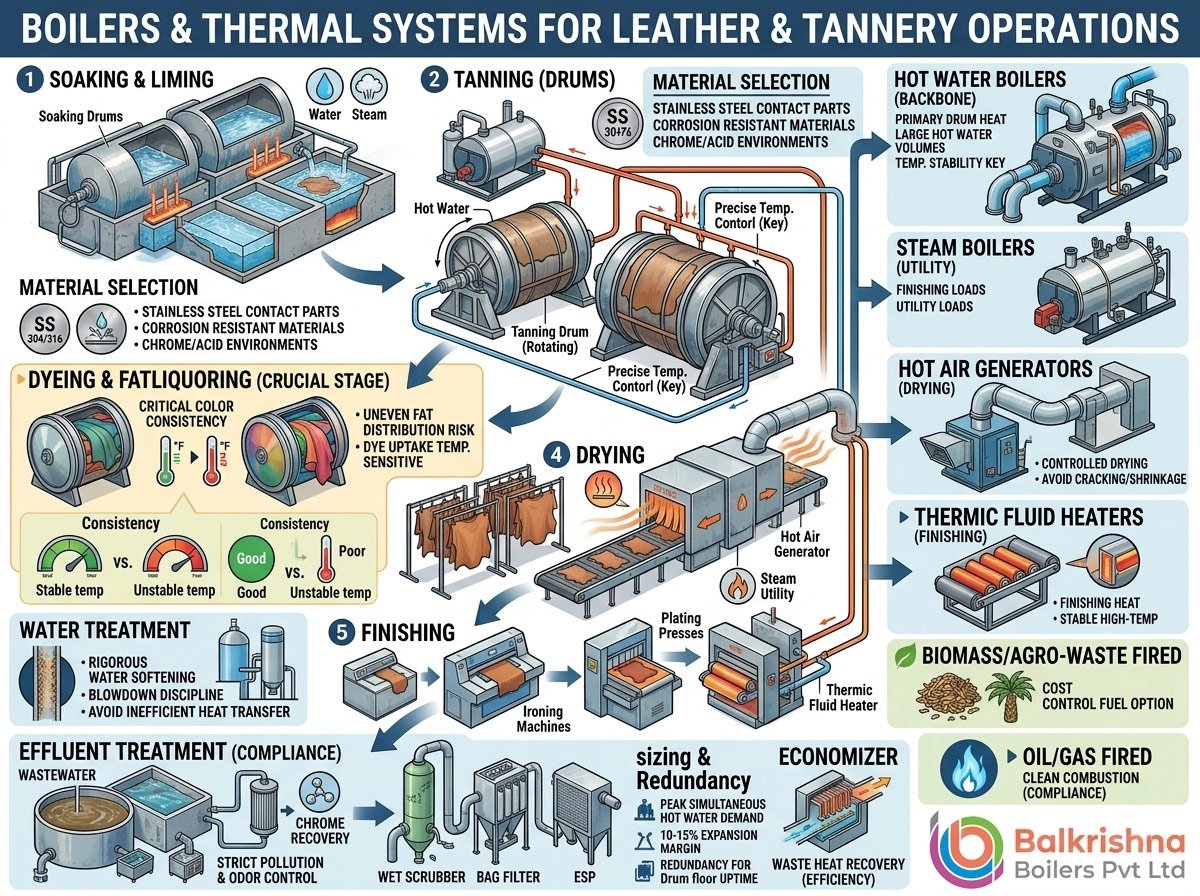
Leather processing is, at its core, a long sequence of water-based chemical treatments — and nearly every one of them depends on heat. Raw hides are soaked, limed, tanned, dyed, and fatliquored inside rotating drums filled with heated water, then dried and finished into the material that eventually becomes footwear, upholstery, or garments. A tannery that can’t hold consistent water temperature across dozens of drum cycles a day struggles with inconsistent dye uptake, uneven softness, and rework — all before the leather even reaches finishing.
For tannery operators, the boiler house sits right at the centre of both product quality and operating cost, and it does so in one of the more chemically demanding environments in industrial manufacturing. This guide covers where heat is actually used across the tanning process, which boiler and heater types fit each stage, and the material, water-quality, and compliance factors that make leather processing a genuinely specialized boiler application.
Where Heat Is Used in Leather Processing
A modern tannery moves hides or skins through a long sequence of wet and dry processing stages, most of which depend on controlled heat:
- Soaking: Raw hides are rehydrated in large drums or pits, often with heated water to speed the process and improve consistency across a batch.
- Liming and unhairing: Hides are treated in lime-and-sulfide solutions to loosen hair and open up the fibre structure — a process that runs more predictably at a controlled, moderately warm temperature.
- Deliming and bating: These conditioning steps prepare the hide for tanning and are also typically run in heated water.
- Tanning: Whether chrome tanning or vegetable tanning, the tanning drum itself needs sustained, controlled temperature for the tanning agent to penetrate and stabilize the hide fibre evenly.
- Dyeing and fatliquoring: This is one of the most heat-sensitive stages in the entire process. Dye uptake and the distribution of fatliquor (which keeps the leather supple) are both highly temperature-dependent, and drum-to-drum or batch-to-batch temperature inconsistency shows up directly as colour variation or uneven softness in the finished leather.
- Drying: Wet leather — whether “wet blue” chrome-tanned stock or dyed crust leather — needs controlled drying to a target moisture level before finishing. Too fast or too hot, and the leather can shrink, harden, or crack.
- Finishing: Ironing, plating, and glazing operations use heated rollers or plates to set the final surface finish and gloss.
- Effluent and sludge handling: Tanneries generate a significant volume of wastewater that typically requires treatment before discharge, and heat is often part of that treatment process, including sludge drying and certain chrome-recovery steps.
Because dyeing, fatliquoring, and tanning all depend on precise drum temperature, and because these stages run continuously across dozens of batches a day, temperature stability — not just raw capacity — is the defining requirement for a tannery boiler system.
Why Tannery Heat Demand Is So Different From Other Industries
Two things set leather processing apart from most other steam-using industries:
- Nearly all the heat is delivered as hot water into rotating drums, not as direct steam. Unlike a dye house that injects steam directly, tanneries typically need large volumes of hot water at a controlled temperature circulated or dosed into drum after drum, batch after batch, throughout the day. This makes hot water generation — not steam generation — the central design decision for most tannery boiler houses.
- The chemical environment is genuinely aggressive. Chrome salts, sulfides, acids, and tannins are all present in various stages of the process, and any part of the heating system that comes into contact with process water or drum condensate needs to be specified with this chemistry in mind — a consideration we’ve written about in more depth in our guide to boilers for the chemical industry, where similar corrosion and material-selection issues apply.
Boiler and Heater Types for Tanneries
Hot Water Boilers — The Backbone of Most Tannery Operations
Because so much of the tanning process runs on heated water fed into drums, a dedicated hot water boiler is typically the single most important piece of thermal equipment in a tannery. Sizing it correctly — for both volume and temperature recovery speed between drum cycles — has a direct impact on how many batches your plant can process per shift without bottlenecking at the drum floor.
Steam Boilers for Utility and Finishing Loads
Alongside drum heating, most tanneries also run a steam boiler for general utility needs, certain finishing operations, and any process step that benefits from direct steam rather than circulated hot water.
Oil and Gas Fired Boilers for Reliable, Clean Combustion
Given how tightly emissions are regulated around India’s major tanning clusters, many tanneries specify an oil/gas fired steam or hot water boiler for cleaner combustion and simpler compliance, particularly where the facility sits near residential areas or within a regulated industrial estate.
Hot Air Generators for Leather Drying
Controlled drying is critical to leather quality, and a properly sized hot air generator gives tanneries the ability to dry wet blue or crust leather without over-drying and risking shrinkage or cracking. As with any drying application, matching capacity to actual dryer-line throughput matters — our guide on how to choose capacity for a hot air generator walks through the sizing logic that applies here.
Thermic Fluid Heaters for Finishing Operations
Ironing, plating, and certain glazing processes benefit from the steady, indirect high-temperature heat a thermic fluid heater can deliver to heated rollers or plates, without the pressure and piping complexity of steam at the finishing line.
Biomass and Agro-Waste Fired Boilers for Cost Control
Where reliable biomass supply is available, a biomass fired steam boiler can meaningfully reduce running costs compared to coal or oil, provided the fuel switch doesn’t compromise the temperature consistency drum processing depends on.
Material Selection and Corrosion Resistance
Tanning chemistry — chrome salts, sulfides, and acidic process water — makes material selection a genuinely important part of specifying a tannery boiler system, not an afterthought. Discuss the following with your supplier:
- Whether condensate return lines and any equipment in direct or indirect contact with process water need stainless steel construction, given the corrosive nature of tannery effluent and drum overflow.
- Feedwater and make-up water quality, since many tanneries draw from groundwater sources with their own hardness and mineral profile that needs treatment before it reaches the boiler.
- Insulation and piping specifications suited to a humid, chemically active plant environment.
Water Treatment: Protecting Fuel Cost and Batch Consistency
Scale build-up inside any boiler wastes fuel — as little as 1mm of scale can raise fuel consumption by 7–10% — but in a tannery, inconsistent heat transfer caused by fouling also risks uneven drum temperatures across a working day, which shows up directly as batch-to-batch colour or softness variation. A disciplined water softening and blowdown program is one of the highest-return investments a tannery can make in both running cost and product consistency.
An economizer to recover flue-gas heat for feedwater pre-heating is worth specifying given how continuously most tannery boiler houses run across multi-shift operation.
Emissions and Odor Control: A Higher Bar for Tanneries
Leather processing carries a well-documented environmental legacy in India’s major tanning clusters, and regulatory scrutiny — particularly around effluent and air emissions — is correspondingly strict. Pairing your boiler with the right pollution control equipment is now a baseline expectation rather than an optional upgrade. A wet scrubber is particularly relevant in this industry, since it can help manage both particulate emissions and some of the odor concerns associated with tannery flue gas, alongside a bag filter or ESP suited to your specific fuel choice.
Sizing and Redundancy for Continuous Drum Processing
Tanneries typically run many drums on staggered, overlapping cycles throughout the day, which means capacity planning should be based on peak simultaneous hot water and steam demand — not an average across the day. The standard approach is to total peak draw across every active drum and process line, then add a 10–15% margin for future expansion and demand variability. Given how directly a boiler shortfall affects drum temperature and batch consistency, many tanneries of meaningful scale also install a second unit purely for redundancy, so scheduled maintenance doesn’t force a slowdown across the drum floor.
Choosing a Boiler Partner for Leather and Tannery Operations
Given the corrosive chemistry, continuous drum-cycle demand, and heightened regulatory scrutiny this industry operates under, your equipment supplier’s relevant experience matters as much as the boiler specification itself. Look for a partner who can demonstrate:
- Experience with hot water systems specifically, not just steam-centric process industries, since hot water is the primary heat carrier in most tanneries.
- An understanding of corrosive, chemically active process environments — our work in the chemical sector, covered in boilers for the chemical industry: what to look for, reflects the same material-selection discipline a tannery needs.
- A track record with fluctuating, batch-cycle demand patterns, similar to what we’ve written about in how the right boiler improves dye house efficiency — dye houses and tanneries share a very similar drum-based, temperature-sensitive process profile.
- Integrated pollution control design, given the emissions and odor scrutiny this industry faces.
- IBR certification and end-to-end support, from site layout through installation, commissioning, and after-sales AMC coverage.
Indian Boilers.com and Balkrishna Boilers Pvt Ltd supply hot water boilers, steam boilers, and hot air generators engineered for continuous, chemically demanding drum-processing operations like tanneries, backed by pollution control equipment suited to this industry’s specific compliance requirements. Our engineering team can help you map heat demand across your soaking, tanning, dyeing, and finishing lines and recommend the right combination of systems.
Frequently Asked Questions
What type of boiler is most important for a tannery? A hot water boiler is typically the central piece of thermal equipment in a tannery, since most drum processes — soaking, liming, tanning, dyeing, and fatliquoring — run on heated water rather than direct steam.
Why is temperature consistency so critical in leather dyeing? Dye uptake and fatliquor distribution are highly temperature-dependent. Inconsistent drum temperature between batches shows up directly as colour variation or uneven softness in the finished leather.
Do tanneries need special boiler materials because of the chemicals used? Yes. Chrome salts, sulfides, and acidic process water make corrosion resistance an important consideration, particularly for any equipment in contact with process water, condensate, or drum overflow.
Can a tannery reduce fuel costs with a biomass boiler? Yes, where a reliable biomass supply is available, though the switch should be evaluated carefully to ensure it doesn’t compromise the temperature consistency drum processing depends on.
Why is emissions control especially important for tannery boilers? India’s major tanning clusters face significant regulatory scrutiny around both effluent and air emissions, given the industry’s environmental history, so integrated pollution control equipment is treated as a baseline requirement rather than optional.
How many boilers does a typical tannery need? Most tanneries running multiple drums on staggered cycles need enough capacity to cover peak simultaneous demand, and many install a second unit for redundancy so maintenance doesn’t disrupt drum-floor temperature consistency.
Specifying or upgrading a boiler system for your tannery or leather processing facility? Contact our engineering team for a hot water and steam capacity recommendation tailored to your drum operations.