
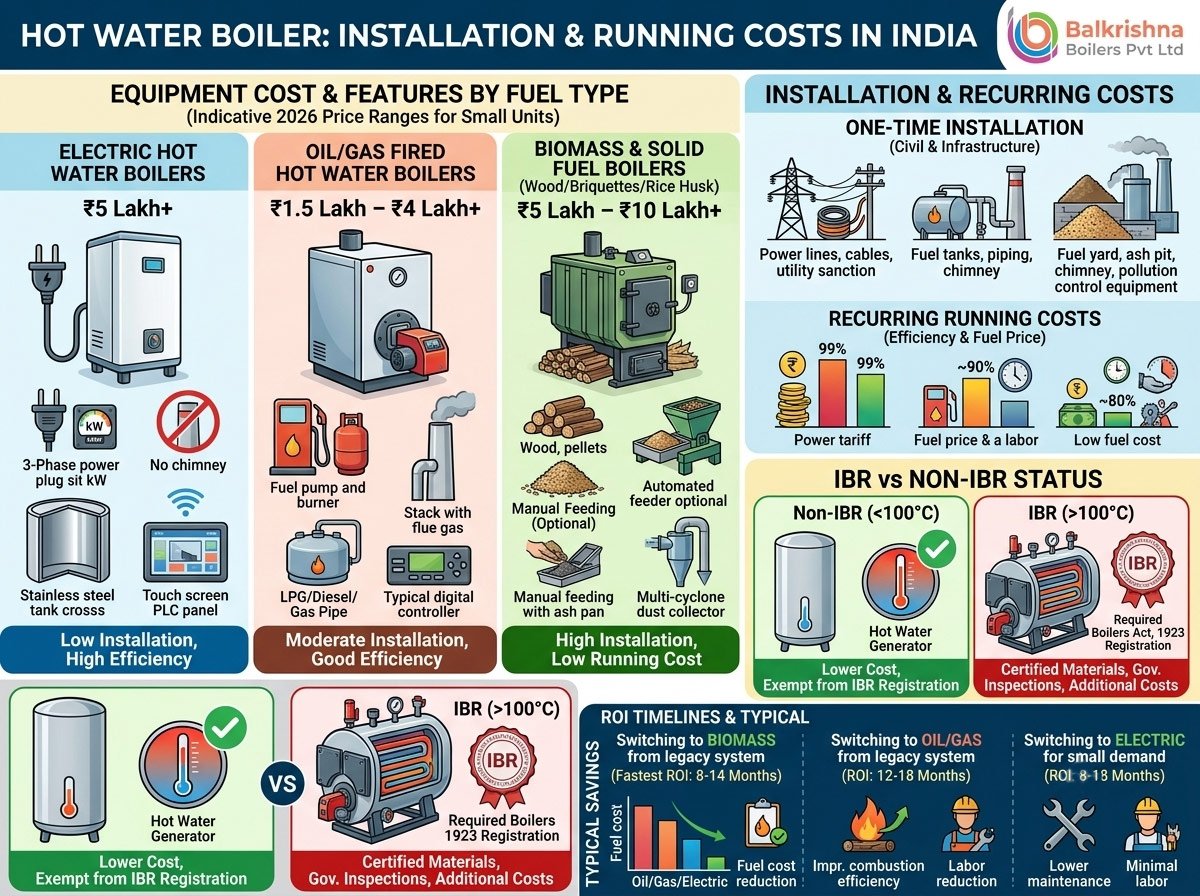
“What will it cost?” is almost always the first question a plant manager asks when specifying a new hot water boiler — and almost always the hardest one to answer with a single number. The equipment price alone can vary by a factor of ten depending on capacity, and the installation cost around it depends just as heavily on fuel type, site readiness, and automation level.
This guide breaks the total cost down into its real components — equipment, installation, and ongoing running cost — with approximate 2026 pricing ranges across electric, oil/gas, and biomass systems, so you can budget accurately instead of guessing.
1. What Actually Determines the Price
Before looking at numbers, it helps to understand what drives them. A hot water boiler’s price isn’t set by a flat rate per litre — it’s shaped by several independent factors that stack together:
- Capacity (kcal/hr or LPH) — the single biggest driver of equipment cost.
- Fuel type — electric, oil/gas, or solid biomass, each with a different base cost and installation profile.
- Automation level — a basic digital controller versus a full PLC/HMI touchscreen system.
- Material of construction — carbon steel versus stainless steel, relevant where water purity or corrosion resistance matters.
- IBR status — units required to be IBR-registered (outlet temperature above 100°C) involve certified materials, government inspection fees, and additional documentation cost.
- Site readiness — an existing boiler house with utilities already in place costs far less to commission than a greenfield installation.
Keeping these six factors in mind makes the price ranges below far more useful than treating them as fixed numbers.
2. Equipment Cost by Fuel Type
Electric Hot Water Boilers
Industrial Electric Hot Water Boilers are priced primarily by kW rating, tank capacity, and automation grade. As a baseline, small-capacity industrial electric hot water boilers start around ₹5,00,000, with larger, high-capacity, PLC-based units ranging up to ₹15,00,000+. The final price is also shaped by material choice — stainless steel construction for higher water-purity applications costs more than standard carbon steel.
Oil/Gas Fired Hot Water Boilers
Oil/Gas Fired Hot Water Boilers, such as the AQUAJET series (0.1 to 2.0 Mcal/hr capacity), are priced according to capacity and burner specification. Approximate 2026 rates for the broader hot water boiler category place small units (50,000–2,00,000 kcal/hr) in the ₹1.5 Lakh to ₹4 Lakh range, medium units (5–10 Lac kcal/hr) between ₹6 Lakh and ₹12 Lakh, and large systems (20 Lac+ kcal/hr) at ₹20 Lakh and above.
Biomass and Solid Fuel-Fired Hot Water Boilers
Biomass Fired Hot Water Boilers and the Briquette / Wood Fired Hot Water Boiler typically start around ₹5,00,000 to ₹10,00,000 for small-capacity units (up to 2 Lac kcal/hr), with pricing scaling based on capacity and whether the fuel feeding system is manual or automated. Automated fuel feeders add to upfront cost but reduce labor dependency over the boiler’s operating life.
3. Installation Cost: Beyond the Equipment Price
The equipment invoice is only part of the total spend. Installation cost varies significantly by fuel type because of the supporting infrastructure each one requires.
Electric installations are the simplest and generally the cheapest to commission. Because electric hot water boilers are skid-mounted and largely plug-and-play, there’s no chimney, no fuel storage tank, and no flue gas ducting to install — this alone can make electric installations meaningfully cheaper on the civil and infrastructure side, even when the equipment price itself is comparable to a fuel-fired unit. The main installation cost driver is electrical infrastructure: cabling, a dedicated transformer or power connection capable of handling a 3-Phase, 415V industrial load, and utility sanctioning where the load is substantial.
Oil/gas installations need a fuel storage tank (or a gas pipeline connection), fuel piping, a chimney or flue outlet, and burner commissioning. Where a gas pipeline (PNG) connection already exists at the site, installation cost drops considerably compared to sites requiring a new LPG or diesel storage setup.
Biomass and solid-fuel installations carry the highest supporting infrastructure cost: a fuel storage yard, ash handling and disposal arrangements, a chimney sized for particulate control, and — critically — pollution control equipment such as multi-cyclone dust collectors or bag filters to keep emissions within CPCB/SPCB limits. This equipment isn’t optional; it’s what keeps a biomass installation compliant, and it should be budgeted as part of the installation cost, not treated as an afterthought.
4. IBR vs Non-IBR: A Real Cost Difference
Whether your hot water boiler needs IBR (Indian Boiler Regulations) registration has a direct and sometimes underestimated impact on total cost. In India, if outlet water temperature stays below 100°C, the unit is generally classified as a Hot Water Generator and does not require IBR registration — this keeps costs down by removing the need for certified boiler-grade steel documentation, third-party radiographic weld testing, and government inspection fees.
If your process genuinely requires temperatures above 100°C, the unit falls under the Boilers Act, 1923, and IBR compliance adds cost at multiple stages: specialized boiler-grade steel (such as SA 515/516 Gr. 70), design appraisal, welder qualification, and multi-stage government inspections (design, material, and hydro-test) before dispatch. Non-IBR systems also avoid the ongoing cost of annual government inspections and, in many cases, the requirement for a certified boiler attendant — a real recurring saving over the equipment’s lifetime, not just a one-time installation difference.
If you’re unsure which classification applies to your planned operating temperature, our guide on Hot Water Boiler Safety Standards You Should Know covers the IBR threshold and compliance requirements in more detail.
5. Running Cost: The Number That Matters More Than Sticker Price
A lower purchase price doesn’t always mean lower total cost. Running cost — driven by fuel price and thermal efficiency — usually outweighs the upfront equipment difference within the first few years of operation.
Electric boilers achieve close to 99% thermal efficiency, meaning almost all purchased electricity converts to usable heat. However, per-unit electricity cost is typically higher than biomass fuel cost, so running cost depends heavily on your local industrial power tariff.
Oil/gas boilers typically run at 85–92% efficiency. Fuel cost is generally higher than biomass but the systems require minimal labor and virtually no manual fuel handling, which offsets some of the fuel cost disadvantage through lower operating labor.
Biomass and briquette-fired boilers run at lower thermal efficiency (roughly 78–82%) but consistently offer the lowest fuel cost per delivered unit of heat — switching from oil/gas to biomass can reduce operational heating costs by 60% to 80% in many parts of India, at the trade-off of manual fuel handling, ash disposal, and slightly higher maintenance labor.
For a full breakdown of how to weigh these trade-offs against your specific site conditions, see our comparison guide, Choosing Between an Electric and Fuel-Fired Hot Water Boiler.
6. Return on Investment (ROI) Timelines
Most industrial clients switching from an inefficient legacy heating system to a properly sized modern hot water boiler see a full return on investment within 8 to 18 months, depending on the fuel switch involved:
- Switching to biomass or briquettes from oil/gas or electric typically delivers the fastest payback, given the significant fuel cost differential, often within 8 to 14 months.
- Switching to oil/gas from an older, inefficient system typically pays back within 12 to 18 months, driven by improved combustion efficiency and reduced labor.
- Switching to electric from a fuel-fired system often shows ROI through lower maintenance and installation cost rather than fuel savings alone, particularly for small-to-medium installations where zero fuel handling and minimal labor requirements offset a higher per-unit power cost.
7. Hidden Costs Worth Budgeting For
A few line items are easy to overlook when comparing quotes, but they materially affect total installed cost:
- Water treatment systems — a softener or dosing system is effectively mandatory, especially for electric boilers where scale buildup on immersed heating elements causes premature failure. Just 1mm of scale can reduce efficiency by roughly 10%.
- Circulation pumps — forced circulation is required for hot water systems to prevent localized boiling and ensure uniform heating; pump sizing and cost should be included in the project budget, not assumed to be part of the base boiler price.
- Insulated piping — heat loss in poorly insulated distribution piping quietly erodes the efficiency gains of an otherwise well-chosen boiler.
- Pollution control equipment — mandatory for solid-fuel systems, and a real cost that shouldn’t be treated as a later add-on.
- Commissioning and training — proper commissioning and operator training on safety protocols protects your investment and reduces early-life breakdowns.
8. A Practical Budgeting Table
| Fuel Type | Small Unit Equipment Cost | Installation Complexity | Thermal Efficiency | Typical ROI |
|---|---|---|---|---|
| Electric | ₹5 Lakh+ | Low — no chimney/fuel storage | 98–99.5% | 8–18 months (labor/maintenance savings) |
| Oil/Gas | ₹1.5–4 Lakh (small) | Moderate — fuel storage/piping, chimney | 85–92% | 12–18 months |
| Biomass/Briquette | ₹5–10 Lakh (small) | High — fuel yard, ash handling, pollution control | 78–82% | 8–14 months |
(Figures are approximate 2026 indicative ranges for small-capacity units and vary with site conditions, automation level, and current material costs.)
9. Where This Cost Fits Into Your Application
Installation budgeting also depends on what the boiler is actually serving. A system feeding a hotel or hospital laundry has different simultaneity and sizing requirements than one feeding a textile dyeing line — undersizing to save on upfront cost is one of the most common (and expensive) mistakes plants make. Our guide on How Hot Water Boilers Support Laundry and Textile Washing Units walks through how peak simultaneous demand, not average demand, should drive capacity — and therefore cost — decisions.
10. Getting an Accurate Quote
Because so many variables affect final price, a genuinely accurate quote requires sharing your actual requirements rather than comparing generic price lists. At minimum, share:
- Required flow rate (LPH — litres per hour).
- Desired outlet temperature (this determines IBR applicability).
- Preferred fuel type, or openness to a fuel comparison.
- Site details — available power supply, existing chimney/fuel infrastructure, and floor space.
Our engineering team typically turns this into a detailed technical and commercial proposal within 24 hours. The full Hot Water Boiler category at IndianBoilers.com covers the complete fuel-type range, and the same product logic carries through on our flagship manufacturing site — the Balkrishna Boilers Hot Water Boiler series, including the AQUAJET, AQUAMAX, VST SERIES, VTFH SERIES, and VTMH SERIES.
Frequently Asked Questions
What is the cheapest type of hot water boiler to install in India? Electric hot water boilers generally have the lowest installation cost due to the absence of chimney, fuel storage, and pollution control requirements — though running cost depends on your local electricity tariff.
Does a hot water boiler always need government approval before installation? Only if outlet temperature exceeds 100°C, which brings it under IBR (Boilers Act, 1923). Below that threshold, most hot water generators are exempt from registration.
How much does biomass fuel switching actually save? Facilities switching to wood or briquette fuel commonly see operational heating cost reductions of 60% to 80% compared to oil or gas, though this varies with local fuel availability and pricing.
Is a cheaper boiler always a worse long-term investment? Not necessarily — but it’s important to compare total cost of ownership (equipment + installation + running cost + maintenance) rather than equipment price alone. A cheaper unit with poor efficiency or heavy labor requirements can cost more over its operating life.
Final Word
There’s no single “right” price for a hot water boiler installation in India — the honest answer depends on capacity, fuel type, IBR status, and site readiness, all of which shift the number meaningfully in either direction. Budgeting accurately means looking past the equipment sticker price to installation infrastructure, running cost, and realistic ROI timelines.
For a detailed, site-specific quote, share your required flow rate and desired temperature with our engineering team. Get in touch with IndianBoilers.com or reach out to Balkrishna Boilers for a technical and commercial proposal.