
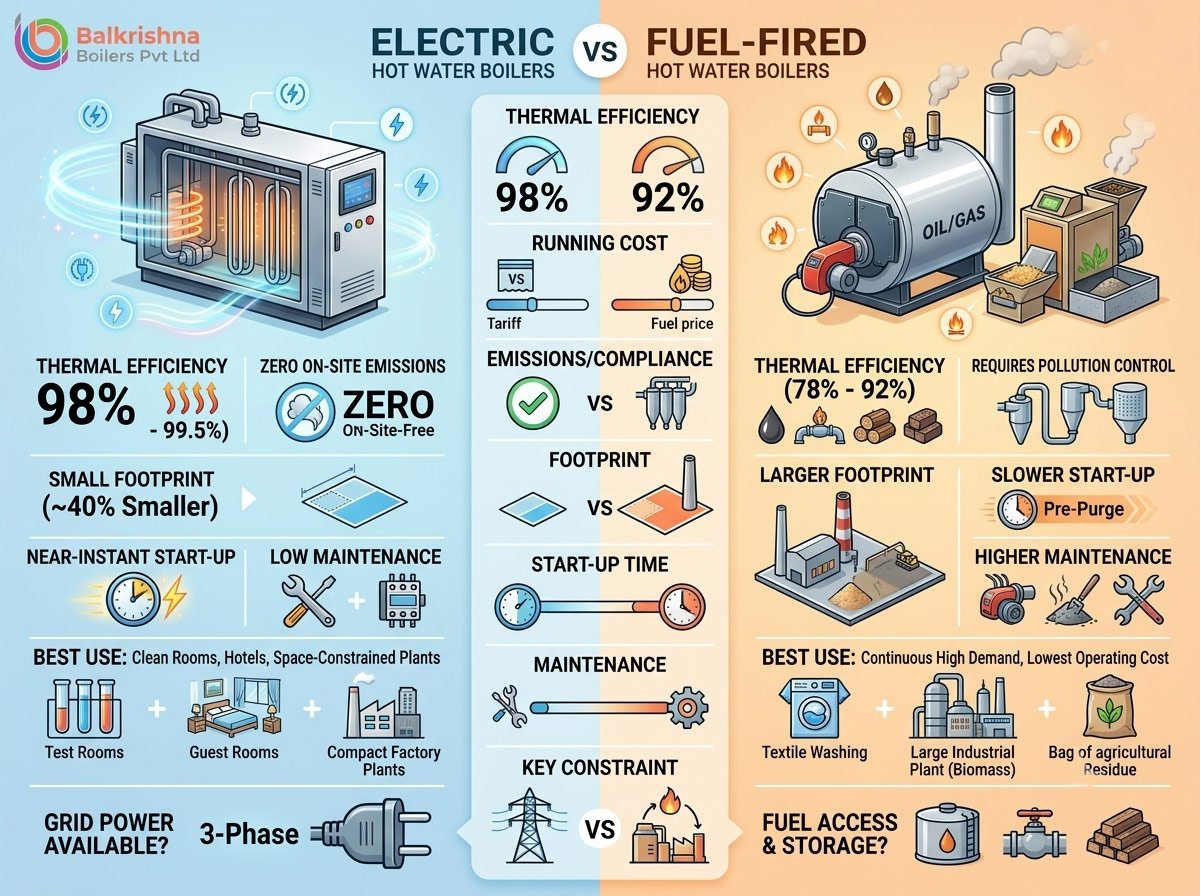
Every plant manager specifying a new hot water boiler eventually lands on the same fork in the road: electric or fuel-fired. Both technologies do the same fundamental job — heating water and circulating it through a closed loop — but they get there through very different mechanisms, with different cost structures, space requirements, and operational trade-offs attached.
There’s no universally “better” option here. An electric hot water boiler is the right call for one facility and the wrong one for another, purely based on power availability, fuel access, and how the boiler will actually be used day to day. This guide breaks down exactly what changes between the two, so the decision comes down to your numbers, not a generic recommendation.
1. How Each Technology Actually Works
Electric hot water boilers, such as the Industrial Electric Hot Water Boiler, heat water by passing electrical current through immersed resistance elements — typically Incoloy or SS 316L heaters — with a thyristor-based control system regulating output. There’s no combustion, no chimney, and no flame anywhere in the process.
Fuel-fired hot water boilers burn a combustible fuel — oil, gas, or solid biomass — inside a furnace, and transfer that heat to water through a heat exchanger. This includes the Oil/Gas Fired Hot Water Boiler, the Biomass Fired Hot Water Boiler, and the Briquette / Wood Fired Hot Water Boiler, each built around a different fuel-handling and combustion system.
That single distinction — combustion versus no combustion — cascades into nearly every other difference between the two categories.
2. Thermal Efficiency: The Headline Number
Electric boilers convert almost all input energy directly into heat. With no flue gas losses, no radiation losses from a hot combustion chamber, and no standby losses from maintaining a flame, electric hot water systems typically achieve 98% to 99.5% thermal efficiency — essentially, nearly every unit of electricity purchased ends up as heat in the water.
Fuel-fired systems lose energy at several points in the combustion process: heat that escapes up the flue with exhaust gases, radiation losses from the boiler shell, and — for solid fuel systems — losses tied to incomplete combustion or moisture content in the fuel. Most modern oil/gas hot water boilers operate at 88% to 92% efficiency, while biomass and solid-fuel models typically range from 78% to 82%.
On paper, electric wins the efficiency comparison outright. But efficiency alone doesn’t determine running cost — that depends on what you’re paying per unit of energy, not just how much of it gets converted to heat.
3. Running Cost: Where the Real Decision Happens
This is usually the deciding factor, and it depends heavily on regional energy pricing.
Electricity cost per unit of delivered heat is a function of your local tariff and the boiler’s near-perfect conversion efficiency. In regions with high industrial electricity tariffs, even 99% efficiency doesn’t always translate to the lowest running cost per kcal delivered — but in areas with favorable industrial power rates, or facilities that can shift load to off-peak hours, electric can be genuinely competitive.
Biomass fuel — wood, briquettes, rice husk, groundnut shell — is consistently the lowest-cost fuel option per unit of heat in most parts of India, which is why biomass and briquette-fired hot water boilers remain popular for continuous, high-volume process heat, despite the lower thermal efficiency and the added labor of fuel handling and ash disposal.
Oil and gas typically sit in the middle: cleaner and more automated than solid fuel, with running costs that fluctuate with fossil fuel pricing but generally lower than grid electricity for high-demand, continuous operations.
The honest way to compare is on a cost-per-delivered-kcal basis, factoring in your actual local tariff or fuel price, not just the headline efficiency percentage. A facility with cheap grid power and no space for fuel storage may find electric the clear winner, while a facility with access to low-cost agricultural residue may find biomass unbeatable on running cost despite its lower efficiency rating.
4. Installation and Footprint
Electric hot water boilers are compact, skid-mounted, and largely “plug and play.” Because there’s no combustion, there’s no chimney, no flue gas ducting, and no fuel storage yard — industrial electric boiler installations can occupy roughly 40% less floor space than an equivalent fuel-fired setup. This makes electric a strong fit for urban plants, rooftop installations, or facilities where floor space is at a premium.
Fuel-fired systems need more planning: a chimney or flue outlet, adequate ventilation, and — for solid fuel systems in particular — a dedicated fuel storage and ash handling area. Oil/gas systems need less space than solid fuel but still require fuel storage tanks or a gas line connection, plus safety clearances around the burner and fuel train.
If your facility is space-constrained or located in a dense industrial zone with limited setback distances, this factor alone can tilt the decision toward electric.
5. Emissions and Regulatory Load
Electric boilers produce zero on-site emissions — no CO2, NOx, SOx, or particulate matter at the point of use. This significantly simplifies compliance: no chimney height requirements, no stack emission monitoring, and generally lighter paperwork with state Pollution Control Boards. For facilities in urban or environmentally sensitive zones, or those pursuing carbon-neutrality targets, this is often the deciding factor regardless of running cost.
Fuel-fired boilers — particularly solid-fuel systems — require pollution control equipment (multi-cyclone dust collectors, bag filters) to keep particulate emissions within CPCB/SPCB limits, along with chimney height compliance and periodic stack monitoring. Oil and gas combustion is cleaner than solid fuel but still produces flue gas emissions that need to meet local norms.
6. Maintenance and Operational Complexity
Electric hot water boilers are mechanically simple: no burners to clean, no soot to remove, and no fuel pumps or feeders to service. Routine maintenance is largely limited to checking electrical contactors, periodic descaling of heating elements, and water quality monitoring. Because heating elements sit in direct contact with water, water treatment is non-negotiable — scale buildup on an immersed element causes localized overheating and premature failure, so a softener or dosing system should be treated as a core part of the installation, not an optional extra.
Fuel-fired boilers require burner maintenance, periodic cleaning of heat-exchange surfaces (soot and ash buildup reduce efficiency over time), and — for solid fuel systems — daily attention to fuel feeding and ash removal. This translates to a higher ongoing labor requirement, which matters when comparing total cost of ownership, not just fuel price.
7. Duty Cycle and Response Time
Electric boilers respond almost instantly — heating elements begin transferring heat the moment current flows, with no warm-up delay. This makes electric systems well suited to intermittent or highly variable demand, where the boiler needs to ramp up and down quickly without holding a standing flame.
Fuel-fired boilers, particularly larger shell-type units, take longer to reach operating temperature from a cold start and are generally better suited to continuous, steady-state demand where the system runs for extended periods rather than cycling frequently. If your facility — a laundry, textile washing line, or process plant — runs hot water demand continuously across a shift, a properly sized fuel-fired system can be more economical over that sustained load; a more detailed look at continuous washing demand is covered in our post on How Hot Water Boilers Support Laundry and Textile Washing Units.
8. Power Availability: The Practical Constraint
None of the above matters if the electrical infrastructure isn’t there to support it. Industrial electric hot water boilers typically require a 3-Phase, 415V, 50Hz supply capable of handling significant continuous load — a large electric boiler can draw enough current that it requires dedicated transformer capacity and utility approval.
In areas with unreliable grid supply or where industrial power sanctioning is a lengthy process, a fuel-fired system avoids this dependency entirely. This is a genuinely practical constraint, not just a cost comparison, and it’s worth confirming with your electricity provider before committing to an electric system at scale.
9. Which Industries Typically Choose Which
Electric hot water boilers are strongly preferred in:
- Pharmaceutical and clean-room environments, where zero combustion byproducts protect product purity.
- Hospitals and hotels, where quiet, flameless operation near patient or guest areas matters.
- Urban or space-constrained industrial plots.
- Facilities actively pursuing decarbonization or carbon-neutrality targets.
Fuel-fired hot water boilers — particularly biomass and oil/gas — remain the standard in:
- High-volume, continuous-duty textile washing and dyeing operations, where fuel cost dominates the operating budget.
- Facilities with access to low-cost agricultural residue or an existing gas pipeline connection.
- Sites where floor space for fuel storage isn’t a constraint.
- Rural or semi-urban locations where grid power sanctioning for large loads is difficult.
For a deeper look at safety devices and compliance requirements that apply across both fuel categories, see our guide on Hot Water Boiler Safety Standards You Should Know, which covers fuel-specific precautions in detail.
10. A Side-by-Side Summary
| Factor | Electric Hot Water Boiler | Fuel-Fired Hot Water Boiler |
|---|---|---|
| Thermal efficiency | 98–99.5% | 78–92% depending on fuel |
| Emissions | Zero on-site | Requires pollution control equipment |
| Footprint | ~40% smaller | Larger — needs chimney/fuel storage |
| Start-up time | Near-instant | Slower, especially solid fuel |
| Maintenance | Low (descaling, contactors) | Higher (burner, ash, fuel handling) |
| Best duty cycle | Intermittent/variable demand | Continuous, steady-state demand |
| Key constraint | Grid power availability | Fuel access and storage space |
| Running cost driver | Local electricity tariff | Local fuel price |
11. Where to Look Across Our Range
Whether the decision lands on electric or fuel-fired, the full Hot Water Boiler category at IndianBoilers.com covers both paths — from the Industrial Electric Hot Water Boiler to fuel-flexible options including the Oil/Gas Fired Hot Water Boiler and Biomass Fired Hot Water Boiler.
The same range carries through on our flagship manufacturing site. The Balkrishna Boilers Hot Water Boiler series includes the AQUAJET and AQUAMAX fuel-fired packaged models, along with the VST SERIES, VTFH SERIES, and VTMH SERIES — giving plants a genuine choice of configuration rather than a one-size-fits-all recommendation.
Frequently Asked Questions
Is an electric hot water boiler always more expensive to run than a fuel-fired one? Not always — it depends entirely on your local electricity tariff versus local fuel price. In regions with favorable industrial power rates, electric can be competitive despite fuel-fired systems using cheaper raw fuel per unit.
Do electric hot water boilers need IBR certification? Depending on the volume and pressure of the unit, electric hot water boilers can be manufactured as either IBR-certified or Non-IBR, based on whether outlet temperature exceeds 100°C.
Which option has lower long-term maintenance cost? Electric systems generally have lower ongoing maintenance, since there are no burners, soot, or fuel-handling systems to service — though water treatment remains essential to protect the heating elements.
Can I switch from a fuel-fired boiler to electric later if my power supply improves? It’s possible, but typically requires a new unit rather than a retrofit, since the heat generation mechanism, control system, and safety devices differ substantially between the two designs.
Final Word
The electric-versus-fuel-fired decision isn’t about which technology is objectively better — it’s about matching the boiler to your site’s power availability, fuel access, space, emissions requirements, and duty cycle. Run the numbers on cost-per-delivered-kcal using your actual local tariffs and fuel prices, factor in space and compliance constraints, and the right choice usually becomes clear.
If you’d like help running that comparison for your specific load and location, our engineering team can walk through the numbers with you. Get in touch with IndianBoilers.com or reach out to Balkrishna Boilers for a technical consultation.