
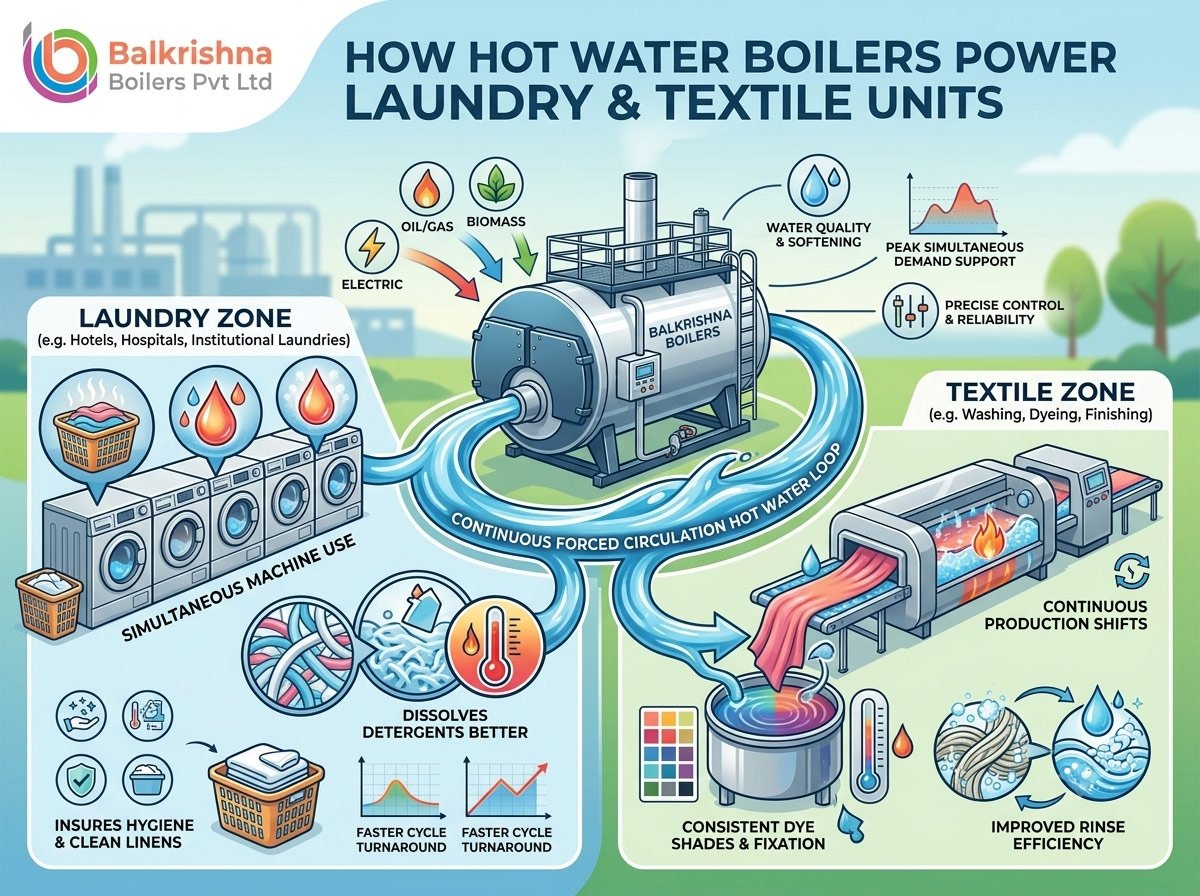
Walk into any large commercial laundry or textile processing house and you’ll notice something in common: nobody talks about the washing machines first. They talk about hot water supply. Wash quality, cycle time, chemical effectiveness, and even fabric handling all trace back to one thing — whether the plant has a hot water source that can keep up with continuous, simultaneous demand.
This is where a purpose-built hot water boiler earns its place. Unlike a domestic geyser or a small storage tank, an industrial hot water boiler is designed to circulate large volumes of consistently heated water on a continuous loop — exactly what laundries, hotels, hospitals, and textile washing/dyeing units need to run at scale without water temperature becoming the bottleneck in production.
1. Why Laundry and Textile Washing Depend on Hot Water Temperature
Washing effectiveness isn’t just about detergent and agitation — temperature does a large share of the work. Hot water:
- Dissolves detergents and surfactants faster and more completely, improving cleaning efficiency per wash cycle.
- Breaks down oils, grease, and protein-based stains far more effectively than cold or lukewarm water — critical for hospital linens, food-industry uniforms, and heavily soiled hospitality textiles.
- Opens fabric fibers, allowing detergent to penetrate and lift embedded dirt, which is especially important for towels, bedding, and industrial workwear.
- Supports dyeing and finishing chemistry in textile units, where specific temperature bands are needed for dye uptake, fixation, and even shade consistency across a batch.
- Reduces microbial load on linens in hospital and hospitality settings, supporting hygiene compliance without relying solely on chemical disinfectants.
The catch is that most industrial washing processes need this hot water continuously and simultaneously across multiple machines — not one geyser feeding one tap. That’s a fundamentally different engineering problem than domestic hot water supply, and it’s exactly the gap a Hot Water Boiler is built to close.
2. What Makes a Boiler Different From a Storage Tank Here
A large storage water heater can hold a big volume of hot water, but once that volume is drawn down by several washing machines running at once, recovery time becomes the constraint — the tank has to reheat before the next batch can start. In a commercial laundry running back-to-back loads all shift, that recovery lag directly eats into throughput.
An industrial hot water boiler solves this differently. Instead of relying on a static reserve, it uses forced circulation: a pump continuously pushes hot water through the loop to washing machines, tunnel washers, or dyeing vats, while the returning (cooled) water is reheated on the way back into the boiler. As long as the boiler’s output rating (typically measured in kcal/hr or LPH) matches or exceeds simultaneous demand, temperature doesn’t drop as machines cycle — there’s no “waiting for the tank to catch up.”
This is precisely why commercial laundries, hotel housekeeping operations, and textile washing/dyeing houses are consistently listed as core applications across our boiler range — from the Biomass Fired Hot Water Boiler to the Oil/Gas Fired Hot Water Boiler, both of which are engineered for exactly this kind of continuous, multi-point draw.
3. Laundry Operations: Hotels, Hospitals, and Institutional Laundries
Large hotels, hospitals, and industrial laundry services share a common operating pattern: high linen volume, tight turnaround windows, and hygiene standards that leave no room for inconsistent water temperature.
A properly sized hot water boiler supports this in a few concrete ways:
- Simultaneous machine loading. Central laundries often run 4–10+ washer-extractors at once during peak hours. A boiler sized correctly delivers stable temperature to all of them without one machine “stealing” hot water from another.
- Consistent hygiene outcomes. Hospitals in particular need documented, repeatable wash temperatures for infection control — something a fluctuating storage-tank system can’t reliably guarantee.
- Faster cycle turnaround. Because the boiler continuously regenerates hot water rather than depleting a fixed reserve, back-to-back loads don’t have to wait for reheating.
- Lower energy waste. A correctly sized boiler with a digital or PLC-based controller modulates output to match real-time demand, rather than keeping an oversized tank hot around the clock.
For hospitality and healthcare laundries specifically, Electric Hot Water Boilers are frequently the preferred choice — zero on-site combustion means no flue gas, no soot risk near clean linen storage, and precise thyristor-based temperature control that holds within a tight band.
4. Textile Washing, Dyeing, and Finishing
Textile processing houses put a different kind of demand on hot water systems. Washing raw fabric, scouring, dyeing, and finishing all require heat — but the temperature requirement, water chemistry, and continuity needs shift depending on the process stage.
- Pre-treatment and scouring — hot water is used to remove natural waxes, oils, and sizing agents from raw fabric before dyeing, typically in the 60–95°C range depending on fiber type.
- Dyeing — dye uptake and fixation are temperature-sensitive; inconsistent water temperature across a batch can cause visible shade variation, a costly quality defect in textile production.
- Washing and rinsing after dyeing — removes excess dye and chemicals; hot water improves rinse efficiency and reduces water consumption per batch compared to cold rinsing.
- Finishing treatments — certain fabric finishes require controlled, moderate heat application.
Because textile houses typically run continuous multi-shift operations, fuel economics matter as much as performance. This is where solid-fuel systems like the Briquette / Wood Fired Hot Water Boiler become attractive — biomass and briquette fuel costs run significantly lower than oil or gas over continuous operation, which matters when a dyeing unit is running hot water demand across three shifts a day. For a deeper look at how thermal fluid systems compare for higher-temperature textile processes like stentering and calendering, see our post on Thermic Fluid Heaters for Textile Processing: Why They’re Preferred, which covers the boundary between hot water and thermic fluid applications in more detail.
5. Sizing a Hot Water Boiler for Washing Operations
Under-sizing is the single most common mistake in laundry and textile boiler selection — and it’s almost always driven by looking at average demand instead of peak simultaneous demand.
To size correctly, plants should account for:
- Number of machines running simultaneously at peak load, not the total installed count.
- Water temperature rise required — the difference between incoming feed water temperature and the target wash temperature, which drives how much heat energy is actually needed per litre.
- Recovery time expectations — how quickly the system needs to return to set-point between batches.
- Future capacity headroom — laundries and textile units rarely shrink; sizing with 15–20% headroom avoids a premature capacity upgrade.
- Simultaneity factor — in mixed-use facilities (say, a hotel with both laundry and guest-room hot water draw), boiler sizing has to account for overlapping demand windows, not just laundry alone.
Getting this calculation wrong in either direction is costly: an undersized boiler creates production bottlenecks and inconsistent wash quality, while an oversized one wastes fuel running below its efficient operating range. Our engineering team typically asks for required LPH (litres per hour) and desired temperature as the starting point for a proper capacity recommendation — the same approach we use across the Hot Water Boiler range.
6. Fuel Choice for Laundry and Textile Applications
Fuel selection changes the running economics more than almost any other decision in a laundry or textile boiler project.
Electric hot water boilers suit hospitals, hotels, and clean-environment laundries where zero emissions, silent operation, and precise control outweigh running cost — particularly in urban locations where flue gas or fuel storage isn’t practical.
Oil/gas-fired boilers, like the Oil/Gas Fired Hot Water Boiler, offer fast start-up and fully automatic operation, a good fit for laundries and processing houses that need quick temperature ramp-up each shift without manual fuel handling.
Biomass and briquette-fired systems deliver the lowest per-litre heating cost for high-volume, continuous-operation textile units where fuel cost dominates the total operating budget — a trade-off worth weighing against the manual handling and ash disposal these systems require.
This same product logic carries through to our flagship manufacturing brand. The Balkrishna Boilers Hot Water Boiler range includes the AQUAJET and AQUAMAX packaged models, along with the VST SERIES, VTFH SERIES, and VTMH SERIES — configurations suited to different fuel types, footprints, and continuous-duty requirements common in laundry and textile installations.
7. Water Quality: Often the Hidden Constraint
Laundry and textile applications are especially sensitive to water hardness. Scale buildup inside a boiler’s heat exchanger doesn’t just reduce thermal efficiency — in textile dyeing specifically, hard water minerals can interfere with dye chemistry and cause uneven shade results across a batch. A basic water softening system upstream of the boiler protects both equipment life and product quality, and is a standard recommendation across our Hot Water Boiler Safety Standards You Should Know guide, which covers water treatment alongside the broader safety checklist.
8. Safety and Compliance in Continuous-Duty Washing Operations
Laundries and textile units typically run hot water boilers for extended hours across multiple shifts, which makes reliable safety controls — not just peak performance — a genuine operating requirement. At minimum, a system running this kind of duty cycle should have:
- A low water level cut-off to prevent dry-firing during long, unattended operating stretches.
- An over-temperature cut-off, independent from the primary controller.
- Pressure relief valves as a secondary safety layer.
- Automatic controls that maintain set-point temperature without constant manual monitoring across long shifts.
Most hot water systems used for laundry and textile washing operate below 100°C outlet temperature, which generally keeps them outside IBR registration requirements — but the underlying safety hardware should be present regardless of regulatory status. Our full breakdown of applicable standards and fuel-specific precautions is covered in Hot Water Boiler Safety Standards You Should Know.
9. Comparing Hot Water Boilers to Steam for Washing Applications
Some laundry and textile operators default to steam because it’s the traditional choice, without evaluating whether hot water would actually serve the process better. Steam is genuinely necessary where latent heat is required — certain finishing presses, autoclaves, or sterilization steps. But for straightforward washing, rinsing, and moderate-temperature dyeing, a hot water boiler is often simpler to operate, avoids steam trap and condensate losses, and delivers better overall thermal efficiency for the application. If you’re weighing the two for a new installation, our Steam Boiler range remains the right choice where the process genuinely calls for it — but it’s worth confirming that requirement before defaulting to the more complex, higher-pressure system.
Frequently Asked Questions
What temperature is typically needed for commercial laundry washing? Most commercial and hospital laundry cycles run between 60°C and 90°C depending on fabric type and hygiene requirements, well within the range of a standard Low-Temperature Hot Water (LTHW) boiler.
Can one hot water boiler supply both laundry and general building hot water needs? Yes, provided the boiler is sized for the combined peak simultaneous demand of both uses — this is a common configuration in hotels, where laundry and guest-room hot water draw from the same system.
Is a biomass-fired boiler suitable for a textile dyeing unit? Yes — biomass and briquette-fired hot water boilers are widely used in textile processing houses for their lower running cost, provided the facility has space and manpower for fuel handling and ash disposal.
Does hard water affect textile dyeing results? Yes. Mineral content in untreated water can interfere with dye uptake and cause shade inconsistency, which is why water softening is recommended upstream of the boiler in dyeing applications.
Final Word
For laundries and textile washing units, hot water isn’t a support utility — it’s a production input that directly affects throughput, wash quality, and in textile processing, product consistency. A correctly sized, properly fueled hot water boiler with forced circulation removes the recovery-time bottleneck that storage tanks create, and gives operators the consistent, continuous supply that multi-shift washing operations actually need.
If you’re planning a new laundry facility or upgrading an existing textile washing line, our engineering team can help calculate the right capacity and fuel configuration for your peak demand. Get in touch with IndianBoilers.com or reach out to Balkrishna Boilers for a technical consultation.