
Ask ten people to describe a “water heater” and most will picture the geyser mounted in a bathroom — a small tank that warms enough water for a shower and shuts off. Ask the same people about a “hot water boiler” and you’ll get a shrug, or worse, the assumption that it’s just a bigger version of the same appliance. In an industrial procurement conversation, that assumption gets expensive fast.
The two devices solve genuinely different problems. One is a point-of-use domestic appliance. The other is process heating equipment engineered for continuous industrial or commercial duty, closed-loop circulation, and — depending on temperature — regulatory oversight under the Boilers Act. If you’re specifying equipment for a factory, hotel, hospital, or processing plant, understanding where the line actually sits will save you from under-sizing your heating system or over-paying for capacity you don’t need.
1. What a Water Heater Actually Is
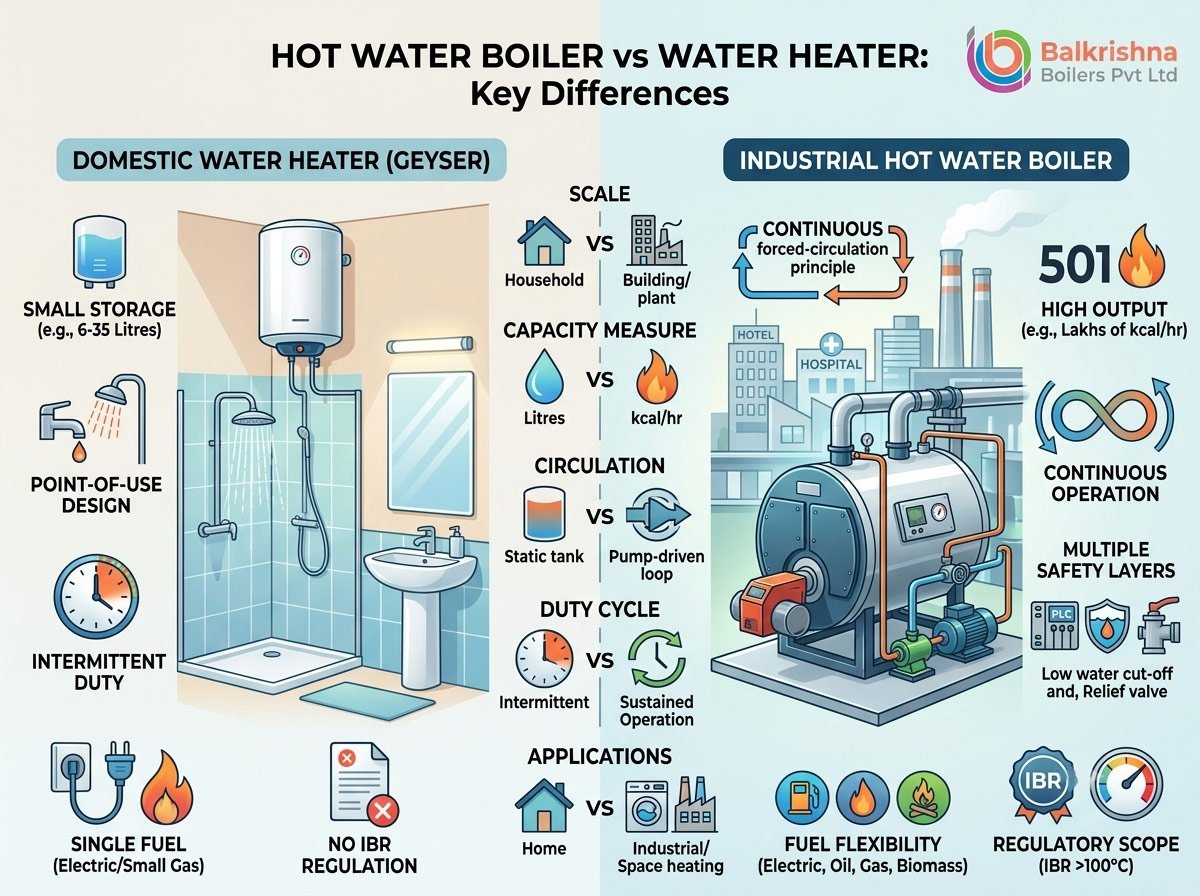
A water heater — often called a geyser in India — is built around one job: storing and heating a relatively small volume of water for direct, immediate use at a tap, shower, or sink. Most residential units hold anywhere from 6 to 35 litres, heated by a simple electric resistance element or a small gas burner, with a basic thermostat cycling the heat on and off.
Key characteristics of a domestic water heater:
- Small storage volume, typically single-digit to double-digit litres for household use.
- Point-of-use design — the water heated is usually consumed directly at that outlet, not circulated back.
- Simple controls — a thermostat and a basic pressure/temperature relief valve, with minimal automation.
- Intermittent duty — designed for short bursts of demand (a shower, a sink of dishes), not continuous output.
- No IBR or industrial regulatory scope — these fall under consumer appliance safety standards, not the Boilers Act.
This is perfectly adequate for a home, a small office pantry, or a single washroom. It is not adequate for a hotel with 200 rooms needing hot water simultaneously, or a food processing line that needs consistent hot water for cleaning-in-place (CIP) cycles all shift long.
2. What an Industrial Hot Water Boiler Actually Is
A Hot Water Boiler is process heating equipment. Instead of storing a fixed volume and heating it once, it operates on a continuous forced-circulation principle: a pump pushes water out through a closed loop of pipes to radiators, heat exchangers, or process equipment, and the cooled water returns to the boiler to be reheated — indefinitely, for as long as the plant needs it.
Key characteristics of an industrial hot water boiler:
- High continuous output, rated in kcal/hr or LPH (litres per hour) rather than a fixed tank size — commonly ranging from 50,000 kcal/hr for smaller units up to 20,00,000+ kcal/hr for large industrial systems.
- Closed-loop circulation driven by a dedicated pump, not a static tank.
- Multiple layered safety systems — low water level cut-off, over-temperature cut-off, pressure relief valves, and often a PLC-based digital controller.
- Fuel flexibility — available as Electric, Oil/Gas Fired, Biomass Fired, or Wood/Briquette Fired systems, chosen based on fuel economics and site infrastructure.
- Regulatory classification — if outlet temperature stays below 100°C, it’s typically treated as a Hot Water Generator, exempt from IBR registration; above 100°C, it falls under the Boilers Act, 1923 and must be registered.
This is equipment designed to be the thermal backbone of a facility — not a single fixture serving one tap.
3. The Core Differences, Side by Side
Purpose: A water heater serves a single point of consumption. A hot water boiler serves an entire building or process loop — multiple radiators, process vessels, or heat exchangers simultaneously.
Capacity and scale: A water heater is measured in litres of storage. A hot water boiler is measured in heat output per hour, because it isn’t storing water so much as continuously regenerating heated water as it’s drawn from the loop.
Circulation: A water heater has no circulation system — water sits in the tank until drawn. A boiler relies on a forced-circulation pump to keep hot water moving through the system and returning for reheating.
Duty cycle: Water heaters cycle on and off intermittently based on sporadic household demand. Boilers are built for sustained, near-continuous operation across a full production shift or heating season.
Fuel and automation: Water heaters typically run on a single fixed-wattage element or a basic burner. Industrial boilers offer multi-fuel options and PLC or digital temperature controllers that modulate output automatically to match load.
Regulatory oversight: Water heaters are consumer appliances, governed by product safety standards (like BIS certification), not the Boilers Act. Hot water boilers may require IBR registration depending on operating temperature, along with periodic inspection.
Application scale: Water heaters serve individual fixtures. Boilers serve building-wide space heating, hydronic radiant floors, district heating loops, or industrial process heat — applications covered in more depth in our piece on Thermic Fluid Heater vs Hot Water Boiler: Key Differences, which draws a similar equipment-class comparison for higher-temperature process heat.
4. Where the Confusion Usually Comes From
Two things blur the line in everyday conversation.
First, terminology overlaps. In some regions, “hot water boiler” is used loosely to describe any tank that produces hot water — including large commercial storage water heaters. Technically, a genuine boiler always involves a heat exchanger and (in most industrial designs) forced circulation, while a storage water heater simply heats and holds a static volume.
Second, both devices share the same end goal — hot water — so from a user’s perspective at the tap, the outcome looks identical. The difference only becomes obvious when you look at what’s feeding that tap: a 15-litre tank cycling on and off, or a continuously circulating loop backed by a boiler rated for lakhs of kcal/hr.
This distinction matters most when a business incorrectly assumes a bank of domestic water heaters can substitute for a proper boiler system — usually because the upfront cost looks lower. In practice, running dozens of small water heaters to match the output of a single industrial unit ends up costing more in electricity, maintenance, and floor space, while offering none of the automated safety controls or fuel flexibility of a purpose-built boiler.
5. When You Actually Need a Hot Water Boiler
If any of the following apply to your facility, a domestic-style water heater isn’t the right category of equipment at all:
- You need to heat an entire building through radiators, baseboard heaters, or hydronic radiant floors.
- Your process — textile washing, food processing CIP cycles, pharmaceutical cleaning, or dairy operations — requires a continuous, reliable hot water supply throughout a shift, not intermittent bursts.
- You’re running district heating across multiple buildings or a large campus.
- Simultaneous demand from many outlets (hotel rooms, hospital wards, factory washrooms) would overwhelm a tank-based system.
- You need documented safety compliance and automated control for insurance, audit, or industry-specific certification purposes — a common requirement in sectors covered in our guide on the Best Boiler for Textile, Pharma, and Food Industry.
6. Choosing the Right Fuel and Configuration
Once you’ve confirmed you need a genuine industrial hot water boiler rather than a water heater, the next decision is fuel type — and this is where the economics diverge sharply from a simple household appliance.
Electric hot water boilers, like the Industrial Electric Hot Water Boiler, suit facilities prioritizing zero on-site emissions, compact footprint, and precise digital control — common in pharma and clean-room environments where combustion byproducts are unacceptable.
Oil/gas-fired systems, such as the Oil/Gas Fired Hot Water Boiler, deliver fast response and fully automatic operation without fuel storage or ash handling, making them popular in urban or space-constrained industrial plots.
Biomass and solid-fuel systems, including the Biomass Fired Hot Water Boiler and Briquette/Wood Fired Hot Water Boiler, offer the lowest running cost for plants with access to agricultural waste or wood residue, at the trade-off of manual fuel handling and ash disposal.
For specialized fuel streams, purpose-built units like the Hot Water Boiler For CBG Plant are engineered around variable-calorific-value biogas rather than adapted from a standard burner package.
On our flagship manufacturing site, the same product logic carries through the Balkrishna Boilers Hot Water Boiler range, which includes the AQUAJET and AQUAMAX packaged models, along with the VST SERIES, VTFH SERIES, and VTMH SERIES — vertical and multi-pass configurations suited to different fuel and space constraints.
7. Safety and Compliance: Not the Same Rulebook
Because water heaters and hot water boilers sit in entirely different regulatory categories, their compliance requirements don’t overlap much. A domestic water heater needs to meet consumer product safety marks. An industrial hot water boiler above 100°C outlet temperature requires IBR registration, periodic inspection, and — depending on scale — a trained attendant.
Even for non-IBR hot water generators below 100°C, responsible manufacturers still build in a full safety stack: low water level cut-off, over-temperature cut-off, and pressure relief valves as standard, not optional extras. If you’re evaluating a system and want a deeper breakdown of exactly what to check before installation, our detailed guide on Hot Water Boiler Safety Standards You Should Know walks through the full checklist, fuel by fuel.
8. A Practical Comparison Table
| Factor | Domestic Water Heater | Industrial Hot Water Boiler |
|---|---|---|
| Capacity measure | Litres of storage | kcal/hr or LPH output |
| Circulation | None (static tank) | Forced circulation loop |
| Duty cycle | Intermittent | Continuous |
| Fuel options | Single element/burner | Electric, oil/gas, biomass, wood/briquette |
| Automation | Basic thermostat | PLC/digital controller |
| Regulatory scope | Consumer product standards | IBR (if above 100°C) |
| Typical use | Single tap/shower | Building, plant, or process loop |
Frequently Asked Questions
Can I use several domestic water heaters instead of one hot water boiler? Technically yes, but it’s rarely economical or practical at scale. Multiple small units cost more in combined running expense, take up more space, and lack the centralized safety controls and automation of a single properly sized boiler.
Does a hot water boiler always need IBR registration? No — only if outlet temperature exceeds 100°C. Most low-temperature hot water (LTHW) systems used for space heating stay under that threshold and are exempt.
Is a hot water boiler the same as a steam boiler? No. A hot water boiler heats water without converting it to steam, operating at far lower pressures than a steam system. Steam boilers are used where latent heat is specifically required, such as sterilization or mechanical work.
What’s the main advantage of a boiler over a large storage water heater for commercial use? Continuous circulation and heat regeneration. A boiler system never “runs out” the way a large storage tank eventually does under sustained simultaneous demand — it keeps reheating water as it circulates back from the loop.
Final Word
A water heater and a hot water boiler both produce hot water — but that’s roughly where the similarity ends. One is a small, intermittent-duty appliance built for a single tap. The other is engineered process equipment built for continuous, building-wide, or plant-wide thermal demand, with the automation and safety systems to match. Choosing correctly up front avoids both under-capacity headaches and unnecessary overspend.
If you’re unsure which category your facility actually needs, our engineering team can help size the right system for your load. Get in touch with IndianBoilers.com or reach out to Balkrishna Boilers for a technical consultation.