
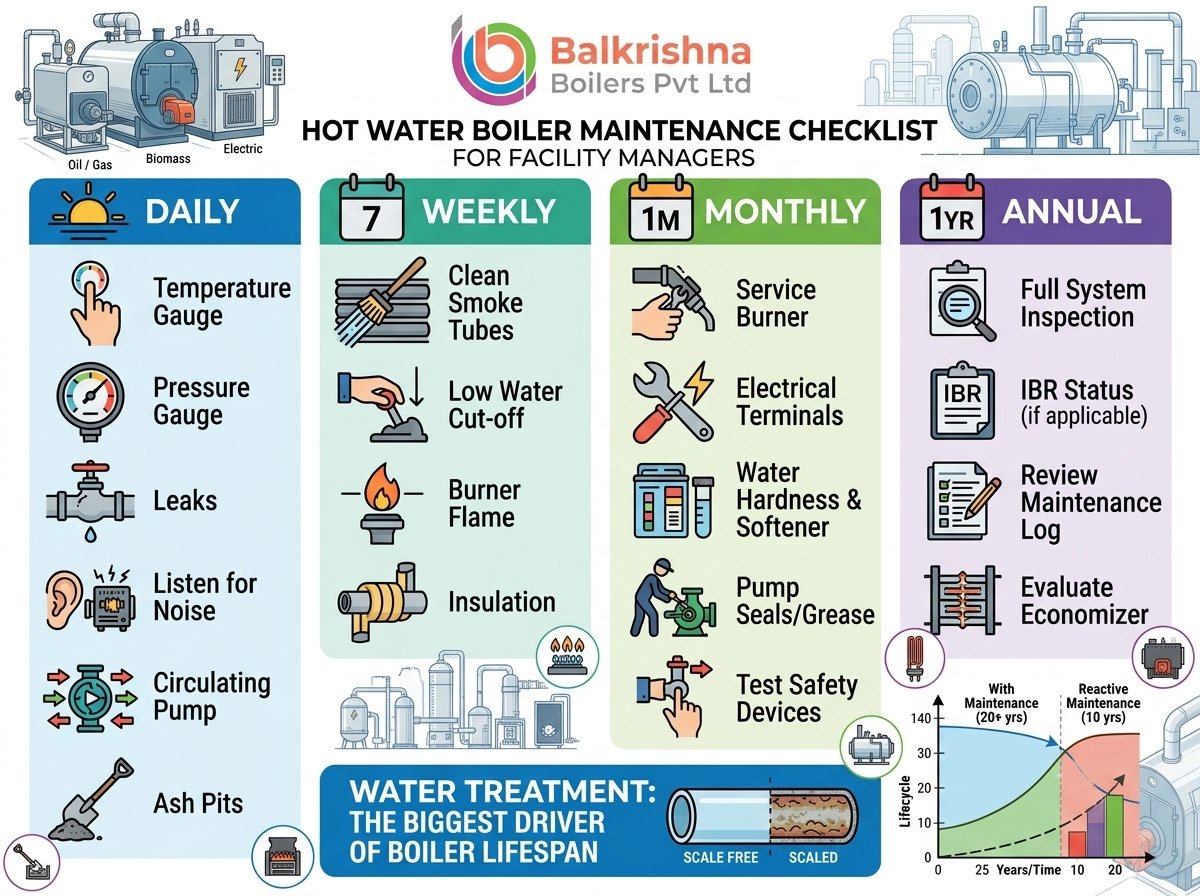
A hot water boiler is one of the few pieces of building equipment that quietly runs for years without complaint — right up until it doesn’t. And when it fails, it’s rarely sudden. It’s almost always the end result of small, unaddressed issues: a softener that wasn’t monitored, a burner that wasn’t serviced on schedule, a blowdown valve that got skipped one shift too many.
At Balkrishna Boilers Pvt Ltd, our service teams see the same pattern across hospitals, hotels, textile units, and commercial buildings: facilities with a documented maintenance schedule get 15–20+ years out of a hot water boiler, while facilities running reactive, as-needed maintenance are often replacing equipment in half that time. This checklist gives facility managers a practical, sequenced routine — daily, weekly, monthly, and annual — that you can hand directly to your maintenance team.
Why Hot Water Boiler Maintenance Is Different From Steam Boiler Maintenance
If your facility also runs a steam boiler, it’s worth knowing upfront that hot water systems are meaningfully lower-maintenance. There’s no phase change, no steam trap network, and — for most commercial installations under 100°C — no IBR-mandated annual shutdown inspection by a certified inspector. We’ve covered the full IBR-focused maintenance routine for steam systems separately in our Steam Boiler Maintenance Checklist for Indian Factories; this guide focuses specifically on what a hot water system needs, which is a lighter but still essential routine.
That said, “lower maintenance” doesn’t mean “no maintenance.” Scale, fouling, and pump wear affect hot water boilers just as they do steam systems — the consequences just show up as gradually rising fuel bills and inconsistent temperatures rather than a compliance violation.
Daily Checks
These take a few minutes and should be part of a designated staff member’s shift routine, not left to “whoever remembers.”
- Check the temperature gauge against your set point — a boiler consistently running colder than expected is often the first sign of scale or a burner issue.
- Inspect the pressure gauge (for pressurized systems) to confirm it’s within normal operating range.
- Look for visible leaks around pipe joints, the pump, and the pressure relief valve.
- Listen for unusual noise — kettling or popping sounds from the heat exchanger often indicate scale buildup starting to interfere with heat transfer.
- Confirm the circulating pump is running smoothly, without excessive vibration or noise, since forced circulation is what prevents localized boiling in a hot water system.
- Check ash pits daily if running a solid-fuel unit like our biomass fired hot water boiler or wood/briquette fired hot water boiler — a full ash pit restricts airflow and drags down combustion efficiency.
Weekly Checks
- Clean smoke tubes with a wire brush on solid-fuel and oil/gas units — soot buildup on heat transfer surfaces is one of the most common, and most preventable, causes of declining efficiency.
- Test the low water level cut-off by simulating a low-water condition (per your unit’s manual) to confirm the burner or heating element shuts down correctly. This is the single most important safety check on the list — it’s what prevents dry-firing, one of the leading causes of tube and element failure.
- Check burner flame condition on oil/gas units — a healthy flame should be steady and evenly colored; flickering, excessive smoke, or an unusual color signals a combustion problem worth investigating before it gets worse.
- Inspect insulation and lagging on pipework for damage, which directly affects distribution efficiency and heat loss between the boiler and point of use.
Monthly Checks
- Service the burner — clean the nozzle, filters, and ignition electrodes on oil/gas units. This is standard practice across our oil/gas fired hot water boiler installations and is one of the lowest-cost, highest-return maintenance tasks on this list.
- Check electrical terminals and connections, particularly critical on electric hot water boiler units where the heating elements sit in direct contact with water — loose terminals or scale-related overheating are the main failure points on electric systems.
- Test water hardness using a simple test kit, and confirm your water softener is regenerating correctly. This single check prevents the majority of long-term scale problems.
- Inspect pump seals for wear or leakage, and grease bearings per the manufacturer’s schedule.
- Check all safety devices — pressure relief valves, over-temperature cut-offs, and low-water alarms — through a manual test cycle, not just a visual inspection.
Every 6 Months
- Deep service and descale — even with a functioning water softener, some scale accumulation is normal over time. A six-month deep clean of the heat exchanger surfaces keeps efficiency close to design specification. Just 1mm of limescale can cut efficiency by around 10%, so this single service interval has an outsized effect on fuel cost.
- Flush sediment from the bottom of the tank or shell, particularly important on shell-type units with larger water hold-up.
- Full visual inspection of the pressure vessel, welds, and external shell for any signs of corrosion or stress.
- Review your blowdown routine if your system includes one — removing concentrated solids from the boiler water at a consistent frequency (typically once per shift on higher-use systems) prevents sludge buildup at the source rather than treating it after the fact.
Annual Checks
- Full system inspection by a qualified technician, including internal tube/element condition, refractory (if applicable), and combustion efficiency testing on fuel-fired units.
- Confirm IBR status if applicable — most hot water systems under 100°C remain non-IBR, but if your facility runs a pressurized high-temperature system above that threshold, confirm your certification and inspection status are current.
- Review your maintenance log against performance data — rising fuel consumption per unit of hot water delivered over the year is the clearest early signal that something in the system (scale, burner tuning, insulation) needs attention before it becomes a bigger repair.
- Evaluate whether an economizer or waste heat recovery unit would pay for itself at your facility’s usage level — these recover heat from flue gases to pre-heat incoming water and can meaningfully cut annual fuel cost on higher-capacity systems.
The Single Biggest Driver of Boiler Lifespan: Water Treatment
If a facility manager only implements one thing from this checklist, it should be consistent water treatment. Untreated or hard water is responsible for the majority of premature hot water boiler failures we see in the field. Scale doesn’t just reduce efficiency — left unaddressed, it eventually causes tube or element failure that requires a full heat exchanger replacement rather than a routine service.
A standard water softener, checked monthly and serviced per its own maintenance schedule, is the cheapest insurance policy available for a hot water boiler system. This applies across every fuel type in our range — the AQUAJET oil/gas series, the biomass-fired AQUAMAX and VTFH SERIES, and the electric ELECTRO AQUA — since scale forms wherever hard water meets a heated surface, regardless of how that surface is heated.
Common Maintenance Mistakes We See in the Field
- Skipping the burner service because “it’s still running fine.” Combustion efficiency degrades gradually, so a burner can run for months past its service interval without an obvious symptom — while quietly costing more in fuel every week.
- Testing the low water cut-off only during commissioning. This safety device needs periodic functional testing throughout the boiler’s life, not just when it’s first installed.
- Assuming electric boilers need no maintenance. Electric systems have a genuinely lighter routine than combustion boilers — no soot, no burner, no ash — but scale on the heating elements is still a real risk if the water isn’t treated, and can lead to element burnout.
- Treating water softener regeneration as “set and forget.” A softener that’s stopped regenerating properly gives no obvious warning sign until scale has already started accumulating.
- No documented log. Without a written maintenance record, it’s nearly impossible to spot the gradual efficiency decline that signals a developing problem — which is exactly the kind of issue this checklist is designed to catch early.
Building This Into a Facility Routine
The checklist above works best as a physical or digital log posted near the boiler room, with daily and weekly items assigned to a specific staff member and monthly/annual items tracked against a calendar. Facilities that pair this with an Annual Maintenance Contract (AMC) typically see the most consistent results, since the higher-skill tasks — burner tuning, internal inspection, combustion efficiency testing — are handled by trained technicians on a guaranteed schedule rather than whenever time allows.
How Balkrishna Boilers Supports Ongoing Maintenance
Across our 5,000+ installations in India and 30+ countries, after-sales support is built into how we work with facility managers, not treated as a separate add-on. We offer Annual Maintenance Contracts, 24/7 technical assistance, and a ready stock of genuine spare parts across our hot water and steam ranges — whether your installation is an oil/gas fired hot water boiler, a biomass system, or an electric unit.
If your facility is overdue for a service review, or you’re setting up a maintenance schedule for a newly installed system, you can review our full range on indianboilers.com or balkrishn.com’s Hot Water Boiler page, and reach our service team directly through Contact Us.
Frequently Asked Questions
How often should a hot water boiler be serviced? A monthly burner service and electrical check, a deep clean and descale every six months, and a full annual inspection covers most commercial installations. Daily and weekly checks (temperature, leaks, low water cut-off testing) should be part of a standing staff routine in between.
Does an electric hot water boiler need less maintenance than a gas or biomass unit? Yes, meaningfully less — there’s no burner to service, no soot, and no ash handling. The main ongoing task is checking electrical terminals and preventing scale buildup on the heating elements through consistent water treatment.
What’s the most common cause of hot water boiler failure? Scale buildup from untreated or hard water is the leading cause of both reduced efficiency and eventual tube or element failure. A functioning water softener, checked monthly, prevents the majority of these failures.
Do hot water boilers need IBR inspection like steam boilers? Generally no — hot water systems operating below 100°C are typically classified as non-IBR and don’t require the annual government inspection that steam boilers do. If your system operates above that threshold, confirm your specific IBR status with your supplier.
Should I sign an Annual Maintenance Contract (AMC) or handle maintenance in-house? Daily and weekly checks are straightforward enough for in-house staff with basic training. The higher-skill tasks — burner tuning, internal inspection, combustion efficiency testing — are best handled under an AMC with trained technicians, since these are the checks most likely to be skipped or done inconsistently without a guaranteed schedule.
Due for a service, or setting up a maintenance schedule for a new installation? Contact our service team to discuss an Annual Maintenance Contract or a one-time inspection for your facility.