
Not every industrial or commercial heating requirement needs steam. A large share of process heating, space heating, and hot water demand across factories, hospitals, hotels, and institutional buildings simply needs hot water — reliably, safely, and at a temperature well below boiling. That’s exactly the job a hot water boiler is built for.
This guide is a complete beginner’s explanation of what a hot water boiler is, how it actually works, where it’s used, and how it compares to steam boilers and thermic fluid heaters — the other two heating technologies you’ll commonly find across Indian industry. If you’re evaluating heating options for a new facility or trying to understand what’s already installed at your plant, this article will give you the foundation to make an informed decision.
1. What Is a Hot Water Boiler?
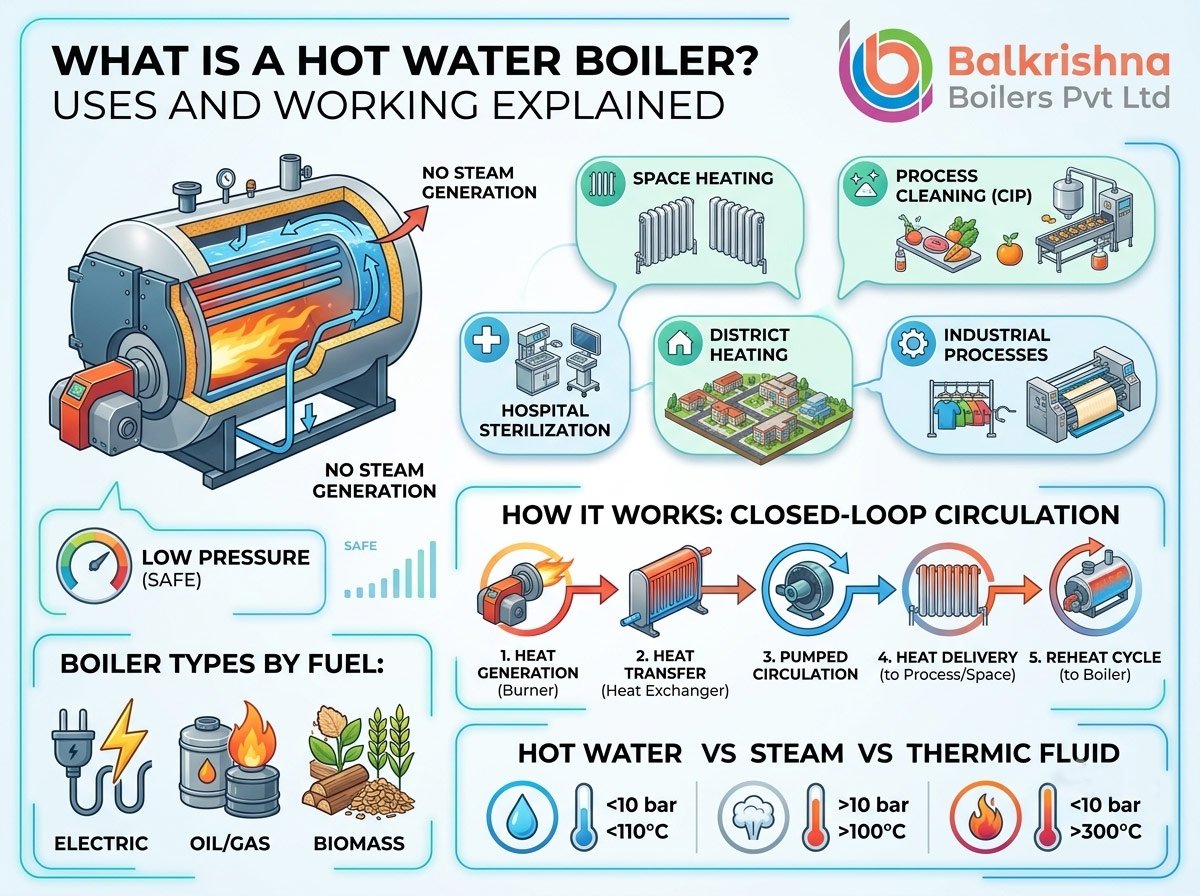
A hot water boiler is a heating system designed to heat water and circulate it — without converting it into steam — to deliver thermal energy for process heating, space heating, or general hot water demand. Unlike a steam boiler, which deliberately boils water into vapor to transfer heat, a hot water boiler keeps the water in its liquid state throughout the entire heating and delivery cycle.
This distinction matters enormously in terms of pressure, safety, and application. Because the water never turns to steam, hot water boilers typically operate at far lower, more manageable pressures than steam systems producing comparable heat output.
2. How a Hot Water Boiler Works
The working principle is straightforward, though the details vary by fuel type and design:
- Heat Generation: Fuel — natural gas, LPG, diesel, biomass, or electricity — is used to generate heat inside a combustion chamber (or, for electric models, through direct-contact heating elements).
- Heat Transfer to Water: The generated heat is transferred to water circulating through the boiler’s heat exchange surface — typically a shell-and-tube or fire-tube arrangement.
- Circulation: A pump circulates the heated water through an insulated piping network to the points of use — process equipment, radiators, air handling units, or heat exchangers.
- Heat Delivery: At each point of use, the hot water releases its thermal energy to the process or space being heated.
- Return Cycle: The now-cooled water returns to the boiler to be reheated, completing a closed (or semi-closed) loop.
This is functionally similar to how a thermic fluid heater operates — both are closed-loop systems that avoid the complexities of steam generation — but hot water boilers operate at much lower temperatures, typically up to 95°C for standard non-condensing designs, whereas thermic fluid systems are built specifically for high-temperature applications up to 300°C and beyond. If you’re trying to decide between the two for your application, our detailed comparison in thermic fluid heater vs hot water boiler: key differences breaks down exactly where each technology fits best.
3. Types of Hot Water Boilers by Fuel
A. Electric Hot Water Boilers
Electric hot water boilers heat water using resistance or ceramic bobbin heating elements, offering flame-free, low-maintenance operation with precise temperature control. They’re increasingly popular in facilities prioritizing zero on-site emissions and minimal fuel handling complexity. Our electric hot water boiler range, marketed under the ELECTROAQUA name, uses automatic thyristor control for stable, precise output.
B. Oil and Gas Fired Hot Water Boilers
Oil and gas fired hot water boilers burn liquid fuels (diesel, LDO, furnace oil) or gaseous fuels (natural gas, PNG, LPG) to heat water via a combustion chamber and heat exchange surface. These systems offer quick start-up, compact footprint, and clean combustion. Our oil/gas fired hot water boiler, the AQUAJET series, is built as a horizontal, three-pass, fully wet-back design engineered for maximum thermal efficiency and fuel flexibility.
C. Biomass Fired Hot Water Boilers
For facilities looking to reduce fuel costs and their carbon footprint, biomass fired hot water boilers burn organic materials — wood chips, rice husk, briquettes, or agricultural waste — to generate heat. Since biomass releases only the carbon absorbed during the plant’s growth cycle, it’s considered part of the current carbon cycle rather than adding “ancient” fossil carbon to the atmosphere. Our biomass fired hot water boiler, part of the VTFH Series, is a popular choice for industries wanting consistent process heat without steam system complexity.
Balkrishna Boilers offers equivalent proven ranges under AQUAJET and AQUAMAX for combustion-fired systems, along with the VST Series, VTFH Series, and VTMH Series covering vertical and multi-fuel configurations for a wide range of capacity and space requirements.
4. Low-Temperature vs High-Temperature Hot Water Systems
Hot water boilers are generally categorized by the temperature and pressure at which they operate:
A. Low-Temperature Hot Water (LTHW) Systems
- Maximum Temperature: Up to 110°C
- Common Use: Residential and commercial building heating — schools, offices, hospitals
- Key Characteristic: Operates at low pressure, significantly minimizing safety complexity and maintenance requirements
B. High-Temperature Hot Water (HTHW) Systems
- Maximum Temperature: Above 121°C
- Common Use: District heating (warming entire campuses or industrial complexes) and large-scale industrial processes
- Key Characteristic: Operates at meaningfully higher pressure, which is necessary to keep water in its liquid state above 100°C
Understanding which category your application falls into is the first step in specifying the right system — most standard industrial and commercial hot water demand falls comfortably within the LTHW range.
5. Industrial and Commercial Applications of Hot Water Boilers
A. Space Heating
The most familiar application: hot water circulated through radiators, fan coil units, or underfloor heating systems to warm buildings — schools, offices, hospitals, and hotels across colder regions of India and for export markets in even colder climates.
B. Process Washing and Cleaning
Many industrial cleaning and washing processes — including CIP (Clean-in-Place) systems in food and beverage plants — require consistent hot water rather than steam, making hot water boilers the more efficient and appropriately sized choice.
C. Sterilization and Hygiene Applications
Hospitals, pharmaceutical facilities, and food processing plants often rely on hot water systems for sterilization processes that don’t require the higher temperatures steam provides, avoiding the added complexity and cost of a steam system for this specific need.
D. District and Campus Heating
Large institutional campuses, industrial parks, and multi-building facilities often use a centralized high-temperature hot water system to distribute heat efficiently across multiple buildings from a single source.
E. Swimming Pools and Recreational Facilities
Hotels, resorts, and sports complexes commonly use hot water boilers to maintain consistent pool and spa water temperatures efficiently.
F. Low-Temperature Process Heating
Certain industrial processes — such as tempering, low-temperature drying, or maintaining process fluid temperatures — fall well within the hot water boiler’s operating range, making it a more cost-effective and lower-maintenance choice than steam for these specific needs.
6. Condensing vs Non-Condensing Hot Water Boilers
For general audiences, the most important efficiency distinction is between condensing and non-condensing designs:
- Non-Condensing (Traditional) Boiler: Heat is recovered from the fuel, but a meaningful amount of heat energy is lost up the chimney with the exhaust gases.
- Condensing Boiler: Designed to extract additional heat from the flue gases by condensing water vapor out of the exhaust, recovering the latent heat that would otherwise be wasted — resulting in noticeably higher overall efficiency, often reaching the low-to-mid 90% range.
For facilities running hot water demand year-round, the efficiency gain from a condensing design typically justifies the modest additional upfront cost through faster payback on fuel savings.
7. Hot Water Boilers vs Steam Boilers: Which Do You Need?
A common point of confusion for facilities managers is whether their application actually needs steam or would be better served — more safely and more cost-effectively — by hot water.
| Factor | Hot Water Boiler | Steam Boiler |
|---|---|---|
| Operating Pressure | Low (typically under 10 bar) | Higher, scales with required temperature |
| Typical Use Case | Space heating, washing, low-temp process heat | High-temperature process heat, sterilization, power generation |
| Regulatory Complexity | Generally simpler | Often requires IBR compliance and certified attendants |
| Response Time | Moderate | Fast, especially with water-tube designs |
| Best Suited For | Comfort heating, washing, moderate-temperature processes | Textiles, pharma, chemical reactions, sterilization at scale |
If your process genuinely requires steam — for sterilization at scale, chemical reactions, or textile processing — our guide on industrial uses of steam boilers and how they work explains where steam remains the right choice. But for a large share of comfort heating and moderate-temperature process needs, a correctly sized hot water boiler delivers the same outcome with lower pressure, simpler compliance, and often lower operating cost.
8. Hot Water Boilers vs Thermic Fluid Heaters
The other common point of comparison is between hot water boilers and thermic fluid heaters, since both are closed-loop, non-steam systems. The key difference is temperature range: hot water boilers typically top out around 95-110°C for standard designs, while thermic fluid heaters are purpose-built for high-temperature applications — reactors, presses, and dryers requiring 150-300°C — without the extreme pressure a steam system would need to reach those temperatures. Our full breakdown in thermic fluid heater vs hot water boiler: key differences covers this comparison in complete detail, including which industries and applications favor each technology.
9. Maintenance Basics for Hot Water Boilers
Hot water boilers are generally lower-maintenance than steam systems, but a few basics keep them running efficiently over their service life:
- Water Treatment: Using treated or softened water prevents scale buildup on heat exchange surfaces, which reduces efficiency and can shorten equipment life over time.
- Routine Inspection: Regular checks of pressure relief valves, circulation pumps, and control systems catch small issues before they become costly failures.
- Descaling: Periodic descaling, particularly for systems using untreated water, maintains heat transfer efficiency and prevents localized overheating on the exchange surface.
- Combustion Tuning: For fuel-fired systems, periodic combustion analysis and burner tuning maintains efficiency and reduces fuel consumption over the boiler’s operating life.
10. Choosing the Right Hot Water Boiler for Your Facility
A few key questions determine the right specification:
- What temperature does your application actually require? Most comfort heating and washing applications sit comfortably within standard LTHW range.
- What’s your available fuel infrastructure? Facilities with existing gas supply, biomass availability, or a clean-power priority will naturally lean toward different fuel types.
- What’s your daily and peak demand? Sizing correctly avoids both undersized systems that can’t meet peak demand and oversized systems that run inefficiently at partial load.
- Do you need condensing efficiency? For continuous, high-utilization applications, the efficiency gain from a condensing design typically pays for itself well within the equipment’s service life.
11. Get Expert Guidance on Your Hot Water Boiler Requirement
Whether you need a compact electric system for a small facility or a large multi-fuel hot water boiler for an industrial campus, choosing the right specification makes a real difference in long-term operating cost and reliability. At Indian Boilers.com, our technical team helps facilities across India specify the right hot water boiler for their exact temperature, capacity, and fuel requirements.
Our parent company, Balkrishna Boilers Pvt Ltd, brings over 25 years of experience and more than 5,000 installations worldwide across the full range of industrial heating technologies — steam, hot water, thermic fluid, and electric systems alike.
- Explore Our Hot Water Boiler Range: indianboilers.com/product-category/hot-water-boiler
- View the Full Balkrishna Boilers Range: balkrishn.com/hot-water-boiler.php
- Get a Customized Quote: Contact our technical team with your temperature and capacity requirements for a tailored proposal.