
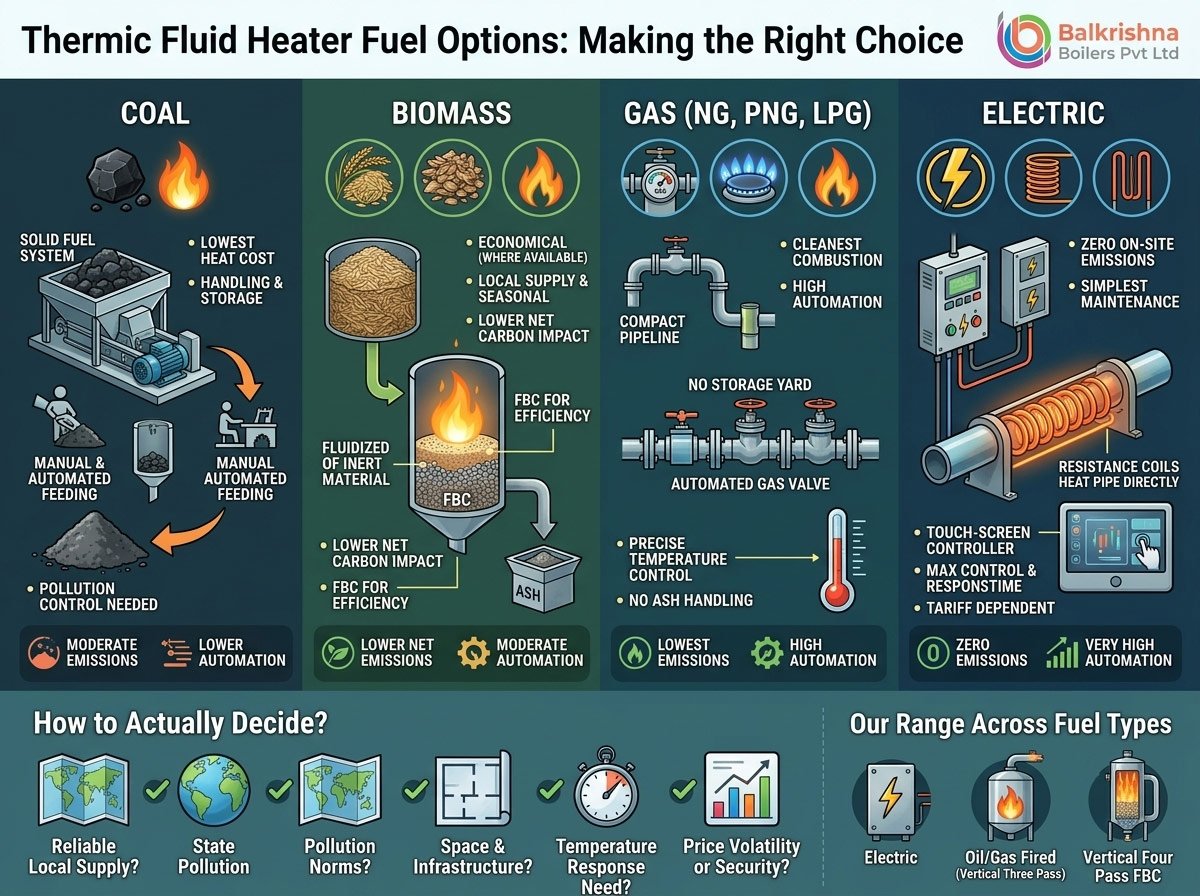
Fuel choice is one of the first decisions a plant makes when specifying a thermic fluid heater — and it’s a decision that shapes running cost, compliance requirements, and day-to-day operations for the life of the system. Unlike sizing or fluid selection, which can be adjusted or corrected later without enormous cost, fuel choice is largely locked in at commissioning, since switching burner or firing systems later means significant capital work, not a simple retune.
This guide compares coal, biomass, gas, and electric options across the factors that actually matter for a plant making this decision: running cost, emissions and compliance, fuel handling and storage, automation level, and reliability of supply.
The Fuel Options at a Glance
| Fuel Type | Typical Running Cost | Emissions Profile | Fuel Handling Complexity | Automation Level |
|---|---|---|---|---|
| Coal | Low to moderate | Higher — needs pollution control equipment | High — storage, feeding, ash removal | Moderate |
| Biomass (husk, wood, briquettes) | Low, if locally available | Lower net carbon impact | High — storage, feeding, ash removal | Moderate |
| Natural Gas / LPG / PNG | Moderate to higher | Cleanest combustion | Low — no solid handling | High |
| Liquid Fuel (HSD, FO, LDO) | Moderate to higher | Moderate | Low to moderate — tank storage | High |
| Electric | Depends on tariff | Zero on-site emissions | Minimal | Very high |
Coal-Fired Thermic Fluid Heaters
Where it fits: Plants with reliable, cost-effective coal access and existing solid-fuel handling infrastructure, typically running large, continuous thermal loads where fuel cost dominates the running-cost equation.
Running cost: Coal remains one of the lowest-cost fuel options per unit of heat delivered in many regions of India, which is why it remains in use across large industrial thermal loads despite the added handling complexity.
Emissions and compliance: Coal firing requires pollution control equipment — typically a dust collector or bag filter system, and increasingly an ESP or wet scrubber depending on state pollution control board requirements — to manage particulate emissions. This is a genuine capital and compliance addition to the base system cost, and one that’s worth confirming against your specific state’s current emission norms before committing to coal, since these requirements have tightened in many states in recent years.
Fuel handling: Coal requires storage space, a fuel feeding system (manual or automated depending on scale), and a plan for ash removal and disposal. Plants without existing solid-fuel handling infrastructure should factor this operational complexity into the total cost comparison, not just the per-unit fuel price.
Biomass-Fired Thermic Fluid Heaters
Where it fits: Plants located near reliable biomass supply — rice husk, wood waste, agricultural residue, or biomass briquettes — particularly common in textile, food processing, and agro-processing clusters where these fuels are locally abundant.
Running cost: Where biomass is genuinely available at low, stable cost, it’s often the most economical fuel option available, sometimes undercutting even coal. The caveat is regional and seasonal availability — biomass pricing and supply reliability can vary significantly by location and season in a way coal and gas generally don’t.
Emissions and compliance: Biomass carries a lower net carbon impact than fossil fuels, since it releases roughly the carbon dioxide the plant material absorbed during growth rather than “ancient” carbon locked away for millions of years — a genuine sustainability argument that’s become more relevant as plants face increasing pressure around emissions targets. Like coal, biomass firing needs particulate control equipment to meet pollution board requirements.
Fuel handling: Similar handling complexity to coal — storage, feeding, and ash management — with the added consideration of biomass fuel’s variability in moisture content and calorific value depending on source and season, which can require more attentive combustion management to maintain consistent efficiency compared to a more standardized fuel like gas.
FBC (Fluidized Bed Combustion) design: For biomass and other solid fuels, an FBC design burns fuel in a fluidized bed of inert material, achieving more complete and even combustion than a simple grate-fired system, particularly valuable given the variability of biomass fuel quality. Our Vertical Four Pass FBC Thermic Fluid Heater is built specifically for this kind of fuel flexibility.
Gas-Fired Thermic Fluid Heaters (Natural Gas, LPG, PNG)
Where it fits: Plants with reliable pipeline gas access, or where LPG supply logistics work economically, particularly in industries prioritizing clean combustion and minimal fuel handling — food processing and pharmaceuticals are common examples given the hygiene and compliance sensitivity of those sectors.
Running cost: Generally moderate to higher than coal or biomass per unit of heat delivered, though this varies significantly with local gas pricing and whether the plant has PNG pipeline access versus needing to source LPG.
Emissions and compliance: Gas combustion is the cleanest of the fired-fuel options, producing minimal particulate matter and generally requiring less extensive pollution control equipment than solid fuel firing — a meaningful simplification for plants in areas with strict emission norms or limited space for pollution control infrastructure.
Fuel handling: By far the simplest of the fired-fuel options — no storage yard, no ash handling, no fuel feeding system. This operational simplicity is a real factor for plants weighing total system complexity, not just per-unit fuel cost.
Automation: Gas-fired burners generally support the highest level of automation among fired-fuel options, with precise modulating control that responds quickly to load changes — relevant for processes with frequent setpoint changes or tight temperature control requirements.
Liquid Fuel-Fired Systems (Furnace Oil, HSD, LDO)
Where it fits: Plants without pipeline gas access but wanting cleaner combustion and simpler handling than solid fuel, or as a backup/dual-fuel option alongside gas for supply security.
Running cost: Generally comparable to or somewhat higher than gas, depending on current liquid fuel pricing, which has historically been more volatile than piped gas pricing in many regions.
Fuel handling: Requires tank storage and a fuel supply system, but avoids the solid-fuel handling complexity of coal or biomass — a middle ground in terms of operational simplicity.
Dual-fuel flexibility: Many gas-fired systems can be configured for dual-fuel operation, burning either gas or a liquid fuel depending on availability and relative pricing — a useful hedge for plants concerned about supply security on a single fuel source.
Electric Thermic Fluid Heaters
Where it fits: Plants without practical access to a fired-fuel infrastructure, those prioritizing zero on-site combustion emissions, R&D or smaller-batch operations valuing precision and rapid response, or facilities in areas with strict local emission restrictions that make any combustion-based system difficult to permit.
Running cost: Depends entirely on local electricity tariffs relative to fired-fuel alternatives — in regions with high electricity cost relative to fuel, electric heating carries a real running-cost premium, though this needs to be weighed against the operational savings (no fuel handling, no combustion maintenance, no pollution control equipment) covered below.
Emissions and compliance: Zero on-site combustion emissions, and typically the simplest path through local pollution control board approval, since there’s no flue gas or particulate matter to manage on-site.
Fuel handling and maintenance: The simplest option by a wide margin — no fuel storage, no combustion system to maintain, no ash or soot to manage. This translates into genuinely lower ongoing maintenance overhead compared to any fired-fuel system.
Automation and control: Electric systems generally offer the fastest response time and most precise temperature control of any fuel option, since electrical heating elements respond to control signals more directly than a combustion process does — a meaningful advantage for processes needing tight, fast-responding temperature control.
Our Electric Thermic Fluid Heater covers this option in more detail.
How to Actually Decide
A few questions that should drive the decision more than any general fuel-cost ranking:
What fuel is reliably available at your specific location? A fuel that’s economical in one region may be difficult to source consistently in another. Biomass availability in particular varies significantly by geography — a fuel choice that looks attractive on a national average cost comparison may not hold up against your specific plant’s actual supply reliability.
What’s your state pollution control board’s current stance on solid fuel firing? Emission norms have tightened in many states, and the pollution control equipment required for coal or biomass firing has become a more significant part of the total system cost than it once was. This is worth confirming as current information with your local authority or your equipment supplier before finalizing fuel choice, rather than assuming historical norms still apply.
How much floor space and handling infrastructure can you dedicate? Solid fuel systems need meaningfully more space — storage, feeding, ash handling — than gas, liquid fuel, or electric systems. For space-constrained plants, this can be a deciding factor independent of running cost.
Does your process need fast, precise temperature response, or steady sustained output? Electric and gas systems generally offer faster, more precise control than solid fuel firing, which matters more for some applications — like the mold and die temperature control covered in our piece on thermic fluid heater applications in the plastics industry — than others.
What’s your appetite for fuel price volatility versus supply security? Locally available biomass and coal can offer cost stability in some regions, while gas and liquid fuel pricing tends to track broader market movements more directly. A dual-fuel configuration is worth considering if supply security matters more than optimizing for the single lowest-cost fuel.
Fuel Choice and System Efficiency
Whatever fuel you choose, the efficiency principles are the same — a well-designed multi-pass coil, correct combustion tuning, and (where applicable) a Waste Heat Recovery Unit all apply regardless of fuel type, though combustion tuning specifics differ meaningfully between solid, liquid, and gaseous fuels. Our piece on how thermic fluid heaters improve energy efficiency covers these levers in more depth, and our guide on thermic fluid heater capacity: how to choose the right size notes that fuel supply capacity — whether that’s gas line sizing, biomass storage volume, or electrical supply capacity — needs to be confirmed alongside heater capacity itself, since a correctly sized heater still can’t deliver rated output without adequate fuel supply to match.
Our Range Across Fuel Types
At Balkrishna Boilers Pvt Ltd, we manufacture thermic fluid heaters across the full range of fuel options, and our technical team can help you weigh the trade-offs against your specific site conditions rather than defaulting to whichever fuel is most common in your industry:
- Electric Thermic Fluid Heater
- Oil / Gas Fired Thermic Fluid Heater
- Vertical Three Pass Oil / Gas Fired Thermic Fluid Heater
- Vertical Four Pass FBC Thermic Fluid Heater — for coal and biomass fuel flexibility.
Not Sure Which Fuel Fits Your Plant?
If you’re weighing fuel options for a new thermic fluid heater, or reconsidering fuel choice for an upcoming expansion, get in touch with your location, available fuel sources, and capacity requirement, and our technical team will help you work through the trade-offs before you commit.