
A thermic fluid heater is built to run for decades. We’ve seen units in the field cross 20 years of continuous service — and we’ve also seen three-year-old heaters limp into our workshop with carbonized coils and a burnt-out pump, all because of maintenance that got pushed to “next shutdown” one too many times. The difference almost never comes down to the machine. It comes down to the maintenance calendar.
Unlike a steam boiler, a thermic fluid heater doesn’t punish neglect immediately. There’s no visible pressure gauge climbing into the red, no water level alarm shrieking on the panel. The oil keeps circulating, the process keeps running, and the plant keeps producing — right up until the coil fouls, the fluid degrades past its flash point, or a pump seal finally gives up. By then, the fix is a shutdown, a coil replacement, and a full fluid drain, not a five-minute log entry.
This guide walks through exactly what to check, how often, and why — so your heater keeps delivering high heat at low pressure for its full designed lifespan.
Why Thermic Fluid Heaters Fail Early
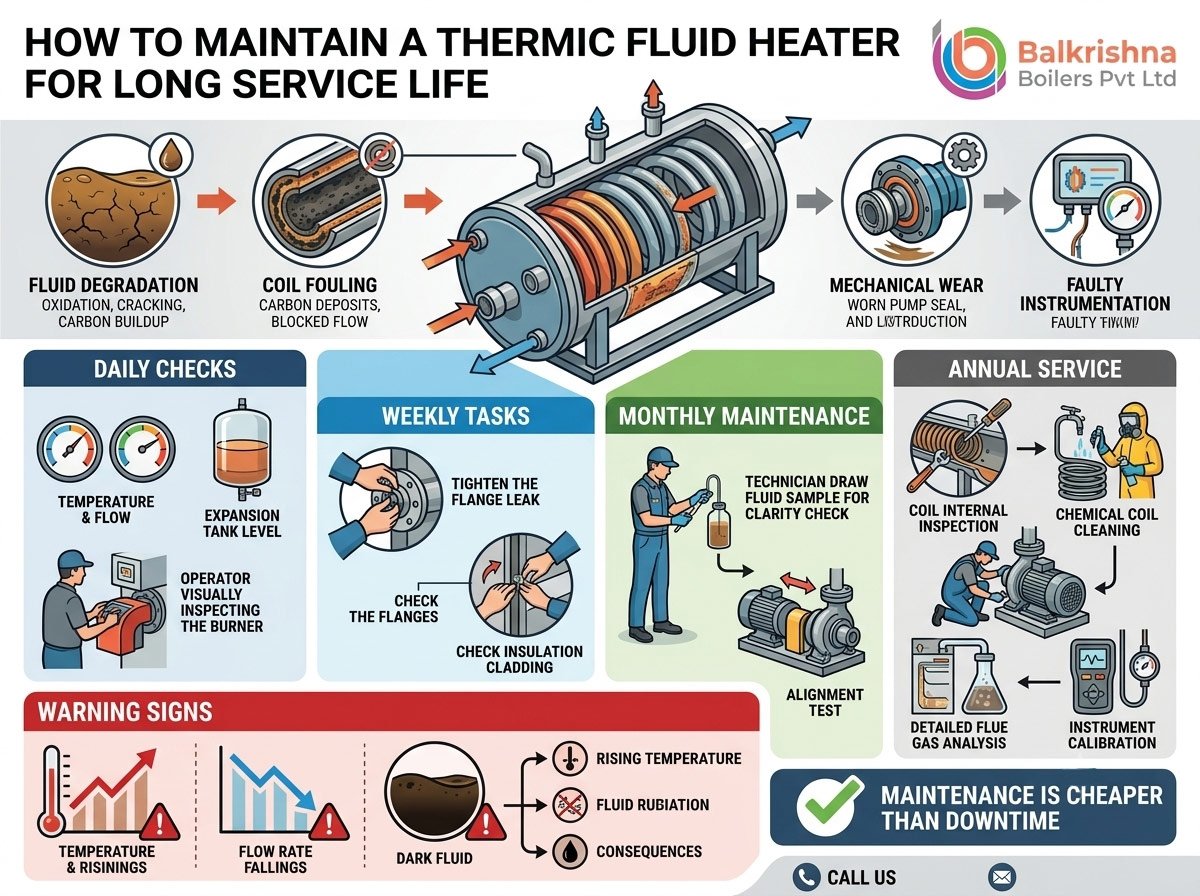
Before getting into the checklist, it helps to understand the three failure paths almost every premature breakdown follows:
- Thermal fluid degradation — oxidation, cracking, and carbon buildup that thickens the oil and reduces heat transfer.
- Coil fouling — carbon deposits inside the coil that insulate the tube wall, forcing the burner to work harder and eventually overheating the film layer.
- Mechanical wear — pump seal failure, burner drift, and instrumentation faults that go unnoticed because there’s no dramatic pressure event to force attention.
Nearly every maintenance task below exists to interrupt one of these three paths before it becomes expensive.
Daily Checks: Five Minutes That Save Five Lakhs
A daily round doesn’t need a technician — a trained operator with a checklist is enough. What matters is consistency.
- Inlet and outlet oil temperature — Compare against the design set point. A growing gap between inlet and outlet temperature, or an outlet temperature that keeps creeping up for the same firing rate, is usually the first sign of coil fouling.
- Flow rate / pump discharge pressure — A falling flow rate at constant pump speed points to a partially blocked coil, a failing pump impeller, or air trapped in the circuit.
- Expansion tank oil level — Should sit within the marked band. A dropping level usually means a leak somewhere in the circuit; a rising level can indicate water contamination or fluid expansion beyond the design range.
- Stack (flue gas) temperature — Rising stack temperature at a stable firing rate is a direct indicator of scale or soot fouling on the fire side of the coil, cutting into your thermal efficiency.
- Unusual noise or vibration from the circulating pump — Cavitation, bearing wear, and misalignment all announce themselves audibly before they cause a failure.
- Visual check of burner flame — Flame should be stable, well-shaped, and the correct colour for the fuel in use. A lazy, smoky, or pulsing flame signals a combustion air or fuel pressure problem.
- Safety interlock indicator lights — Confirm the low-flow switch, high-temperature cut-off, and expansion tank level switch are all showing “healthy” status, not bypassed.
Log every reading. A single day’s numbers tell you little; a trend line across weeks is what actually catches problems early.
Weekly Maintenance Tasks
- Check for oil leaks at flange joints, pump gland packing, and valve stems. Even a slow weep wastes fluid and, over time, lowers the oxidation resistance of the remaining oil because it’s exposed to more oxygen at the leak point.
- Inspect insulation cladding on pipework and the heater body for damage, wet patches, or missing sections. Damaged insulation isn’t just an efficiency loss — it’s a burn hazard and a sign that a joint underneath may be leaking.
- Clean burner viewing glass and check flame pattern more closely than the daily glance — look for carbon streaking that indicates incomplete combustion.
- Verify nitrogen blanketing pressure on the expansion tank (for systems using inert gas padding). Low nitrogen pressure lets atmospheric oxygen into the headspace, which is one of the fastest ways to accelerate oil oxidation.
- Check the low-flow switch and high-temperature cut-off by simulated test where your SOP allows, to confirm they trip correctly rather than assuming the indicator light is telling the truth.
Monthly Maintenance Tasks
- Draw a fluid sample and do a basic on-site check — colour, odour (a sharp, burnt smell indicates cracking), and clarity. Dark, cloudy, or sludgy oil needs a lab test even if it’s not yet due for the scheduled six-month analysis.
- Check pump alignment and coupling for wear. Misalignment shows up first as vibration, then as premature bearing and seal failure.
- Test all safety interlocks formally, not just visually — the low-flow cut-off, high-temperature trip, low-oil-level alarm, and stack temperature monitor should all be function-tested against your maintenance SOP and the results logged.
- Inspect and clean burner nozzles/electrodes for oil/gas-fired units to maintain proper atomization and ignition.
- Review the log trends from daily and weekly readings — is stack temperature creeping up? Is flow rate slowly dropping? Monthly review is where slow-moving problems get caught before they become urgent ones.
Quarterly and Half-Yearly Maintenance
- Fluid analysis (every 6 months) — This is the single most important recurring maintenance task on a thermic fluid heater. A proper lab analysis checks flash point, viscosity, acid number (TAN), and carbon residue. A dropping flash point is the clearest warning sign that your oil is cracking and needs replacement before it becomes a fire risk. We cover this in detail in our thermic fluid heater oil selection guide, including how to read a fluid analysis report and decide between topping up and a full drain.
- Calibrate all instrumentation — temperature sensors, flow meters, and pressure gauges drift over months of continuous high-temperature service. A sensor reading 8°C low can mask a genuine overheating condition.
- Inspect the expansion tank internally for sludge accumulation and confirm the vent line and flame arrestor (where fitted) are clear.
- Check burner combustion efficiency with a flue gas analyzer — measure O2, CO2, and CO levels and retune the air-fuel ratio if efficiency has drifted from commissioning values.
Annual Maintenance: The Deep Service
Once a year — ideally scheduled around a planned production shutdown — the heater needs a full internal inspection.
- Open and inspect the coil internally (via inspection ports or coil removal, depending on design) for carbon deposits. Even well-maintained systems accumulate some film-side carbon over a year; the question is how much, and whether it needs mechanical or chemical cleaning.
- Chemical or mechanical decarbonization of the coil if carbon buildup is found. This is a specialist job — done incorrectly, it can damage the coil surface and create new fouling sites.
- Full fluid drain and refill assessment if the fluid analysis over the year shows the oil is approaching end-of-life. As a rule of thumb, quality mineral-based thermal oils last 3 to 5 years, while synthetic fluids can run 8 to 10 years with disciplined maintenance — but actual condition, not the calendar, should drive the replacement decision.
- Inspect and service the circulating pump — mechanical seal, bearings, and impeller wear should all be checked and replaced proactively rather than reactively.
- Pressure-test the coil and piping where your maintenance schedule and applicable code require it, to catch developing weak points before they become leaks.
- Review and update safety documentation, interlock test records, and the maintenance log against your internal compliance requirements.
Common Warning Signs You Shouldn’t Ignore
| Symptom | Likely Cause | Risk if Ignored |
|---|---|---|
| Rising outlet temperature at constant firing rate | Coil fouling / carbon buildup | Reduced efficiency, eventual film overheating |
| Falling flow rate at constant pump speed | Partial blockage, pump wear, trapped air | Localized overheating, coil damage |
| Rising stack temperature | Fire-side soot/scale deposits | Falling thermal efficiency, higher fuel bills |
| Dark, sludgy, or strong-smelling oil | Oxidation or thermal cracking | Reduced flash point, fire risk, poor heat transfer |
| Frequent low-flow trips | Pump cavitation, air lock, filter blockage | Nuisance shutdowns, production loss |
| Oil weeping at flanges/glands | Gasket or seal wear | Fluid loss, oxidation at exposed surface, housekeeping/fire hazard |
If more than one of these shows up together, that’s usually a sign the fluid itself needs testing rather than chasing individual symptoms.
Building a Maintenance Log That Actually Works
Most heaters that fail early don’t fail because nobody checked them — they fail because the checks weren’t compared against yesterday’s numbers. A maintenance log is only useful if someone reviews the trend, not just records the reading. At minimum, track:
- Inlet/outlet oil temperature and firing rate, daily
- Flow rate and pump discharge pressure, daily
- Stack temperature, daily
- Expansion tank level, daily
- Fluid analysis results, every 6 months, filed and compared against the previous report
A simple spreadsheet with conditional formatting to flag out-of-range values does most of the job. What matters is that someone — a shift engineer, a maintenance head — actually looks at the trend weekly, not just files the numbers.
Thermic Fluid Heater vs. Steam Boiler: Does Maintenance Compare?
If you’re weighing a thermic fluid heater against a steam system for a new line, maintenance load is a fair point of comparison. Thermic fluid heaters skip the water treatment plant, blowdown routine, and IBR compliance overhead that steam boilers carry — but they add fluid analysis and coil decarbonization to the list instead. We’ve laid out the full comparison, including running costs and safety considerations, in Thermic Fluid Heater vs Steam Boiler: Which Suits Your Process? — worth a read if you’re still deciding which system fits your process.
Choosing the Right Fluid Matters as Much as Maintaining It
A large share of “premature” thermic fluid heater failures actually trace back to the wrong fluid for the operating temperature in the first place — not a maintenance lapse. Running a mineral oil rated for 280°C at a consistent 310°C film temperature will crack the fluid no matter how disciplined your monthly checks are. Our detailed breakdown on selecting the right thermic fluid for your heater covers how to match fluid type to your process temperature, and how to read the technical data sheet before you buy.
When to Call for Professional Service
Some jobs are safe for an in-house maintenance team; others need specialist attention:
- In-house: daily/weekly logging, visual inspections, leak checks, basic fluid sampling, instrument reading verification.
- Call a specialist: fluid lab analysis interpretation, coil decarbonization, pump seal replacement, burner combustion tuning, interlock recalibration, and any work involving opening the coil or pressure boundary.
At Balkrishna Boilers Pvt Ltd, we support clients with annual service contracts covering fluid analysis, coil inspection, and combustion tuning across our full range of electric, oil/gas fired, and FBC thermic fluid heaters — whether the unit was supplied by us or another manufacturer.
Final Word: Maintenance Is Cheaper Than Downtime
A thermic fluid heater rewards discipline more than almost any other piece of process equipment on the shop floor. There’s no dramatic failure warning — just a slow drift in numbers that either gets caught on a log sheet or gets caught by a shutdown. Build the daily habit, take the fluid analysis seriously every six months, and treat the annual coil inspection as non-negotiable, and a well-built heater will comfortably outlast its design life.
If your current unit is overdue for a fluid analysis, or you’re evaluating a new thermic fluid heater for an upcoming project, our technical team can help you size the right system and set up a maintenance schedule from day one. Get in touch with your capacity and temperature requirement, and we’ll take it from there.