
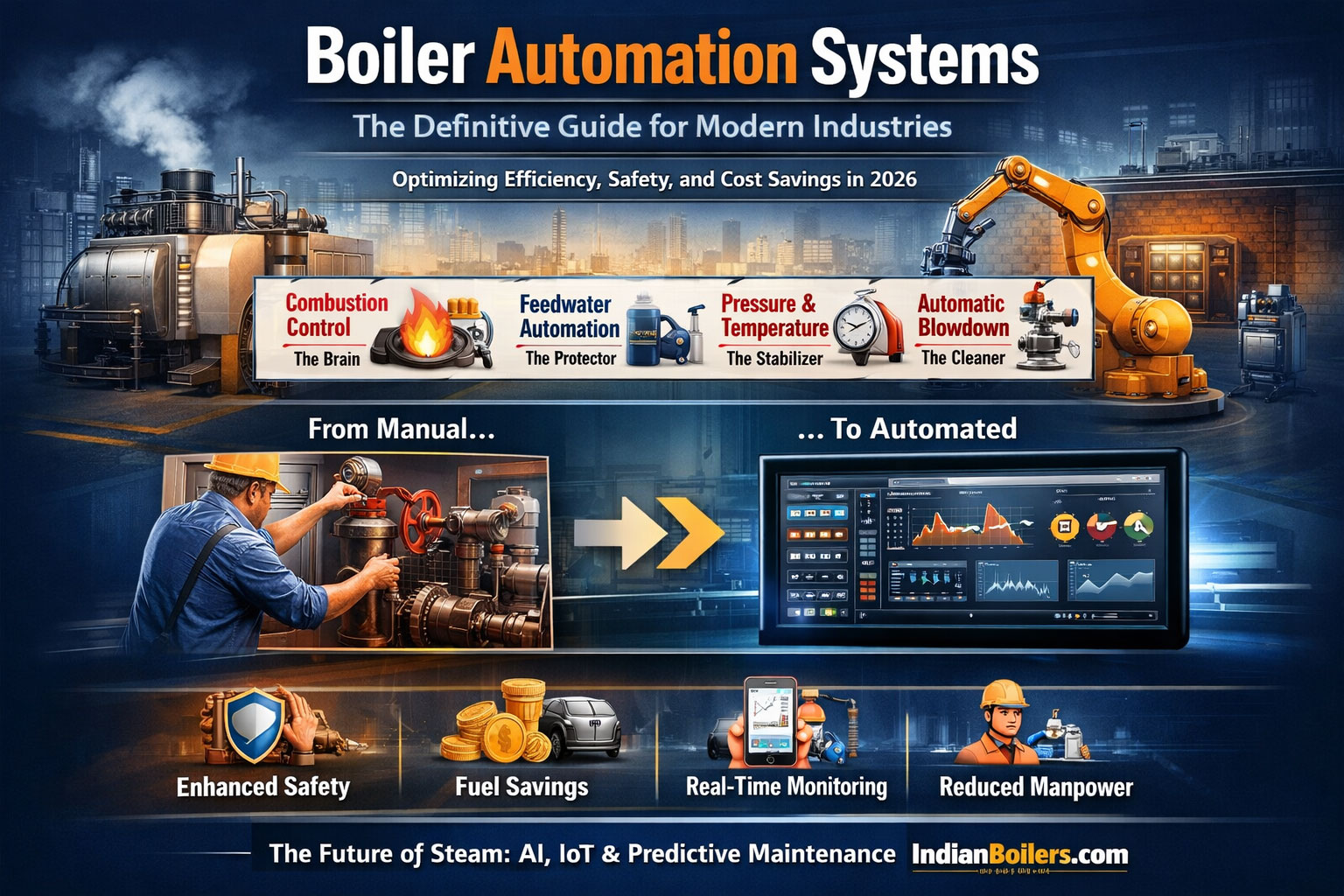
Boiler Automation Systems: What They Actually Do and What They’re Worth
The image of a boiler house run by an operator manually turning valves and squinting at pressure gauges is genuinely fading across Indian industry — not because it looks outdated, but because automated combustion control, feedwater management, and digital monitoring deliver measurable safety and fuel-cost improvements that are increasingly hard to justify skipping. This guide breaks down what boiler automation actually consists of, what it realistically delivers, and how to approach retrofitting an existing IBR-registered boiler rather than assuming it requires a full replacement.
What Boiler Automation Actually Means
At its core, boiler automation is the integration of sensors, controllers, and actuators that manage combustion, water level, pressure, and blowdown without requiring constant manual intervention — all while keeping the boiler within the safe operating parameters IBR compliance demands. This spans a real range of sophistication: a basic system might extend to automatic water level control and simple combustion sequencing; a PLC-based system adds programmable logic for combustion tuning, safety interlocks, and blowdown automation; a full SCADA or DCS (Distributed Control System) setup manages multiple boilers from a centralized interface with historical data logging and remote monitoring. Which level of sophistication makes sense depends on your plant’s scale, criticality of uptime, and existing operator skill base — not every facility needs full DCS integration to capture the bulk of automation’s real benefits.
The Core Components That Actually Matter
Combustion Control
This is the system’s most consequential function, since it directly governs fuel efficiency and emission output. Oxygen (O2) trimming uses flue gas sensors to detect excess oxygen and automatically adjusts forced draft (FD) fan speed to keep combustion in its efficient band, rather than relying on a fixed damper setting tuned for one operating point. Variable Frequency Drives (VFDs) on FD and ID fans let motor speed match actual demand rather than running at full speed and being throttled by a damper — this alone commonly cuts fan electricity consumption by roughly 15–20%, one of the faster-payback automation investments available. Our efficiency-focused guide with proven retrofit tips covers the combustion-control side of efficiency in more depth.
Feedwater Automation
Fluctuating water level remains one of the leading causes of boiler safety incidents, which makes this arguably the highest-stakes automation category. Three-element control — monitoring steam flow, feedwater flow, and drum level simultaneously rather than drum level alone — prevents the “swell and shrink” effect that can otherwise destabilise water level during sudden load changes, maintaining a steady supply of properly dry steam even as demand shifts. This level of control genuinely reduces both the risk of low-water trips and the steam-quality problems that come from an unstable water level.
Pressure and Temperature Management
Automated systems sense a pressure drop the moment a machine on the shop floor draws steam and ramp fuel and air supply accordingly, holding steam pressure far more consistently than manual operator response ever could — this matters directly for process quality in applications sensitive to pressure fluctuation, and for avoiding production delays caused by pressure sag under sudden load.
Automatic Blowdown Control
Manual blowdown, run on a fixed schedule regardless of actual water condition, routinely wastes more hot water and embedded heat than necessary. Automated systems monitor Total Dissolved Solids (TDS) continuously and trigger blowdown only when water chemistry actually requires it, meaningfully reducing both water and heat loss compared to a fixed manual schedule.
Safety: Where Automation Delivers Its Clearest Value
Automation’s safety case is genuinely strong, not just marketing framing: automated systems detect high-pressure or low-water conditions in milliseconds and trigger fail-safe shutdown far faster and more reliably than human reaction time allows, removing a meaningful category of human-error risk from boiler operation. That said, automation doesn’t eliminate the need for IBR-compliant design, periodic third-party inspection, or trained operator oversight — it’s a genuine risk-reduction layer added on top of sound fundamental engineering, not a substitute for it. Reviewing The Boilers Act, 2025 alongside any automation upgrade is worth doing to confirm your registration and inspection obligations remain properly aligned.
Fuel Savings: A Realistic Range, Not a Guarantee
Well-implemented combustion automation — oxygen trimming, VFD-controlled fans, and proper feedwater and blowdown control together — commonly delivers fuel consumption reductions in the range of 3% to 7% compared to manually operated equivalent systems, though the actual figure depends heavily on how far from optimal your current manual operation sits and how consistently your fuel quality varies. A plant already running disciplined manual combustion tuning will see a smaller marginal gain than one with significant variability in operator technique or fuel quality. For a high-capacity biomass or coal-fired system, even the lower end of that range compounds into a genuinely meaningful annual fuel-cost reduction — calculate your own expected figure against your actual fuel spend rather than assuming the top of the range applies universally.
Digital Monitoring and Predictive Maintenance
Cloud-connected monitoring lets plant managers track steam flow, fuel consumption, and efficiency remotely rather than depending entirely on on-site manual logs, and the historical data this generates enables genuine predictive maintenance — catching a developing bearing or pump issue from vibration or performance trend data before it causes an unplanned shutdown, rather than only reacting after failure. Our pieces on how AI and IoT are transforming biomass boiler operations and digital twin technology for boiler efficiency and reliability cover this monitoring layer in more depth.
What Happens to the Operator’s Role
Automation doesn’t eliminate the need for a skilled boiler operator — it shifts their role from constant manual adjustment toward system supervision, exception handling, and interpreting the data the system surfaces. This genuinely reduces physical strain and exposure risk in a high-heat environment, and tends to make the role more analytically demanding rather than simply “easier,” which is worth factoring into operator training plans during a transition rather than assuming automation removes the need for skilled staff entirely.
Manual vs. Automated: A Direct Comparison
| Feature | Manual Operation | Automated System (PLC/SCADA) |
|---|---|---|
| Response to load change | Slower, prone to pressure fluctuation | Near-instantaneous, precise |
| Fuel efficiency | Highly dependent on individual operator skill and consistency | Consistently optimised regardless of shift or operator |
| Safety response | Gauge and alarm-based, dependent on human reaction time | Automated shutdown with digital logging |
| Maintenance approach | Largely reactive — fix after failure | Increasingly predictive — fix based on trend data |
| Record keeping | Manual logbooks, prone to gaps and inconsistency | Digital, continuous, and auditable |
Retrofitting an Existing Boiler — You Don’t Need to Replace It
A common misconception is that automation requires a new boiler purchase. In most cases, an existing IBR-registered boiler can be retrofitted through a structured process:
- Energy audit. Identify where heat and fuel are actually being lost before specifying any automation equipment — this determines what genuinely delivers value versus what would be automation for its own sake.
- Sensor integration. Install properly specified pressure transducers, thermocouples, oxygen sensors, and flow meters matched to your boiler’s actual operating range.
- PLC/SCADA hub installation. The central control system that processes sensor data and drives automated adjustments.
- Actuator installation. Replace manual valves and dampers with motorized or pneumatic actuators capable of automated positioning.
- Commissioning and PID tuning. Fine-tune control loops to respond smoothly across your plant’s actual load variation, not just under test conditions — a poorly tuned control loop can hunt or overshoot, undermining the stability automation is meant to deliver.
- Operator training. Ensure staff understand the new system’s logic and exception-handling procedures, not just its normal operation — this matters as much as the hardware itself for realising genuine safety and efficiency gains.
The Emerging Frontier: AI-Assisted Combustion
Looking beyond current standard automation, AI-based systems are beginning to predict fuel quality variation — particularly relevant for biomass, where moisture and calorific value shift batch to batch — and pre-emptively adjust combustion parameters before efficiency actually drops, rather than reacting after the fact. This is a genuinely promising direction, though it’s worth noting this remains an emerging capability rather than a fully mainstream, proven-at-scale standard across Indian industrial boilers today — worth watching and piloting selectively rather than assuming it’s universally available or necessary for every installation right now.
Calculating Whether Automation Is Worth It for Your Plant
Rather than accepting a blanket “automation pays for itself” claim, run a simple comparison: estimate your current annual fuel spend, apply a conservative 3% savings assumption (the lower end of the realistic range) to get a minimum expected annual saving, then compare that against the quoted retrofit or new-installation automation cost. For most mid-to-large industrial boilers running substantial annual operating hours, this calculation alone typically shows payback within a few years from fuel savings alone — before even factoring in reduced maintenance costs from predictive monitoring or the harder-to-quantify but real value of improved safety response. Smaller, lower-utilisation boilers will see a longer payback purely on fuel savings, which is worth factoring honestly into the decision rather than assuming automation is equally cost-justified at every scale.
Our Automation Offering
Balkrishna Boilers Pvt Ltd — IndianBoilers.com and Balkrishn.com — builds PLC-based automation suites engineered for the operating conditions of Indian industrial plants across our Steam Boiler range, including STEAMJET, STEAMPOWER, and STEAMGEN, alongside retrofit automation packages for existing installations across both new and previously commissioned boilers.
Frequently Asked Questions
Do I need a completely new boiler to add automation? No — most existing IBR-registered boilers can be retrofitted with sensor integration, a PLC/SCADA control hub, and automated actuators without requiring full replacement, provided the underlying pressure vessel and combustion equipment are in sound condition.
How much fuel can I realistically expect to save with automation? Commonly 3–7% compared to manual operation, though the actual figure depends on how far your current manual operation sits from optimal and how variable your fuel quality is — calculate against your specific fuel spend rather than assuming the top of the range.
Does automation replace the need for a trained boiler operator? No — it shifts the operator’s role from constant manual adjustment to system supervision and exception handling, which still requires genuine training and skill, just of a different kind.
Is full SCADA/DCS integration necessary, or is basic PLC automation enough? It depends on your scale and criticality — a single mid-sized boiler may capture most of the real benefit from PLC-based combustion and feedwater automation alone, while multi-boiler facilities with centralized monitoring needs benefit more from full SCADA/DCS integration.
Is AI-based combustion prediction available and reliable today? It’s a genuinely promising emerging capability, particularly for biomass fuel quality variation, but it’s not yet a fully mainstream, proven-at-scale standard across the industry — worth piloting selectively rather than assuming it’s a default feature of any automation package you’re quoted.
Talk to Our Engineering Team
If you’re evaluating automation for a new installation or retrofitting an existing boiler, get in touch with our engineering team for a specification matched to your actual plant, or browse our complete product range.
Further reading: Steam Boiler Efficiency: Boost Savings by 30% with Proven Tips · How AI and IoT Are Transforming Biomass Boiler Operations · Digital Twin Technology: Revolutionizing Boiler Efficiency and Reliability · Boiler Efficiency vs. Fuel Cost: What Matters More?