
Biomass Boiler Technology in 2026: What’s Actually Changed, and What to Verify Before You Believe a Trend Piece
Every industry has its share of “trend” content that overstates certainty and understates nuance, and biomass boiler technology is no exception. This piece covers what’s genuinely changed in the technology and policy landscape as of 2026 — with the caveats and specifics that actually matter for a purchasing decision, rather than headline percentages that won’t survive contact with your local market.
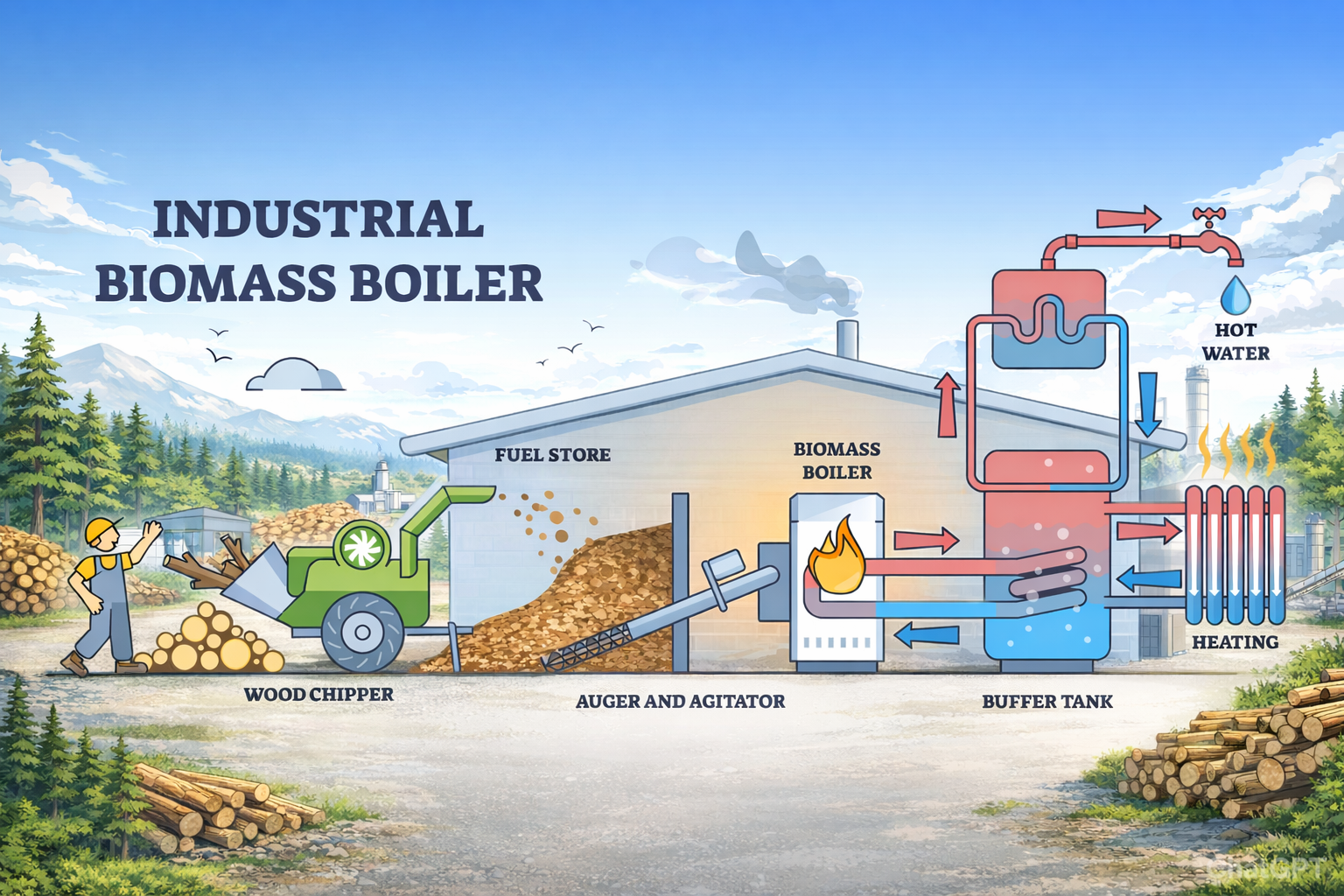
If you want the underlying combustion engineering behind these trends rather than a policy and technology overview, our understanding biomass boiler combustion and what is a biomass boiler guides cover that ground in depth.
1. Automated Combustion Control: A Genuine, Verifiable Shift
Modern biomass systems increasingly integrate real-time O2 and CO sensors feeding directly into automated control panels that adjust air-to-fuel ratios continuously rather than relying on periodic manual tuning. This is a genuine technology shift, not marketing language — it removes the human-error factor from combustion tuning and holds efficiency closer to a system’s design potential consistently, rather than only at the moment it was last manually calibrated. Well-implemented systems commonly reach thermal efficiency in the high-80s to low-90s percentage range, consistent with the efficiency mechanisms covered in our modern boiler efficiency guide.
2. Densified Fuel (“White Coal”): A Genuine Market Shift, With Real Trade-Offs
Raw wood and loose agricultural waste are increasingly being displaced by high-density biomass pellets and briquettes — sometimes marketed as “white coal” — with moisture content consistently held below roughly 10%. This densification genuinely improves calorific value density and reduces ash disposal volume compared to raw biomass, and it’s a real, ongoing shift in how Indian manufacturers source fuel. It’s worth noting this comes with a cost trade-off, though — densified fuel typically costs more per tonne than raw agricultural residue, since processing adds cost; the calorific value and handling improvement is what justifies that premium, not a free efficiency gain.
3. Heat Recovery Integration: Standard Practice, Not a New Trend
Condensing heat exchangers and air preheaters that capture flue gas heat otherwise lost up the chimney, redirecting it into feedwater or process drying, represent genuine efficiency engineering — though it’s worth being precise that this isn’t a brand-new 2026 innovation so much as increasingly standard specification on well-engineered modern systems. Our modern boiler efficiency guide covers exactly how these components work.
4. Fuel Economics: A Framework, Not a Fixed Table
This is where trend pieces most often go wrong — quoting specific rupee-per-litre and rupee-per-tonne figures that are stale within months of publication. Rather than repeat that mistake, here’s the accurate framework: biomass fuel commonly costs meaningfully less per unit of delivered heat than furnace oil, and often less than coal as well, once you account for calorific value differences and the “Coal Cess” and other tax treatment that adds to coal’s effective cost. The magnitude of that savings genuinely varies by your region, current local fuel pricing, and your specific fuel choice within the biomass category — a briquette-to-oil comparison and a raw-husk-to-coal comparison produce very different numbers. Our biomass vs. coal comparison and LPG vs. wood briquettes comparison both walk through this calculation properly — build your own comparison using current local pricing rather than trusting a headline percentage from any single article, including this one.
5. Miniaturization and Decentralization: A Real Design Direction
Industrial parks genuinely face space constraints, and compact, modular biomass systems — like our COMCUBE — are increasingly designed for exactly this constraint, reducing installation footprint and complexity compared to older, larger field-erected designs. This is a genuine and continuing design trend, well suited to boutique pharma labs and food startups operating in constrained facilities.
6. Multi-Fuel Flexibility: An Established, Continuing Trend
Staged combustion design and flexible grate configurations — including our STEAMAX – Wood/Briquette Fired Steam Boiler range — allow manufacturers to shift between rice husk, wood pellets, and other biomass sources based on seasonal availability, without a full system recalibration each time. This isn’t a new-for-2026 feature so much as a continuing maturation of multi-fuel engineering — our multi-fuel boilers guide covers what genuinely makes a system multi-fuel capable versus merely theoretically convertible.
7. Automated Ash Management: A Genuine Hygiene and Labor Improvement
Automated ash removal systems, sealing and moving residue without manual handling, genuinely help maintain the cleaner operating environment that food and hygiene-sensitive industries need — a real, practical improvement over manual ash handling, both for labor conditions and for facilities where ash dust near a production area is a genuine quality concern.
8. Government Policy: What’s Actually Current, Corrected
This is worth getting precisely right, since a reader might make a real financial decision based on this section.
The National Bioenergy Programme, administered by MNRE, runs through the current financial year ending March 31, 2026. However, new applications for Central Financial Assistance under this programme actually closed on December 31, 2025 — the Ministry’s own portal confirms further submissions are stopped until further notice. If you’re evaluating a biomass project specifically counting on this subsidy, confirm current application status directly with MNRE or your State Nodal Agency before finalizing project economics, since the programme’s continuation or a successor scheme beyond this window isn’t yet confirmed as of this writing.
Carbon credit monetization through India’s evolving Carbon Credit Trading Scheme is a genuine, developing mechanism — but it isn’t a blanket, automatic benefit available to any business switching to biomass. Eligibility depends on specific sector designation and compliance mechanism participation, still in phased rollout. Confirm actual eligibility and current market mechanics with a qualified carbon markets consultant rather than assuming any biomass switch automatically generates tradeable credits.
9. Matching Technology to Your Actual Requirement
Rather than a single “2026 lineup” pitch, here’s an honest match-up based on what each system is genuinely built for:
- COMCUBE — biomass-fired steam, best suited to space-constrained small-to-midscale operations with constant steam demand.
- STEAMAX — wood/briquette-fired steam, suited to higher-output, continuous industrial steam generation.
- Biomass-fired hot water and thermic fluid systems — suited to chemical refining, frying, and process applications needing indirect heat rather than steam pressure; confirm current model names and specifications directly with our engineering team, since product naming and configuration are periodically updated.
- Biomass-fired hot air generators — suited to drying applications in tea, spices, and chemical processing where export-quality product standards depend on clean, indirect heat.
Conclusion: Real Trends, Verified Specifics
The genuine direction of biomass boiler technology in 2026 is real: better automated combustion control, more standardized densified fuel, continuing multi-fuel flexibility, and increasingly space-efficient designs. What’s worth being skeptical of is any specific percentage or subsidy claim that isn’t sourced to your actual current situation — fuel pricing, subsidy application windows, and carbon credit eligibility all shift on timelines that a general blog post can’t track in real time on your behalf.
Balkrishna Boilers Pvt Ltd’s engineering team can confirm current specifications, pricing, and subsidy eligibility specific to your project. Explore the full range on IndianBoilers.com or Balkrishn.com.
Planning a biomass project and want current, verified numbers rather than general estimates? Contact our engineering team for a project-specific assessment.