
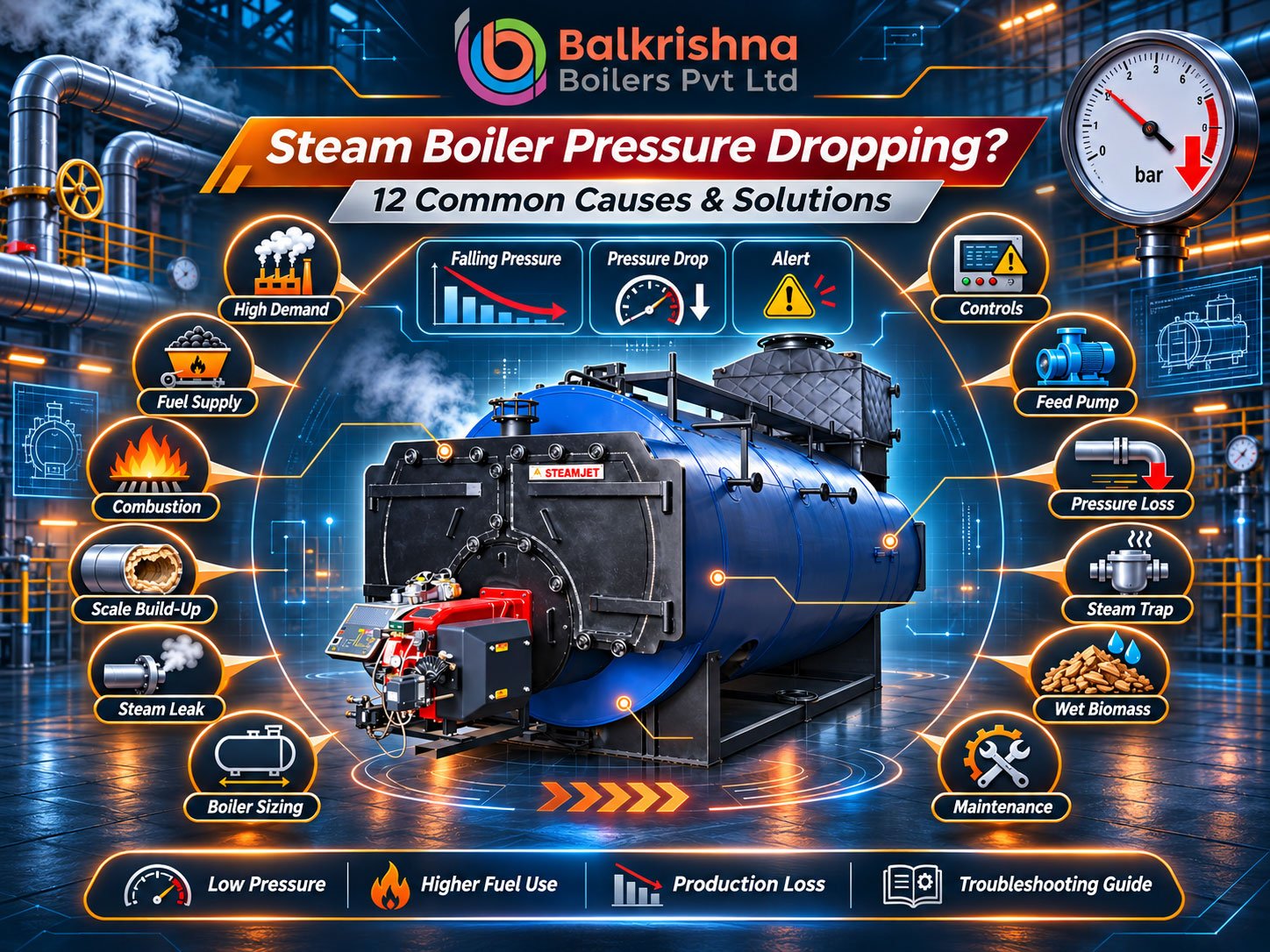
Steam boiler pressure is one of the most important operating parameters in an industrial heating system. Whether a factory uses steam for textile processing, food manufacturing, pharmaceutical production, chemical processing, or industrial cleaning, maintaining stable steam pressure is essential for consistent production.
When steam boiler pressure drops unexpectedly, the results can include reduced heating performance, longer processing cycles, increased fuel consumption, and production interruptions.
However, a pressure drop does not always indicate a problem inside the boiler itself. The underlying cause may involve excessive steam demand, insufficient combustion, feedwater problems, steam leakage, defective controls, or pressure losses in the distribution system.
Understanding these problems helps plant engineers identify the source of pressure instability and determine whether maintenance, operating adjustments, or equipment upgrades are required.
This guide explains 12 common causes of steam boiler pressure drops, their symptoms, and practical troubleshooting approaches for industrial plants.
What Is Steam Boiler Pressure Drop?
Steam boiler pressure drop refers to a reduction in steam pressure below the required operating level.
In an industrial boiler, heat energy converts water into steam. Steam is then delivered through pipelines to manufacturing equipment.
When steam generation and steam consumption are balanced, boiler pressure remains within its intended operating range.
However, if steam demand exceeds the boiler’s ability to generate steam, the pressure begins to fall.
Pressure losses may also occur between the boiler outlet and the point of use because of friction, valves, restrictions, or excessive steam flow.
For example, a factory operating a boiler at a nominal pressure of 10 bar(g) may experience a reduction to 7 bar(g) during production.
Depending on the process requirements, this can affect heating performance and production consistency.
The first troubleshooting step is to determine whether pressure is falling at the boiler, within the steam distribution network, or only at particular process equipment.
1. Excessive Steam Demand
One of the most common causes of low steam pressure is demand exceeding the available steam generation capacity.
This frequently occurs when multiple production machines begin consuming steam simultaneously.
For example, a manufacturing facility may operate several heating vessels, drying machines, and sterilization units from one boiler.
If all equipment starts consuming steam at the same time, the total demand may temporarily exceed the boiler’s rated output.
Common symptoms:
- Pressure drops during peak production.
- Pressure recovers when machines stop.
- Boiler firing remains near maximum output.
- Production equipment experiences slower heating.
Recommended solutions:
Review the actual simultaneous steam demand of the plant rather than simply adding the nameplate capacities of connected machines.
Where practical, stagger the startup of large steam-consuming equipment and examine whether adequate steam storage, control response, or additional boiler capacity is required.
Plants planning expansion should evaluate the appropriate industrial steam boiler range.
For detailed sizing guidance, read our existing article on how to calculate steam boiler capacity for your plant.
2. Insufficient Fuel Supply
A steam boiler depends on a consistent fuel supply to generate the required amount of heat.
If fuel delivery becomes insufficient, the boiler may struggle to maintain steam pressure during normal operation.
The problem varies according to fuel type.
In oil-fired boilers, clogged fuel filters, unsuitable fuel temperature, or fuel pump problems may affect combustion.
Gas-fired boilers may experience insufficient supply pressure or flow, while biomass boilers may suffer from irregular fuel feeding.
Common symptoms:
- Steam pressure decreases during higher firing demand.
- Burner output becomes unstable.
- Fuel supply alarms occur.
- Combustion performance deteriorates.
Recommended solutions:
Qualified maintenance personnel should verify fuel supply conditions, inspect the fuel-handling equipment, and confirm that the combustion system operates within manufacturer specifications.
For facilities with access to reliable natural gas, the Oil and Gas Fired Steam Boiler is an option worth evaluating for stable industrial steam generation.
Any adjustment involving burners, gas trains, or safety interlocks must follow approved procedures.
3. Improper Burner Combustion
A burner may receive enough fuel but still fail to produce the required heat because of inefficient combustion.
Improper air-to-fuel ratios, blocked burner components, flame instability, or faulty combustion controls can reduce effective heat output.
This problem may develop gradually and remain unnoticed until production demand increases.
Common symptoms:
- Reduced steam generation.
- Excessive or abnormal exhaust emissions.
- Increased fuel consumption.
- Repeated burner faults.
- Inconsistent boiler pressure.
Recommended solutions:
Arrange a combustion performance assessment by a qualified boiler technician.
The assessment may include checking burner components, combustion airflow, control settings, and measured flue-gas conditions.
Combustion tuning should be based on instrument readings and equipment specifications rather than visual flame appearance alone.
Maintaining proper combustion can improve steam availability while reducing unnecessary fuel consumption.
4. Scale Formation Inside the Boiler
Poor feedwater quality can lead to mineral deposits forming on internal heat-transfer surfaces.
These deposits are commonly known as boiler scale.
Scale acts as a thermal barrier between the heating surface and the water. As deposits accumulate, heat transfer can deteriorate.
The boiler may consequently require more fuel to produce the same steam output.
In severe cases, deposits can also contribute to dangerous overheating of pressure-retaining components.
Common symptoms:
- Declining thermal performance.
- Increased fuel consumption.
- Reduced steam generation.
- Abnormal metal temperature indications.
- Water chemistry outside specified limits.
Recommended solutions:
Maintain a feedwater treatment system appropriate for the boiler’s pressure, design, and operating conditions.
Monitor hardness, dissolved solids, pH, and other relevant parameters according to the approved water treatment program.
Arrange internal inspections and cleaning through qualified personnel.
Our article on steam boiler blowdown explains why controlling dissolved solids is important for boiler reliability.
5. Steam Leakage in Pipelines and Valves
Steam leakage is another important reason for pressure loss in industrial steam systems.
Even when the boiler produces adequate steam, leaking components can waste steam before it reaches production equipment.
Potential leakage points include pipe joints, valve glands, flanges, damaged gaskets, and defective steam traps.
Leaks may become more significant as steam distribution systems age.
Common symptoms:
- Audible hissing noises.
- Visible steam escaping from fittings.
- Localized pressure reductions.
- Increased fuel consumption without increased production.
- Persistent condensation around damaged components.
Recommended solutions:
Conduct a systematic steam leakage survey using appropriate inspection methods.
Prioritize significant leaks and isolate affected sections through approved procedures before repairs.
Steam piping, pressurized valves, and fittings must never be repaired while exposed to hazardous pressure or temperature.
For further information about valve functions and maintenance, refer to our guide on types of boiler valves.
6. Incorrect Boiler Capacity Selection
An undersized boiler cannot reliably satisfy a plant’s peak simultaneous steam requirement.
For example, a boiler rated at 1,000 kg/hr cannot be expected to continuously supply 1,500 kg/hr of steam at its specified operating conditions.
When demand consistently exceeds rated capacity, steam pressure will decline.
However, increasing boiler size without examining the demand profile can also create operating problems.
Oversized boilers may experience excessive cycling or inefficient operation at low loads.
Recommended solutions:
Assess average steam demand, peak demand, operating pressure, production cycles, and potential future expansion.
Instead of selecting a boiler solely by capacity, compare its full-load and part-load performance.
For smaller industrial applications, explore the Gas Fired Steam Boiler.
For more demanding pressure requirements, the Water Tube Boiler may be suitable, depending on the specified steam capacity, pressure, and operating duty.
The final selection should be based on an engineering load assessment.
7. Faulty Pressure Controls and Sensors
Modern steam boilers use pressure sensors, controllers, transmitters, and safety devices to monitor and regulate operation.
If these instruments provide inaccurate readings, the control system may respond incorrectly.
For example, an incorrectly calibrated pressure transmitter may report a higher pressure than the actual operating pressure.
As a result, the combustion controller may not increase heat input when required.
Common symptoms:
- Pressure readings disagree between instruments.
- Burner modulation behaves unexpectedly.
- Unexplained pressure fluctuations occur.
- Pressure-related alarms activate repeatedly.
Recommended solutions:
Check pressure measurements against correctly calibrated reference instruments.
Qualified personnel should inspect sensing lines, electrical connections, controller settings, and relevant instrumentation.
Never bypass protective pressure controls or safety interlocks to maintain production.
Automation is useful only when its measurement and protection systems operate correctly.
8. Feedwater Pump Problems
A steam boiler requires a controlled supply of treated feedwater.
If the feedwater pump cannot maintain the required flow, boiler water level may fall and protective systems may reduce firing or shut down the boiler.
Potential causes include pump wear, suction restrictions, insufficient feedwater tank level, cavitation, control malfunction, and electrical problems.
Common symptoms:
- Low-water alarms.
- Feedwater pressure instability.
- Unusual pump vibration or noise.
- Repeated boiler trips.
- Inconsistent water level.
Recommended solutions:
Verify feedwater system performance, pump operating conditions, and tank level.
Check that the pump is correctly specified for the boiler’s operating pressure and required flow.
Where appropriate, evaluate standby feedwater arrangements to improve reliability.
A low-water condition is a serious safety hazard. Operators must follow the manufacturer’s shutdown and recovery procedures rather than attempting an uncontrolled restart.
9. Excessive Steam Distribution Pressure Loss
Sometimes the boiler operates normally, but steam pressure is significantly lower at the point of use.
This may indicate excessive pressure loss in the steam distribution network.
Potential causes include undersized pipelines, unnecessary restrictions, partially closed valves, blocked strainers, excessive flow velocity, and poorly selected pressure-reducing equipment.
Long piping runs can also contribute to pressure loss.
Recommended solutions:
Measure pressure at the boiler outlet, distribution headers, and critical process equipment under representative operating conditions.
Compare the measured pressure difference with the distribution system’s design requirements.
An engineering review may identify opportunities to improve pipe sizing, valve selection, insulation, and distribution layout.
Avoid increasing boiler pressure simply to compensate for a distribution problem without verifying equipment ratings and safe operating limits.
10. Poor Steam Trap Performance
Steam traps help remove condensate and non-condensable gases from steam systems while limiting unnecessary live steam loss.
A defective steam trap may fail in either an open or closed condition.
A failed-open trap can continuously discharge steam and increase the boiler load.
A failed-closed trap can allow condensate to accumulate, reducing heat-transfer performance and potentially contributing to water hammer.
Common symptoms:
- Unusual condensate discharge.
- Poor heating performance.
- Water hammer or vibration.
- Increased steam consumption.
- Uneven process temperatures.
Recommended solutions:
Implement a steam trap inspection program appropriate to the facility.
Use suitable diagnostic methods, including temperature and ultrasonic testing where applicable.
Replace defective traps with correctly sized and specified equipment.
Steam trap maintenance is particularly valuable for factories operating extensive steam distribution networks.
11. Poor-Quality or High-Moisture Biomass Fuel
Biomass-fired boilers use fuels such as wood chips, briquettes, agricultural residues, and other suitable solid fuels.
Fuel moisture, particle size, calorific value, and feeding consistency all influence combustion performance.
When fuel contains excessive moisture, more energy is required to evaporate that water, reducing the heat available for steam generation.
Irregular feeding can also produce fluctuations in furnace heat release.
Common symptoms:
- Steam pressure fluctuations after fuel changes.
- Increased fuel consumption.
- Inconsistent combustion.
- Difficulty maintaining rated output.
- Excessive unburned material.
Recommended solutions:
Establish fuel acceptance specifications covering moisture, size, contamination, and calorific value.
Maintain suitable fuel storage and handling arrangements.
Confirm that the boiler combustion and feeding systems are designed for the intended fuel.
Plants using agricultural or wood-based fuel can explore the Wood and Briquette Fired Steam Boiler or Wood Chip Fired Boiler.
Fuel selection should consider both availability and the actual performance requirements of the boiler.
12. Inadequate Maintenance and Fouled Heat-Transfer Surfaces
Industrial boilers require routine maintenance to maintain safe and efficient operation.
Over time, soot, ash, corrosion products, and other deposits may accumulate in combustion and heat-transfer areas.
These deposits can reduce effective heat transfer and contribute to lower steam generation.
Maintenance problems may also involve fans, pumps, burners, sensors, controls, and other auxiliary equipment.
Common symptoms:
- Gradual reduction in steam output.
- Higher exhaust gas temperatures.
- Increasing fuel consumption.
- Unusual equipment vibration.
- Frequent operating interruptions.
Recommended solutions:
Develop a preventive maintenance schedule based on manufacturer recommendations, fuel characteristics, operating hours, inspection findings, and statutory requirements.
Maintenance should include appropriate inspection of heat-transfer surfaces, combustion equipment, safety systems, pumps, and instrumentation.
Pressure-retaining components and safety-critical devices must be inspected and repaired only by appropriately qualified personnel.
Quick Troubleshooting Table: Steam Boiler Pressure Drop
| Problem | Possible Cause | Recommended Action |
|---|---|---|
| Pressure falls during peak production | Excessive steam demand | Review simultaneous steam load |
| Boiler cannot maintain firing output | Fuel supply restriction | Inspect fuel supply system |
| Poor steam generation with high fuel use | Combustion inefficiency | Arrange combustion assessment |
| Gradual efficiency reduction | Internal scaling | Inspect water treatment and deposits |
| Pressure loss along pipelines | Leakage or restrictions | Survey distribution system |
| Persistent pressure shortage | Undersized boiler | Recalculate steam requirement |
| Unstable pressure readings | Faulty instrumentation | Calibrate pressure instruments |
| Low-water alarms and shutdowns | Feedwater system fault | Inspect pump and controls |
| Low pressure at process equipment | Distribution pressure loss | Evaluate piping and valves |
| High steam consumption | Defective steam traps | Inspect and replace faulty traps |
| Variable pressure with biomass fuel | Moisture or feed variation | Improve fuel quality control |
| Reduced output over time | Fouled heat-transfer surfaces | Perform scheduled maintenance |
How to Prevent Steam Boiler Pressure Drops
Preventing pressure instability requires a combination of correct boiler selection, reliable utilities, trained operators, and preventive maintenance.
The following practices are important.
Monitor Steam Demand
Record steam flow and boiler pressure during different production periods.
Identify recurring pressure reductions associated with particular machinery or operating schedules.
Maintain Proper Feedwater Quality
Operate the water treatment system within the specifications applicable to the boiler.
Poor feedwater quality can contribute to scale formation, corrosion, and unreliable operation.
Inspect Steam Distribution
Check pipelines, valves, insulation, condensate systems, and steam traps for defects.
Correcting distribution problems can improve process pressure without changing the boiler.
Evaluate Fuel and Combustion Performance
Monitor fuel quality, fuel supply, burner performance, and relevant combustion parameters.
The appropriate checks depend on whether the system uses oil, gas, electricity, biomass, or another energy source.
Follow a Preventive Maintenance Program
Use documented inspection schedules and operating records to identify developing problems.
Qualified engineers should investigate abnormal trends before they lead to repeated shutdowns.
Choosing the Right Boiler for Stable Steam Pressure
Different industrial processes require different steam generation technologies.
Choosing equipment involves more than comparing rated steam capacity.
Engineers should also evaluate load variation, operating pressure, available fuel, environmental requirements, utility infrastructure, and maintenance capabilities.
Oil and Gas Fired Steam Boilers
An Oil and Gas Fired Steam Boiler may suit facilities requiring controlled combustion and dependable steam generation with access to suitable liquid or gaseous fuels.
Biomass Steam Boilers
Biomass systems can be attractive for facilities with reliable access to suitable agricultural residues or wood-based fuels.
Explore the Biomass Steam Boiler range to compare relevant options.
Electric Steam Boilers
Electric boilers generate heat without an on-site combustion process.
They may be suitable where electrical infrastructure, tariffs, emissions requirements, and steam demand make electric heating practical.
Browse the Electric Boiler range for available models.
Water Tube Boilers
A Water Tube Boiler may be appropriate for applications requiring specific high-pressure capabilities or demanding steam operating conditions.
The correct technology depends on the complete engineering specification rather than fuel or pressure alone.
Frequently Asked Questions
1. Why does my steam boiler pressure keep dropping?
Common causes include excessive steam demand, inadequate fuel supply, burner problems, scale buildup, steam leakage, faulty controls, and feedwater system problems. Pressure measurements at different points help identify the cause.
2. Can low feedwater level cause boiler pressure loss?
Yes. Feedwater problems can activate protective controls, reduce firing, or stop steam generation. Low water is a serious safety condition requiring the approved shutdown and recovery procedure.
3. Can steam leakage reduce boiler pressure?
Yes. Significant steam leakage increases total steam demand and can reduce the pressure available to production equipment.
4. How can boiler pressure be kept stable?
Stable pressure requires adequate boiler capacity, consistent fuel and feedwater supplies, properly functioning controls, sound steam distribution, and regular maintenance.
5. Does a larger boiler always solve low steam pressure?
No. If the main problem is a restricted pipeline, faulty valve, defective controller, or steam leak, installing a larger boiler may not solve it. The cause should be identified before considering replacement.
6. When should a boiler be replaced?
Replacement may be appropriate when the boiler cannot meet actual process requirements, is uneconomical to maintain, or fails to satisfy applicable safety and operating requirements. An engineering assessment should precede the decision.
Conclusion
Steam boiler pressure drops can affect production efficiency, product quality, fuel consumption, and plant reliability.
The underlying cause may involve the boiler itself, its fuel and feedwater systems, operating controls, or the steam distribution network.
A systematic troubleshooting approach helps distinguish between temporary load fluctuations, maintenance problems, and genuine capacity limitations.
Rather than immediately increasing pressure settings or replacing equipment, plant operators should identify the source of the problem through appropriate measurements and qualified engineering assessment.
At Indian Boilers, we provide industrial steam generation and heating solutions for a wide range of manufacturing applications.
Whether your facility requires an oil and gas fired boiler, biomass-fired steam boiler, electric steam boiler, or water tube boiler, selecting equipment based on actual operating requirements is essential for dependable long-term performance.
Explore our Industrial Boiler Products or contact Indian Boilers to discuss your steam generation requirements with our team.