
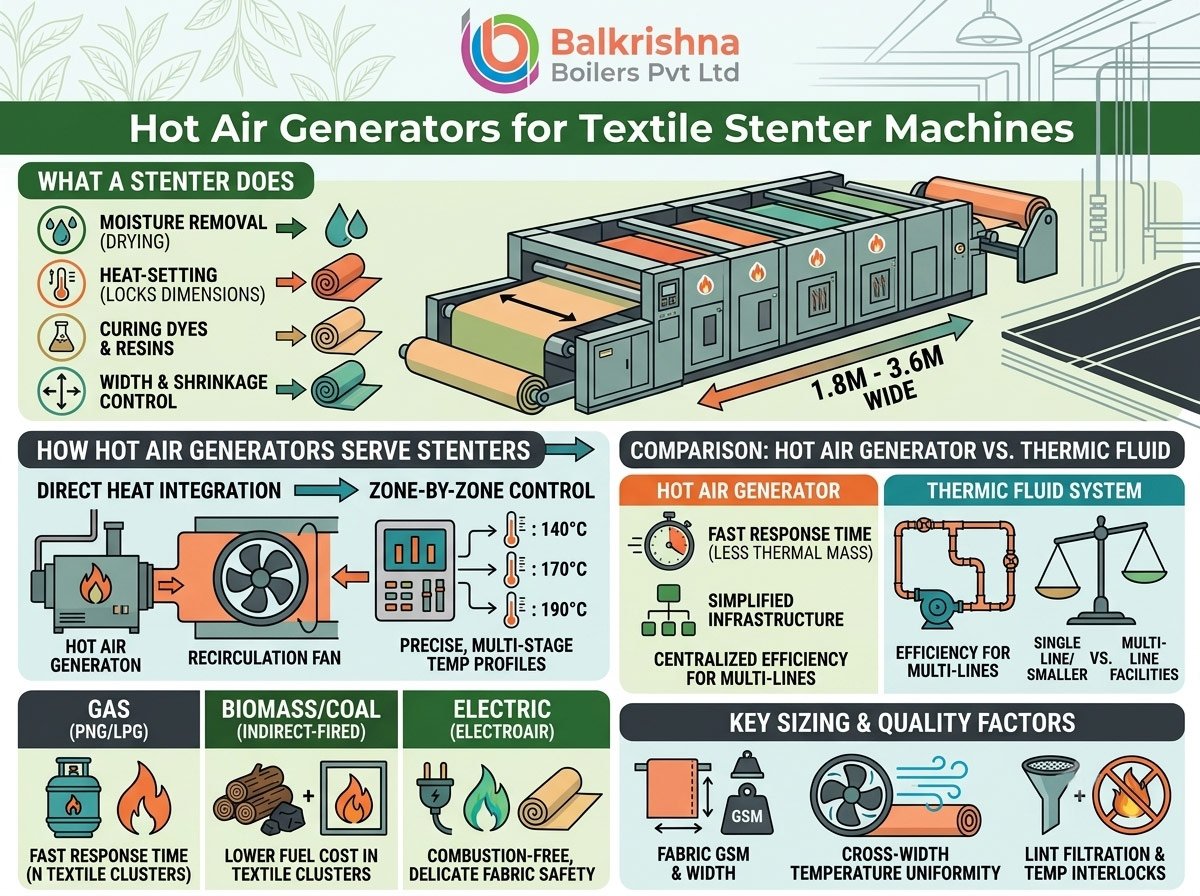
The stenter frame is the workhorse of textile finishing — the machine responsible for drying, heat-setting, curing, and dimensionally stabilizing fabric after dyeing and washing. Every stenter chamber, often divided into 6, 8, or more independently controlled zones, depends on precise, evenly distributed hot air to deliver consistent fabric quality across the full width and length of every roll processed. Get the hot air wrong — uneven, too hot, too cool, poorly distributed — and the result shows up immediately as shrinkage variation, uneven shade, poor dimensional stability, or scorched fabric edges.
While many textile finishing lines rely on thermic fluid heaters to indirectly heat stenter zones via finned heat exchangers, a growing number of textile units — particularly those prioritizing faster response, simpler infrastructure, or specific process requirements — use dedicated hot air generators to deliver heat directly into the stenter chamber. This guide covers exactly how hot air generators serve textile stenter applications, how they compare to thermic fluid-heated stenters, and how to specify the right system for your finishing line.
1. What a Stenter Machine Does and Why Heat Precision Matters
A stenter frame pulls fabric through a series of heated chambers while holding it at a controlled width using pin or clip chains along both edges. As the fabric passes through each zone, hot air performs several critical functions simultaneously:
- Moisture Removal: Drying fabric after wet processing (dyeing, washing) to a controlled final moisture content.
- Heat-Setting: For synthetic fibers particularly, heat-setting locks in dimensional stability and prevents shrinkage or distortion in later processing or end use.
- Curing: Fixing dyes, resins, or finishing chemicals applied earlier in the process, which often require sustained exposure to a specific temperature for a defined dwell time.
- Width and Shrinkage Control: Maintaining precise fabric width throughout the heating process to meet exact specification tolerances demanded by garment manufacturers.
Because each of these functions depends on temperature accuracy and airflow uniformity across the full fabric width — often 1.8 to 3.6 meters wide — even small inconsistencies in hot air delivery translate directly into measurable fabric defects and rejected batches.
2. How Hot Air Generators Deliver Heat to Stenter Zones
A. Direct Integration With Stenter Chambers
Hot air generators can be positioned to feed heated air directly into individual stenter zones, with recirculation fans within each chamber ensuring the hot air is evenly distributed across the fabric width before a portion is exhausted and replaced with fresh heated air.
B. Zone-by-Zone Temperature Control
Since different stages of the stenter process often require different temperatures — an initial drying zone may run cooler than a later heat-setting or curing zone — hot air generator systems are typically configured to allow independent temperature control across each zone, giving process engineers the flexibility to run precise, multi-stage temperature profiles matched to the specific fabric and finish being applied.
C. Recirculation for Efficiency
Because stenter chambers exhaust a portion of moisture-laden air continuously, well-designed systems recirculate a portion of the still-warm exhaust air, blending it with fresh heated air to reduce the total energy needed to maintain each zone’s setpoint — directly improving overall system efficiency.
3. Hot Air Generators vs Thermic Fluid Heating for Stenters
This is one of the most common technology decisions textile finishing units face, and the right answer depends on the specific priorities of the plant.
A. Response Time
Hot air generators generally respond faster to temperature setpoint changes than thermic fluid-heated finned coils, since there’s less thermal mass to heat or cool between adjustment and effect — an advantage for finishing lines that frequently change fabric type or finish recipe.
B. Infrastructure Complexity
A thermic fluid system requires a central heater, circulating pump, piping network, and finned heat exchangers within each stenter zone — more infrastructure, but capable of efficiently serving multiple stenter lines and other heat users from a single centralized heat source. A hot air generator, by contrast, is typically a more self-contained, zone-direct solution requiring less centralized piping infrastructure, though each line generally needs its own dedicated generator capacity.
C. Multi-Line Facilities
For textile units running multiple stenter lines plus other high-temperature processes (calendering, other dryers), a centralized thermic fluid system — as detailed in our guide on thermic fluid heaters for textile processing — often proves more efficient overall, since one heater can serve multiple demand points simultaneously.
D. Single-Line or Smaller Operations
For smaller finishing units or single-stenter-line operations, a dedicated hot air generator can offer a simpler, more directly responsive solution without the complexity of a centralized fluid distribution system.
Both approaches are valid, well-proven technologies in Indian textile finishing — the right choice depends on your plant’s overall heat demand profile, not just the stenter line in isolation.
4. Fuel Options for Textile Stenter Hot Air Systems
A. Gas-Fired Systems
Natural gas, PNG, or LPG-fired hot air generators offer fast response, precise modulation, and clean combustion — well suited to finishing operations running frequent fabric and recipe changes that demand quick, accurate temperature adjustment.
B. Biomass and Coal-Fired Systems
For textile units prioritizing lower fuel costs, biomass or coal-fired hot air generators (necessarily indirect-fired, to keep combustion gases isolated from fabric-contact air) remain a common and cost-effective choice, particularly in textile clusters with established solid fuel supply chains.
C. Electric Systems
For premium finishing operations or facilities prioritizing precise, combustion-free heat with zero risk of any combustion byproduct affecting delicate or light-colored fabric, our electric hot air generator (ELECTROAIR) delivers clean, stable heat with tight temperature control.
Balkrishna Boilers supports textile finishing operations with proven ranges including AQUAJET and AQUAMAX for combustion-fired systems, and EDOPAC for electric-fired applications.
5. Direct-Fired vs Indirect-Fired Considerations for Textiles
Whether a direct-fired or indirect-fired hot air generator is appropriate for a stenter application depends on the fabric and finish involved:
- Indirect-Fired Systems are generally preferred where combustion byproduct contact could affect fabric color, odor, or chemical finish integrity — particularly relevant for light-colored fabrics, technical textiles, or fabrics with sensitive chemical finishes.
- Direct-Fired Systems may be acceptable for certain robust, non-sensitive fabric types where maximum thermal efficiency is prioritized and combustion contact doesn’t affect final product quality.
Our complete breakdown of this decision, including the underlying mechanics of each design, is available in direct vs indirect fired hot air generators explained.
6. Sizing a Hot Air Generator for a Stenter Line
Correct sizing depends on several textile-specific factors:
- Fabric Width and Line Speed: Wider fabric and faster line speeds both increase the total heat load required to maintain target temperature across the full processing width.
- Number of Zones: Each independently controlled zone adds to total system heat demand, particularly zones requiring higher curing or heat-setting temperatures.
- Fabric Type and GSM: Heavier fabrics (higher grams per square meter) require more energy to heat and dry than lightweight fabrics at the same line speed.
- Moisture Load: The amount of moisture being removed — influenced by the wet processing steps before the stenter — directly affects the heat input required in the initial drying zones.
For general sizing principles applicable across our heating product range, our guide on thermic fluid heater capacity: how to choose the right size explains the core methodology of matching capacity to actual peak demand.
7. Quality Control Through Proper Hot Air System Design
A few design factors directly affect the fabric quality outcomes textile finishers care about most:
- Cross-Width Uniformity: Air distribution ductwork and nozzle design within each zone must deliver consistent airflow and temperature across the full fabric width — uneven distribution is one of the most common causes of shade and shrinkage variation across a fabric roll.
- Fast, Accurate Zone Response: Since different fabric batches often require different temperature profiles, quick and accurate response to setpoint changes minimizes off-spec fabric produced during transition between batches.
- Stable Long-Run Performance: For continuous, high-utilization finishing lines, consistent performance over long production runs — without temperature drift — is critical to maintaining batch-to-batch consistency.
8. Safety and Maintenance Considerations
- Fire Safety: Textile fibers and lint are highly combustible; proper filtration, regular lint and duct cleaning, and appropriate clearances between hot air components and fabric are essential safety practices.
- Temperature Interlocks: Automated high-temperature cutoffs protect against fabric scorching in the event of a control malfunction, preventing costly batch losses.
- Routine Duct and Filter Cleaning: Lint buildup in ducting and filters reduces airflow efficiency over time and increases fire risk — a maintenance priority specific to textile hot air applications that doesn’t apply in the same way to other industries.
9. Choosing the Right Partner for Your Textile Finishing Line
Whether you’re running a single stenter line or a full finishing plant with multiple lines and complementary processes, choosing the right heating technology — and the right partner to specify and support it — makes a measurable difference in fabric quality consistency and operating cost. At Indian Boilers.com, our technical team works directly with textile finishers to specify hot air and thermic fluid systems matched to actual line speed, fabric type, and zone configuration requirements.
Our parent company, Balkrishna Boilers Pvt Ltd, brings over 25 years of experience and more than 5,000 installations worldwide, including extensive experience supporting textile processing and finishing operations across India’s major textile clusters.
- Explore Our Hot Air Generator Range: indianboilers.com/product-category/hot-air-generator
- Explore Our Thermic Fluid Heater Range: indianboilers.com/product-category/thermic-fluid-heater
- View the Full Balkrishna Boilers Range: balkrishn.com
- Get a Custom Quote for Your Stenter Line: Contact our technical team with your fabric width, zone count, and line speed for a tailored system proposal.