
A residential pool heater has an easy job — heat a modest volume of water, hold it at temperature between occasional swims, and cycle off the rest of the time. A commercial or institutional pool is a different problem entirely. Hotels, resorts, clubs, sports academies, and residential township pools deal with massive water volumes, constant surface heat loss, and — depending on the facility — near-continuous occupancy that keeps demanding heat all day.
This is where a purpose-built industrial hot water boiler earns its place over a standard pool heater. Just as they do for laundries, hospitals, and process industries, Hot Water Boilers provide the continuous, high-output heat that commercial-scale pool heating genuinely requires — reliably, and at a running cost that residential-grade equipment simply isn’t built to sustain.
1. Why Commercial Pools Need Industrial-Grade Heating
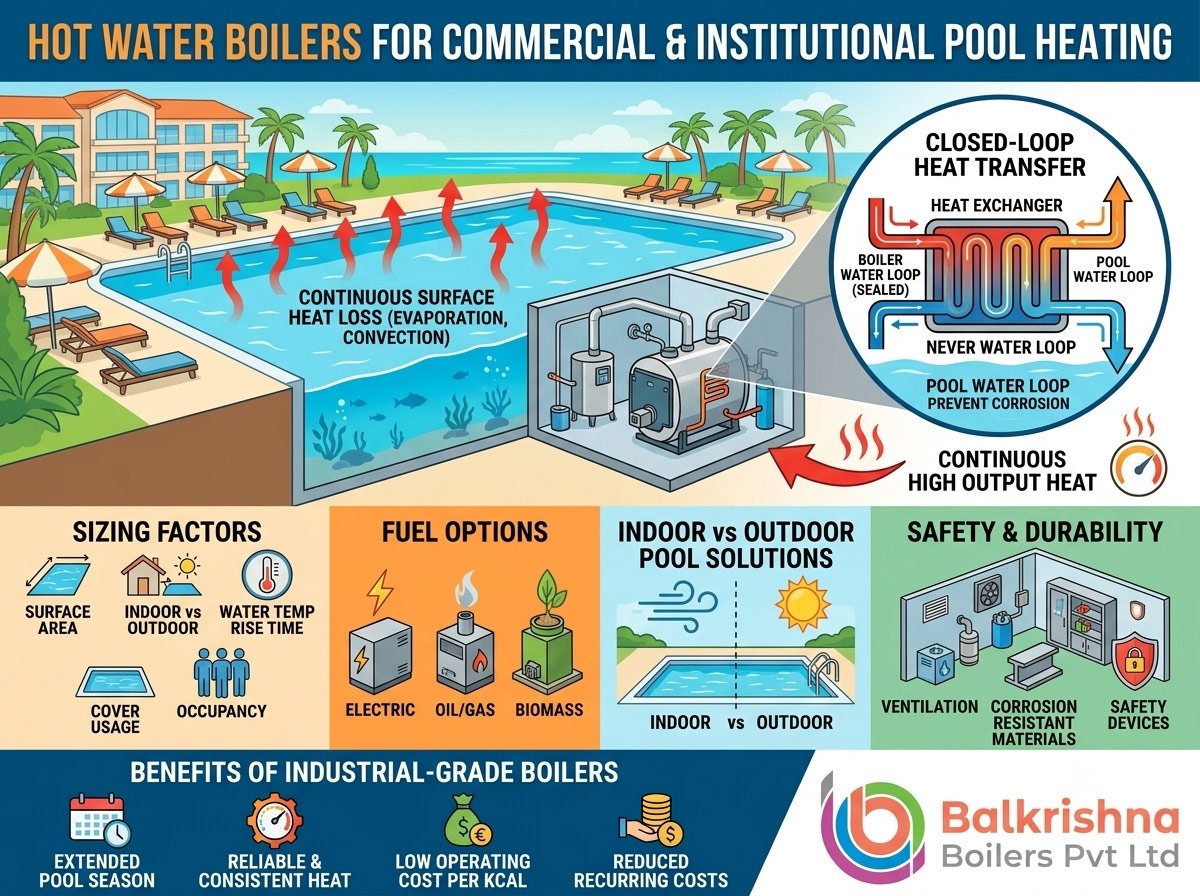
A swimming pool loses heat constantly, primarily through evaporation at the water surface, along with convection, radiation, and conduction through the pool structure itself. Evaporative loss alone can account for the majority of a pool’s total heat loss, especially on outdoor pools exposed to wind and low humidity. This means pool heating isn’t a one-time job of raising water to temperature — it’s an ongoing battle to replace heat that’s continuously escaping, for as long as the pool is in use.
For a small residential pool, a compact heater can keep pace. For a hotel pool serving hundreds of guests, a resort with multiple pools, or a sports facility running training sessions from early morning to late evening, the heat-loss volume scales dramatically — and so does the required heating capacity. Undersized heating in this context doesn’t just mean a slightly cooler pool; it means the system never catches up, guests notice, and the facility’s reputation takes the hit.
2. How a Hot Water Boiler Heats a Pool
Unlike a small in-line pool heater that sits directly in the plumbing loop, an industrial hot water boiler typically heats water in a closed, sealed loop that never mixes with the pool water itself. Instead, heat is transferred to the pool through a heat exchanger — pool water is circulated through one side of the exchanger while the boiler’s hot water loop passes through the other, transferring heat without the two water streams ever combining.
This separation matters for a practical reason: pool water is chemically treated (chlorinated, pH-balanced) and would otherwise corrode a boiler’s internal components if circulated directly through it. Using a dedicated heat exchanger protects the boiler’s service life while still delivering the continuous heat output the pool needs.
A dedicated circulation pump — the same forced-circulation principle used across all hot water boiler applications — keeps the boiler’s loop moving heat to the exchanger continuously, matching the boiler’s output to the pool’s ongoing heat-loss rate rather than trying to “batch heat” the water once and let it coast.
3. Sizing a Boiler for a Commercial Pool
Correct sizing is the single most important decision in a pool heating project, and it depends on more than just pool volume.
Key factors that determine required boiler output (typically expressed in kcal/hr):
- Pool surface area — the primary driver of evaporative heat loss, since evaporation happens at the surface, not throughout the water volume.
- Indoor vs outdoor installation — outdoor pools lose considerably more heat to wind and ambient temperature swings than indoor pools, which benefit from a controlled environment.
- Desired water temperature and rise time — heating a cold pool up to temperature at the start of a season requires more capacity than simply maintaining an already-warm pool.
- Ambient temperature and wind exposure, particularly relevant for outdoor and rooftop pools common in Indian hotels.
- Cover usage — a pool cover dramatically reduces evaporative loss when the pool isn’t in use, which can meaningfully lower the sustained heating load a boiler needs to carry.
- Occupancy pattern — a facility running near-continuous swim sessions needs sustained output capacity, not just a system that can hit temperature once in the morning.
Because pool heat-loss calculations involve several site-specific variables, our engineering team typically works from actual pool dimensions, desired temperature, and installation environment (indoor/outdoor) to recommend an accurately sized system, rather than relying on generic sizing tables that don’t account for local conditions.
4. Fuel Options for Pool Heating
The fuel decision for a commercial pool follows largely the same logic as any other hot water boiler application — running cost, space, emissions, and duty cycle all matter — but pool heating adds its own set of practical considerations.
Electric hot water boilers, such as the Industrial Electric Hot Water Boiler, are well suited to hotel and resort settings where the boiler plant may sit close to guest areas — zero combustion means no flue gas, no soot, and quiet operation, which matters in a hospitality environment where noise and emissions near amenity spaces are a real concern. Precise thyristor-based temperature control also helps maintain a consistent pool temperature without overshoot.
Oil/gas-fired boilers, like the Oil/Gas Fired Hot Water Boiler, suit larger facilities — sports academies, large resorts, or township clubhouses — where sustained, high-capacity heating is needed and a gas pipeline connection or fuel storage area is already available. Fast start-up and automatic modulation help manage the variable demand between peak occupancy hours and quieter periods.
Biomass and briquette-fired systems, including the Biomass Fired Hot Water Boiler, can be a strong fit for large institutional facilities — sports complexes, educational campuses with pool facilities — where continuous heating demand over long operating hours makes lower fuel cost per delivered kcal the dominant factor, and space for fuel storage isn’t a constraint.
For a full breakdown of how these fuel trade-offs compare across running cost, footprint, and maintenance, our guide on Choosing Between an Electric and Fuel-Fired Hot Water Boiler covers the decision framework in more detail — the same considerations apply whether the end use is a process line or a pool.
5. Indoor vs Outdoor Pool Considerations
Indoor pools benefit from a stable, enclosed environment, which significantly reduces heat loss from wind and dramatically cuts evaporative loss when combined with proper ventilation and humidity control. Boiler sizing for indoor pools can generally be based on maintenance load (replacing steady-state heat loss) rather than the larger swings outdoor installations face.
Outdoor pools — the more common scenario for Indian hotel rooftops, resorts, and open-air club facilities — face substantially higher and more variable heat loss, driven by wind speed, direct sun exposure, and overnight ambient temperature drops. Outdoor installations typically need a higher-capacity boiler and benefit significantly from a pool cover during non-operating hours to limit overnight heat loss that the boiler would otherwise need to make up each morning.
6. Water Quality: A Pool-Specific Concern
Water treatment matters for every hot water boiler application, but pool heating adds a layer of complexity: the heat exchanger interface between the boiler loop and pool water needs materials resistant to the chlorinated, chemically treated pool water on one side, while the boiler’s own closed loop still needs standard water treatment to prevent scale buildup on the other. Facilities should confirm heat exchanger material specification (typically titanium or high-grade stainless steel for pool applications) as part of the system design, since a heat exchanger unsuited to chlorinated water will corrode and fail well before the boiler itself shows any wear. For the boiler’s own internal water treatment requirements, our guide on Hot Water Boiler Safety Standards You Should Know covers scale prevention and water softening in more detail.
7. Insulation and Heat Retention
Because pool heating is a sustained, ongoing load rather than a brief burst of demand, insulation quality — both on the boiler shell and on the piping running to the heat exchanger — has an outsized impact on total running cost. A well-insulated system loses less heat between the boiler and the pool, meaning more of the fuel spend actually reaches the water rather than radiating away along the route. This is covered in depth in our guide on Hot Water Boiler Insulation: Why It Matters for Efficiency, and the principle applies directly here — pool heating installations with long piping runs between the boiler house and the pool deck are exactly the scenario where insulation quality shows up most clearly in the fuel bill.
8. Safety Considerations Specific to Pool Environments
Pool plant rooms present a genuinely humid, corrosive environment — chlorine off-gassing and constant moisture accelerate corrosion on unprotected metal components faster than in a typical dry boiler house. A few practical safety and durability points matter here specifically:
- Corrosion-resistant materials for components exposed to the pool plant room atmosphere, not just the water-contact surfaces.
- Adequate ventilation in the plant room to manage humidity and chlorine off-gassing around the boiler and controls.
- Standard boiler safety devices — low water cut-off, over-temperature cut-off, pressure relief valves — remain just as essential here as in any other application; a humid plant room environment is not a reason to compromise on this hardware.
- Heat exchanger isolation valves, allowing the exchanger to be serviced or replaced without draining or disrupting the boiler’s own closed loop.
9. Running Cost and ROI for Commercial Pool Heating
For hotels and resorts, pool heating is a guest-experience investment as much as a utility cost — an unreliable or inadequately heated pool affects guest satisfaction and reviews directly. Facilities that upgrade from an undersized or ageing heating system typically see the return not just in fuel efficiency, but in extended pool usability across cooler months and reduced complaints during peak season. Sports academies and institutional facilities running pools on a fixed daily schedule see the clearest fuel-cost comparison, since consistent, predictable occupancy makes it straightforward to calculate cost-per-delivered-kcal across fuel options — the same framework covered in our guide on Hot Water Boiler Installation Costs in India.
10. Where to Look for Pool Heating Systems
The full Hot Water Boiler category at IndianBoilers.com covers the fuel-type range suited to pool heating projects, from the Industrial Electric Hot Water Boiler to the Oil/Gas Fired Hot Water Boiler and Biomass Fired Hot Water Boiler. The same engineering carries through on our flagship manufacturing site — the Balkrishna Boilers Hot Water Boiler series, including the AQUAJET, AQUAMAX, VST SERIES, VTFH SERIES, and VTMH SERIES.
Frequently Asked Questions
What temperature is typically maintained for a commercial pool? Most commercial swimming pools are maintained between 26°C and 30°C, with therapy or hydrotherapy pools sometimes run warmer — all comfortably within the standard output range of a Low-Temperature Hot Water (LTHW) boiler.
Does pool water circulate directly through the boiler? No. Pool water is chemically treated and would corrode boiler internals. A dedicated heat exchanger transfers heat from the boiler’s closed loop to the pool water without the two streams mixing.
How much bigger does an outdoor pool heater need to be compared to indoor? There’s no fixed multiplier — it depends on wind exposure, ambient temperature, and cover usage — but outdoor pools consistently require higher sustained capacity than an equivalent indoor pool due to greater evaporative and convective heat loss.
Can one boiler serve both a pool and other hotel hot water needs? Yes, provided it’s sized for the combined peak simultaneous demand of both — a common configuration in hotels where the boiler also feeds guest-room hot water and laundry, discussed further in our post on How Hot Water Boilers Support Laundry and Textile Washing Units.
Final Word
Commercial pool heating is a continuous, high-volume thermal load that residential-grade equipment isn’t designed to sustain. A properly sized industrial hot water boiler, paired with a suitable heat exchanger and good insulation practice, delivers the consistent, reliable heat that hotels, resorts, and institutional facilities need — without turning pool comfort into a recurring guest complaint.
If you’re planning a new pool installation or upgrading an underperforming heating system, our engineering team can help calculate the right capacity for your pool dimensions and environment. Get in touch with IndianBoilers.com or reach out to Balkrishna Boilers for a technical consultation.