
Once the sizing and product decisions are done, plant owners usually have one more question before they sign off on an electric boiler purchase: what does installation actually involve, and how long will it take? It’s a fair question, and the answer is one of the more genuinely attractive parts of switching to electric — installation is significantly simpler and faster than a comparable fuel-fired system, but it still involves real planning that’s worth understanding upfront.
At Indian Boilers.com, part of Balkrishna Boilers Pvt Ltd, our team handles installation coordination for electric boiler clients regularly, and this guide walks through exactly what to expect at each stage — from site preparation through commissioning — so there are no surprises once your unit arrives.
Why Electric Boiler Installation Is Fundamentally Simpler
A fuel-fired boiler installation involves civil work for a boiler house, chimney construction and statutory height clearance, fuel storage and handling infrastructure, and often a longer approval cycle tied to combustion equipment. An electric boiler removes almost all of this. There’s no chimney, no fuel yard, and typically no requirement for a dedicated, structurally reinforced boiler house — which is why installation timelines for electric units are consistently shorter than fuel-fired equivalents of similar capacity.
That said, “simpler” doesn’t mean “no planning required.” The stages below outline what a properly managed installation actually looks like.
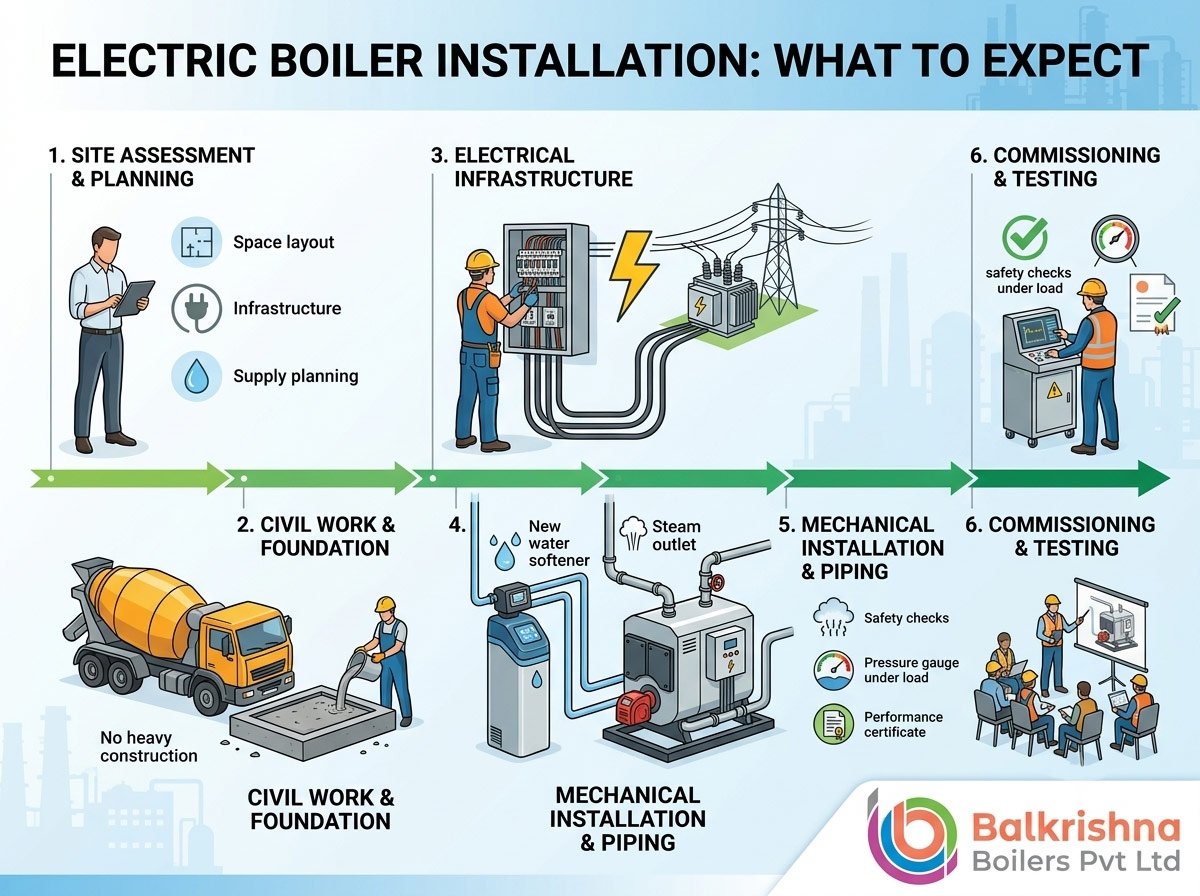
Stage 1: Site Assessment and Planning
Before the boiler arrives, a proper installation begins with confirming the site can actually support it.
Space and layout. While electric boilers have a small footprint compared to fuel-fired systems, the unit still needs adequate clearance for maintenance access, ventilation, and safe operation. Our engineers review your intended location against the specific model’s dimensions before finalizing placement — a step covered as part of the broader sizing process in our guide on how to size an electric boiler for your facility.
Electrical infrastructure confirmation. This is the single most important pre-installation check. Confirming your sanctioned electrical load, transformer capacity, and available switchgear can support the boiler’s power draw needs to happen before delivery, not after — our guide on electric boiler power consumption formulas and examples walks through exactly how to calculate expected draw so this conversation with your electrical contractor happens with accurate numbers.
Water supply and treatment planning. Since heating elements sit in direct contact with water, confirming your feedwater source and planning a properly sized softening system is part of site planning, not an afterthought added after commissioning. We cover why this matters so much in our electric boiler maintenance guide.
Steam or hot water distribution routing. If the boiler is replacing an existing system, some distribution piping may be reusable; if it’s a new installation, routing from boiler to point of use needs to be planned to minimize distribution losses — one of the genuine advantages of electric boilers being installable close to the point of use.
Stage 2: Civil and Foundation Work
Electric boilers are typically skid-mounted or tank-style units that require a level, adequately load-rated foundation — usually a simple concrete plinth rather than the extensive civil work a fuel-fired boiler house demands. For most industrial and SME installations, this foundation work is straightforward and can be completed in parallel with other pre-delivery preparation, rather than sitting on the project’s critical path the way boiler-house construction does for combustion systems.
No chimney construction, no flue routing, and no fuel storage structure are required — which is where most of the installation timeline savings actually come from compared to a fuel-fired equivalent.
Stage 3: Electrical Infrastructure Installation
This stage typically involves the most coordination with your electrical contractor, and it’s worth planning early rather than treating it as a final step.
Cabling and switchgear. Properly rated cabling sized for the boiler’s specific current draw, along with correctly specified switchgear and protection devices, needs to be installed and tested before the boiler can be commissioned. Undersized cabling or generic switchgear borrowed from unrelated equipment is a common shortcut that creates safety and reliability issues down the line.
Transformer or supply upgrade, if required. If your site assessment identified a gap between available capacity and the boiler’s power draw, this upgrade needs to be completed before commissioning — and it’s typically the longest-lead-time item in the entire installation process, so identifying this need early during site assessment avoids it becoming a bottleneck later.
Earthing and protection verification. Proper earthing is critical given that heating elements operate in direct water contact — earth continuity and resistance should be tested and verified as part of electrical installation, not assumed to be adequate from existing site infrastructure.
Stage 4: Water Treatment System Installation
If a new softener or water treatment system is part of the installation — which it should be for any facility not already running properly sized treatment — this is typically installed and commissioned alongside the boiler itself, positioned to feed treated water directly into the boiler’s feedwater line. Getting this right from day one avoids the scale-related issues that account for a large share of avoidable electric boiler maintenance problems later.
Stage 5: Mechanical Installation and Piping
With foundation, electrical, and water treatment work complete, the boiler itself is positioned and connected:
- Steam or hot water outlet piping connected to distribution lines
- Feedwater inlet connected to the treated water supply
- Safety valve discharge piping routed to a safe location per statutory requirements
- Blowdown piping connected for routine water quality maintenance
- Control panel wiring connected and tested
This stage is generally quick for electric boilers precisely because there’s no flue gas path, burner assembly, or combustion air supply to integrate — a meaningful share of a fuel-fired boiler’s mechanical installation time simply doesn’t apply.
Stage 6: Commissioning and Testing
Before a boiler is handed over for regular operation, a proper commissioning process verifies every safety and performance system independently:
Safety system verification. Low-water cut-off, pressure switches, safety valve function, over-current protection, and earth leakage protection should all be individually tested during commissioning — not assumed to work correctly simply because they’re installed. Our guide on electric boiler safety features you shouldn’t compromise on covers exactly what these systems should demonstrate during this stage.
Performance testing under load. The boiler is run through its operating range to confirm it reaches rated pressure and temperature within expected timeframes and holds steady under representative load conditions.
Water quality verification. Feedwater treatment system performance is checked to confirm it’s delivering water within the boiler’s specified quality range before regular operation begins.
Documentation and statutory certification. For IBR-applicable installations, statutory inspection and certification is completed as part of commissioning — this is a legal requirement for qualifying pressure and capacity thresholds, not an optional formality.
Operator training. Your plant team should receive hands-on training on daily checks, basic troubleshooting, and what each safety system indicator means — this is a standard part of proper commissioning, not a separate add-on service.
Typical Installation Timeline
While exact timelines vary by capacity, site readiness, and whether electrical infrastructure upgrades are needed, a well-planned electric boiler installation for a standard industrial or SME application typically moves considerably faster than a comparable fuel-fired project — largely because civil work, chimney construction, and fuel infrastructure simply aren’t part of the process. The most common factor that extends an electric boiler installation timeline isn’t the boiler itself, but electrical infrastructure upgrades identified late in the process — which is exactly why the site assessment stage matters so much.
Common Installation Delays and How to Avoid Them
Electrical infrastructure gaps discovered too late. This is, by a clear margin, the most common cause of installation delay. Confirming sanctioned load and transformer capacity during initial sizing — not after the boiler has already been ordered — avoids this almost entirely.
Water treatment system sized as an afterthought. A softener sized generically rather than for the boiler’s actual feedwater demand either underperforms from day one or needs to be replaced shortly after installation. Size it correctly the first time, as part of the same planning process as the boiler itself.
Skipping proper foundation preparation. Even though civil requirements are lighter than a fuel-fired system, a level, adequately rated foundation still needs to be ready before delivery to avoid installation delays on-site.
Incomplete commissioning documentation. For IBR-applicable units, incomplete or improperly filed statutory documentation can delay final sign-off even after the physical installation is complete — working with a supplier experienced in this certification process avoids unnecessary back-and-forth.
What Our Installation Support Includes
For clients purchasing from our Electric Boiler range, our team supports site assessment, electrical infrastructure guidance, water treatment sizing, and full commissioning — including statutory certification coordination for IBR-applicable installations. This same support extends across our capacity range, from smaller SME-focused units covered in our buyer’s guide for small and medium enterprises up to larger industrial installations.
On the Balkrishna Boilers side, our installation and commissioning support covers the full Electric Boiler series — ELECTROMAX, ELECTROAQUA, ELECTROAIR, ELECTROPAC, and INDUCTRON — with the same structured process from site assessment through final handover.
Planning Installation Alongside Your Buying Decision
If you’re still evaluating an electric boiler purchase, it’s worth discussing installation requirements — particularly electrical infrastructure and water treatment — with your supplier before finalizing an order, not after. A supplier who walks through site assessment as part of the sales process, rather than treating it as a separate downstream step, is a good sign of genuine installation experience.
Final Thoughts
Electric boiler installation is genuinely simpler and faster than a fuel-fired equivalent — no chimney, no fuel infrastructure, and typically no dedicated boiler house required. But a smooth installation still depends on proper site assessment, early confirmation of electrical infrastructure capacity, correctly sized water treatment, and thorough commissioning with full safety system verification. Planning these steps from the start, rather than reacting to them once the boiler has already arrived, is what separates a straightforward installation from a delayed one.
If you’re planning an electric boiler installation, get in touch with our team for a site assessment, or explore the full Electric Boiler range on Indian Boilers.com and Balkrishna Boilers to review specifications before you plan your installation.