
One of the biggest reasons plant owners switch to an electric boiler is the promise of low maintenance — no burners to clean, no soot to remove, no fuel-handling equipment to service. That promise is real, but “low maintenance” doesn’t mean “no maintenance.” Electric boilers still have a handful of components that need regular attention, and the plants that get the longest life and best efficiency out of their units are the ones that follow a simple, consistent maintenance routine from day one.
At Indian Boilers.com, part of Balkrishna Boilers Pvt Ltd, our service team sees the same handful of avoidable issues come up again and again — almost always tied to skipped water treatment or deferred inspections rather than any fault in the equipment itself. This guide walks plant owners through exactly what to check, how often, and why each item matters.
Why Electric Boiler Maintenance Is Different From Fuel-Fired Boilers
A coal, biomass, or oil-fired boiler needs maintenance across two systems: the combustion side (burners, fuel handling, flue path, ash removal) and the water/steam side (feedwater, heating surfaces, safety valves). An electric boiler eliminates the entire combustion side — there’s no burner to tune, no fuel line to inspect, no chimney to sweep, no ash to remove.
What remains is the water/steam side and the electrical side. This is why electric boiler maintenance is genuinely lighter — but it also means the two areas that do remain deserve real attention, because they’re now the only things standing between your boiler and a failure.
The Two Systems That Actually Need Attention
1. The Water Side — Where Most Problems Actually Start
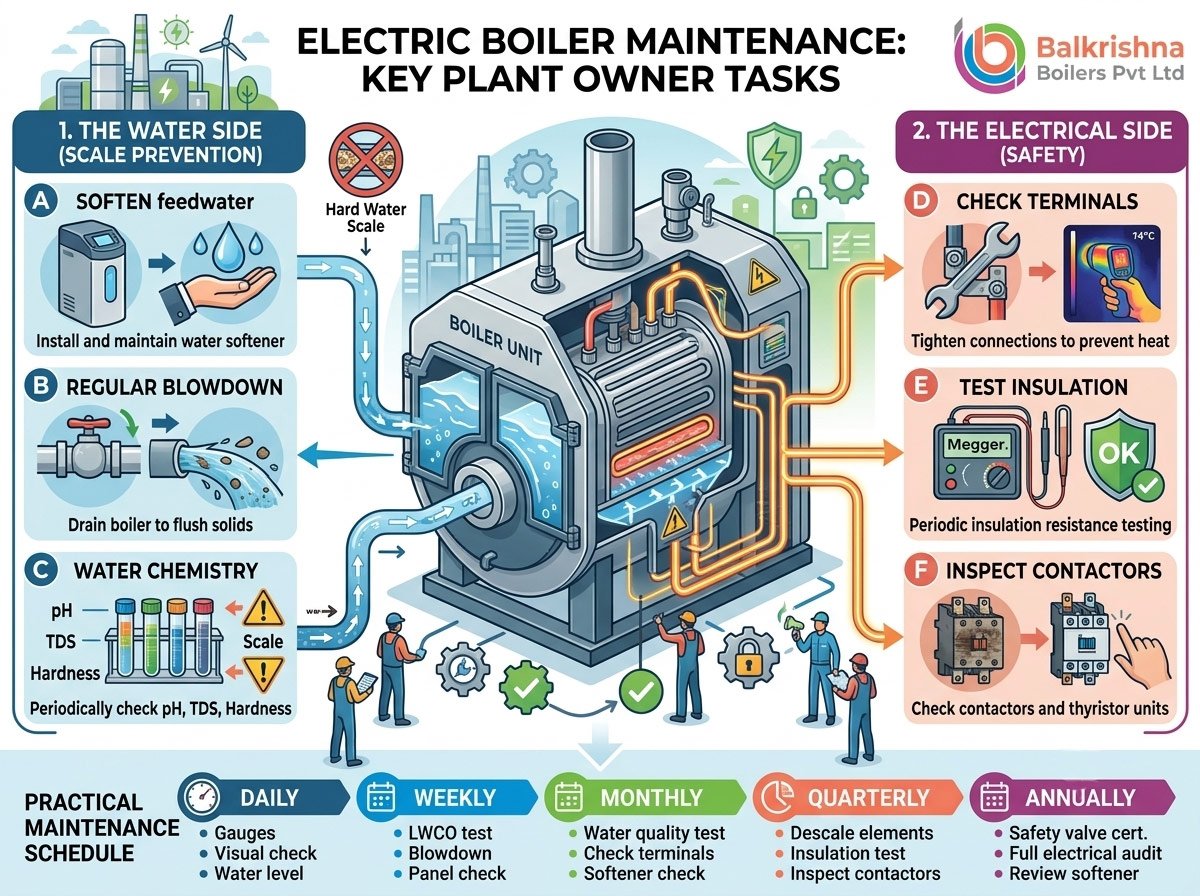
Heating elements in an electric boiler sit in direct contact with water. This is the single most important fact to understand about electric boiler maintenance, because it explains almost every avoidable failure our service team encounters.
Scale buildup is the number one cause of element failure. Untreated or hard water leaves mineral deposits (mostly calcium and magnesium) on the surface of heating elements. Scale acts as an insulating layer — it forces the element to work harder to transfer the same amount of heat, which raises element temperature, shortens element life, and increases electricity consumption for the same steam output. In serious cases, scale buildup causes local overheating and premature element burnout.
The fix is straightforward: install and properly maintain a water softener. This is not an optional accessory — it is the single highest-leverage maintenance step for any electric boiler owner. If your facility already runs a softener for other equipment, confirm its capacity is sized for the boiler’s feedwater demand too, not just shared undersized capacity.
Blowdown matters even with softened water. Softening reduces hardness but doesn’t eliminate dissolved solids entirely. Regular blowdown — draining a small amount of boiler water to flush out concentrated solids — prevents buildup inside the vessel and keeps water chemistry within the range your boiler is designed for.
Water chemistry should be checked periodically, not just at commissioning. TDS (total dissolved solids), pH, and hardness should all sit within the range specified in your boiler’s operating manual. A basic water test kit or a monthly lab check is inexpensive insurance against a much larger repair bill later.
2. The Electrical Side — Where Safety Checks Matter Most
Because heating elements draw significant current, the electrical system carries real safety implications if left unchecked.
Terminal connections should be checked and tightened periodically. Loose or corroded terminals create resistance, generate localized heat, and are one of the more common causes of unplanned shutdowns. This is a quick visual and mechanical check that takes minutes but prevents a much bigger problem.
Insulation resistance testing on heating elements should be part of a periodic service schedule, particularly in humid environments where moisture ingress over time can degrade insulation and create earth-leakage risk.
Contactors and thyristor control units (where fitted, for precise load modulation) should be inspected for wear, particularly on units that cycle frequently in intermittent-demand applications. Pitted or worn contacts reduce switching reliability and can eventually cause control faults.
Overload and short-circuit protection devices should be tested to confirm they trip correctly — these are the safety net that protects both the equipment and your electrical infrastructure if something does go wrong upstream.
Safety Devices: What to Verify on Every Inspection
Every properly engineered industrial electric boiler — including our Electric Boiler range — ships with multiple layers of protection. A maintenance routine isn’t complete unless these are verified periodically, not just installed and forgotten:
- Pressure switches — confirm automatic cut-off engages at the correct high-pressure threshold.
- Safety valves — verify mechanical pressure release operates freely and hasn’t seized; these should be manually tested at a set interval, not just left in place.
- Low-water cut-off — this is the single most critical safety device on any steam boiler, electric or fuel-fired. It must be tested to confirm it reliably shuts the heating elements down if water level drops below a safe threshold, preventing dry-firing and element burnout.
- Over-current protection — confirms the electrical circuit is protected against overload conditions before they become a fire or equipment-damage risk.
A Practical Maintenance Schedule for Electric Boilers
While exact intervals depend on your specific model, water quality, and duty cycle, here’s a general framework most SME and mid-sized industrial plants can work from:
Daily / Every shift:
- Visual check of pressure and temperature gauges against expected operating range
- Confirm no unusual noise, vibration, or leakage
- Check water level indicator
Weekly:
- Manual test of low-water cut-off and safety valve operation
- Blowdown to flush concentrated solids from the vessel
- Visual inspection of electrical panel for warning indicators
Monthly:
- Water quality test (TDS, hardness, pH) against manufacturer-specified range
- Check and tighten electrical terminal connections
- Inspect softener resin/salt levels and regenerate as needed
Quarterly to Half-Yearly:
- Descaling inspection of heating elements (frequency depends heavily on water quality)
- Insulation resistance testing on heating elements
- Inspection of contactors, thyristor units, and control wiring for wear
Annually:
- Full safety valve certification/testing per statutory requirement
- Comprehensive electrical system audit
- Review of water treatment system performance and softener capacity against actual usage
Plants running continuous, high-utilization loads should lean toward the more frequent end of these intervals; plants with intermittent, lower-utilization loads — common in many SME applications covered in our Electric Boilers for SMEs buyer’s guide — can often extend intervals slightly, but water treatment checks should never be skipped regardless of utilization.
Common Maintenance Mistakes That Shorten Boiler Life
Skipping the water softener, or undersizing it. This is, without exception, the most common and most expensive mistake we see. A softener that isn’t sized for the boiler’s actual feedwater demand fails quietly — hardness slips through in small amounts that accumulate over months until element failure forces an unplanned shutdown.
Treating low maintenance as no maintenance. Because electric boilers don’t demand the daily attention a combustion system does, it’s easy for inspection routines to lapse. The lighter maintenance burden is a genuine advantage, but it only holds if the reduced list of checks still happens on schedule.
Ignoring early warning signs. A gradual increase in time-to-steam, a rise in electricity consumption for the same output, or minor fluctuations in pressure control are often early indicators of scale buildup or an element beginning to fail — not something to wait out until a full breakdown occurs.
Using unqualified personnel for electrical work. While day-to-day checks are straightforward, terminal tightening, insulation testing, and control system work should be done by someone trained on the specific electrical systems involved, particularly at higher voltage/capacity ratings.
Not keeping maintenance records. A simple logbook of water test results, blowdown frequency, and inspection dates makes it far easier to spot a developing trend before it becomes a failure — and it’s useful documentation if you ever need to make a warranty claim.
How Heating Element Life Compares to Combustion Components
A well-maintained electric boiler with properly treated feedwater can see heating elements last several years of continuous operation — genuinely competitive with, and often better than, the lifespan of burner components on an equivalent fuel-fired system, which face constant thermal cycling and combustion by-product exposure. The difference is that element life is almost entirely within your control through water treatment, whereas burner wear on a combustion system is driven by a wider range of factors including fuel quality and combustion tuning that are harder to fully control.
When to Call in Professional Service Support
Plant maintenance teams can comfortably handle daily checks, blowdown, and basic terminal inspection. A few situations warrant calling in the manufacturer’s service team rather than handling in-house:
- Any change in element performance that persists after a normal descaling cycle
- Insulation resistance readings outside the specified safe range
- Repeated nuisance tripping of safety devices, which may indicate a developing fault rather than a simple calibration issue
- Any work on thyristor control systems or precision modulation electronics
Balkrishna Boilers provides service support across our Electric Boiler range, including the ELECTROMAX, ELECTROAQUA, ELECTROAIR, and INDUCTRON series, so plant owners aren’t left sourcing generic electrical contractors unfamiliar with industrial boiler-specific safety systems.
Maintenance as Part of Your Original Buying Decision
If you’re still evaluating an electric boiler purchase, it’s worth factoring maintenance requirements into your decision now rather than after commissioning. Confirm with your supplier what water treatment capacity your specific model needs, what the recommended service intervals are, and what after-sales support looks like — our Electric Boiler product category page lists specifications for each model, and our team can walk through maintenance expectations for your specific capacity and application before you buy.
For plants comparing electric against a fuel-fired steam boiler partly on maintenance grounds, our industrial boiler blog section covers the combustion-side maintenance burden of coal and biomass systems in detail, which makes for a useful side-by-side comparison.
Final Thoughts
Electric boilers genuinely do reduce the maintenance burden compared to fuel-fired systems — but the components that remain, particularly water treatment and electrical safety checks, are non-negotiable if you want your boiler to run efficiently and reliably for its full service life. A simple, consistent schedule built around water quality monitoring, periodic electrical checks, and verified safety-device testing is almost always enough to avoid the handful of failure modes that account for most unplanned electric boiler downtime.
If you’d like a maintenance schedule tailored to your specific boiler model and water conditions, get in touch with our service team, or explore our full Electric Boiler range on Indian Boilers.com and Balkrishna Boilers to see specification and support details for each model.